
Controlling the climate within a greenhouse is a delicate dance, essential for cultivating healthy, thriving plants. Among the many variables growers must manage, temperature stands out as paramount. When the sun beats down, temperatures inside can soar far beyond comfortable or even survivable limits for many species. This makes effective cooling systems not just beneficial, but critical. But have you ever considered how the sheer size of your greenhouse – its internal volume – directly influences how quickly you can bring those temperatures down? It’s a relationship often overlooked, yet fundamental to efficient climate control. Understanding this dynamic can save you energy, improve plant health, and help you design a more responsive and effective cooling strategy for your unique growing environment.
The Physics of Heat and Air Volume in a Greenhouse
To grasp the relationship between greenhouse volume and cooling speed, we first need to understand how heat behaves within an enclosed space. Greenhouses are designed to capture solar energy, which warms the air, plants, and structural elements inside. This phenomenon, known as the greenhouse effect, is fantastic for warmth during colder months but becomes a significant challenge when temperatures climb.
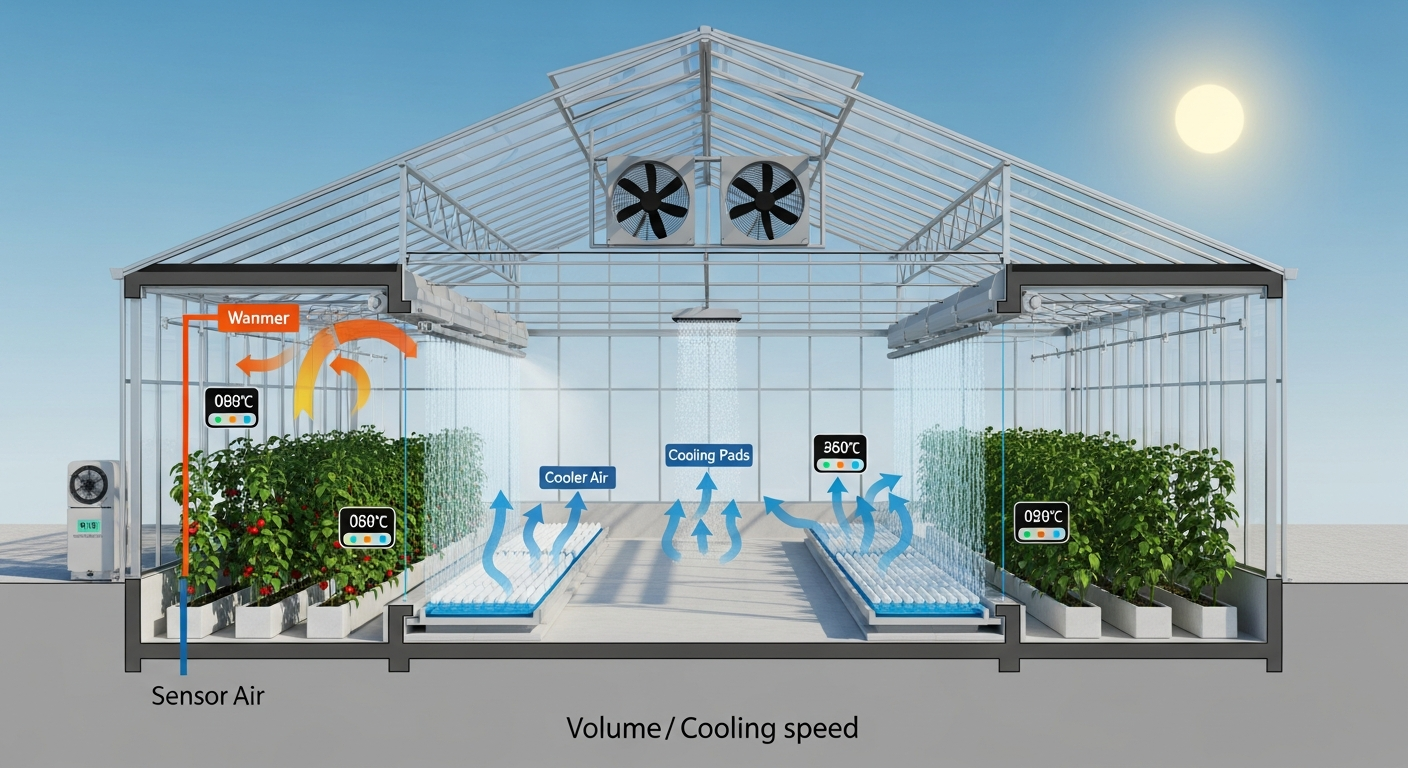
Air itself has a thermal mass – it takes a certain amount of energy to raise its temperature, and conversely, it holds that heat, taking time to release it. In a smaller greenhouse, there’s less air volume to heat up, so temperatures can rise very quickly when exposed to direct sun. However, with appropriate cooling mechanisms, this smaller volume can also be cooled down relatively fast because there’s less air to exchange or condition.
Conversely, a larger greenhouse contains a significantly greater volume of air. This increased air mass can act as a buffer, slowing down the initial rate of temperature increase. It takes more energy and time for solar radiation to heat up a massive volume of air compared to a smaller one. However, once that larger volume of air is heated, it retains a tremendous amount of thermal energy. Dissipating this heat and achieving a rapid cooling speed then requires a much more robust and sustained effort from your cooling systems. Think of trying to cool a small cup of coffee versus an entire swimming pool – the principles, though different in scale and medium, highlight the challenge of managing thermal energy in large volumes.
Volume’s Direct Impact on Cooling System Efficiency and Capacity
The internal volume of your greenhouse dictates the fundamental requirements for any cooling system you implement. Whether you rely on natural ventilation, mechanical fans, or evaporative cooling, the air volume is a key calculation point.
- Ventilation Systems: Both natural and mechanical ventilation aim to exchange hot internal air with cooler external air.
- Natural Ventilation: For larger volumes, relying solely on natural ventilation (ridge vents, side vents) can be less effective for rapid cooling. While a larger structure might have more surface area for vents, the sheer volume of air that needs to move to create significant air changes can be challenging without adequate height and design to promote the stack effect. Cooling speed will generally be slower and more dependent on external wind conditions.
- Mechanical Ventilation: This is where volume directly translates to fan power. Cooling speed in a mechanically ventilated greenhouse is often measured by the air exchange rate (ACH), or how many times the entire volume of air within the greenhouse is replaced per hour. To achieve a target ACH (e.g., 1-2 changes per minute for aggressive cooling), larger greenhouses require fans with significantly higher Cubic Feet per Minute (CFM) ratings. An undersized fan system in a large greenhouse will struggle to achieve optimal cooling speeds, leading to prolonged periods of high temperatures.
- Evaporative Cooling (Pad & Fan Systems): These systems cool air by drawing it through water-saturated pads. The effectiveness and cooling speed are directly tied to the volume of air being moved and the surface area of the cooling pads.
- Larger greenhouses need proportionally larger pad areas and more powerful fans to pull the cooled air through the entire structure effectively. If the system is not scaled to the volume, cool air might only reach certain zones, leaving others hot, and the overall cooling speed will be diminished. The air velocity through the greenhouse is crucial; sufficient volume requires adequate air movement to transport cool, moist air across the entire growing space.
- Active Cooling (Refrigeration/AC Units): While less common for typical commercial greenhouses due to cost, smaller hobby greenhouses might use air conditioning. The British Thermal Unit (BTU) rating of an AC unit must be carefully matched to the greenhouse volume and heat load. A larger volume simply means a higher BTU requirement to achieve a desired cooling speed, translating directly to higher energy consumption.
Practical Tip: When designing or upgrading your cooling system, calculate your greenhouse’s total volume (length x width x average height). Then, research recommended air exchange rates for your specific crops and climate. This will allow you to select fans and cooling pads with the appropriate CFM ratings to ensure efficient cooling speed.
The “Goldilocks” Principle: Finding the Right Balance
It’s not simply a case of “bigger is better” or “smaller is easier.” The optimal greenhouse volume, when considering cooling speed, adheres to a “Goldilocks” principle – it needs to be “just right” for your specific needs, budget, and climate control strategy.
- Advantages of Larger Volume:
- Thermal Stability: As mentioned, a larger air mass can act as a buffer, leading to slower temperature swings once equilibrium is reached. This can be beneficial for plants sensitive to rapid fluctuations.
- Reduced Peak Temperatures: While it takes longer to cool down, it also takes longer to heat up to extreme levels if the external heat input isn’t constant and overwhelming.
- Space for Growth: More space means more plants, better air circulation around individual plants, and potentially more room for equipment.
- Challenges with Larger Volume:
- Slower Cooling Response: If cooling systems are undersized or external conditions are extreme, the sheer volume of hot air makes rapid cooling a significant challenge.
- Higher Initial Costs: Larger fans, more extensive evaporative pads, or more powerful active cooling systems come with a higher upfront investment.
- Increased Operational Costs: Running larger, more powerful equipment consumes more energy (electricity for fans, water for evaporative pads), leading to higher utility bills.
- Advantages of Smaller Volume:
- Faster Cooling Response: With appropriately sized systems, a smaller air volume can be cooled down much more quickly.
- Lower Initial & Operational Costs: Smaller equipment generally costs less to purchase and run.
- Challenges with Smaller Volume:
- Rapid Temperature Swings: Less thermal mass means temperatures can rise and fall very quickly, potentially stressing plants if climate control isn’t highly responsive.
- Limited Growing Space: Obvious limitation on the number and size of plants you can cultivate.
The key is to match the greenhouse volume with a climate control system that can handle its specific heat load and desired cooling speed, taking into account the plants you grow and your local climate.
Optimizing Cooling Speed for Any Greenhouse Volume
Regardless of your greenhouse’s size, several strategies can help you optimize cooling speed and maintain stable temperatures:
- Accurate Heat Load Calculation: Don’t guess! Factor in solar radiation, plant respiration, equipment heat, and external temperatures to determine the actual heat load your cooling system needs to overcome. This is critical for sizing equipment correctly.
- Strategic Ventilation: Ensure proper air inlets and outlets are in place. For mechanical systems, position fans and vents to create a uniform flow of air, minimizing “dead spots” where hot air can stagnate. For natural ventilation, optimize vent size and placement (ridge and sidewall vents) to maximize the stack effect and allow hot air to escape efficiently.
- Pre-emptive Shading: Don’t wait for temperatures to soar. Utilize shade cloth, reflective coatings, or automated shading systems to reduce the amount of solar radiation entering the greenhouse in the first place. Reducing the heat load significantly lessens the burden on your cooling systems and improves cooling speed.
- Insulation and Sealing: While seemingly counterintuitive for cooling, good insulation and sealing reduce unwanted heat gain through the structure itself. This makes your cooling efforts more efficient, as less new heat is constantly entering the system. Seal any gaps or cracks that allow uncontrolled hot air infiltration.
- Automated Climate Control: Invest in reliable thermostats and sensors that can trigger cooling systems precisely when needed. Variable speed fans can also help fine-tune airflow, providing rapid cooling when necessary and gentler air movement during less critical periods, optimizing energy usage and cooling speed.
- Maintenance: Regularly clean cooling pads, fan blades, and vents. Blocked pads or dirty fan blades significantly reduce efficiency and cooling speed.
Conclusion
The relationship between greenhouse volume and cooling speed is undeniably crucial for effective climate management. A larger volume presents both advantages, like thermal buffering, and challenges, such as requiring more robust and energy-intensive cooling systems to achieve rapid temperature drops. Conversely, a smaller volume can cool down faster but is more susceptible to rapid temperature fluctuations. The secret to success lies not in simply having a big or small greenhouse, but in understanding your specific heat load and meticulously matching it with an appropriately sized and efficiently managed cooling system. By implementing smart design, calculated equipment, and proactive strategies, you can ensure your greenhouse, regardless of its size, maintains the optimal environment for your plants to flourish, even when the heat outside is relentless.