
In the intricate world of greenhouse cultivation, precise climate control is not just a luxury; it’s the backbone of successful plant growth and abundant yields. Among the myriad factors influencing your botanical haven, how you choose to heat your greenhouse stands out as a critical decision. It’s more than just warming the air; it’s about understanding how plants perceive and utilize heat, a concept that often boils down to the fundamental differences between radiant and convective heating. Delving into the science behind these methods reveals that plants don’t just “feel” warm air; they actively respond to different forms of thermal energy, impacting everything from photosynthesis to water uptake. Let’s uncover the secrets to optimizing your greenhouse environment by mastering the science of heat transfer.
Understanding How Heat Moves: Convection, Conduction, and Radiation
Before diving into the specifics of greenhouse heating systems, it’s crucial to grasp the three primary ways heat energy is transferred. While all three play a role in a greenhouse environment, convection and radiation are the most relevant when discussing heating strategies.
- Conduction: This is the transfer of heat through direct contact. Think of a heating mat warming the bottom of a plant tray or heat moving from a warm pipe directly into the soil. While vital for specific applications like root zone heating, it’s less about warming the entire greenhouse space.
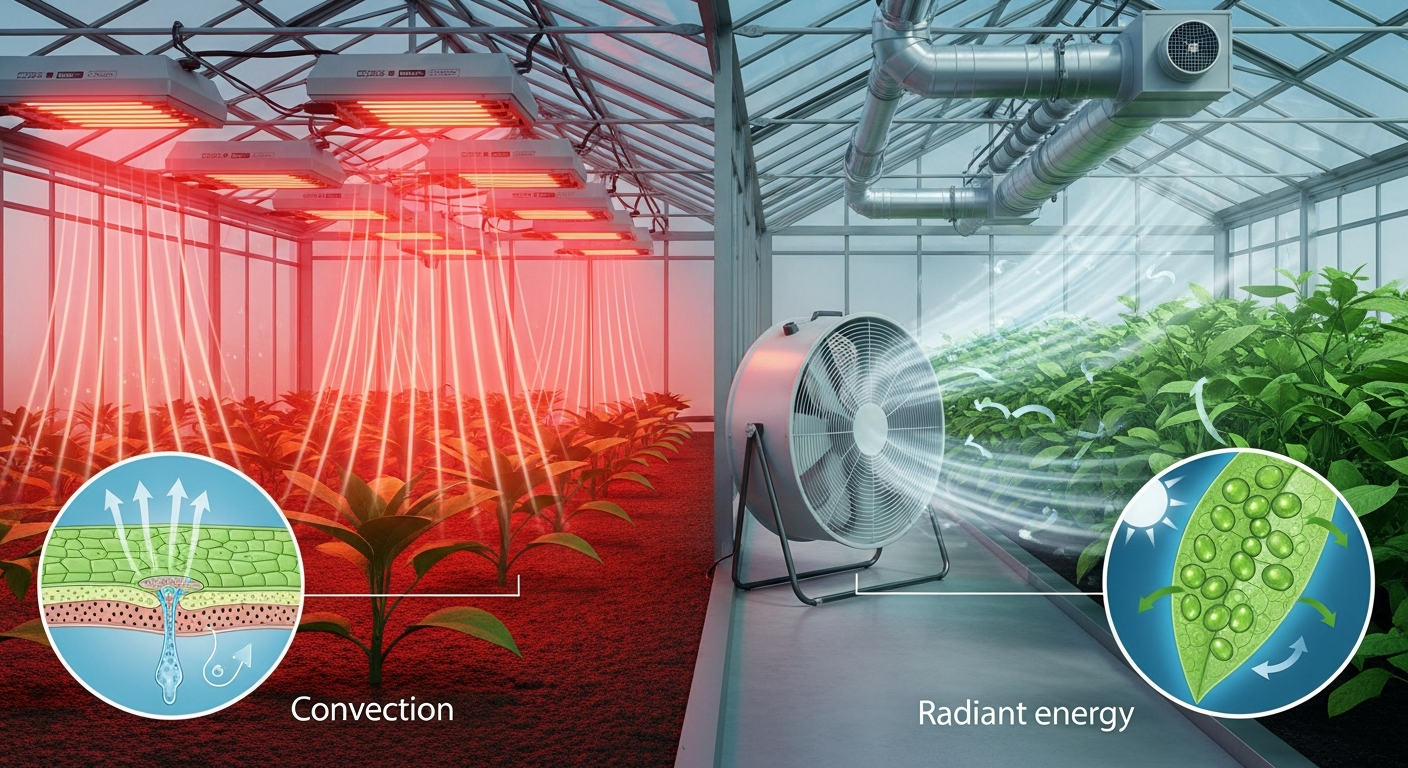
- Convection: Heat transfer through the movement of fluids (liquids or gases). In a greenhouse, this means hot air rising, cooling, and then sinking, creating air currents that distribute warmth. Most traditional greenhouse heaters rely heavily on convection to raise the ambient air temperature.
- Radiation: Heat transfer through electromagnetic waves, specifically infrared radiation. Unlike conduction or convection, radiation doesn’t require a medium to travel through. This is how the sun warms the Earth, and it’s also how specialized heaters can directly warm plants and surfaces within your greenhouse, much like standing in direct sunlight on a cool day feels warmer than standing in the shade.
Understanding these distinctions is the first step toward creating an energy-efficient and plant-friendly greenhouse climate control system.
Convective Heating: Warming the Air Around Your Plants
Convective heating is perhaps the most intuitive and widely used method in traditional greenhouses. It works by heating the air within the growing space, typically through forced-air heaters, unit heaters, or even older boiler systems that circulate hot water through pipes that radiate heat, warming the surrounding air. Fans then help distribute this heated air throughout the structure, aiming for a uniform ambient temperature.
How Convective Heating Works for Plants:
- Ambient Warmth: Plants primarily absorb heat from the surrounding air through their leaves and stems. The goal is to bring the air temperature to an optimal level for photosynthesis and metabolic processes.
- Air Movement: While beneficial for temperature distribution, excessive air movement can also increase transpiration rates, potentially leading to dehydration if not managed with proper humidity levels.
Advantages of Convective Heating:
- Even Air Temperature: With proper fan placement and heater sizing, convective systems can achieve a relatively uniform air temperature throughout the greenhouse, benefiting all plants equally.
- Rapid Heating: Forced-air systems can quickly raise the ambient temperature of the greenhouse, which is useful for rapid temperature recovery after cold spells or during periods of high ventilation.
- Simplicity: Often simpler to install and maintain than complex radiant systems.
Disadvantages of Convective Heating:
- Energy Inefficiency: Hot air naturally rises and escapes through vents or gaps in the greenhouse structure, leading to significant heat loss. This can make convective heating less energy-efficient, especially in tall structures.
- Temperature Stratification: Hot air accumulates near the roof, creating a temperature gradient where the top of the greenhouse is significantly warmer than the plant canopy or floor level. This “wasted heat” doesn’t directly benefit the plants.
- Drying Effect: Heating air often reduces its relative humidity, potentially drying out plant foliage and increasing water demand. This can also necessitate additional humidification systems.
- Dust and Pathogen Spread: The constant movement of air can circulate dust, spores, and pests, potentially spreading diseases within the greenhouse.
Practical Tip: To combat temperature stratification in convective systems, install horizontal air flow (HAF) fans strategically to gently mix the air from top to bottom, pushing warm air down towards the plants and improving overall heating efficiency.
Radiant Heating: Directly Warming Plants and Surfaces
Radiant heating operates on a fundamentally different principle: it emits infrared radiation that directly warms solid objects—plants, soil, benches, and floors—without significantly heating the air in between. Think of the warmth you feel from the sun on a cool day; the air temperature might be low, but the sun’s rays make you feel warm. Common radiant heating systems include overhead infrared heaters, bottom heat systems like heated benches or heat mats, and even radiant floor heating (hydronic systems).
How Radiant Heating Works for Plants:
- Direct Absorption: Plants directly absorb the infrared energy, which raises their leaf temperature and stem temperature. This can mean the plant itself is warmer than the surrounding air.
- Root Zone Advantage: Systems like heated benches or root zone heating mats directly warm the growing medium and roots, which is crucial for seed germination, nutrient uptake, and overall plant vigor.
Advantages of Radiant Heating:
- Energy Efficiency: By directly warming the plants and surfaces, less heat is lost to the ambient air and subsequently through the greenhouse structure. This can lead to significant energy savings, especially in larger or less insulated greenhouses.
- Reduced Stratification: Radiant heat warms objects at all levels, eliminating the issue of hot air collecting at the roof.
- Lower Air Temperatures: Plants can thrive with lower ambient air temperatures when their leaves and roots are directly warmed. This can reduce heating costs further while maintaining optimal plant function.
- Improved Humidity Control: Since less air is heated, humidity levels can be maintained more easily, reducing plant water stress and the need for supplemental humidification.
- Less Air Movement: Reduced air circulation means less dust, fewer airborne pathogens, and a generally calmer environment for plants.
- Targeted Heating: Allows for zone heating, where different areas or specific plant types can receive tailored warmth, optimizing resources.
Disadvantages of Radiant Heating:
- Initial Cost: Installation can be more expensive than basic convective systems.
- Hot Spots: Improperly designed or placed radiant heaters can create uneven heating, leading to “hot spots” if not carefully calibrated.
- Less Ambient Air Warmth: While good for plants, radiant heating alone might not sufficiently warm the air for human comfort in colder climates without supplemental heating.
Practical Tip: For seedlings and cuttings, investing in heated benches or propagation mats that provide direct radiant root zone heating can drastically improve germination rates and early growth, often more effectively and efficiently than trying to heat the entire air volume.
The Plant’s Perspective: Why the Method Matters for Growth
From a plant’s point of view, the source of heat significantly impacts its physiological processes. It’s not just about a numerical temperature reading on a thermostat; it’s about where that heat is being applied and how it influences critical functions.
- Leaf Temperature vs. Air Temperature: Plants primarily perform photosynthesis in their leaves. Optimal leaf temperature is crucial. With convective heating, leaf temperature tends to closely mirror air temperature. With radiant heating, leaf temperature can be several degrees warmer than the surrounding air, allowing for optimal photosynthesis even if the air itself is cooler. This differential can lead to faster growth rates and better yields.
- Transpiration and Water Use: Convective heating often leads to drier air and increased air movement, which can accelerate transpiration (water evaporation from leaves). While some transpiration is necessary, excessive rates can stress plants and increase water consumption. Radiant heating, by keeping ambient air temperatures lower and reducing air movement, can help manage transpiration more effectively, leading to more efficient water use.
- Root Zone Health: The temperature of the root zone directly impacts nutrient and water uptake. Radiant systems, especially those designed for bottom heat, are highly effective at maintaining ideal root temperatures, which can be critical for the health and vigor of young plants or specific crops. Convective systems are less efficient at delivering heat directly to the root zone without significantly overheating the entire greenhouse.
Understanding these subtle yet profound differences is key to truly optimizing your greenhouse for maximum plant growth and health.
Choosing Your Greenhouse Heating Strategy: A Hybrid Approach
The decision between radiant and convective greenhouse heating isn’t always an either/or scenario. In many modern greenhouses, a hybrid approach often yields the best results, combining the strengths of both methods to create an ideal environment.
Considerations for Your Greenhouse:
- Plant Type: Do your plants require significant bottom heat (e.g., propagation, specific tropicals)? Are they sensitive to humidity fluctuations?
- Greenhouse Size and Construction: Larger, less insulated greenhouses may benefit more from the energy efficiency of radiant heat, while smaller, well-sealed structures might manage with convective.
- Climate: In extremely cold climates, a combination might be essential to provide both ambient warmth and direct plant heat.
- Budget: Evaluate the initial installation cost versus long-term operating (energy) costs. Radiant systems often have higher upfront costs but lower running costs.
- Control Needs: How precisely do you need to control different zones or specific temperatures (air vs. leaf vs. root)?
A Recommended Hybrid Strategy:
Many successful greenhouse operations use radiant heating (like heated benches or overhead infrared panels) as their primary method to warm plants and surfaces directly, ensuring optimal plant temperature and growth. They then supplement this with a small amount of convective heating (e.g., a forced-air heater) to provide general ambient air warmth for human comfort or to prevent extreme cold snaps, especially when radiant heat alone might not be sufficient to maintain a minimum air temperature.
Actionable Advice: Invest in high-quality environmental sensors that monitor not just air temperature, but also root zone temperature and ideally, leaf temperature. This allows you to fine-tune your heating system to respond to what your plants are truly experiencing, rather than just the air around them. Understanding the nuances of how plants interact with radiant versus convective heat will empower you to create a significantly more efficient and productive growing environment.
Conclusion
The journey to mastering greenhouse heating extends far beyond simply turning up the thermostat. By understanding the scientific distinctions between radiant and convective heat transfer, and how plants “feel” these different forms of energy, you can make informed decisions that dramatically impact your greenhouse’s energy efficiency and your plants’ vitality. Whether you opt for a purely radiant system, a traditional convective setup, or a sophisticated hybrid, the ultimate goal remains the same: creating a precisely controlled environment where your plants don’t just survive, but truly thrive. Embrace the science, and watch your greenhouse flourish.