
In the intricate world of controlled environment agriculture, every parameter plays a crucial role in the success of high-value crops. Growers meticulously manage light, temperature, CO2, and nutrient delivery, often optimizing each component to exacting standards. Yet, one critical environmental factor, humidity, is sometimes underestimated or misunderstood in its profound impact on plant health and productivity. More than just comfort for your plants, humidity directly dictates the efficiency with which your crops can absorb and utilize vital nutrients from their root zone. Understanding this intricate link is not just good practice; it’s a fundamental requirement for unlocking the full genetic potential and maximizing the yield and quality of your most prized plants.
The Dance of Transpiration: How Humidity Drives Nutrient Movement
At the heart of nutrient uptake is a process called transpiration. This is essentially the plant’s way of breathing, where water vapor is released from tiny pores on the leaves called stomata. Think of it as a continuous plumbing system: water is drawn up from the roots, through the stem, and out into the atmosphere, creating a constant “transpiration stream.” This stream is the primary mechanism by which essential minerals, dissolved in water, are pulled into the plant’s vascular system (the xylem) and distributed throughout its tissues.
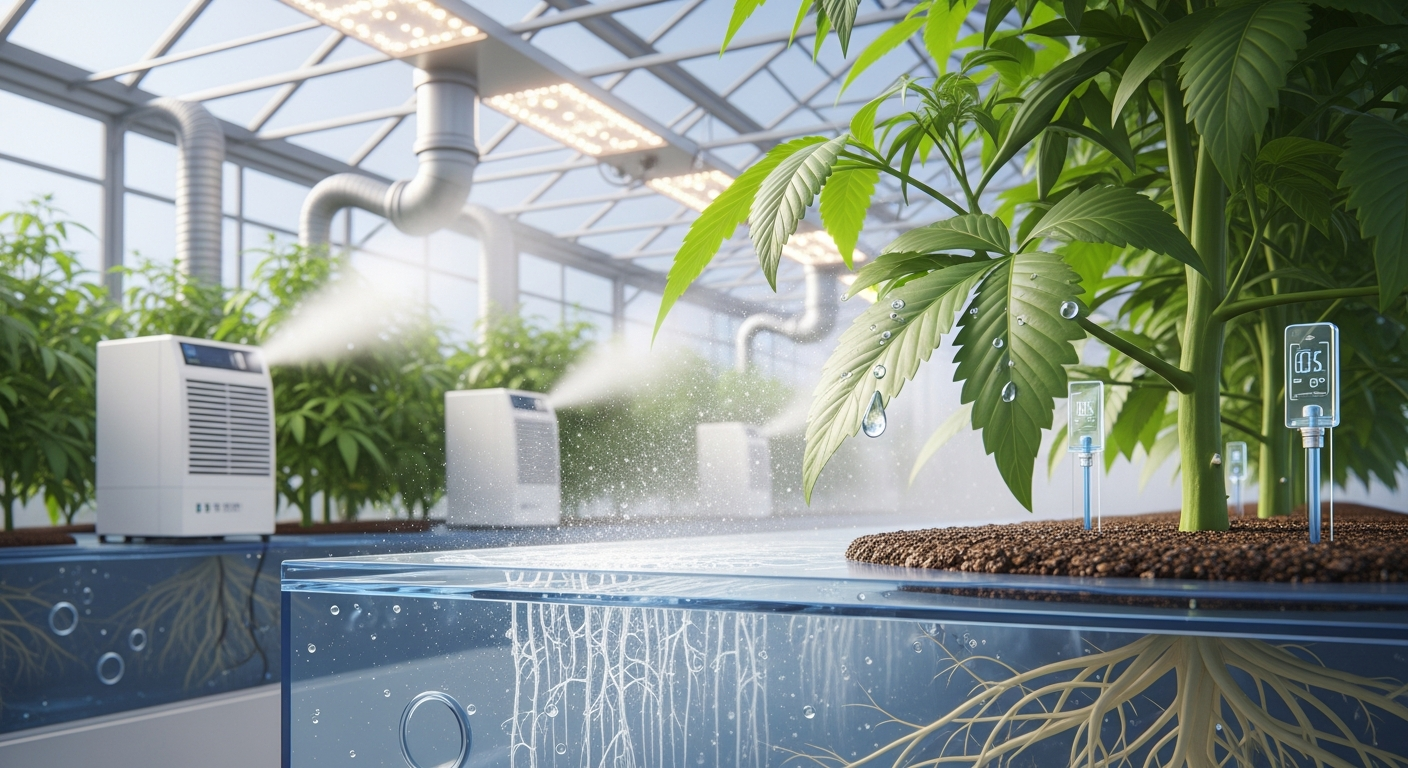
The rate of transpiration is heavily influenced by the humidity of the surrounding air, more precisely by the Vapor Pressure Deficit (VPD). VPD measures the difference between the amount of moisture in the air and how much moisture the air can hold when saturated. A high VPD means the air is dry and “thirsty,” pulling water rapidly from the plant. A low VPD means the air is humid and close to saturation, reducing the plant’s ability to transpire.
- Mass Flow: The most significant driver of nutrient uptake. As water moves into the roots and up the plant during transpiration, it carries dissolved nutrients along with it. A healthy transpiration rate directly supports efficient mass flow.
- Diffusion: Nutrients move from areas of higher concentration to lower concentration, primarily in the root zone. While crucial, diffusion is slower and less efficient than mass flow for overall nutrient delivery.
- Root Interception: Roots grow into new soil areas, physically encountering nutrient ions. This contributes a smaller fraction to total uptake compared to mass flow.
When humidity levels are optimal, plants transpire at a healthy, steady rate. This consistent water movement ensures a continuous supply of nutrients to all parts of the plant, supporting robust growth, strong cell structure, and efficient metabolic processes. Disrupt this balance, and nutrient uptake can suffer significantly.
High vs. Low Humidity: Impact on Nutrient Dynamics
Managing humidity isn’t about finding a single “perfect” number, but rather maintaining a dynamic balance that supports the plant’s needs through different growth stages. Both excessively high and excessively low humidity can create significant challenges for nutrient uptake.
The Perils of High Humidity (Low VPD)
When the air around your plants is very humid (low VPD), the driving force for transpiration diminishes. The air is already saturated with moisture, so the plant struggles to release water vapor. This leads to several critical issues:
- Reduced Transpiration: With less water moving through the plant, the “mass flow” of nutrients slows down dramatically. Nutrients that rely heavily on mass flow for transport, such as calcium and boron, become particularly vulnerable to deficiency, even if they are abundant in the root zone. This often manifests as “tip burn” or stunted new growth.
- Decreased Water Uptake: Roots absorb less water, which can lead to a build-up of salts in the root zone if irrigation isn’t perfectly managed.
- Stomatal Closure: In extreme humidity, stomata may close to prevent water uptake, further halting transpiration and nutrient movement, and also reducing CO2 intake, thus impacting photosynthesis.
- Increased Disease Risk: While not directly a nutrient issue, high humidity creates an ideal environment for fungal pathogens (like powdery mildew and botrytis), which can stress plants and indirectly impair their ability to absorb nutrients.
The Challenges of Low Humidity (High VPD)
Conversely, very dry air (high VPD) causes plants to transpire excessively. While some transpiration is good, too much can be detrimental:
- Excessive Water Loss: Plants lose water faster than their roots can absorb it, leading to dehydration and wilting. This puts immense stress on the plant.
- Stomatal Closure (Stress Response): To conserve water, plants will close their stomata, paradoxically halting transpiration, nutrient uptake, and CO2 absorption. This survival mechanism severely impacts growth.
- Nutrient Burn/Toxicity: Rapid transpiration can lead to a faster accumulation of nutrients in plant tissues, potentially causing “nutrient burn” on leaf margins, especially with mobile nutrients like nitrogen.
- Reduced Photosynthesis: Stomatal closure in response to stress means less CO2 intake, directly impacting the plant’s ability to produce energy, which is essential for active nutrient transport mechanisms.
Optimizing Humidity for Peak Nutrient Efficiency and Crop Health
The goal is to create a humidity environment that encourages a steady, healthy rate of transpiration without causing stress. This requires careful monitoring and proactive climate control.
Monitor and Control VPD
Focusing on VPD rather than just relative humidity (RH) gives you a more accurate picture of plant transpiration stress. Ideal VPD ranges vary by crop type and growth stage:
- Propagation/Cloning: High humidity (low VPD, ~0.4-0.8 kPa) is beneficial to prevent desiccation before roots are established.
- Vegetative Growth: A moderate VPD (~0.8-1.2 kPa) encourages vigorous growth and strong root development, facilitating efficient nutrient uptake.
- Flowering/Fruiting: A slightly higher VPD (~1.0-1.5 kPa) is often preferred to promote fruit development, denser flowers, and reduce the risk of mold, while still supporting nutrient transport.
Practical Tip: Use a high-quality environmental sensor that measures temperature, RH, and calculates VPD. Many modern greenhouse controllers integrate this data for automated adjustments.
Strategies for Humidity Management
Achieving optimal humidity involves a combination of environmental control techniques:
- Dehumidification:
- Mechanical Dehumidifiers: Essential for removing excess moisture, especially in sealed environments or during night cycles when plants are still respiring but not transpiring.
- Ventilation: Exhaust fans and open vents can exchange humid indoor air with drier outdoor air.
- Heating & Ventilation: Running heaters while ventilating can effectively lower RH by raising the air’s capacity to hold moisture, even if the absolute moisture content remains the same.
- Humidification:
- Foggers/Misters: Introduce fine water droplets into the air to increase RH.
- Evaporative Coolers: Can both cool and humidify the air, suitable for dry climates.
- Air Circulation: Proper air movement (using oscillating fans) prevents pockets of stagnant, humid air around plant canopies, promoting even transpiration. This is crucial for preventing localized humidity issues that can lead to disease and hinder nutrient uptake in specific areas.
- Irrigation Management: Water your plants judiciously. Overwatering can lead to increased substrate humidity, root issues, and indirectly affect canopy humidity. Consider irrigation timing to avoid peaks in humidity during sensitive periods.
- Plant Density: Avoid overcrowding your plants, as dense canopies trap moisture and impede airflow, leading to localized high humidity.
Consider Foliar Feeding as a Supplement
While not a primary solution for systemic nutrient issues caused by improper humidity, foliar feeding can be a valuable tool to deliver specific nutrients directly to leaves when root uptake is temporarily compromised due to environmental stress. This is particularly useful for nutrients like calcium and boron during periods of high humidity where their root-to-shoot transport is reduced. However, always view foliar feeding as a supplement, not a replacement for healthy root uptake driven by balanced environmental conditions.
Conclusion
The link between humidity and nutrient uptake is undeniable and profoundly impacts the health, yield, and quality of high-value crops. By understanding the principles of transpiration and VPD, growers can move beyond simply reacting to visible deficiencies and proactively manage their greenhouse climate for optimal plant nutrition. Investing in precise environmental control and diligently monitoring humidity levels, alongside temperature and CO2, empowers growers to create an environment where plants can efficiently absorb every essential nutrient they need. This holistic approach to climate control is not just about preventing problems; it’s about cultivating excellence and realizing the true potential of your valuable harvest.