
Misting systems are often hailed as a magic bullet for managing greenhouse climates, offering a dual solution for both cooling and humidification. However, the effectiveness of these systems isn’t a constant; it’s a dynamic interplay profoundly influenced by a single, often overlooked factor: ambient humidity. Understanding this relationship is not just academic; it’s crucial for optimizing your greenhouse environment, ensuring plant health, and maximizing resource efficiency. From the parched deserts to the muggy tropics, how much water vapor is already in the air dictates whether your misting system will be a cooling savior or a catalyst for fungal woes.
The Fundamental Science of Misting and Evaporative Cooling
At its core, a misting system operates on the principle of evaporative cooling. When tiny water droplets, often measured in microns, are released into the air, they absorb heat energy from their surroundings to transition from liquid to vapor. This process, known as latent heat of vaporization, effectively cools the air. Simultaneously, it increases the amount of water vapor in the atmosphere, thereby raising the relative humidity (RH).
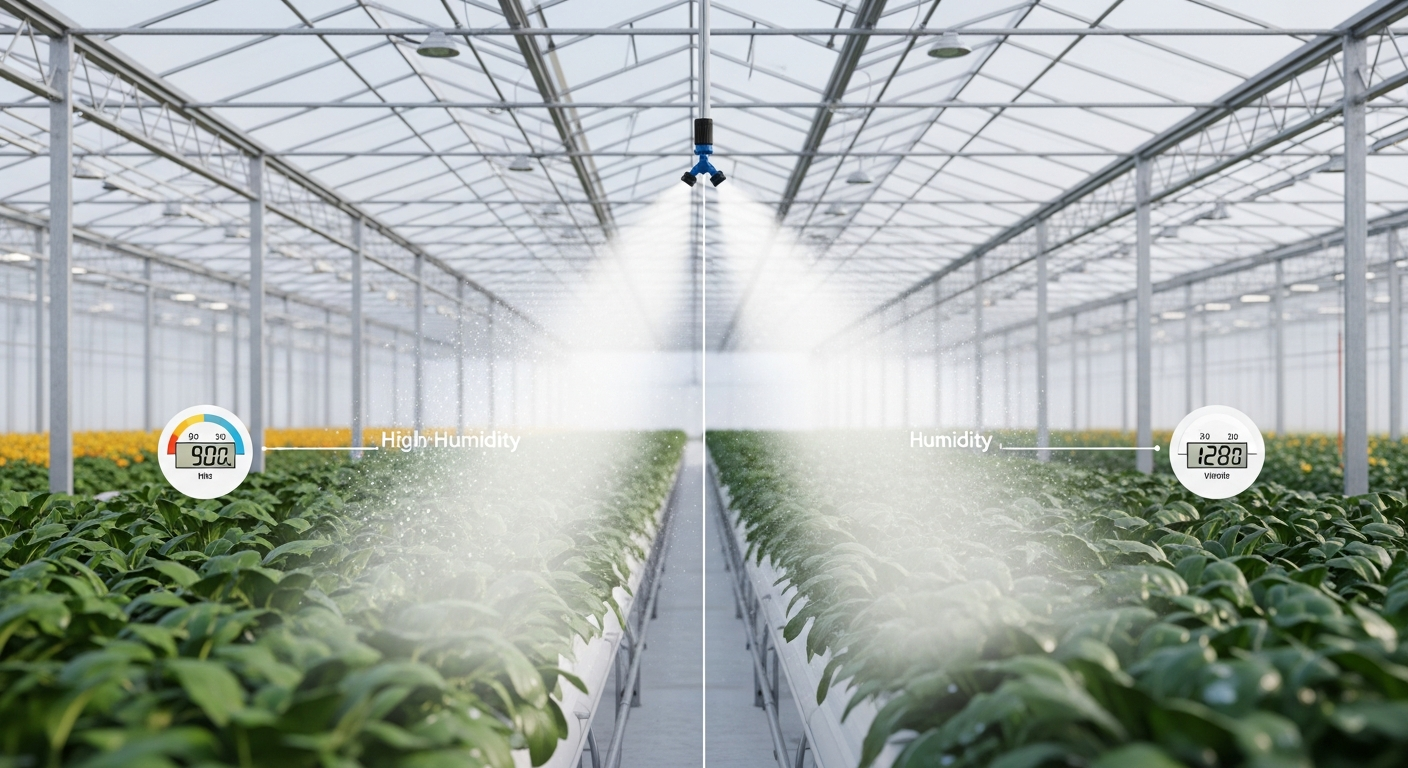
The efficiency of this cooling mechanism is directly tied to how readily these water droplets can evaporate. And that, precisely, is where humidity enters the picture. Air can only hold a finite amount of water vapor at a given temperature. Relative humidity expresses this as a percentage: 100% RH means the air is completely saturated and cannot hold any more moisture. 50% RH means it holds half of its maximum capacity.
A misting system’s success hinges on providing the optimal conditions for rapid evaporation. If the air is dry, it’s like a sponge ready to soak up water. If it’s already damp, the sponge is full, and additional water just sits there.
How Ambient Humidity Dictates Misting System Performance
The amount of moisture already present in the air is the primary determinant of how effective your misting system will be for both cooling and humidification.
When Humidity is Low: The Misting Advantage
In environments with low relative humidity, misting systems operate at their peak efficiency. Dry air has a significant “thirst” for moisture, meaning water droplets evaporate very quickly. This rapid evaporation leads to:
- Maximal Cooling: More latent heat is absorbed from the air, resulting in a substantial temperature drop within the greenhouse. This is why misting and fogging systems are incredibly effective in arid or semi-arid climates.
- Efficient Humidification: The evaporated water vapor effectively increases the overall relative humidity to desired levels, beneficial for plants that thrive in higher moisture environments, such as tropical foliage or during propagation stages.
- Reduced Wetness: Because droplets evaporate so quickly, there’s less chance of plant surfaces becoming excessively wet, minimizing the risk of fungal diseases or water spotting on leaves.
When Humidity is High: The Misting Challenge
Conversely, when ambient relative humidity is already high, the effectiveness of a misting system significantly diminishes, and its operation can even become detrimental. In humid conditions:
- Minimal Cooling: The air is already near saturation, so there’s little capacity for additional water vapor. Droplets evaporate slowly, or not at all, meaning very little latent heat is absorbed, leading to negligible cooling.
- Excessive Wetness: Un-evaporated mist accumulates on plant leaves, flowers, and structural surfaces. This prolonged leaf wetness is a prime breeding ground for opportunistic fungal diseases like Botrytis (grey mold), powdery mildew, and downy mildew.
- Increased Risk of Pathogens: High humidity, especially combined with stagnant air, creates an ideal environment for disease proliferation.
- Water Staining and Damage: Mineral deposits from water can leave unsightly spots on foliage and fruit, potentially reducing crop quality.
- Slippery Surfaces: Floors and walkways can become dangerously slick, posing safety hazards.
The Role of Vapor Pressure Deficit (VPD)
While relative humidity is a commonly used metric, sophisticated growers increasingly turn to Vapor Pressure Deficit (VPD) for a more precise understanding of air’s “drying power” and its impact on plant transpiration. VPD measures the difference between the amount of moisture the air can hold when saturated and the amount it currently holds. A high VPD indicates dry air that pulls a lot of moisture from plants, while a low VPD means humid air where plants transpire less.
Misting systems directly influence VPD by adding moisture to the air. In low humidity (high VPD) conditions, misting efficiently reduces VPD, encouraging healthy plant transpiration without excessive stress. In high humidity (low VPD) conditions, continued misting can push VPD too low, effectively shutting down transpiration, impeding nutrient uptake, and increasing the risk of edema or disease.
Optimizing Misting Systems for Varied Humidity Conditions
Given humidity’s critical role, smart implementation and management of misting systems are paramount.
Intelligent Monitoring and Automation
The most effective strategy involves continuous monitoring of both temperature and relative humidity. Modern greenhouse climate control systems integrate:
- Hygrometers and Temperature Sensors: Placed strategically throughout the greenhouse to provide real-time data.
- Automated Controllers: These systems can be programmed to activate misting only when temperature exceeds a set point AND humidity falls below another set point. They can also integrate with ventilation fans to remove excess humidity if it gets too high, preventing saturation and disease.
- VPD Control: Advanced systems can even target a specific VPD range, adjusting misting and ventilation to maintain optimal plant transpiration.
Choosing the Right Nozzles and Droplet Size
The type of nozzles and the resulting droplet size significantly impact misting effectiveness:
- Finer Mist (Foggers): Ultra-fine droplets (typically <20 microns) evaporate almost instantly, making them ideal for cooling and humidification, especially in regions with moderate to low humidity, as they maximize evaporative surface area. They also minimize wetting of plant surfaces.
- Larger Mist: While easier to produce, larger droplets (50+ microns) take longer to evaporate and are more prone to falling out of the air before evaporation, leading to increased surface wetness. These are generally less efficient for cooling and humidification in most scenarios, especially humid ones. High-pressure systems are key to achieving finer mist.
Water Quality and System Maintenance
The quality of water used and the cleanliness of the system directly affect performance:
- Filtration: Use appropriate filters to remove sediment and minerals that can clog fine nozzles, reducing misting efficiency and potentially damaging plants.
- Regular Cleaning: Periodically clean nozzles to prevent mineral buildup and ensure uniform droplet distribution.
- De-mineralized Water: In areas with hard water, using reverse osmosis (RO) or de-ionized water can prevent nozzle clogging and unsightly mineral deposits on plants.
Strategic Placement and Airflow Management
Even the finest mist won’t be effective if it can’t circulate properly:
- Even Distribution: Place misting lines to ensure uniform coverage across the greenhouse space.
- Horizontal Airflow Fans (HAFs): These fans are crucial for circulating air, helping the mist evaporate more quickly and distribute evenly throughout the canopy, preventing pockets of high humidity and promoting efficient cooling.
- Ventilation: Integrate misting operations with exhaust fans and vents. If humidity rises too high, activating exhaust fans can purge the moist air, drawing in drier air and allowing the misting system to operate more effectively.
Beyond Cooling: Misting for Humidification and Plant Health
While cooling is a primary benefit, misting systems are also vital tools for specific plant health requirements.
Supporting Sensitive Plants and Propagation
Many plants, particularly seedlings, cuttings, and tropical varieties, require consistently high humidity to thrive, especially during propagation. Misting helps maintain the microclimate necessary for:
- Rooting Cuttings: High humidity reduces transpiration stress, allowing cuttings to focus energy on root development.
- Seed Germination: Consistent moisture in the air prevents rapid drying of the germination medium and developing seedlings.
- Exotic Plants: Many orchids, ferns, and other exotics naturally grow in high-humidity environments and benefit greatly from supplemental misting.
In these cases, the goal isn’t just cooling, but actively raising the RH to a beneficial level, which still requires careful monitoring to prevent disease.
Mitigating Plant Stress and Disease
Properly managed misting can reduce heat stress, prevent wilting, and maintain turgidity in plants. However, as previously noted, improperly managed misting in high humidity can exacerbate disease problems. The key is balance: providing enough moisture to support healthy plant functions without creating conditions favorable for pathogens. This often means running misting in short bursts (pulse cycles) to allow for evaporation and preventing prolonged leaf wetness.
Conclusion
Misting systems are indispensable tools for modern greenhouse climate control, offering powerful solutions for cooling and humidification. However, their true potential is unlocked only when their interaction with ambient humidity is fully understood and managed. From the fundamental science of evaporative cooling to the precise control offered by VPD, every aspect of misting effectiveness is dictated by the water vapor content in the air. By intelligently monitoring conditions, selecting appropriate equipment, and implementing strategic operational practices, greenhouse growers can harness the full power of their misting systems, ensuring optimal plant health, maximizing yields, and maintaining a truly balanced greenhouse climate, regardless of the external conditions.