
Keeping your greenhouse at the ideal temperature is a constant ballet between nature’s whims and your plants’ specific needs. While high-tech cooling systems offer precise control, natural ventilation remains a cornerstone of efficient greenhouse climate management, offering cost-effective and environmentally friendly temperature regulation. But it’s not just about having vents; it’s about their size, placement, and operation. In the intricate world of greenhouse climate control, the dimensions of your ventilation openings play a surprisingly critical role in determining your cooling efficiency, directly impacting plant health, energy consumption, and your overall success as a grower.
The Science of Greenhouse Airflow: Why Vent Size Matters for Cooling
At its core, natural greenhouse cooling hinges on two fundamental principles of physics: the stack effect and the wind effect. Both rely heavily on the unobstructed movement of air, and here’s where vent size becomes paramount. The stack effect, often called the chimney effect, occurs because warm air is less dense than cool air. Inside a greenhouse, solar radiation heats the air, causing it to rise. If there are appropriately sized openings at the peak (ridge vents), this hot air will escape, creating a vacuum that draws cooler, denser air in through lower openings (side vents).
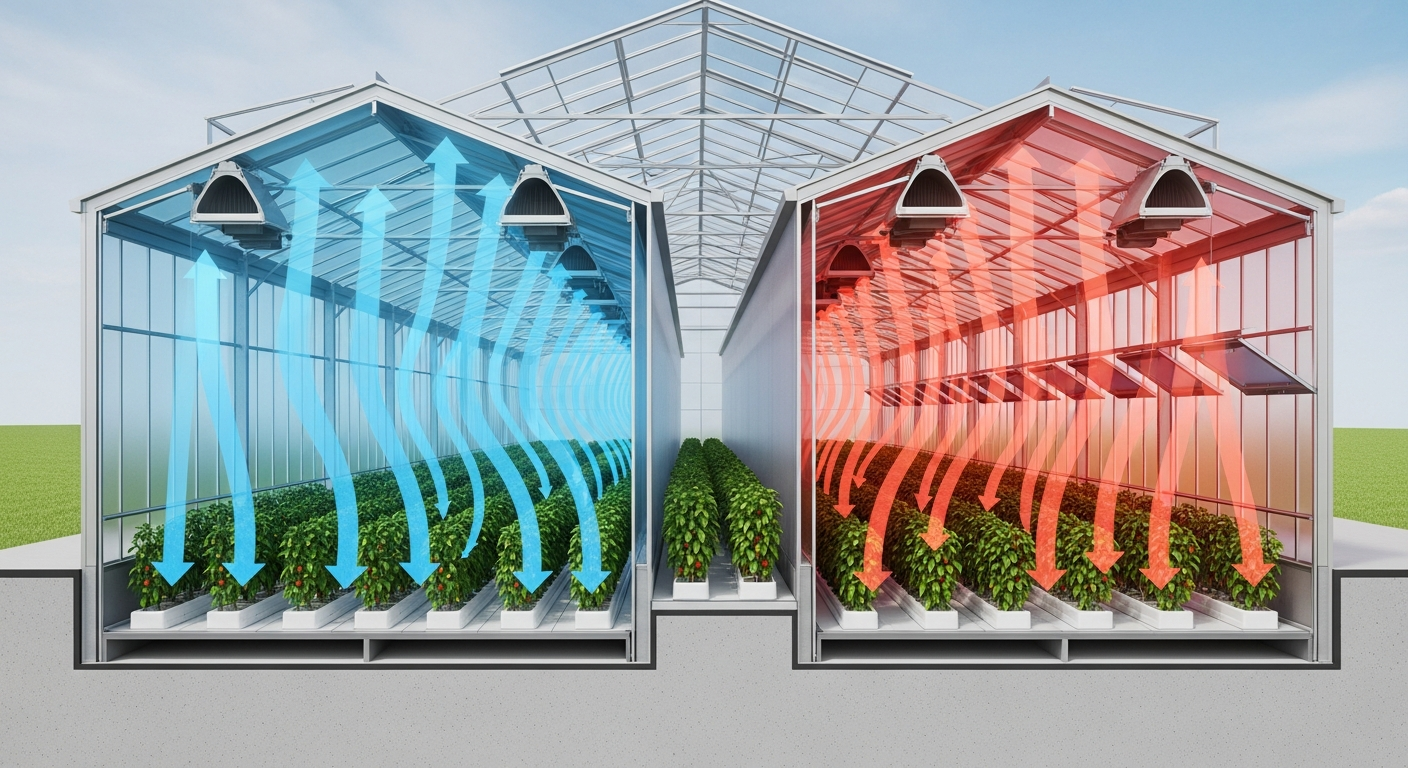
The efficiency of this process is directly proportional to the size of your vents. Smaller vents create greater resistance to airflow, akin to trying to breathe through a narrow straw. This restriction reduces the volume of air that can be exchanged per unit of time, trapping heat and humidity inside. Conversely, larger vent openings offer less resistance, allowing for a higher rate of air exchange and more effective heat dissipation. This principle applies equally to the wind effect, where external winds push air into the greenhouse through windward openings and pull it out through leeward openings. Adequate vent size ensures that the wind’s driving force can be fully utilized to flush out hot air.
Insufficient vent size is a common bottleneck, often leading to persistent issues with overheating, even when vents are fully open. It compromises your greenhouse’s ability to shed excess heat, directly impacting your greenhouse cooling efficiency and the well-being of your plants. Properly sized vents are essential for maintaining optimal temperature control and preventing heat buildup, which can severely stress crops and encourage disease.
Ridge Vents vs. Side Vents: Sizing for Optimal Airflow
A truly efficient natural ventilation system isn’t just about the total vent area; it’s about the strategic placement and proportional sizing of different vent types. Most effective greenhouses utilize a combination of ridge vents and side vents, each playing a crucial role in maximizing airflow efficiency.
- Ridge Vents (Roof Vents): Positioned at the highest point of the greenhouse, ridge vents are the primary exit points for the hot, buoyant air accumulated through the stack effect. For these to be effective, they need to be large enough to allow a significant volume of hot air to escape without creating a bottleneck. They are critical for releasing the hottest air layers that naturally accumulate at the greenhouse apex.
- Side Vents (Eave Vents): Located along the sidewalls, usually closer to the ground, side vents serve two main purposes: they are the entry points for cooler, fresh air, completing the convective loop initiated by the stack effect, and they facilitate cross-ventilation driven by the wind effect. When wind blows across the greenhouse, side vents allow air to flow through, flushing out the internal atmosphere.
The synergy between these two types of vents is paramount. If ridge vents are too small, hot air cannot escape effectively, regardless of how large your side vents are. Conversely, if side vents are undersized, insufficient cool air enters, diminishing the effectiveness of the stack effect and limiting the impact of cross-breezes. A common guideline suggests that the total vent opening area (combining both ridge and side vents) should be at least 15-25% of the greenhouse floor area for effective greenhouse ventilation. Furthermore, many experts recommend that the total area of the ridge vents should be roughly equal to, or slightly larger than, the total area of the side vents to ensure balanced and optimal airflow, especially for purely natural ventilation systems. This balance ensures a steady intake of fresh air to replace the exiting hot air.
Calculating Optimal Vent Size: Practical Guidelines for Growers
While there’s no single “perfect” formula for every greenhouse, several rules of thumb and considerations can guide you in determining the appropriate greenhouse vent size for your specific needs. The most widely cited recommendation for natural ventilation is that the total vent opening area (including both ridge and side vents) should be between 15% and 25% of the greenhouse’s floor area. For hotter climates or for growing heat-sensitive crops, aiming for the higher end of this spectrum – or even exceeding it – can be highly beneficial in achieving sufficient optimal ventilation and preventing heat buildup.
Factors Influencing Your Ideal Vent Size:
- External Climate: Greenhouses in consistently hot and humid regions will require a larger total vent area for effective cooling than those in cooler climates. High solar radiation further increases the need for robust ventilation.
- Crop Type and Density: Densely planted crops, or those with high transpiration rates, will contribute more heat and humidity, demanding greater ventilation capacity. Crops sensitive to heat stress will also benefit from maximum cooling efficiency. Consider the canopy density and how it might impede internal airflow.
- Greenhouse Orientation and Structure: The way your greenhouse is oriented relative to prevailing winds, as well as its height and shape, can influence airflow. Taller greenhouses naturally enhance the stack effect due to a greater temperature differential between intake and exhaust.
- Internal Obstructions: Internal benches, equipment, and even the plants themselves can impede airflow. Factor this into your ventilation strategy, recognizing that more physical obstructions may necessitate larger vent openings to compensate.
- Desired Temperature Differential: How much warmer are you willing to let the interior be compared to the exterior? A smaller desired differential (i.e., wanting internal temperatures very close to external ambient temperatures) requires more aggressive ventilation, often meaning larger vents.
Practical Tip: Don’t just rely on calculations. Observe your greenhouse closely. Are temperatures consistently higher than desired even with vents fully open? Do you see stagnant air pockets, especially in the upper reaches or corners? These are signs that your current vent system, particularly its size, might be inadequate. When in doubt, it’s generally better to err on the side of having slightly larger vents, as you can always partially close them if conditions are too cool or breezy. It’s much harder (and more expensive) to increase vent size after construction, making initial thoughtful greenhouse design crucial.
Beyond Size: Other Factors Influencing Greenhouse Venting Efficiency
While vent size is undeniably a cornerstone of effective natural cooling, it’s part of a larger ecosystem of factors that contribute to optimal greenhouse climate control. Neglecting these can undermine even the most perfectly sized ventilation system.
- Vent Placement and Operation: Proper distribution of vents across the greenhouse, along with the ability to open them fully and precisely, is crucial. Automated vent openers (thermostatically controlled) can significantly improve responsiveness to changing conditions, ensuring vents open at the exact moment cooling is needed.
- Insect Screens: While essential for pest management, insect screens can dramatically reduce airflow, sometimes by as much as 30-50%, depending on mesh size and cleanliness. If screens are necessary, you might need to compensate with larger gross vent areas or supplemental mechanical ventilation to maintain equivalent airflow.
- Maintenance: Keep vent mechanisms clean and well-lubricated to ensure they open and close fully without sticking. Clear any debris from screens or vent openings that could obstruct airflow, as even minor blockages can reduce efficiency.
- Internal Air Circulation: Even with large external vents, internal air circulation fans (horizontal airflow fans or HAF fans) can help break up stagnant air pockets, distribute fresh air more evenly throughout the plant canopy, and enhance the movement of air towards exhaust vents, thereby improving the overall airflow and cooling effect.
- Greenhouse Covering Material: Different glazing materials have varying thermal properties. Materials that allow more light penetration but retain less heat can also reduce the overall cooling load, lessening the burden on your ventilation system.
Considering these complementary factors alongside careful vent sizing will lead to a more robust and responsive greenhouse ventilation system, ultimately contributing to better crop health and greater productivity.
Optimizing Your Greenhouse: The Critical Role of Vent Size
In the complex art and science of greenhouse cultivation, maintaining precise temperature control is paramount for plant health and productivity. As we’ve explored, the often-underestimated aspect of greenhouse vent size stands out as a critical determinant of your cooling efficiency, particularly when relying on natural ventilation. Adequate vent area, strategically distributed between ridge and side openings, facilitates the powerful natural forces of the stack effect and wind effect, allowing your greenhouse to breathe and effectively dissipate excess heat.
Investing time in understanding and optimizing your ventilation system’s dimensions isn’t just about preventing overheating; it’s about fostering a stable, healthy growing environment, reducing the reliance on energy-intensive mechanical cooling, and ultimately, ensuring the flourishing success of your plants. By embracing thoughtful design and paying attention to these fundamental principles of optimal ventilation, you empower your greenhouse to regulate its climate naturally, economically, and effectively, contributing significantly to your overall success as a grower.