
For many greenhouse growers, evaporative cooling systems are the go-to solution for maintaining optimal temperatures, offering an energy-efficient and cost-effective way to beat the heat. Also known as “swamp coolers” or “pad and fan systems,” they leverage the natural process of water evaporation to lower air temperature. However, growers in regions characterized by consistently high humidity often find their evaporative coolers struggling to perform, leading to frustration and suboptimal growing conditions. The very principle of evaporative cooling—adding moisture to the air—becomes a double-edged sword when the air is already saturated. But despair not! Optimizing evaporative cooling in high-humidity climates is not an insurmountable challenge; it simply requires a more nuanced approach, combining smart design, diligent maintenance, and strategic supplemental techniques. This article will delve into the intricacies of making your evaporative cooling system work effectively, even when the air feels thick with moisture, ensuring your greenhouse maintains a happy, healthy climate for your plants.
Understanding the Evaporative Cooling Challenge in Humid Climates
To effectively optimize evaporative cooling, it’s crucial to first grasp why it becomes less efficient in humid environments. Evaporative cooling works by converting sensible heat (the heat you can feel) into latent heat (the heat stored in water vapor during a phase change). As water evaporates from a wet surface (like a cooling pad or mist), it draws energy from the surrounding air, thereby lowering the air’s temperature. The maximum temperature drop achievable through this process is limited by the wet-bulb temperature, which is the lowest temperature to which air can be cooled by the evaporation of water.
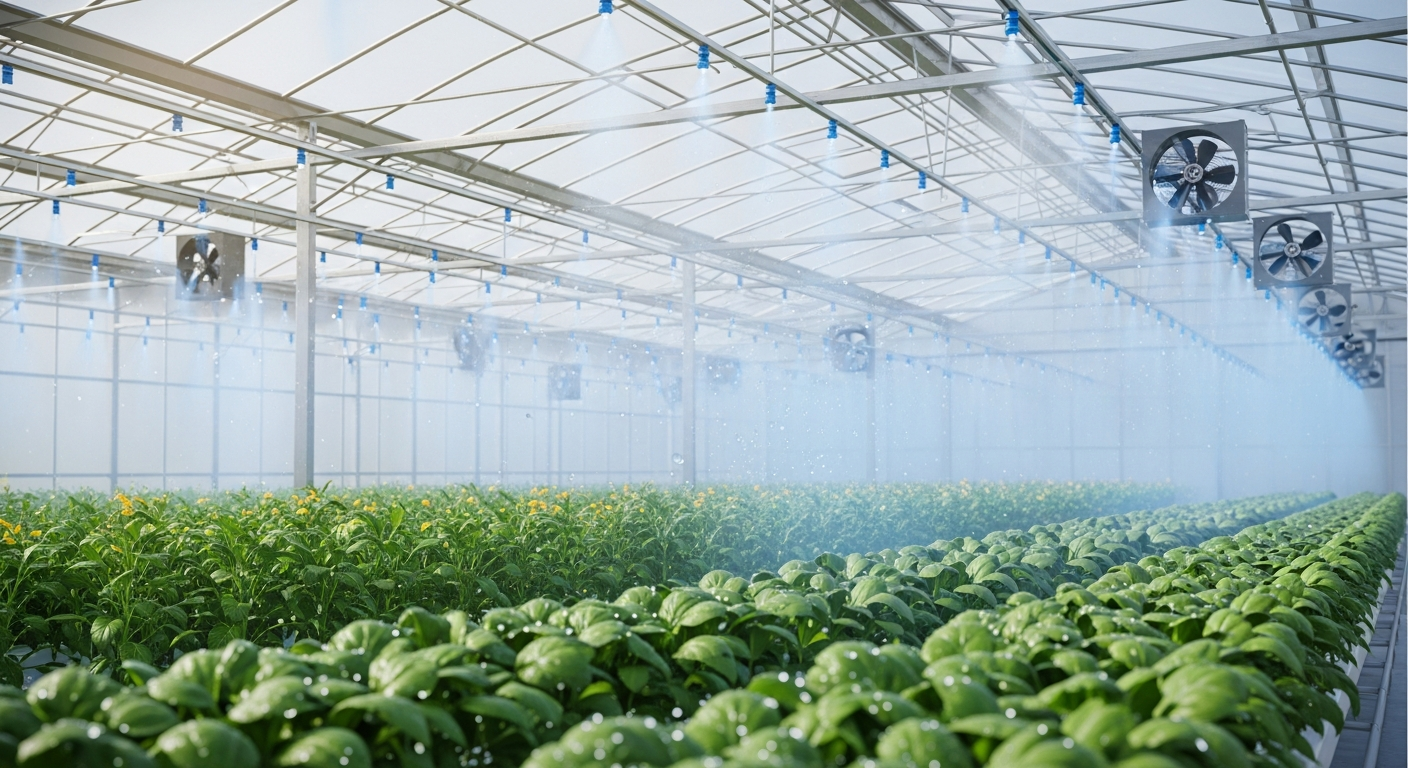
In regions with low relative humidity, the difference between the dry-bulb temperature (what a standard thermometer reads) and the wet-bulb temperature is significant. This difference, known as the wet-bulb depression, allows for considerable evaporation and thus a substantial cooling effect. However, as relative humidity rises, the air’s capacity to absorb more moisture diminishes. The wet-bulb depression shrinks, meaning less water can evaporate, and consequently, a much smaller temperature drop is achieved. Furthermore, adding more moisture to already humid air can create an environment ripe for fungal diseases and hinder plant transpiration, even if a slight temperature reduction occurs. This is the core challenge: balancing cooling with the risk of creating excessively damp conditions.
Foundational Strategies for Maximizing Evaporative Cooling Effectiveness
Even in humid climates, the efficiency of your evaporative cooling system can be significantly improved by focusing on fundamental principles and diligent management. These strategies aim to maximize the small window of opportunity for evaporation and ensure the system operates at its peak potential.
Optimize Ventilation and Airflow
Ventilation is paramount, especially in high-humidity environments. The goal is not just to cool the air, but to remove the saturated, hot air and replace it with fresh, slightly drier (even if marginally so) ambient air. This helps maintain the wet-bulb depression, however small it might be.
- Adequate Fan Sizing and Placement: Ensure your exhaust fans are appropriately sized for your greenhouse volume, aiming for at least one complete air change per minute. Fans should be strategically placed to pull air uniformly across the cooling pads and through the entire growing area.
- Effective Airflow Path: Design your greenhouse layout and plant spacing to allow for unimpeded airflow from the intake (cooling pads) to the exhaust fans. Obstructions can create stagnant pockets of humid air.
- Horizontal Airflow Fans (HAF): Supplementing your pad and fan system with HAF fans distributed throughout the greenhouse helps to destratify air, mix cooler air with warmer pockets, and reduce localized humidity buildup around plants. This constant air movement promotes transpiration and prevents condensation.
- Minimize Recirculation: Ensure that exhaust air is expelled far enough away from fresh air intakes to prevent it from being drawn back into the greenhouse. This would defeat the purpose of removing humid air.
Prioritize Pad & System Maintenance
The efficiency of your evaporative cooler hinges on the performance of its components, particularly the cooling pads.
- Clean Cooling Pads: Algae, mineral deposits (scale), and dust can clog the cooling pads, reducing their evaporative surface area and impeding airflow. Regularly inspect and clean pads. Replace them when they become excessively clogged or deteriorated.
- Consistent Water Distribution: Ensure the water distribution system (pump, pipes, drip emitters) is functioning correctly, providing an even flow of water across the entire surface of the pads. Dry spots on the pads are wasted potential.
- Proper Pump Function: The pump needs to be powerful enough to circulate water efficiently. Check for clogs in the pump or water lines.
- Water Quality: Hard water can lead to rapid mineral buildup on pads. Consider water softening or regular acid washing for maintenance if your water supply has high mineral content.
Strategic Water Management
How and when you introduce water to your evaporative system significantly impacts its efficiency in humid conditions.
- Intermittent Operation: Instead of continuous operation, consider running your evaporative system in cycles. In very high humidity, continuous wetting might just saturate the air further without much cooling benefit. Pulsing the water allows for some evaporation and then a slight drying out before the next cycle, optimizing the use of the limited wet-bulb depression.
- Minimize Excess Water: Ensure that water doesn’t pool excessively at the base of the pads, as this indicates inefficient evaporation and contributes to unnecessary humidity. Adjust water flow rates as needed.
- Drainage: Good drainage for the pads is essential to prevent waterlogging and reduce the risk of algae and bacterial growth.
Advanced Techniques and Supplementary Cooling for Humid Regions
When baseline optimization isn’t enough, especially during peak heat and humidity, integrating advanced techniques or supplementary systems becomes necessary to maintain acceptable greenhouse climates.
Integrate Dehumidification Strategies
Since the problem is too much moisture, actively removing it is a direct solution. While traditional dehumidifiers can be energy-intensive, some options are viable:
- Desiccant Dehumidification: For high-value crops where precise environmental control is critical, desiccant systems can effectively remove moisture from the air. They work by passing air over a material that absorbs moisture, which is then regenerated (dried) by heat. These systems are typically more expensive to install and operate but offer superior humidity control.
- Heating and Ventilation (H+V): This counter-intuitive strategy involves slightly raising the greenhouse temperature with heaters while simultaneously increasing ventilation. The warmer air can hold more moisture before reaching saturation, allowing the ventilation system to exhaust more moisture from the greenhouse. This is often used during nighttime or early morning hours to “dry out” the greenhouse environment.
Focus on Sensible Cooling
When latent cooling (evaporation) is limited, focusing on sensible cooling—reducing heat gain directly—becomes crucial.
- Shading Systems: External or internal shade cloths can significantly reduce the amount of solar radiation entering the greenhouse, lowering the sensible heat load. This is one of the most cost-effective methods for reducing daytime temperatures.
- Reflective Roof Coatings: Applying a white, reflective coating to the exterior of the greenhouse roof can reflect a substantial portion of solar radiation, preventing heat from penetrating the structure.
- High-Pressure Fogging Systems: While still an evaporative cooling method, high-pressure fogging systems produce extremely fine water droplets (microns in size). These tiny droplets evaporate much more rapidly than those from misting systems, allowing for more efficient cooling with minimal wetting of plants and surfaces, even in relatively humid conditions. Careful control is needed to prevent over-saturation.
- Radiant Barriers: Installing reflective insulation or barriers can help block radiant heat transfer into the greenhouse.
Explore Hybrid Systems
In extreme cases, a hybrid approach combining evaporative cooling with other methods might be the only way to achieve target temperatures.
- Evaporative Cooling with Mechanical Cooling: For peak heat loads, supplementing evaporative cooling with traditional mechanical air conditioning (chillers) for short periods can make a significant difference. This is a costly option, typically reserved for high-value crops or research facilities.
- Ground-Coupled Heat Exchangers: While primarily used for heating in winter, these systems can also provide some passive cooling in summer by circulating air or water through underground pipes where temperatures are more stable. Their cooling capacity is often limited but can contribute to overall temperature moderation.
Greenhouse Design and Crop Selection Considerations
Proactive design choices and appropriate crop selection can preemptively address many of the challenges posed by high humidity.
Greenhouse Structure
- Greenhouse Height: Taller greenhouses have a larger air volume, which can buffer temperature and humidity fluctuations more effectively. The warm, humid air rises, creating a slightly cooler zone for plants below.
- Orientation: Orienting your greenhouse to minimize direct summer sun exposure on large wall surfaces can reduce heat gain. Considering prevailing winds for natural ventilation is also important.
- Roof Vents: Incorporating passive or automated roof vents (ridge vents) can enhance natural ventilation and allow warm, humid air to escape through convection, reducing reliance on mechanical systems.
- Glazing Materials: Choosing glazing materials with good light diffusion properties can help distribute light evenly and reduce hot spots, while also having lower thermal conductivity than some materials.
Crop Selection
Sometimes, the most practical solution is to adapt what you grow to your climate rather than fighting it constantly.
- Humidity-Tolerant Crops: Select crop varieties known to thrive in humid conditions and are less susceptible to fungal diseases under such environments. Many tropical and sub-tropical plants naturally adapt to high humidity.
- Adjust Growing Practices: Modify irrigation schedules to avoid watering late in the day, reducing overnight humidity. Increase plant spacing to improve air circulation around individual plants, which reduces the microclimate humidity directly within the canopy. Pruning strategies can also open up the canopy for better airflow.
Conclusion
Optimizing evaporative cooling in high-humidity regions is undeniably more challenging than in arid zones, but it is far from impossible. It requires a holistic approach that goes beyond simply turning on a fan and pump. By understanding the limitations of evaporative cooling in moist air, diligently maintaining your existing systems, and strategically integrating advanced techniques like enhanced ventilation, shading, dehumidification, and even thoughtful greenhouse design, growers can significantly improve their climate control. The key is to be proactive, continuously monitor your greenhouse environment, and be willing to experiment with a combination of these strategies to find the perfect balance for your specific crops and local climate. With a multi-faceted approach, you can create a thriving greenhouse environment where your plants flourish, even when the air outside feels thick with humidity.