
In the rapidly evolving world of smart buildings, wireless lighting control has emerged as a cornerstone for enhancing energy efficiency, operational flexibility, and user comfort. However, when it comes to deploying these systems in large spaces – think expansive office complexes, sprawling warehouses, multi-floor educational institutions, or vast retail environments – the stakes are significantly higher. Here, the choice of underlying wireless technology is paramount, directly impacting system performance, scalability, reliability, and long-term cost-effectiveness. This article delves into a critical evaluation of two leading wireless mesh technologies for large-scale lighting control: Bluetooth Mesh and Zigbee, helping you navigate their strengths, weaknesses, and optimal applications.
The Imperative of Robust Wireless Lighting Control in Large Spaces
Modern commercial and industrial facilities demand more than just on/off lighting. They require sophisticated control systems that can adapt to changing needs, optimize energy consumption, and even provide valuable data insights. Wireless solutions offer unparalleled flexibility compared to traditional wired systems, simplifying installation and future modifications. Yet, scaling these benefits to truly large spaces presents unique challenges:
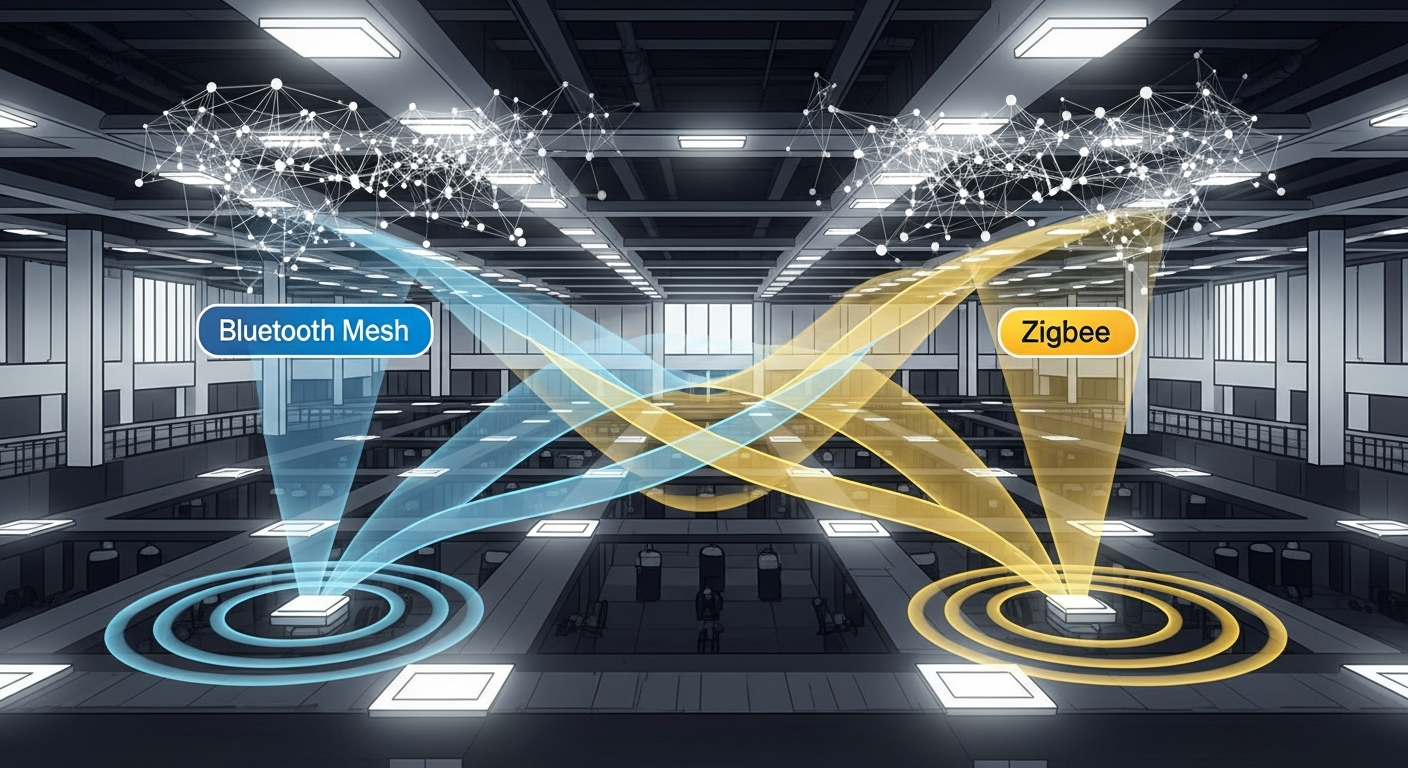
- Range and Coverage: Signal degradation over vast distances and through multiple obstructions requires a robust network architecture.
- Scalability: The system must comfortably accommodate hundreds, if not thousands, of lighting fixtures, sensors, and control devices without performance degradation.
- Reliability: Consistent, uninterrupted operation is non-negotiable for critical infrastructure. Dropped commands or unresponsive lights are unacceptable.
- Latency: Commands, especially for synchronized actions across large areas, need to be executed almost instantaneously.
- Interference: Large spaces often host numerous other wireless technologies (Wi-Fi, cellular), necessitating a system resilient to interference.
- Security: Protecting the lighting network from unauthorized access and cyber threats is crucial, especially when integrated with other building systems.
Addressing these challenges effectively is where mesh networking technologies like Bluetooth Mesh and Zigbee truly shine. They allow devices to relay messages to one another, extending the network’s reach and creating a self-healing, resilient communication pathway.
Bluetooth Mesh: A New Era for Large-Scale Lighting Networks
Introduced in 2017 by the Bluetooth Special Interest Group (SIG), Bluetooth Mesh builds upon the ubiquitous Bluetooth Low Energy (BLE) standard to deliver a powerful, many-to-many communication protocol specifically designed for large-scale device networks. It has rapidly gained traction in the commercial lighting control sector due to its inherent advantages.
Key Strengths of Bluetooth Mesh for Large Spaces:
- Massive Scalability: Bluetooth Mesh can theoretically support tens of thousands of nodes within a single network, making it highly suitable for even the largest installations. Each device can act as a repeater, extending the network’s reach.
- Enhanced Reliability: Its “managed flood” messaging approach ensures messages are relayed across the network multiple times, significantly increasing the probability of delivery even if some paths are temporarily blocked or devices are offline. The self-healing nature automatically reroutes messages around failed nodes.
- Robust Security: Bluetooth Mesh incorporates strong, multi-layered security features, including AES-CCM encryption for all messages and sophisticated key management, protecting the network from eavesdropping and unauthorized control.
- Native Smartphone Interoperability: Leveraging the existing Bluetooth standard, commissioning and control can often be done directly from smartphones and tablets, simplifying installation and ongoing management. This also opens doors for location-based services and asset tracking.
- Growing Ecosystem & Standardization: Backed by the Bluetooth SIG, Bluetooth Mesh benefits from a rapidly expanding ecosystem of hardware and software vendors, ensuring greater choice and future compatibility.
- Proximity Services & Data: Beyond lighting, Bluetooth Mesh can facilitate indoor positioning, wayfinding, and occupancy sensing, transforming the lighting infrastructure into a smart data backbone for the building.
Considerations for Bluetooth Mesh Deployment:
- Gateway Dependency for Cloud Connectivity: While devices communicate directly within the mesh, a gateway is typically required to connect the lighting network to the internet or a broader Building Management System (BMS) for remote control and data analytics.
- Potential for Latency in Dense Networks: In extremely dense networks with high traffic, the managed flood approach, while reliable, can sometimes introduce minor latency for certain types of messages compared to routed protocols. However, for typical lighting commands, this is rarely an issue.
- Learning Curve: While setup can be intuitive with good apps, understanding the mesh network concepts (e.g., publish/subscribe model, groups) might require some initial learning.
Practical Tip: When designing a Bluetooth Mesh lighting control system for a large space, strategically place gateways to ensure optimal cloud connectivity and minimize message hops for critical control zones. Leverage the built-in smartphone commissioning tools to streamline deployment.
Zigbee: A Proven Workhorse for Extensive Wireless Lighting
Zigbee is another dominant force in the wireless networking landscape, particularly renowned for its success in home automation and commercial applications like smart lighting. Based on the IEEE 802.15.4 standard, Zigbee has a long-standing reputation for being a reliable, low-power, and highly scalable mesh technology.
Key Strengths of Zigbee for Large Spaces:
- Mature & Robust Mesh Networking: Zigbee’s mesh protocol is highly refined and proven in countless large-scale deployments. It supports a vast number of nodes and features robust routing algorithms that ensure message delivery and self-healing capabilities.
- Exceptional Energy Efficiency: Designed from the ground up for low-power operation, Zigbee is ideal for battery-powered sensors and switches within a lighting control ecosystem, extending battery life significantly.
- Wide Interoperability with Zigbee 3.0: The advent of Zigbee 3.0 has significantly improved interoperability, unifying various application profiles (like Zigbee Light Link – ZLL) and ensuring that devices from different manufacturers can work together more seamlessly.
- Dedicated Lighting Profiles: Zigbee has specific application profiles optimized for lighting (like ZLL), which means a rich ecosystem of compliant lighting products is available.
- Reliable & Secure: Zigbee employs AES-128 encryption and robust authentication mechanisms to secure network communications and prevent unauthorized access.
- Less Susceptible to Wi-Fi Interference (with Channel Planning): While it operates on the 2.4 GHz band like Wi-Fi, Zigbee allows for specific channel selection, which, with proper site surveys and channel planning, can minimize interference from Wi-Fi networks.
Considerations for Zigbee Deployment:
- Interference on 2.4 GHz: Despite channel planning, operating on the crowded 2.4 GHz band means Zigbee can still experience interference from Wi-Fi, Bluetooth, and other wireless devices, potentially impacting performance if not carefully managed.
- Gateway Required for External Connectivity: Similar to Bluetooth Mesh, Zigbee networks require a gateway to connect to IP networks, the cloud, or other building systems.
- Commissioning Complexity: While improving, commissioning large Zigbee networks can sometimes be more involved than with Bluetooth Mesh, often requiring specialized tools or greater expertise.
- Limited Native Smartphone Support: Direct smartphone connectivity is less common compared to Bluetooth Mesh, often relying on gateway apps or dedicated controllers.
Practical Tip: For large Zigbee lighting installations, always conduct a thorough site survey to identify potential sources of interference. Plan your Zigbee channels carefully to avoid overlap with existing Wi-Fi networks. Investing in professional commissioning tools can greatly streamline large deployments.
Bluetooth Mesh vs. Zigbee: Making the Right Choice for Your Large Space
Both Bluetooth Mesh and Zigbee offer compelling solutions for wireless lighting control in large commercial spaces, delivering the scalability and reliability required. The “best” choice often depends on specific project requirements, existing infrastructure, and future integration goals.
Comparative Analysis:
- Scalability: Both are highly scalable to thousands of nodes. Bluetooth Mesh’s architecture can potentially handle higher node counts (e.g., 32,000+), while Zigbee is also well-proven for very large deployments. Negligible difference for most real-world scenarios.
- Interoperability:
- Bluetooth Mesh: Benefits from a universal standard and the ubiquity of Bluetooth on smart devices, fostering a rapidly growing, inherently interoperable ecosystem.
- Zigbee: Has a mature, established ecosystem with strong device-level interoperability (especially with Zigbee 3.0), but gateway solutions are key for broader integration.
- Security: Both offer robust, industry-standard encryption (AES-128 for Zigbee, AES-CCM for Bluetooth Mesh) and secure commissioning processes.
- Power Consumption: Zigbee generally holds an edge for extremely low-power, battery-operated devices due to its design. While Bluetooth LE is also low-power, Zigbee’s duty cycling can be more aggressive for certain applications.
- Commissioning & User Experience:
- Bluetooth Mesh: Often simpler and more intuitive for initial setup and ongoing management, leveraging native smartphone apps.
- Zigbee: Can be more complex, sometimes requiring specialized tools, though many vendor solutions simplify the process.
- Beyond Lighting:
- Bluetooth Mesh: Strong potential for integration with indoor positioning, asset tracking, and other proximity services due to the underlying Bluetooth technology.
- Zigbee: Excellent for integrating various low-power sensors (occupancy, temperature, humidity) into the same network, forming a comprehensive IoT solution for the building.
- Interference Resilience: Both operate in the 2.4 GHz band. Zigbee allows for dedicated channel selection, which helps. Bluetooth Mesh also has adaptive frequency hopping. Both require careful planning in crowded RF environments.
Actionable Advice: Before committing to either technology, consider these questions:
- What is the ultimate scale of your project in terms of devices?
- What other building systems (HVAC, security, occupancy sensors) need to integrate with your lighting control?
- What is the technical expertise of your installation and maintenance teams?
- Are future services like indoor navigation or asset tracking a potential requirement?
- What is your budget for hardware, installation, and ongoing maintenance?
Conclusion
Both Bluetooth Mesh and Zigbee stand as powerful, reliable, and scalable solutions for modern wireless lighting control in large commercial and industrial spaces. Each technology brings a distinct set of advantages to the table. Bluetooth Mesh, with its native smartphone integration, growing ecosystem, and potential for advanced location services, is a compelling choice for future-forward installations seeking broad interoperability and data-rich environments. Zigbee, a seasoned veteran, continues to excel with its proven mesh stability, exceptional energy efficiency for battery-powered devices, and a mature ecosystem, making it a robust option for comprehensive building automation. The optimal selection will hinge on a thorough analysis of specific project needs, existing infrastructure, budget, and long-term strategic goals for your smart building. By carefully evaluating these factors, you can deploy a wireless lighting control system that delivers maximum efficiency, flexibility, and value for years to come.