
In the world of modern horticulture, especially within controlled greenhouse environments, efficiency and precision are paramount. Gone are the days of guessing when to water, relying solely on visual cues or the “finger test.” While these traditional methods served their purpose, they often led to wasted resources, suboptimal plant health, and inconsistent yields. Today, cutting-edge technology allows us to move beyond approximation, ushering in an era of data-driven decision-making. At the forefront of this revolution is the concept of Volumetric Water Content (VWC), a powerful metric that enables growers to establish precision irrigation triggers, transforming how we manage water in our greenhouses for healthier plants and a healthier bottom line.
Understanding Volumetric Water Content (VWC): The Core Metric
At its heart, Volumetric Water Content (VWC) quantifies the amount of water present in a given volume of soil or substrate. Expressed as a percentage, VWC tells you exactly what proportion of your growing medium is occupied by water. For example, a VWC of 30% means that 30% of the substrate volume is water, while the remaining 70% is composed of solid particles and air. This seemingly simple metric is profoundly impactful because it provides a direct, objective measure of plant-available water.
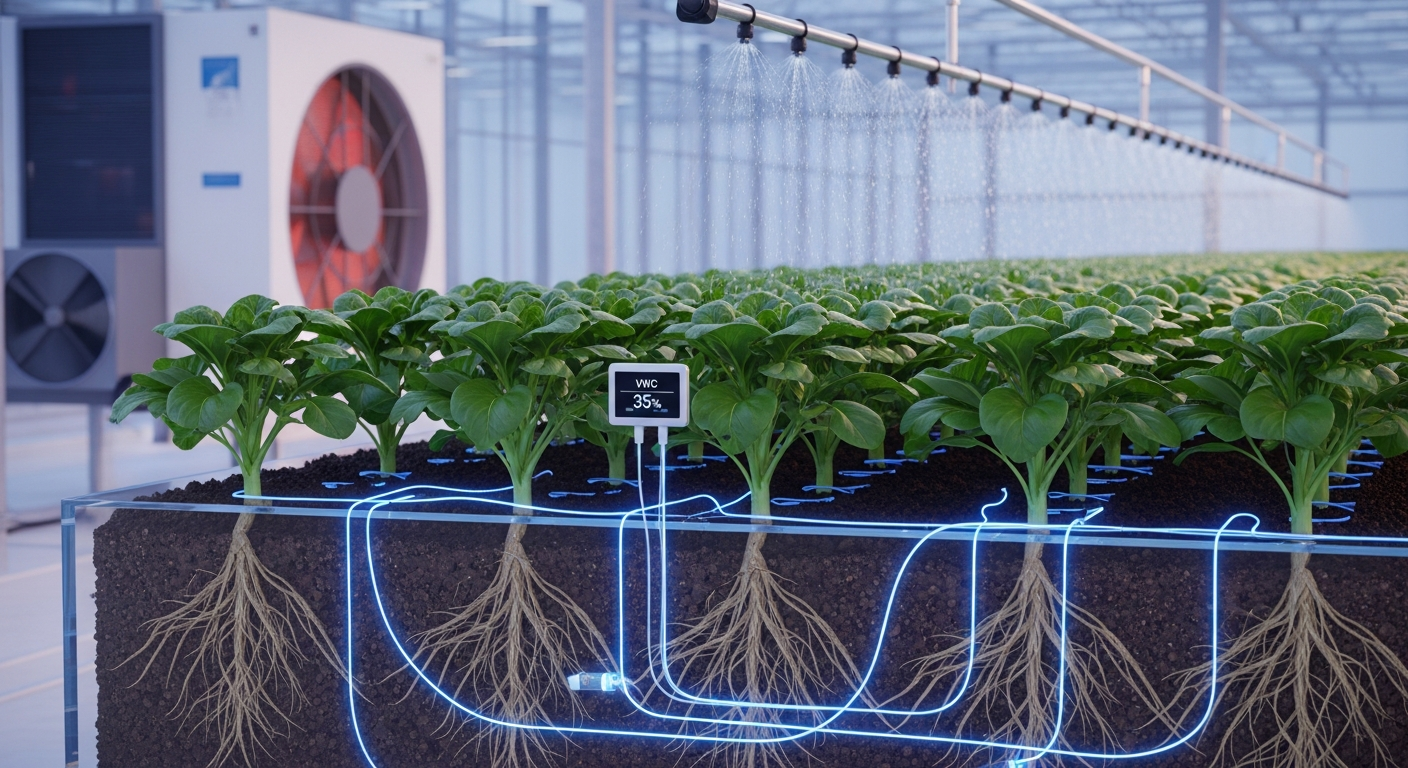
Traditional irrigation methods often relied on gravimetric water content (measuring water by weight), which required destructive sampling, or simply observing plant wilting and leaf color – indicators that often signify stress has already occurred. VWC, measured by modern soil moisture sensors or substrate moisture sensors, offers a real-time, non-destructive, and highly accurate snapshot of the moisture conditions in the root zone. This allows greenhouse growers to understand not just if their plants have water, but how much water, and whether it’s within the optimal range for their specific crop and growth stage. By understanding and actively monitoring VWC, you gain an unparalleled level of control over your irrigation strategy, moving from reactive watering to proactive precision irrigation.
Why VWC is a Game-Changer for Greenhouse Irrigation
Integrating VWC into your irrigation strategy offers a multitude of benefits that directly impact plant health, resource efficiency, and overall profitability. It’s not just about saving water; it’s about optimizing the entire growing environment.
- Optimized Plant Health and Growth: Overwatering suffocates roots, leading to anaerobic conditions, nutrient lockout, and an increased risk of root rot and fungal diseases. Underwatering, conversely, causes plant stress, stunted growth, and reduced yields. By maintaining VWC within the ideal range, plants experience consistent moisture availability, promoting robust root development, efficient nutrient uptake, and vigorous growth. This leads to healthier, more resilient plants and higher quality produce.
- Significant Water Conservation: One of the most immediate and tangible benefits of VWC-based irrigation is the reduction in water usage. Instead of irrigating on a fixed schedule or by guesswork, you only water when the VWC drops below a predetermined threshold. This eliminates unnecessary irrigation events, prevents runoff, and drastically reduces water waste, contributing to a more sustainable operation.
- Enhanced Nutrient Management: Over-irrigating not only wastes water but also leaches valuable nutrients out of the root zone. This means plants don’t receive the intended nutrition, and more fertilizer is required to compensate. Precision irrigation based on VWC ensures that water and dissolved nutrients remain available in the active root zone, improving nutrient uptake efficiency and reducing fertilizer costs and environmental impact.
- Disease Prevention: Consistent moisture levels, avoiding both extremes, significantly reduces the incidence of common greenhouse diseases. Root rot, powdery mildew, and other fungal issues often thrive in overly wet conditions or on stressed plants. Maintaining optimal VWC helps create an environment less conducive to these pathogens.
- Resource and Labor Efficiency: Automated VWC-triggered irrigation systems can reduce the labor required for manual watering and monitoring. Furthermore, by conserving water and nutrients, you’re also saving on associated energy costs for pumping and mixing. This frees up valuable time for growers to focus on other critical aspects of crop management.
- Data-Driven Decision Making: VWC sensors provide continuous data, allowing growers to track trends, identify anomalies, and refine their irrigation strategies over time. This data is invaluable for understanding how different environmental factors (light, temperature, humidity) impact water demand, enabling truly adaptive and intelligent irrigation.
Implementing VWC-Based Irrigation Triggers
Successfully integrating VWC into your greenhouse operation requires a systematic approach, from selecting the right hardware to defining your specific irrigation setpoints.
Choosing the Right VWC Sensors
The foundation of VWC precision irrigation lies in accurate and reliable sensors. There are generally two main types:
- Capacitance Sensors: These are the most common and cost-effective for greenhouse applications. They measure the dielectric permittivity of the growing medium, which changes with water content. They are generally robust and provide continuous readings.
- Time Domain Reflectometry (TDR) Sensors: While often more expensive, TDR sensors are known for their high accuracy and reliability, especially in challenging conditions. They measure the time it takes for an electromagnetic pulse to travel along a waveguide within the soil.
When choosing and placing sensors, consider:
- Substrate Type: Some sensors are better suited for specific substrates (e.g., rockwool, coco coir, soil). Ensure compatibility.
- Sensor Placement: Install sensors directly in the active root zone of representative plants. In larger greenhouses, strategically place multiple sensors to account for microclimates or variations in irrigation delivery. Avoid placing them near drippers or at the edge of containers where readings might not be representative.
- Calibration: While many sensors come factory-calibrated, field calibration can significantly improve accuracy for your specific substrate. Follow manufacturer guidelines for this crucial step.
Defining Your Irrigation Setpoints (Triggers)
This is where the art and science of VWC converge. You’ll need to define both a lower VWC threshold (the “refill point”) and, for some systems, an upper threshold (often related to runoff or drain-to-waste strategies). These setpoints are highly specific and depend on several factors:
- Plant Type and Growth Stage: Different crops have different water demands. Young seedlings require less water than mature fruiting plants. Research the specific VWC requirements for your chosen crop at various developmental stages.
- Substrate Type: Growing media vary widely in their water retention characteristics. Rockwool, for instance, holds water differently than peat or coco coir. Understand the water-holding capacity and air porosity of your substrate.
- Environmental Conditions: High light, high temperature, and low humidity will increase transpiration and thus water demand. Your VWC triggers may need to be dynamic or adjusted seasonably to account for these changes.
- Desired Drain-to-Waste Percentage (for hydroponics/soilless): In many soilless systems, a certain percentage of drainage is desired to prevent salt buildup and ensure fresh nutrient delivery. Your upper VWC threshold might trigger irrigation until a specific drain percentage is achieved.
Start with conservative VWC ranges and gradually adjust based on plant response and yield data. Observe how your plants react to different VWC levels and look for signs of stress or optimal vigor.
Integrating VWC Data with Irrigation Systems
Once you have VWC sensors providing data, the next step is to use that data to control your irrigation. This can range from simple manual intervention to fully automated systems:
- Manual Control with Data: Growers can monitor VWC readings from a display or app and manually trigger irrigation cycles when levels drop. This offers a stepping stone to automation.
- Automated Irrigation Controllers: Many modern irrigation controllers can directly integrate with VWC sensors. You program the controller with your desired VWC thresholds, and it automatically activates irrigation pumps and valves when necessary, shutting them off once the target VWC is reached.
- Smart Greenhouse Control Systems: For advanced operations, VWC data can be integrated into comprehensive greenhouse climate control systems. These systems can factor in not only VWC but also light intensity, temperature, humidity, and VPD (Vapor Pressure Deficit) to create highly sophisticated, predictive irrigation schedules.
Practical Tips for Maximizing VWC Precision
- Regular Sensor Maintenance: Periodically check sensors for physical damage, clean off any residue or algae buildup, and ensure they are securely placed in the substrate. Recalibrate if you suspect inaccuracies.
- Monitor Trends, Not Just Readings: Don’t just look at the current VWC number. Analyze how VWC changes throughout the day and night. A sharp, consistent drop indicates high plant water uptake, while a slow decline or plateau might suggest a problem or low demand.
- Integrate with Environmental Data: VWC doesn’t exist in a vacuum. Understand how light levels, temperature, humidity, and VPD influence your plants’ water usage. A comprehensive environmental monitoring system alongside VWC data provides the fullest picture.
- Start Simple, Then Optimize: If you’re new to VWC-based irrigation, begin with a single crop or section of your greenhouse. Learn the nuances of your system and plant responses before scaling up.
- Document Everything: Keep detailed records of your VWC setpoints, irrigation events, plant growth, and yields. This data will be invaluable for refining your strategy over time and achieving continuous improvement.
The Future of Precision Irrigation with VWC
The journey towards hyper-efficient greenhouse operations continues. The integration of VWC data with advanced analytics, artificial intelligence (AI), and machine learning is paving the way for even smarter irrigation systems. Imagine systems that not only react to current VWC levels but also predict future water demand based on weather forecasts, plant growth models, and historical data, automatically adjusting irrigation triggers to anticipate needs. This predictive capability, coupled with sophisticated robotics for individual plant care, will unlock unprecedented levels of resource efficiency and plant productivity.
Conclusion
Volumetric Water Content (VWC) is more than just a metric; it’s a cornerstone of modern, sustainable, and profitable greenhouse cultivation. By moving beyond traditional guesswork and embracing data-driven precision irrigation, growers can ensure optimal plant health, conserve precious water and nutrient resources, prevent diseases, and ultimately achieve higher yields and better quality produce. The initial investment in VWC sensors and automation pays dividends in the form of reduced operating costs, environmental stewardship, and a thriving crop. If you’re serious about taking your greenhouse operation to the next level of efficiency and control, making VWC the heart of your irrigation strategy is an indispensable step.