
The quest for the ideal greenhouse climate is a delicate dance between warmth and coolness, light and shade, and critically, humidity. Misting systems are powerful tools in a greenhouse grower’s arsenal, offering a highly effective way to combat rising temperatures. However, their use comes with a significant caveat: the potential for over-humidification, which can quickly turn a beneficial cooling strategy into a breeding ground for plant diseases and other issues. This article delves into the art and science of using misting systems to keep your greenhouse cool and comfortable for your plants, all while maintaining optimal humidity levels.
The Evaporative Cooling Principle: A Double-Edged Sword
At its core, a misting system cools a greenhouse through the principle of evaporative cooling. When tiny water droplets are introduced into the air, they absorb heat energy from the surrounding environment as they change from a liquid to a gaseous state (water vapor). This process, known as the latent heat of vaporization, effectively removes heat from the air, causing a noticeable drop in temperature.
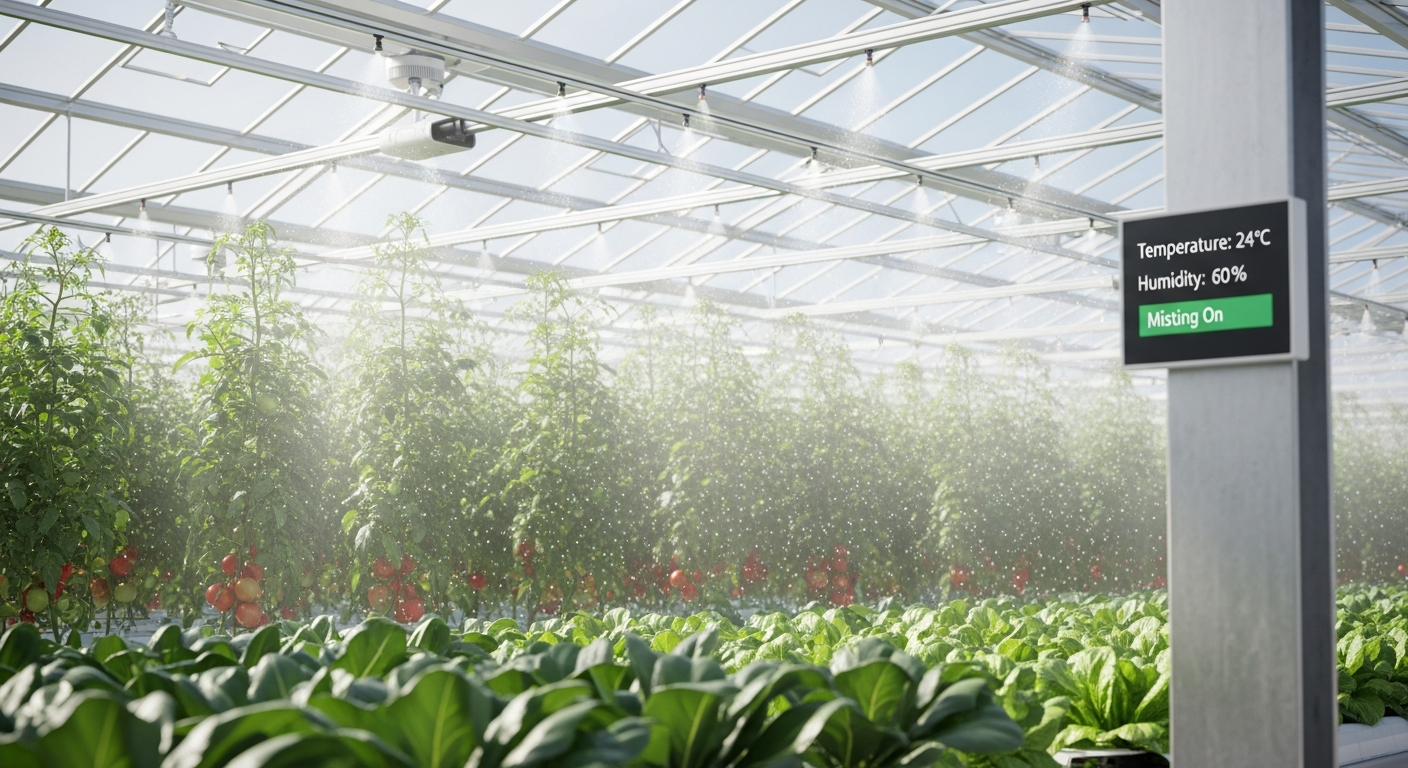
While this cooling effect is highly desirable, especially in hot climates, the byproduct of evaporation is increased relative humidity (RH). High humidity, if not managed correctly, can lead to several problems for your plants:
- Fungal and Bacterial Diseases: Many common greenhouse pathogens, such as botrytis, powdery mildew, and downy mildew, thrive in high-humidity environments where water can linger on leaf surfaces.
- Reduced Transpiration: Plants cool themselves and transport nutrients through transpiration, the process of releasing water vapor from their leaves. In highly humid air, the rate of transpiration slows down significantly because the air is already saturated with moisture, making it harder for plants to “breathe” and absorb nutrients.
- Pollen Viability: For fruiting plants, extremely high humidity can negatively impact pollen viability and fruit set, leading to poor yields.
- Nutrient Uptake Issues: When transpiration slows, the uptake of water and essential nutrients from the roots can also be impaired, potentially leading to nutrient deficiencies.
Therefore, the challenge is to harness the cooling power of misting systems without creating a muggy, unhealthy atmosphere for your valuable crops. The key lies in understanding the systems and implementing smart management strategies.
Choosing the Right Misting System for Humidity Control
Not all misting systems are created equal, especially when it comes to their impact on humidity and plant wetting. The primary differentiator is droplet size.
Low-Pressure Misting Systems
These are often the most accessible and budget-friendly options, typically connecting directly to a standard garden hose. They operate at pressures below 100 PSI (pounds per square inch) and produce larger water droplets, similar to a fine spray. While they can provide some cooling, their larger droplets are more prone to:
- Wetting Plant Surfaces: The larger droplets take longer to evaporate and can easily settle on leaves, creating ideal conditions for fungal growth.
- Inefficient Cooling: A significant portion of the water may not evaporate effectively into the air, leading to wasted water and less efficient cooling.
- Higher Localized Humidity: Areas directly beneath or near the misters can become excessively humid and damp.
For these reasons, low-pressure systems are generally not recommended for comprehensive greenhouse cooling where humidity control is paramount. They might be suitable for very temporary spot cooling in arid climates or for specific applications like propagation where high humidity is desired and controlled.
High-Pressure Fogging/Misting Systems
Operating at pressures ranging from 500 PSI to over 1,000 PSI, these systems are the workhorses for efficient greenhouse cooling. They use specialized nozzles to atomize water into incredibly fine particles, often referred to as “fog” or “dry fog,” with droplet sizes typically in the 10-25 micron range. The advantages include:
- Rapid Evaporation: The minute droplets evaporate almost instantly upon release, efficiently absorbing heat and dissipating into the air rather than settling on plants. This minimizes plant wetting.
- Superior Cooling: The rapid and complete evaporation provides more effective and uniform cooling throughout the greenhouse space.
- Better Humidity Control: While still increasing humidity, the rapid evaporation means the moisture is more evenly distributed and less likely to create localized zones of excessive saturation, especially when combined with good ventilation.
Ultrasonic Foggers
These systems use high-frequency sound waves to create an ultra-fine, cool mist without heat. They produce extremely small droplets (often less than 5 microns) and are excellent for precise humidity control, often used in propagation houses or for specific crops requiring very high, consistent humidity. While they can contribute to cooling, their primary role is typically humidification rather than bulk temperature reduction in large greenhouses, due to their lower output volumes compared to high-pressure nozzle systems.
Strategic Implementation: Cooling Without Soaking
Even with the best high-pressure system, strategic implementation is critical to prevent over-humidification. Here’s how to integrate your misting system effectively:
1. Optimal System Placement
The goal is to cool the air, not drench the plants. Misting lines should generally be installed overhead, allowing the fine mist to disperse and evaporate before reaching the canopy. Avoid placing nozzles directly above heat-sensitive plants or in areas where condensate might drip. For larger greenhouses, perimeter placement combined with good air circulation can also be effective, drawing cooler air inward.
2. Short, Frequent Cycles
Instead of running your misting system continuously, implement a cycle of short bursts. For example, a common cycle might be 30 seconds on, 5-10 minutes off, depending on ambient conditions and desired temperature/humidity. This allows the evaporated moisture to dissipate and ventilation systems to cycle out humid air before the next misting cycle begins. The aim is to introduce just enough mist to facilitate cooling without saturating the air.
3. Integrate with Ventilation
This is arguably the most crucial step. Misting systems should always be used in conjunction with a robust ventilation strategy. As the mist evaporates and increases humidity, exhaust fans and passive vents become essential for removing that humid air and drawing in drier, outdoor air. Effective air exchange prevents humidity buildup and ensures that the evaporative cooling process remains efficient.
- Exhaust Fans: Program them to activate simultaneously with or immediately after misting cycles to purge the humid air.
- Circulation Fans: Horizontal airflow (HAF) fans are vital for distributing the cool, humidified air evenly throughout the greenhouse, preventing stagnant, overly humid pockets and promoting uniform conditions.
4. Sensor-Based Automation
The most sophisticated and effective way to manage misting systems is through automation driven by environmental sensors:
- Thermostats: Set a temperature threshold to activate the misting system. For example, if the greenhouse temperature exceeds 80°F (27°C), the system turns on.
- Humidistats: Crucially, these sensors monitor relative humidity. Program your system to pause or stop misting if the RH climbs above a predefined limit (e.g., 70-80% for most crops). This prevents over-humidification.
- Timers: Even with sensors, timers can enforce the short-burst cycles, ensuring the system doesn’t run excessively.
An integrated climate controller that combines input from both temperature and humidity sensors offers the most precise control, ensuring cooling only occurs when needed and within acceptable humidity parameters.
5. Water Quality Matters
Poor water quality can lead to nozzle clogging, inconsistent misting, and mineral buildup on plants (calcium, magnesium). Consider filtering your water, especially if you have hard water, to ensure consistent performance and plant health. Reverse osmosis (RO) systems are often used for high-pressure fogging to prevent nozzle clogging and mineral spotting.
Advanced Monitoring and Techniques
For expert growers, delving deeper into environmental metrics can provide even finer control:
- Vapor Pressure Deficit (VPD): While relative humidity tells you how saturated the air is with water, VPD is a more nuanced metric that considers both air temperature and humidity to determine how “thirsty” the air is. It indicates the driving force for plant transpiration. Misting systems can be calibrated to maintain an optimal VPD range for specific crops, promoting healthy growth and preventing issues associated with excessively high or low humidity. A high VPD indicates dry air and rapid transpiration; a low VPD indicates humid air and slow transpiration. The goal is to keep VPD in the sweet spot for your plants.
- Dew Point Monitoring: The dew point is the temperature at which air becomes saturated with water vapor and condensation begins to form. Monitoring dew point can help predict when condensation might occur on plant surfaces, indicating a high risk of fungal diseases, and allow you to adjust your misting strategy proactively.
- Air Movement and Circulation: Beyond ventilation, internal air movement from circulation fans (HAF fans) is paramount. It homogenizes the air, distributes the cooled, humidified air evenly, prevents stagnant layers where humidity can build up, and helps prevent condensation on plant surfaces by constantly moving air over them.
Regular maintenance of your misting system, including cleaning nozzles and checking pump pressure, is also vital to ensure consistent performance and prevent issues.
Conclusion
Misting systems are an indispensable tool for cooling greenhouses, particularly in regions prone to high temperatures. However, mastering their use means understanding the delicate balance between effective cooling and preventing detrimental over-humidification. By selecting high-pressure systems that produce fine, quickly evaporating mist, strategically placing nozzles, implementing short and frequent misting cycles, and critically, integrating them with robust ventilation and automated controls driven by temperature and humidity sensors, growers can achieve optimal climatic conditions. For the truly dedicated, understanding concepts like VPD further refines this control. With careful planning and diligent management, your greenhouse can remain cool, comfortable, and healthy, even on the hottest days, ensuring your plants thrive without succumbing to the pitfalls of excess moisture.