
The dream of year-round greenhouse production often bumps up against a formidable foe: temperature control. While heating solutions for colder months are well-established, keeping greenhouses cool during scorching summers or even mild warm spells can be a complex, energy-intensive, and costly endeavor. Traditional cooling methods like evaporative pads, foggers, and extensive ventilation fans consume significant electricity and water, often struggling to maintain ideal conditions when the mercury truly soars. But what if there was a way to tap into the Earth’s own consistent temperature to create a perfectly balanced microclimate for your plants, regardless of the season outside? Enter geothermal cooling, a sustainable and highly efficient solution rapidly gaining traction in modern horticulture.
Geothermal cooling leverages the stable temperature of the earth a few feet below the surface – a temperature that remains relatively constant throughout the year, typically ranging between 45-75°F (7-24°C) depending on your geographical location. By harnessing this natural thermal reservoir, greenhouse operators can achieve remarkable energy savings, create optimal growing environments, and move closer to truly sustainable year-round production. This article will delve into the mechanisms, benefits, and practical considerations of integrating geothermal cooling into your greenhouse operations, unlocking the potential for a more stable, efficient, and environmentally friendly future.
Understanding Geothermal Cooling for Greenhouse Climates
At its core, geothermal cooling for greenhouses is about heat exchange. The principle is elegantly simple: the ground beneath our feet acts as a massive thermal battery, absorbing solar energy in summer and releasing latent heat in winter. Geothermal systems capitalize on this by circulating a heat-carrying fluid (usually water mixed with antifreeze) through a buried loop of pipes. In a cooling scenario, excess heat from the greenhouse air is absorbed by the fluid, which then carries it underground to dissipate into the cooler earth. The now-cooled fluid returns to the greenhouse, ready to absorb more heat, completing a continuous cycle.
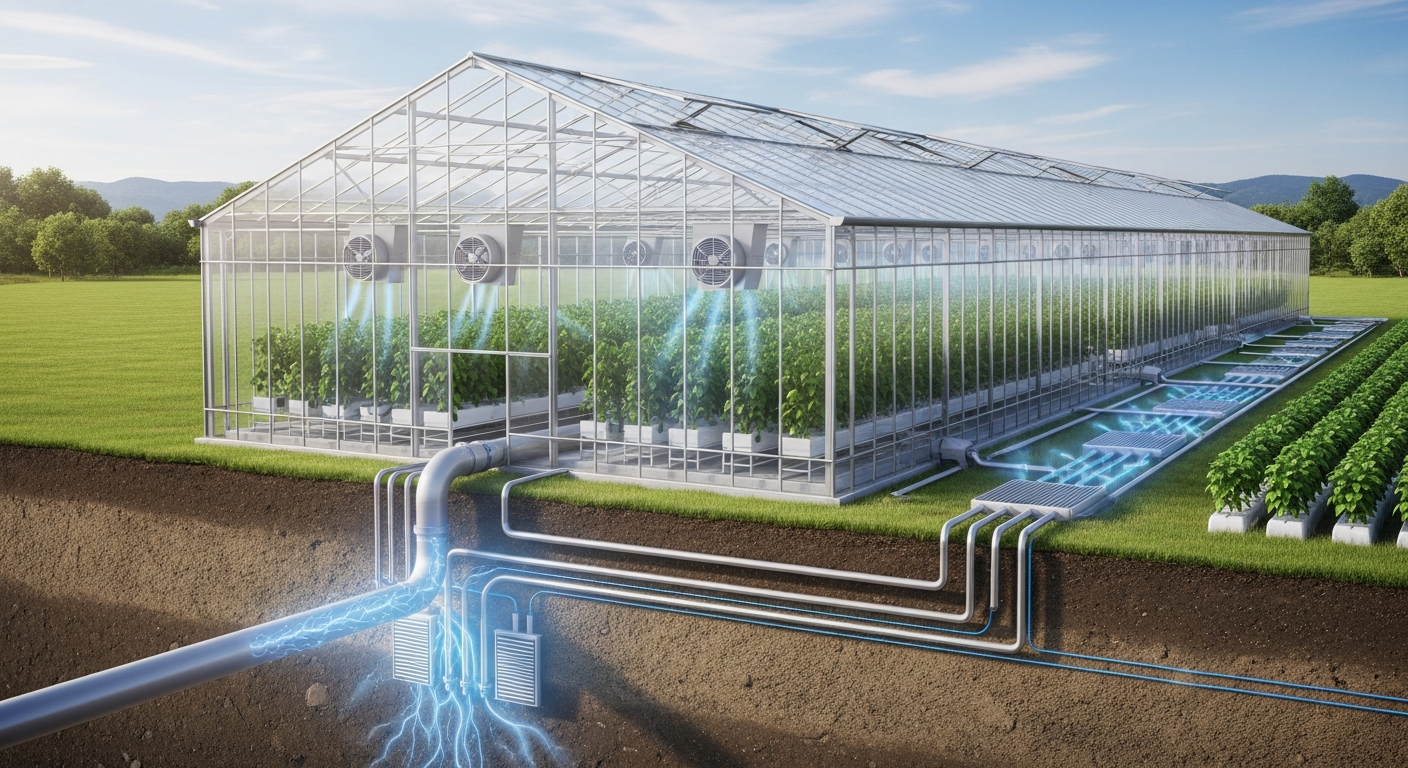
How Ground-Source Heat Pumps (GSHPs) Work for Cooling
- Heat Absorption: Air from the greenhouse is drawn into a heat pump unit.
- Refrigerant Cycle: Inside the heat pump, a refrigerant absorbs heat from the greenhouse air, causing it to evaporate into a gas.
- Heat Transfer to Ground Loop: This hot refrigerant gas is then compressed, increasing its temperature and pressure. It transfers its heat to the fluid circulating in the underground loop.
- Heat Dissipation: The fluid in the ground loop carries this heat deep into the earth, where the soil is significantly cooler than the greenhouse air. The earth absorbs the heat, cooling the fluid.
- Cooled Air Return: The now-cooler refrigerant condenses back into a liquid, and the chilled fluid from the ground loop helps cool the greenhouse air before it’s recirculated, providing efficient and consistent cooling.
This process is remarkably energy-efficient because the system only moves heat, rather than generating it. The stable subterranean temperatures provide an excellent “heat sink” in summer, allowing GSHPs to operate with significantly higher efficiency than conventional air conditioners or chillers that reject heat into warmer ambient air.
Key Advantages of Geothermal Cooling for Year-Round Greenhouse Production
The benefits of implementing geothermal cooling in your greenhouse extend beyond mere temperature regulation, impacting operational costs, plant health, and environmental stewardship.
Significant Energy Efficiency and Cost Savings
Perhaps the most compelling advantage is the drastic reduction in energy consumption. Ground-source heat pumps are typically 3-5 times more efficient than traditional cooling systems. While the initial installation cost for geothermal systems can be higher, the long-term operational savings on electricity bills are substantial. The return on investment (ROI) is often surprisingly quick, especially for commercial greenhouse operations with high energy demands for climate control. Many operations report savings of 50-70% on their cooling energy costs.
Stable and Consistent Climate Control
Geothermal systems excel at maintaining a remarkably consistent internal temperature. Unlike conventional systems that cycle on and off more frequently, leading to temperature fluctuations, geothermal provides a steady, gentle cooling effect. This stability reduces stress on plants, promotes more uniform growth, and can lead to higher yields and improved crop quality. Precision climate control is vital for sensitive crops, and geothermal offers an unparalleled level of consistency.
Environmental Sustainability and Reduced Carbon Footprint
By relying on the Earth’s natural thermal energy, geothermal cooling dramatically reduces a greenhouse’s carbon footprint. It minimizes the consumption of fossil fuels associated with electricity generation, contributing to a greener, more sustainable horticultural industry. Furthermore, these systems typically use environmentally friendly refrigerants and have a much longer lifespan than conventional HVAC equipment, reducing waste.
Enhanced Year-Round Cultivation Capabilities
For growers in regions with extreme summer heat, geothermal cooling can be a game-changer. It enables the cultivation of temperature-sensitive crops that might otherwise struggle or be impossible to grow profitably during the hottest months. This opens up new market opportunities and allows for continuous production cycles, maximizing the productivity and profitability of the greenhouse facility.
Reduced Maintenance and Extended Lifespan
The outdoor components of a geothermal system (the buried loops) are durable and protected from harsh weather, vandalism, and outdoor air conditions, meaning they can last for 50 years or more with minimal maintenance. The indoor heat pump components are also typically long-lasting (20-25 years), as they aren’t exposed to the same wear and tear as outdoor air conditioning units. This translates to lower maintenance costs and fewer disruptions to greenhouse operations over time.
Integrating Geothermal Systems: Practical Considerations for Greenhouses
While the benefits are clear, successfully implementing geothermal cooling requires careful planning and consideration.
Site Assessment and Geological Survey
The first step is a thorough site assessment. This includes understanding the soil composition, water table, and available land area for installing the ground loops. A professional geological survey can provide crucial data to design the most efficient and cost-effective system, whether vertical, horizontal, or pond loops are best suited for your site.
System Sizing and Design
Correctly sizing the geothermal system is paramount. An undersized system won’t provide adequate cooling, while an oversized one will be more expensive and less efficient. Factors like greenhouse size, glazing materials, insulation levels, desired internal temperature, and crop type all play a role in determining the cooling load. Work with experienced geothermal engineers who specialize in agricultural applications to ensure optimal design.
Integration with Existing Climate Control Systems
Geothermal cooling can work seamlessly alongside other greenhouse climate control technologies. It can pre-condition air for ventilation systems, reduce the load on supplemental evaporative coolers, or be combined with advanced humidity control systems. A hybrid approach often yields the best results, using geothermal as the primary, highly efficient cooling source, supplemented by other methods during peak demand or for fine-tuning specific zones.
Initial Investment vs. Long-Term ROI
The upfront cost of a geothermal system is often higher than conventional cooling systems due to the drilling or trenching required for ground loops. However, it’s crucial to evaluate this against the significantly lower operating costs over the system’s long lifespan. Factor in potential government incentives, tax credits, and rebates for renewable energy systems, which can further improve the ROI. Many systems pay for themselves within 5-10 years, offering decades of virtually free energy thereafter.
Professional Installation and Maintenance
Geothermal installation is a specialized field. Always use certified and experienced geothermal contractors to ensure the system is designed and installed correctly. While the buried components require little maintenance, the indoor heat pump unit will need periodic checks, filter changes, and professional servicing, similar to any HVAC system, to ensure continued optimal performance.
Practical Tip: Consider starting with an earth-tube system (also known as an earth-air heat exchanger) for passive cooling. These systems circulate greenhouse air through buried pipes, using the earth’s stable temperature to pre-cool incoming air. While less powerful than active GSHPs, they offer a low-cost, low-energy solution for reducing the overall cooling load, and can be a great first step or complement to a full geothermal heat pump system.
Conclusion
The journey towards truly sustainable and profitable year-round greenhouse production demands innovative solutions for climate control. Geothermal cooling stands out as a powerful, environmentally responsible, and economically intelligent investment for modern greenhouse operators. By harnessing the Earth’s constant thermal energy, growers can achieve unparalleled temperature stability, drastically reduce energy consumption and operating costs, and cultivate a wider array of crops with greater efficiency.
While the initial step requires careful planning and a professional approach, the long-term benefits of a geothermal system – from enhanced plant health and higher yields to a significantly reduced carbon footprint – make it an increasingly attractive and viable option for any greenhouse looking to thrive in the changing climate and competitive market. Embrace the power beneath your feet, and unlock a new era of stable, efficient, and sustainable greenhouse production.