
In the world of greenhouse cultivation, precise watering is not just a best practice; it’s an art and a science that directly impacts plant health, yield, and resource efficiency. While many growers rely on visual cues, calendar schedules, or even the tried-and-true “finger test,” these methods often fall short of providing the optimal hydration plants need to thrive. The secret to truly understanding your plants’ water needs lies in a concept called soil moisture tension. It’s a fundamental principle that, once grasped, unlocks the potential for vastly improved irrigation strategies, leading many savvy growers to consider the ultimate step in precision: automated watering systems based on real-time soil data.
What is Soil Moisture Tension and Why Does it Matter?
Soil moisture tension, also known as matric potential, is a critical measurement that describes how tightly soil holds onto water. Unlike simple volumetric soil moisture content (which tells you how much water is present), soil moisture tension tells you how available that water is to your plants. Think of it like this: a sponge can be full of water, but if you’re trying to suck water out of it with a straw, it’s much harder when the sponge is just damp compared to when it’s saturated and dripping. The “tension” is the suction force plants’ roots must exert to extract water from the soil.
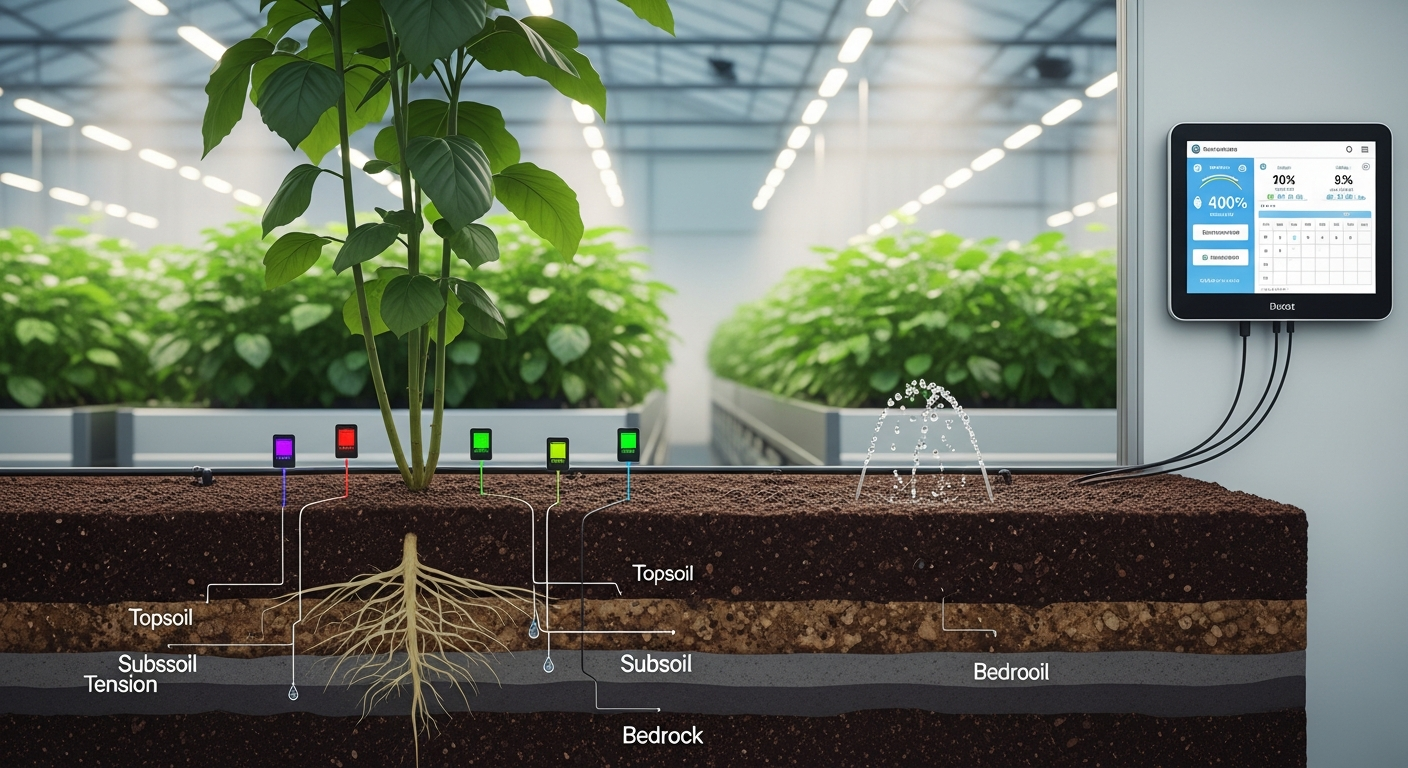
This measurement is typically expressed in units like kilopascals (kPa), centibars (cB), or bars. A lower number (closer to 0 kPa or cB) indicates that the soil is very wet, and water is easily available. As the soil dries out, the tension increases (e.g., 50 kPa, 100 kPa, 200 kPa), meaning the soil is holding onto its water more tightly, and plants have to work harder to get it. If the tension gets too high, plants enter a state of water stress, leading to reduced growth, wilting, and ultimately, severe damage or death.
Understanding soil moisture tension is paramount because:
- It reflects plant availability: It’s a direct indicator of how much effort a plant needs to expend to draw water.
- Prevents overwatering: Low tension (very wet soil) can lead to root rot, nutrient leaching, and oxygen deprivation in the root zone.
- Prevents underwatering: High tension (very dry soil) causes water stress, stunted growth, and reduced yields.
- Optimizes water use: By watering only when necessary based on tension, you conserve water, a precious resource.
- Improves nutrient uptake: Proper soil moisture tension ensures efficient transport of nutrients to the plant.
Measuring Soil Moisture Tension: Tools for Precision
While the “feel test” might give you a rough idea, modern greenhouse operations demand precision. Several tools are available to accurately measure soil moisture tension:
Tensiometers
These are perhaps the most direct way to measure soil moisture tension. A tensiometer consists of a porous ceramic cup filled with water, sealed to a vacuum gauge. When inserted into the soil, water moves in and out of the ceramic cup, equilibrating with the soil’s matric potential. The vacuum gauge then displays the tension. Tensiometers are highly accurate for measuring wet to moderately moist conditions (typically 0 to -80 kPa), making them ideal for many greenhouse crops that prefer consistently moist soil.
Granular Matrix Sensors (GMS)
Also known as gypsum blocks, these sensors consist of a block of gypsum, nylon, or a composite material with embedded electrodes. As the block absorbs or releases water to equilibrate with the surrounding soil, its electrical resistance changes. This change in resistance can be correlated to soil moisture tension. GMS are robust, less sensitive to salinity than some other sensors, and can measure a wider range of tensions (typically -30 to -200 kPa or more), making them suitable for crops that tolerate or even prefer drier conditions.
Capacitance/Dielectric Sensors (Indirect Correlation)
While capacitance and time-domain reflectometry (TDR) sensors primarily measure volumetric water content (VWC), some advanced models can be calibrated to infer soil moisture tension, especially when combined with soil-specific calibration curves. These sensors work by measuring the dielectric constant of the soil, which changes with water content. They offer real-time data, are often less affected by soil salinity than GMS, and can be integrated into automated systems easily.
Choosing the right sensor depends on your crop, budget, and desired level of precision. Regardless of the tool, consistent monitoring provides invaluable data for informed irrigation decisions.
Interpreting Readings for Optimal Plant Health
Once you have a sensor in place, the real power comes from understanding what the readings mean for your specific plants. There isn’t a universal “perfect” tension number, as it varies significantly based on:
- Plant Species: Desert cacti will tolerate much higher tensions than a moisture-loving fern.
- Growth Stage: Seedlings and young plants often require more consistent moisture (lower tension) than mature plants. Fruiting or flowering stages can also have critical hydration needs.
- Growing Medium: Soilless mixes (like coco coir or rockwool) have different water retention characteristics than traditional soil.
- Environmental Conditions: High temperatures and low humidity increase plant transpiration, requiring lower tension to prevent stress.
However, we can establish some general guidelines (values are illustrative and should be adjusted based on specific crop needs):
- 0 – 10 kPa (0-10 cB): Too Wet/Saturated. This range indicates over-saturation, leading to anaerobic conditions, root rot, and nutrient leaching. Generally, avoid prolonged periods in this range.
- 10 – 30 kPa (10-30 cB): Optimal Range for Many Crops. This is often the sweet spot where water is readily available, but the soil isn’t waterlogged. Plants can easily access water without expending excessive energy. Ideal for most vegetables, ornamentals, and young plants.
- 30 – 60 kPa (30-60 cB): Moderate Dryness. Some plants, particularly those adapted to slightly drier conditions or during specific growth stages (e.g., hardening off), might tolerate this range. However, for many crops, prolonged periods here might induce mild stress.
- 60 – 100+ kPa (60-100+ cB): Stress Point/Wilting. At these higher tensions, plants are working hard to extract water. Visible wilting may occur, growth will slow significantly, and productivity will decline. This is often the point at which irrigation should have already occurred.
Actionable Tip: The best approach is to establish a “refill point” (when to start watering) and a “shut-off point” (when to stop watering) for your specific crop and growing medium. Observe your plants’ behavior in relation to the tension readings. For example, if your tomatoes thrive with irrigation kicking in at 25 kPa and stopping at 10 kPa, you’ve found your sweet spot.
The Case for Automated Watering Based on Soil Moisture Tension
Manual watering, even with regular tension checks, requires significant labor and introduces potential for human error. This is where automated watering systems, especially those driven by soil moisture tension, shine. By connecting your soil moisture sensors to an irrigation controller, you can create a truly responsive watering system that mimics nature’s intelligence.
Key Benefits of Automation
- Precision and Consistency: Eliminates guesswork. Plants receive water exactly when they need it, not on an arbitrary schedule. This means no more overwatering on cool, cloudy days or underwatering during hot, sunny spells.
- Significant Water Savings: By watering only to the optimal tension, you avoid runoff and deep percolation, drastically reducing water consumption and utility costs.
- Nutrient Retention: Less overwatering means less leaching of valuable nutrients from the root zone, leading to healthier plants and reduced fertilizer waste.
- Optimized Plant Health and Yield: Consistent, optimal moisture levels prevent water stress, leading to stronger root development, more vigorous growth, and ultimately, higher yields and better quality produce.
- Reduced Labor Costs: Free up valuable time that would otherwise be spent on manual watering or checking soil conditions.
- Environmental Stewardship: Minimizing water and fertilizer use contributes to a more sustainable greenhouse operation.
Automated systems are particularly beneficial for larger greenhouse operations, high-value crops, or growers who manage multiple zones and want to ensure peak efficiency and plant performance around the clock.
Implementing an Automated System: Practical Steps
Ready to transition to a smarter watering strategy? Here’s how to get started:
- Assess Your Needs:
- What types of crops are you growing?
- What are your existing irrigation methods (drip, flood, overhead)?
- What is your budget for initial investment?
- Choose the Right Sensors: Based on your crop and desired tension range, select tensiometers, GMS, or calibrated VWC sensors. Consider the sensor’s longevity, accuracy, and compatibility with potential automation controllers.
- Strategic Sensor Placement:
- Place sensors in the active root zone of representative plants.
- If you have different crops or growing zones, use multiple sensors.
- Avoid placing sensors too close to emitters or at the edge of containers, which might give skewed readings.
- Select an Irrigation Controller: Look for smart controllers specifically designed for greenhouse environments. These can receive data from your soil moisture sensors and trigger irrigation cycles based on user-defined tension thresholds. Many modern controllers offer cloud-based monitoring and remote control via smartphone apps.
- Set Your Thresholds: This is the crucial step derived from your interpretation of tension readings. Program your controller to initiate irrigation when the tension reaches your “refill point” (e.g., 25 kPa) and to stop when it reaches your desired “shut-off point” (e.g., 10 kPa).
- Test and Calibrate: After installation, run tests. Monitor both the sensor readings and your plants’ responses. Adjust thresholds as needed. Periodically check and recalibrate sensors according to manufacturer instructions.
- Monitor and Optimize: Automation doesn’t mean “set it and forget it.” Regularly review historical data from your sensors and observe your plants. Fine-tune your thresholds as plants grow, seasons change, or you introduce new varieties.
By integrating soil moisture tension monitoring into an automated watering system, you’re not just watering; you’re providing precision hydration, creating an ideal growing environment where your plants can truly flourish.
Conclusion
Understanding soil moisture tension is a game-changer for any greenhouse grower. It moves watering from an art based on intuition to a science grounded in data, offering a clear window into your plants’ true hydration needs. When coupled with automated irrigation systems, this understanding transforms into unparalleled efficiency, leading to significant savings in water and labor, while simultaneously boosting plant health and overall productivity. Embracing soil moisture tension-based automation isn’t just an upgrade; it’s an investment in a more sustainable, profitable, and thriving greenhouse future.