
In an era where water conservation is paramount and agricultural efficiency dictates sustainability, understanding and optimizing soil moisture levels has become a critical endeavor. From commercial farms striving for maximum yield with minimal input to home gardeners aiming for healthier plants, precise knowledge of soil water content is the cornerstone of effective irrigation management. The advent of soil moisture sensors has revolutionized this field, offering real-time data that empowers informed decision-making. However, navigating the landscape of available technologies can be daunting. At the heart of advanced soil moisture monitoring are two prominent technologies: Time-Domain Reflectometry (TDR) and Capacitance (often referred to as Frequency Domain Reflectometry, or FDR) sensors. Both measure the dielectric properties of soil, but they achieve this through distinct methodologies, each presenting a unique set of advantages and considerations. This comprehensive guide will delve into the intricacies of TDR and Capacitance technologies, comparing their operational principles, performance characteristics, and practical applications to help you choose the best solution for your specific needs.
The Critical Role of Soil Moisture Monitoring in Modern Agriculture and Beyond
Soil moisture is arguably the most vital variable in terrestrial ecosystems, influencing everything from plant growth and nutrient uptake to hydrological cycles and climate regulation. For anyone involved in cultivating land or managing natural resources, knowing how much water is available in the soil is not just beneficial; it’s often essential for success and sustainability.
Why Monitor Soil Moisture?
- Optimized Irrigation Scheduling: The most significant benefit is preventing both over-irrigation and under-irrigation. Over-irrigation wastes precious water, leaches nutrients below the root zone, promotes disease, and can lead to waterlogging, depriving roots of oxygen. Under-irrigation, conversely, causes plant stress, reduces yield, and can ultimately lead to crop failure. Soil moisture sensors provide the data needed to apply water precisely when and where it’s needed, maximizing water use efficiency.
- Enhanced Crop Health and Yield: By maintaining optimal soil moisture levels, plants experience less stress, absorb nutrients more efficiently, and develop stronger root systems. This directly translates to healthier plants, improved fruit or grain quality, and significantly higher yields.
- Nutrient Management: Water is the medium through which plants absorb dissolved nutrients. Understanding soil moisture helps ensure that nutrients are available to the plants and are not washed away by excessive watering. It also guides fertilization timing.
- Environmental Stewardship: Reducing water waste lessens the strain on freshwater resources. By preventing runoff and deep percolation, soil moisture monitoring also minimizes the leaching of fertilizers and pesticides into groundwater and surface waters, protecting aquatic ecosystems.
- Cost Savings: Water and energy (for pumping) are significant expenses in agriculture. Precise irrigation based on sensor data can lead to substantial reductions in water consumption and energy bills, improving the economic viability of operations.
- Risk Management: In drought-prone areas or regions with strict water quotas, accurate soil moisture data is invaluable for managing water allocations effectively and making critical decisions during challenging periods.
Fundamentally, modern soil moisture sensors work by measuring the soil’s dielectric permittivity, also known as the dielectric constant. Water has a very high dielectric constant (around 80) compared to soil minerals (typically 2-5) and air (1). Therefore, the bulk dielectric permittivity of the soil is highly dependent on its volumetric water content (VWC). The higher the water content, the higher the dielectric permittivity. Both TDR and Capacitance technologies leverage this principle, but they differ in how they measure this electrical property.
Time-Domain Reflectometry (TDR): The Precision Standard
Time-Domain Reflectometry (TDR) is often considered the gold standard for accurate and reliable soil moisture measurement, particularly in scientific research and high-precision applications. It’s a robust technology that provides highly accurate data on soil volumetric water content (VWC).
How TDR Technology Works
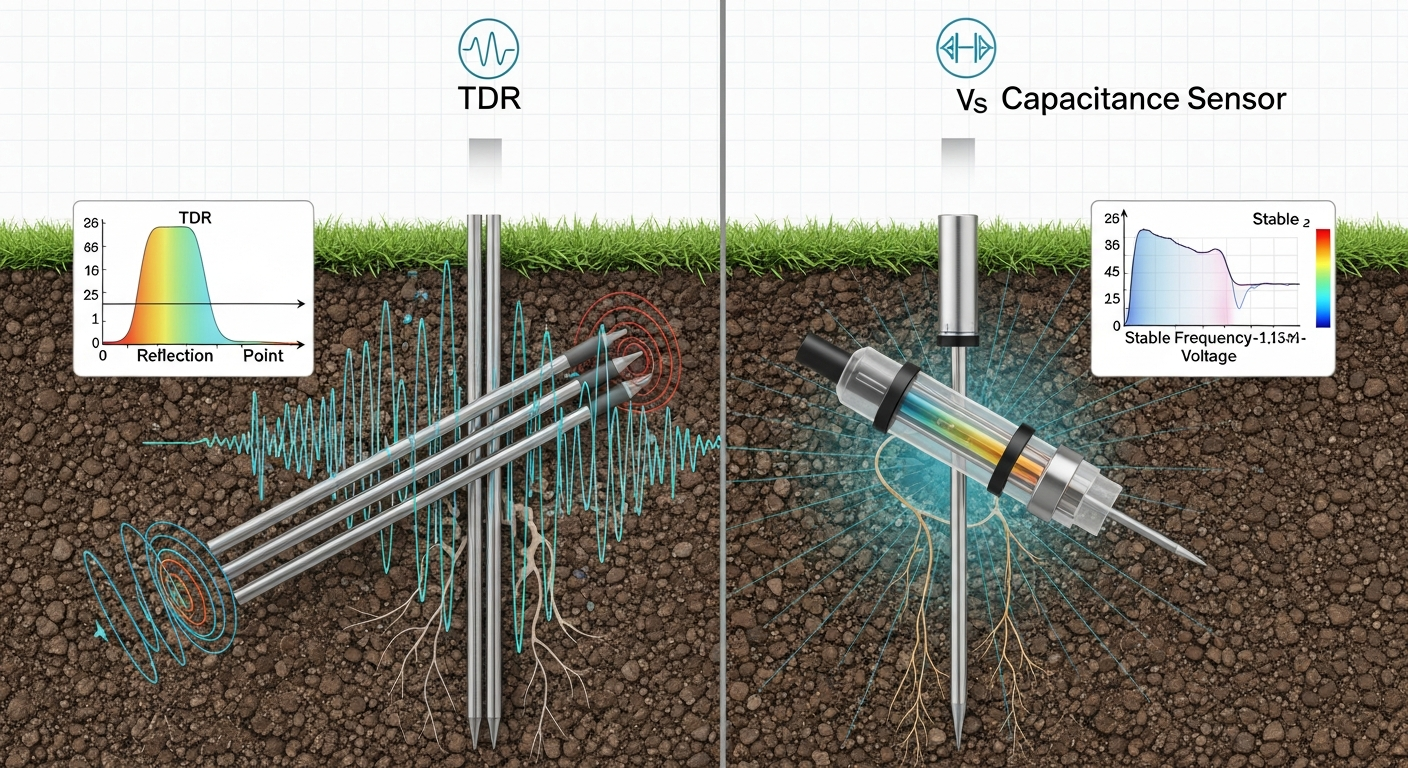
TDR sensors operate on a principle similar to radar or sonar. A TDR device sends a high-frequency electromagnetic pulse down a metallic waveguide (typically two or three parallel rods or probes) inserted into the soil. As the pulse travels along the rods, it encounters changes in the dielectric permittivity of the surrounding material – namely, the soil and its water content. When the pulse reaches the end of the rods, or a significant change in impedance, a portion of the pulse is reflected back to the sensor. The TDR instrument measures the time it takes for the pulse to travel down the rods and return (the "travel time").
The speed at which the electromagnetic pulse travels through the soil is inversely related to the square root of the soil’s dielectric permittivity. A higher water content means a higher dielectric permittivity, which slows down the pulse. By precisely measuring the travel time and knowing the physical length of the probes, the TDR sensor can calculate the apparent dielectric permittivity of the soil. This apparent dielectric permittivity is then converted into volumetric water content (VWC) using empirical or theoretical calibration equations, most commonly the Topp equation.
Advantages of TDR Sensors
- High Accuracy and Precision: TDR sensors are renowned for their superior accuracy and ability to provide highly precise measurements of VWC. This makes them ideal for research and applications where minute changes in soil moisture are critical.
- Minimal Sensitivity to Salinity: Unlike some other technologies, TDR measurements are relatively insensitive to variations in soil salinity (electrical conductivity, EC). While very high EC can attenuate the signal, TDR can often simultaneously measure bulk EC, providing valuable additional soil information.
- Temperature Stability: TDR measurements are generally stable across a wide range of soil temperatures, requiring minimal to no temperature compensation.
- Robust and Durable: TDR probes are typically constructed from sturdy materials, designed to withstand harsh field conditions and offer a long operational lifespan.
- Direct Measurement of Dielectric Permittivity: The measurement is a direct physical property of the soil, making it fundamental and reliable.
Disadvantages of TDR Sensors
- Higher Cost: TDR systems, particularly the readout units, are significantly more expensive than capacitance-based systems, making them less accessible for widespread commercial applications or small-scale operations.
- Complexity of Installation and Operation: Proper installation is crucial for accurate readings. This often involves careful insertion of the probes to ensure good contact with the soil and minimize air gaps. The equipment itself can be more complex to operate and requires a deeper understanding of the technology.
- Larger Physical Footprint: TDR probes can be relatively bulky, making them less discreet or suitable for shallow soil layers without disturbing the root zone.
- Requires Specialized Data Loggers: Often, TDR sensors require proprietary or specialized data loggers capable of handling their specific signal output, which adds to the overall system cost.
Applications of TDR Sensors
TDR technology is predominantly used in:
- Agricultural Research: For precise studies on water-crop relationships, irrigation efficiency, and hydrological modeling.
- Environmental Monitoring: In hydrology, forestry, and ecological studies to track soil water dynamics in natural ecosystems.
- Geotechnical Engineering: For monitoring soil stability, landslide prediction, and infrastructure projects.
- High-Value Crop Production: Where the cost of the sensor is justified by the value of the crop and the need for extremely precise water management (e.g., vineyards, orchards, nurseries).
Practical Tip: When installing TDR probes, ensure excellent soil-to-probe contact. This often means creating a pilot hole slightly smaller than the probe diameter and gently tapping the probes in, or digging a trench and carefully backfilling around horizontally inserted probes to minimize air pockets. Any air gaps will significantly skew readings.
Capacitance Sensors (Frequency Domain Reflectometry – FDR): Versatility and Accessibility
Capacitance sensors, often broadly categorized under Frequency Domain Reflectometry (FDR) technology, represent a more widely adopted and often more cost-effective solution for soil moisture monitoring. They offer a good balance of accuracy, ease of use, and affordability, making them popular across various applications from commercial agriculture to smart home gardening systems.
How Capacitance Technology Works
Capacitance sensors operate by generating an oscillating electromagnetic field and measuring how that field is affected by the surrounding soil. The sensor typically consists of a pair of electrodes or a circuit board printed with traces that act as a capacitor. When the sensor is embedded in the soil, the soil (and its water content) becomes part of the dielectric material between the capacitor’s plates.
As the volumetric water content of the soil changes, its dielectric permittivity changes, which in turn alters the capacitance of the sensor. The sensor measures this change in capacitance (or the frequency shift of an oscillating circuit), and this measurement is then correlated to the soil’s dielectric permittivity. Similar to TDR, this dielectric permittivity value is then converted into volumetric water content (VWC) using an internal calibration curve.
Modern capacitance sensors vary widely in design and sophistication. Some are simple, single-point probes, while others are multi-depth probes with multiple sensing rings or sections along their length, allowing for soil moisture profiling at different depths.
Advantages of Capacitance Sensors
- Affordability: Generally, capacitance sensors are significantly less expensive than TDR systems, making them a more feasible option for large-scale deployments, multiple monitoring sites, or budget-conscious users.
- Ease of Installation: Most capacitance sensors are relatively easy to install. Many are designed as simple probes that can be pushed or buried into the soil without requiring specialized tools or complex procedures.
- Smaller Physical Footprint: Many capacitance probes are slender and compact, making them less intrusive and suitable for various applications, including container gardening or sensitive root zones.
- Continuous Monitoring: They are well-suited for continuous data logging and integration with automated irrigation systems due to their relatively low power consumption and straightforward output.
- Wide Range of Applications: From precision agriculture fields to residential gardens, greenhouses, and landscape management, their versatility is a major advantage.
Disadvantages of Capacitance Sensors
- Sensitivity to Soil Salinity and Temperature: Depending on the sensor’s design and quality, capacitance measurements can be more susceptible to variations in soil electrical conductivity (salinity) and temperature compared to TDR. Higher salinity can lead to overestimation of VWC if not compensated for.
- Calibration Requirements: While many come with factory calibrations for common soil types, achieving the highest accuracy often requires soil-specific calibration, especially for unusual or highly variable soil compositions. Without proper calibration, accuracy can be lower than TDR.
- Accuracy Variability: The accuracy of capacitance sensors can vary significantly between different manufacturers and models. Cheaper sensors may offer less consistent readings.
- Installation Quality is Still Important: Although easier to install than TDR, ensuring good contact between the sensor and the soil is still critical to avoid air gaps that can lead to inaccurate readings.
Applications of Capacitance Sensors
Capacitance technology finds widespread use in:
- Commercial Agriculture: For general irrigation scheduling in row crops, orchards, and vineyards, where a balance of cost and performance is needed.
- Landscape and Turf Management: For optimizing irrigation in parks, golf courses, sports fields, and residential landscapes.
- Greenhouse and Nursery Operations: Monitoring soil moisture in pots, grow bags, and hydroponic substrates.
- Home Gardening and Smart Irrigation Systems: Integrated into automated systems to water plants only when necessary.
- Entry-Level Research and Educational Purposes: Providing valuable data without the prohibitive cost of TDR systems.
Practical Tip: When selecting a capacitance sensor, check if it offers temperature and salinity compensation. For optimal accuracy, consider performing a simple soil-specific calibration if your soil type is unusual or if highly precise measurements are required. Always ensure the sensor is firmly inserted into the soil with no air pockets around the sensing area.
TDR vs. Capacitance: Making the Informed Choice
Choosing between TDR and Capacitance technologies involves weighing several factors, including your budget, the required level of accuracy, the specific application, and the complexity of operation you are willing to undertake. Both are effective at measuring soil moisture, but they excel in different scenarios.
Key Comparison Points
| Feature | Time-Domain Reflectometry (TDR) | Capacitance (FDR) Sensors |
|---|---|---|
| Measurement Principle | Measures travel time of an electromagnetic pulse. | Measures capacitance/frequency shift of an oscillating electric field. |
| Accuracy | Generally considered the highest accuracy and precision. | Good to very good accuracy; can be high with proper calibration. |
| Cost | Higher initial investment for hardware and readout units. | More affordable, suitable for widespread deployment. |
| Sensitivity to Salinity (EC) | Relatively insensitive; can measure EC simultaneously. | Can be more sensitive; quality sensors include compensation. |
| Sensitivity to Temperature | Very stable; minimal temperature effect. | Can be affected; quality sensors include compensation. |
| Installation Complexity | More demanding; requires careful insertion to avoid air gaps. | Easier and quicker to install. |
| Footprint | Often larger and more robust probes. | Generally smaller, more compact, and less intrusive. |
| Data Logging | Often requires specialized or proprietary loggers. | Compatible with a wide range of standard data loggers. |
| Typical Applications | Scientific research, high-value crops, critical monitoring. | General agriculture, landscaping, smart irrigation, widespread networks. |
When to Choose TDR
- Research and Scientific Applications: When the highest possible accuracy and reliability are paramount for precise experimental results.
- High-Value Crops: For crops where even minor water stress can lead to significant financial losses, justifying the investment.
- Complex Soil Conditions: If you need to monitor soil electrical conductivity (salinity) simultaneously or in environments with highly variable soil properties where TDR’s robustness is an advantage.
- Long-Term, Stable Monitoring: For installations where long-term stability and minimal drift are critical.
When to Choose Capacitance Sensors
- Budget Constraints: When cost-effectiveness is a primary concern, especially for large areas requiring many sensors.
- Widespread Deployment: Ideal for establishing dense networks of sensors across fields or landscapes.
- Ease of Use: For users who prefer simpler installation and integration with common data logging or irrigation control systems.
- General Irrigation Management: For most agricultural and landscape applications where good accuracy is sufficient to guide irrigation decisions.
- Multi-Depth Profiling: Many capacitance sensors offer multi-depth measurement capabilities in a single probe, providing valuable soil moisture profiles.
It’s worth noting that the performance gap between high-end capacitance sensors and TDR has narrowed considerably in recent years. Many modern capacitance probes from reputable manufacturers offer excellent accuracy, temperature stability, and even salinity compensation, providing TDR-like performance at a more accessible price point.
Essential Considerations for Effective Soil Moisture Monitoring
Beyond choosing the right technology, the success of your soil moisture monitoring program hinges on several practical considerations.
1. Site Selection and Sensor Placement
The location of your sensors is critical. Place them in areas representative of the overall field or management zone, away from compacted areas, edges, or anomalies. For crop fields, sensors should be placed within the root zone, typically at multiple depths (e.g., shallow, mid-root zone, deep) to understand water uptake patterns and potential leaching. Consider soil variability; you may need multiple sensors even within a small area if soil types differ significantly.
2. Installation Best Practices
Regardless of technology, proper installation is non-negotiable for accurate readings.
- Good Soil Contact: The most crucial aspect. Air gaps around the sensor or probes will cause erroneous low readings because air has a very low dielectric constant. Use a pilot hole, slurry, or careful backfilling.
- Vertical vs. Horizontal: Most sensors are designed for vertical installation. Multi-depth sensors are almost always vertical. For specific research, horizontal installation might be used but requires greater care.
- Cable Protection: Bury cables to protect them from wildlife, machinery, and UV degradation. Use conduit where necessary.
- Sensor Depth: Ensure sensors are placed at depths relevant to your crop’s root zone. For trees, this might be much deeper than for annual vegetables.
3. Calibration and Data Interpretation
- Factory vs. Field Calibration: Many sensors come factory-calibrated for general soil types. For the highest accuracy, especially with unique or highly variable soils, consider a soil-specific calibration. This involves taking gravimetric soil moisture samples at the sensor location and correlating them with sensor readings.
- Understanding Soil Water Characteristics: To make sense of the data, you need to understand your soil’s properties, particularly its field capacity (the maximum amount of water soil can hold against gravity) and permanent wilting point (the moisture level at which plants can no longer extract water). Sensor readings should be interpreted relative to these thresholds.
- Root Zone Depletion: Monitor the depletion of soil moisture within the effective root zone. Irrigation should be triggered before the soil moisture drops below a critical threshold (management allowable depletion) that would cause plant stress.
4. Data Logging and Integration
Modern soil moisture sensors are typically connected to data loggers that record measurements over time. These loggers can range from simple handheld devices to sophisticated, internet-connected systems that upload data to cloud platforms.
- Real-time Access: Cloud-based systems offer remote, real-time access to data, allowing for timely irrigation decisions from anywhere.
- Automated Irrigation: Integrate sensors with smart irrigation controllers to automate watering based on actual soil moisture levels, removing guesswork.
- Data Visualization: Utilize platforms that provide clear graphs and alerts to easily visualize soil moisture trends and identify irrigation needs.
5. Maintenance and Longevity
While generally robust, sensors require some maintenance.
- Regular Checks: Periodically check connections, cables, and the physical integrity of the sensors.
- Cleaning: If removed, clean sensors of soil residue before reinstallation or storage.
- Calibration Check: Over time, sensor readings can drift. Occasional checks against gravimetric samples can confirm continued accuracy.
Actionable Advice: Start small. Begin by deploying a few sensors in critical or representative areas. Learn how your soil responds to irrigation and precipitation, and how your plants react. Gradually expand your network as you gain confidence and understanding. Combine sensor data with visual observations of plant health and weather forecasts for the most holistic approach to water management.
Conclusion
The ability to accurately monitor soil moisture content is a transformative tool for anyone dedicated to efficient water use and optimal plant health. Both Time-Domain Reflectometry (TDR) and Capacitance (FDR) sensors offer sophisticated means to achieve this, fundamentally by measuring the soil’s dielectric permittivity. TDR stands as the paragon of precision, favored in research and high-stakes applications due to its superior accuracy, minimal sensitivity to salinity and temperature, and robust construction. However, its higher cost and installation complexity can be prohibitive for widespread use. Capacitance sensors, on the other hand, shine in their versatility, affordability, and ease of installation, making them the go-to choice for commercial agriculture, landscaping, and automated irrigation systems. While historically less accurate than TDR, modern capacitance sensors have significantly closed this gap, offering excellent performance for most practical applications.
The decision between TDR and Capacitance technology ultimately hinges on a careful evaluation of your specific requirements, including budget, desired accuracy level, the scale of your operation, and the complexity of your soil environment. Regardless of the technology chosen, meticulous installation, proper calibration, and intelligent interpretation of data are crucial for maximizing the benefits of soil moisture monitoring. By embracing these powerful tools, we can collectively move towards more sustainable, efficient, and productive water management practices, ensuring healthy plants and a greener future.