
In today’s interconnected world, lighting is no longer just about flicking a switch. Modern spaces, from smart homes to sprawling commercial complexes, leverage sophisticated automation systems to enhance energy efficiency, convenience, and occupant comfort. At the heart of many such systems lie two fundamental, yet often misunderstood, electrical components: relay switches and contactors. While both serve the crucial function of remotely controlling electrical circuits, understanding their distinct characteristics and optimal applications is key to designing a robust and effective lighting automation strategy. This article will delve into the world of relays and contactors, illuminating their roles in intelligent lighting control and guiding you toward making informed decisions for your next automation project.
The Core of Remote Control: Understanding Electromechanical Switches
Before we differentiate between relays and contactors, it’s essential to grasp the concept of an electromechanical switch. Simply put, these devices use a small electrical current to control a much larger one. This allows for remote operation, automation, and the isolation of control circuits from high-power loads, enhancing safety and flexibility. Both relays and contactors operate on the principle of electromagnetism: when a current flows through a coil, it creates a magnetic field that attracts a movable armature, which in turn opens or closes electrical contacts.
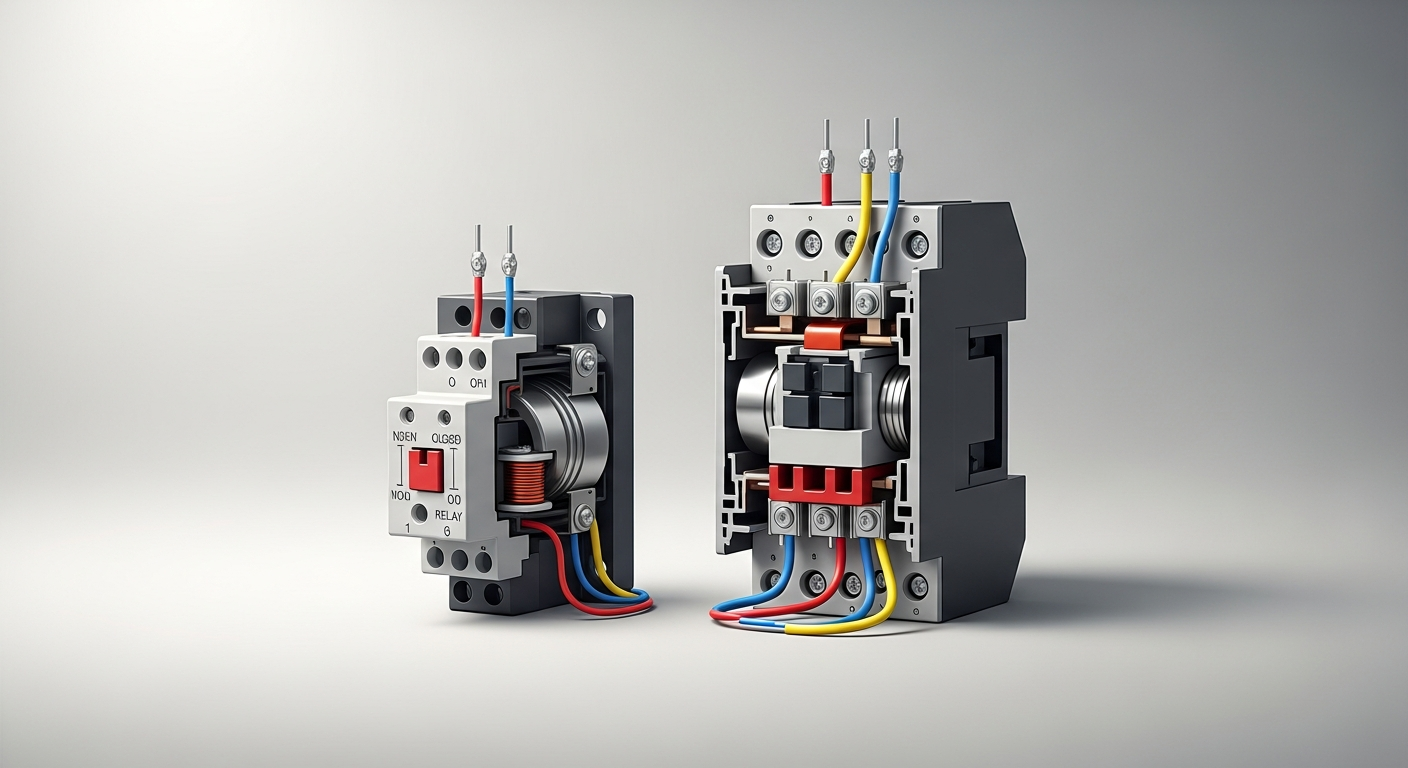
What is a Relay Switch?
A relay switch, often simply called a relay, is an electrically operated switch. It typically consists of an electromagnet, an armature, a spring, and a set of electrical contacts. When current flows through the electromagnet’s coil (the control circuit), it generates a magnetic field that pulls the armature, causing the contacts to change state (either opening a normally closed circuit or closing a normally open one). When the current stops, the spring returns the armature to its original position.
- Key Characteristics:
- Low Current Capacity: Relays are generally designed for switching lower currents, typically up to 10-20 amps, though specialized versions can handle more.
- Compact Size: Their smaller footprint makes them ideal for integration into printed circuit boards (PCBs) or compact control panels.
- Fast Switching: They can operate quickly, making them suitable for rapid control applications.
- Diverse Contact Configurations: Available in various forms, such as SPST (Single Pole, Single Throw), DPDT (Double Pole, Double Throw), allowing for versatile control schemes.
- Applications in Lighting Automation:
- Individual Fixture Control: Switching individual LED drivers or fluorescent ballasts.
- Zone Control: Activating small groups of lights in a specific area, like a single office or a corridor section.
- Signal Routing: Acting as an interface between low-voltage control systems (e.g., smart home hubs, occupancy sensors) and the higher voltage lighting circuits.
- Logic Functions: Used in more complex control systems to implement logical “AND,” “OR,” or “NOT” functions for lighting sequences.
What is a Contactor?
A contactor is essentially a heavy-duty relay, specifically designed for high current applications. While sharing the same fundamental operating principle as a relay, contactors are built to handle significantly larger electrical loads, often involving industrial motors or extensive lighting banks. They are robust, built for durability, and typically feature arc suppression measures due to the higher currents they interrupt.
- Key Characteristics:
- High Current Capacity: Contactors are rated for switching currents from tens to thousands of amps, making them suitable for large-scale power distribution.
- Robust Construction: Built with more substantial contacts, stronger springs, and often features like arc chutes to safely dissipate electrical arcs when contacts open under load.
- Multi-Pole Design: Commonly available with multiple power poles (e.g., 3-pole for 3-phase power, or multi-pole for switching multiple lighting circuits simultaneously).
- Auxiliary Contacts: Often include smaller auxiliary contacts for signaling and interlocking with other control devices.
- Applications in Lighting Automation:
- Main Circuit Switching: Turning entire floors of lighting on or off, such as in large office buildings, warehouses, or retail spaces.
- Outdoor Lighting Control: Automating parking lot lights, streetlights, or façade lighting.
- High-Wattage Fixtures: Controlling large banks of high-intensity discharge (HID) lamps or powerful LED floodlights.
- Building Management System (BMS) Integration: Serving as the power switching interface for centralized building automation systems that control lighting across vast areas.
Relay Switches in Modern Lighting Automation Strategies
For many smaller or more granular lighting automation tasks, relays are the workhorses. Their versatility and compact size make them indispensable. Consider a modern office setup where individual desks have task lighting, and overhead lighting is divided into smaller zones. Relays excel in providing precise control over these smaller segments.
Practical Applications and Advantages:
- Granular Zone Control: A series of relays can manage different lighting zones within a single room based on occupancy, daylight harvesting, or scheduled events. For instance, a meeting room might have three distinct lighting zones, each controlled by a separate relay triggered by a central control panel or smart sensor.
- Interface with Sensors: Occupancy sensors, photocells, and even smart home voice assistants typically output low-voltage signals. Relays serve as the perfect bridge, translating these signals into on/off commands for higher voltage lighting circuits.
- Cost-Effective for Smaller Loads: For circuits drawing less than 15-20 amps, relays offer a more economical solution compared to larger contactors, without sacrificing performance.
- Integration with DALI and 0-10V Dimming: While relays primarily offer on/off control, they can be integrated into systems that also feature dimming. For example, a relay might switch the power to a bank of DALI-controlled luminaires, with the dimming functionality handled by the DALI bus itself.
Tip: When selecting relays for LED lighting, ensure they are rated for the inrush current of the LED drivers. LED power supplies can draw significant inrush currents when first energized, which can prematurely wear out standard relay contacts not designed for such transients.
Contactors: The Backbone of Large-Scale Lighting Control
When the scale of automation grows from rooms to entire buildings or expansive outdoor areas, contactors become indispensable. Their ability to handle substantial electrical loads reliably ensures that large lighting installations operate efficiently and safely.
Practical Applications and Considerations:
- Centralized Control of Main Lighting Panels: In commercial or industrial settings, a single contactor can switch the entire lighting circuit of a floor or a specific area like a parking garage. This allows for scheduled on/off times, emergency shutdown capabilities, or integration with a central BMS.
- Managing High-Wattage Exterior Lighting: Streetlights, stadium lights, or large architectural floodlights consume significant power. Contactors are essential for safely controlling these heavy loads, often on a timed schedule or based on ambient light levels.
- Durability and Longevity: Built for demanding environments, contactors offer exceptional durability and a long operational lifespan, even under frequent switching cycles, making them a wise investment for critical infrastructure.
- Safety and Arc Suppression: Due to the high currents involved, contactors are designed with robust contact materials and often incorporate arc chutes to quickly extinguish the electrical arc formed when contacts open, preventing damage and improving safety.
Tip: When installing contactors, consider their inherent audible “hum” when energized. In noise-sensitive environments like quiet offices or residential areas, choosing “silent” or “low-noise” contactors designed with DC coils or specific dampening features can be crucial. Proper mounting within an insulated enclosure can also help mitigate noise.
Choosing Between Relays and Contactors for Your Lighting Project
The decision to use a relay, a contactor, or a combination of both hinges on several critical factors. A thoughtful analysis of your project’s specific requirements will lead to the most efficient and reliable lighting automation system.
Key Decision Factors:
- Current and Voltage Rating: This is the most crucial factor. If your total lighting load exceeds what a standard relay can safely handle (e.g., above 20 amps, or for higher voltage three-phase circuits), a contactor is mandatory. Always provide a safety margin; don’t push a device to its absolute limit.
- Load Type: While most modern lighting (especially LED) presents a predominantly resistive or slightly capacitive load, some older systems or very large LED drivers might have specific inrush current characteristics. Ensure the selected device can handle these transient currents.
- Number of Poles: Do you need to switch a single phase, multiple phases, or multiple independent circuits? Relays are available in various pole configurations, but contactors often provide more robust multi-pole options for higher power circuits.
- Physical Size and Space Constraints: Relays are smaller and can fit into tighter spaces or on PCBs. Contactors are larger and require more dedicated panel space.
- Cost: Generally, relays are less expensive than contactors. For smaller, distributed loads, using multiple relays might be more cost-effective than a single large contactor and extensive wiring.
- Noise Sensitivity: As mentioned, contactors can produce an audible hum. If the automation is for a quiet environment, a silent contactor or opting for relays might be necessary.
- Control Circuit Voltage: Both relays and contactors are available with various coil voltages (e.g., 12V DC, 24V AC/DC, 120V AC, 230V AC). Ensure the coil voltage matches your control system’s output.
- Frequency of Switching: While both are designed for switching, contactors are generally built for higher endurance and more frequent operation under heavy loads.
Practical Tip for Hybrid Systems: In many advanced lighting automation systems, relays and contactors work in tandem. A low-voltage control system (e.g., a smart home hub or a BMS controller) might use its internal relays or small external relays to switch the coil of a larger contactor. This allows the sophisticated low-voltage system to safely and effectively control high-power lighting circuits without direct exposure to high currents.
Conclusion
Relay switches and contactors are indispensable components in the realm of lighting automation. While they both facilitate remote electrical switching, their distinct current handling capacities, physical sizes, and robust designs dictate their optimal applications. Relays offer granular, cost-effective control for smaller loads and serve as vital interfaces for low-voltage systems. Contactors, on the other hand, are the powerful heavy-lifters, essential for safely managing extensive, high-current lighting installations in commercial and industrial environments. By carefully considering the specific demands of your lighting project—from current ratings and load types to space and noise constraints—you can strategically integrate these electromechanical marvels, creating an efficient, safe, and intelligent lighting system that stands the test of time. Embracing the right switching technology is a fundamental step towards achieving truly smart and responsive lighting environments.