
In the intricate world of controlled environment agriculture, mastering the subtleties of your greenhouse climate is paramount for thriving plants and abundant harvests. While temperature often takes center stage, another crucial environmental factor, humidity, quietly dictates everything from nutrient uptake to disease resistance. Yet, for many growers, the concept of humidity remains shrouded in a fog of misunderstanding, particularly when distinguishing between absolute humidity and relative humidity. Understanding the difference isn’t just academic; it’s the key to unlocking superior plant health and maximizing your greenhouse’s potential. Let’s pull back the curtain on these vital metrics and discover why one offers a far more accurate picture for your precious plants.
The Basics: What is Humidity?
At its core, humidity refers to the amount of water vapor present in the air. This invisible moisture plays a critical role in almost every biological process within your greenhouse. For plants, humidity directly influences transpiration – the process by which water vapor escapes from the leaves into the atmosphere. Transpiration is not merely evaporation; it’s the engine that pulls water and dissolved nutrients from the roots up through the plant, much like a straw. An optimal humidity level facilitates healthy transpiration, ensuring nutrient delivery and cooling the plant. Too little humidity, and plants struggle to transport water, leading to stress; too much, and they can’t transpire efficiently, increasing disease risk and hindering nutrient uptake.
Unpacking Relative Humidity (RH)
Defining Relative Humidity
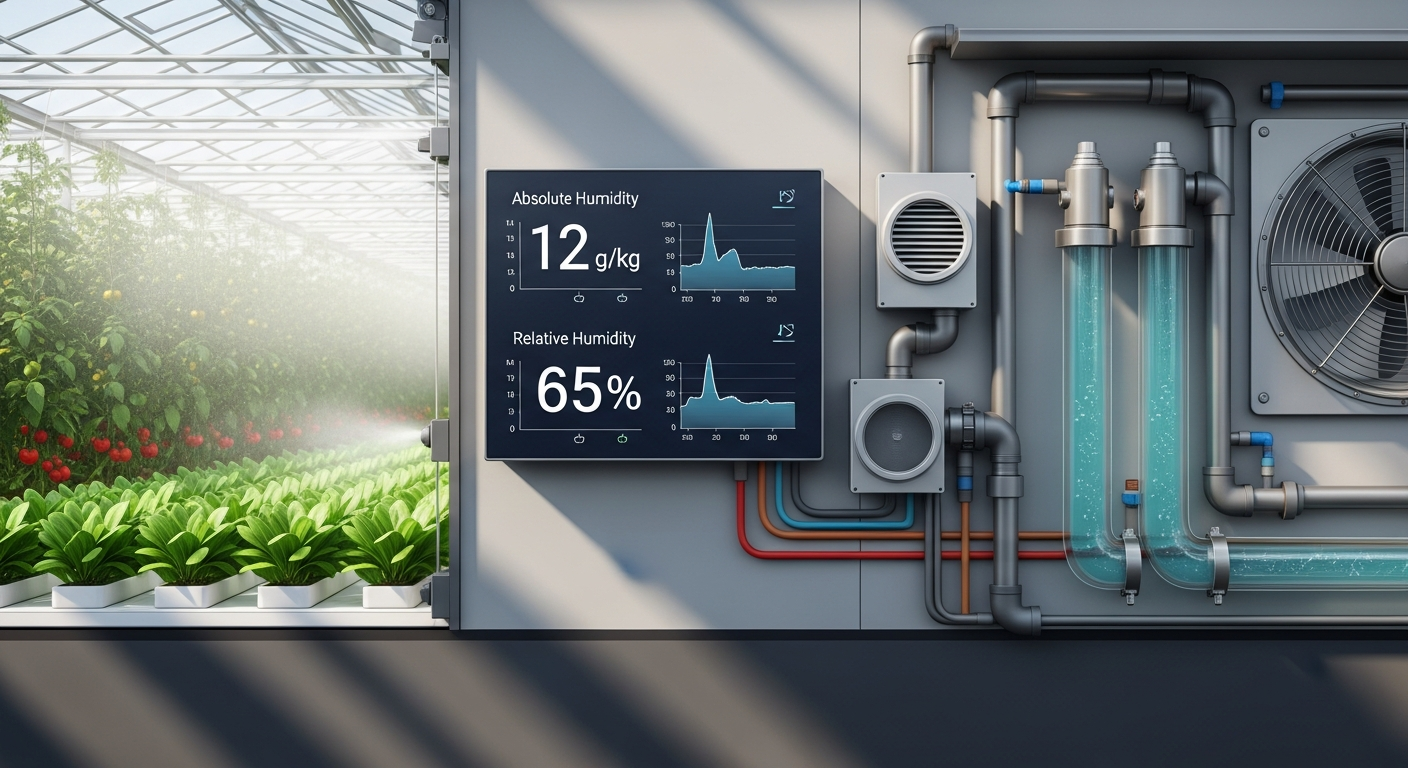
Relative humidity (RH) is arguably the most commonly referenced and understood measure of atmospheric moisture. It’s expressed as a percentage and tells you how much water vapor is currently in the air relative to the maximum amount of water vapor the air can hold at that specific temperature. Think of the air as a sponge: a warm sponge can hold more water than a cold sponge. If your air is 50% RH, it means it’s holding half of the total water vapor it could potentially hold at its current temperature. If it’s 100% RH, the air is completely saturated, and any additional cooling or moisture will lead to condensation.
The Limitations of Relative Humidity for Plants
While easy to measure with a simple hygrometer and useful for general comfort levels, relative humidity has significant limitations when it comes to precision climate control for plants. The biggest drawback is its inherent dependency on temperature. A fixed amount of water vapor in the air will yield a *different* RH percentage depending on the air temperature. For example:
- If the air contains 10 grams of water vapor per cubic meter at 70°F (21°C), the RH might be 50%.
- If the temperature then drops to 60°F (15.5°C) while the actual amount of water vapor remains the same, the RH percentage will rise significantly, perhaps to 75% or higher, simply because cooler air has a lower maximum capacity to hold moisture.
This temperature dependency makes RH a poor standalone indicator for plant transpiration rates. A plant experiencing 80% RH at 90°F (32°C) is under vastly different conditions than a plant experiencing 80% RH at 60°F (15.5°C). In the warmer scenario, there’s still a significant “drying power” in the air, allowing for robust transpiration. In the cooler scenario, the air is much closer to saturation, greatly reducing transpiration and increasing the risk of condensation and fungal diseases like powdery mildew or botrytis.
For growers aiming for precise environmental control, relying solely on RH can be misleading and lead to suboptimal growing conditions or, worse, plant stress and disease outbreaks.
Delving into Absolute Humidity (AH) and Vapor Pressure Deficit (VPD)
Defining Absolute Humidity
Absolute humidity (AH), also known as specific humidity or humidity ratio, offers a more stable and direct measure of the actual amount of water vapor in the air. Instead of a percentage relative to temperature, AH quantifies the mass of water vapor present per unit volume of air (e.g., grams of water per cubic meter, g/m³) or per unit mass of dry air (e.g., grams of water per kilogram of dry air, g/kg). The key distinction is that absolute humidity is not directly affected by temperature changes. If the air contains 10 g/m³ of water vapor, it contains 10 g/m³ regardless of whether the temperature is 60°F or 90°F.
This makes AH a much more reliable metric for understanding the true moisture content of your greenhouse air. While not as commonly displayed on consumer-grade sensors as RH, understanding AH is fundamental to grasping the concept of Vapor Pressure Deficit (VPD), which is the gold standard for advanced greenhouse climate control.
The Power of Vapor Pressure Deficit (VPD)
If relative humidity is the starter’s guide to moisture, and absolute humidity is a deeper dive into the actual water content, then Vapor Pressure Deficit (VPD) is the expert’s toolkit. VPD measures the difference between the amount of moisture the air can hold when saturated (saturation vapor pressure) and the amount of moisture it is currently holding (actual vapor pressure). Essentially, VPD quantifies the “drying power” of the air and, crucially, how thirsty your plants are.
A higher VPD indicates that the air is relatively dry and can pull a lot of moisture from the plants, leading to increased transpiration. A lower VPD means the air is closer to saturation, reducing the plant’s ability to transpire effectively. This makes VPD the most direct and accurate indicator of how your plants are interacting with their atmospheric environment.
Optimal VPD ranges vary significantly depending on the plant species and its growth stage:
- Propagation/Cloning (High Humidity, Low VPD): Young cuttings and seedlings thrive in low VPD (e.g., 0.4-0.8 kPa) to minimize water loss while roots are developing. The air is nearly saturated, reducing the need for active transpiration.
- Vegetative Growth (Moderate Humidity, Mid-Range VPD): As plants grow, they need to transpire more to uptake nutrients. A moderate VPD (e.g., 0.8-1.2 kPa) encourages healthy water movement and robust growth.
- Flowering/Fruiting (Lower Humidity, Higher VPD): During reproductive stages, many plants benefit from a slightly higher VPD (e.g., 1.2-1.6 kPa) to prevent excessive moisture buildup around flowers and fruits, which can lead to mold and disease. This also encourages the plant to “work” harder, which can sometimes lead to increased production of secondary metabolites.
To calculate VPD, you need both air temperature and relative humidity, or ideally, direct vapor pressure readings. Many advanced climate control systems and sensors now provide real-time VPD data, empowering growers to make precise adjustments for peak plant performance.
Practical Application: Managing Humidity in Your Greenhouse
Understanding the difference between absolute and relative humidity, and embracing VPD, is crucial for proactive climate control. Here’s how to apply this knowledge:
Monitoring Tools
- Hygrometers and Thermometers: Standard devices provide RH and temperature, which are the inputs for calculating VPD. Ensure they are accurate and calibrated.
- Psychrometers: These use wet-bulb and dry-bulb temperatures to accurately determine absolute humidity, relative humidity, and dew point.
- VPD Sensors/Controllers: Many modern greenhouse climate control systems now integrate sensors that directly measure and display VPD, making precision adjustments much easier. Investing in such a system can be a game-changer for commercial operations and serious hobbyists.
Strategies for Control
Once you know your target VPD for a given growth stage, you can manipulate your greenhouse environment to achieve it:
- Humidification: If VPD is too high (air is too dry), you need to add moisture.
- Misters/Foggers: Introduce fine water droplets into the air.
- Evaporative Coolers (Swamp Coolers): Add humidity while also cooling the air.
- Wetting Surfaces: Misting paths or benches can temporarily raise humidity.
- Dehumidification: If VPD is too low (air is too moist), you need to remove moisture.
- Ventilation: Exhaust fans pull moist air out, drawing in drier air.
- Dehumidifiers: Specialized units actively remove water vapor from the air.
- Heating and Venting (Heat & Vent): A common strategy where a heater is run briefly while vents are open, warming the air to increase its moisture-holding capacity, then exchanging the moist air. This lowers RH and raises VPD.
- Air Circulation: Installing Horizontal Air Flow (HAF) fans prevents pockets of stagnant, high-humidity air (microclimates) and ensures uniform conditions throughout the canopy. This is critical for preventing fungal diseases.
- Watering Practices: Adjusting the time of day and frequency of watering can impact overall humidity. Watering in the morning allows plants to transpire throughout the day, reducing nighttime humidity.
- Plant Spacing: Ensure adequate space between plants to allow for good airflow, preventing localized high humidity around leaves.
Tuning for Plant Life Stages
Remember to adjust your humidity targets as your plants progress through their life cycle:
- Clones/Seedlings: Aim for low VPD (high RH) to protect delicate tissues and encourage root development.
- Vegetative Growth: Gradually increase VPD (lower RH) to stimulate vigorous transpiration and nutrient uptake.
- Flowering/Fruiting: Maintain a moderate to higher VPD (lower RH) to reduce disease pressure, especially from molds, and support the reproductive phase.
Conclusion: Mastering Your Greenhouse Climate
While relative humidity offers a convenient, immediate snapshot of moisture in the air, a truly optimized greenhouse environment demands a deeper understanding. By shifting your focus from the temperature-dependent fluctuations of relative humidity to the stable measure of absolute humidity, and ultimately embracing the power of Vapor Pressure Deficit (VPD), you gain unparalleled control over your plants’ health and productivity. Investing in the right monitoring tools and implementing strategic climate control measures based on VPD will empower you to create a controlled environment where your plants don’t just survive, but truly thrive. Master your greenhouse climate, and watch your yields and plant quality reach new heights.