
In the world of controlled environment agriculture, precision is paramount. From meticulously controlled temperatures to optimized nutrient delivery, every variable plays a crucial role in plant health and yield. Yet, one fundamental aspect often goes overlooked despite its profound impact on automated greenhouse setups: wettability. Understanding how water interacts with your growing medium – whether it enthusiastically soaks in or stubbornly beads on the surface – is key to efficient hydration, nutrient uptake, and ultimately, the success of your crops. This article delves into the science behind wettability and provides actionable strategies for managing substrate hydration in your automated systems, ensuring your plants receive exactly what they need, exactly when they need it.
The Fundamental Science of Wettability
At its core, wettability describes the ability of a liquid to maintain contact with a solid surface. In our context, it’s how readily water spreads across and penetrates your chosen growing media. This interaction is governed by a delicate balance of forces, primarily surface tension of the water and the surface energy of the substrate material.
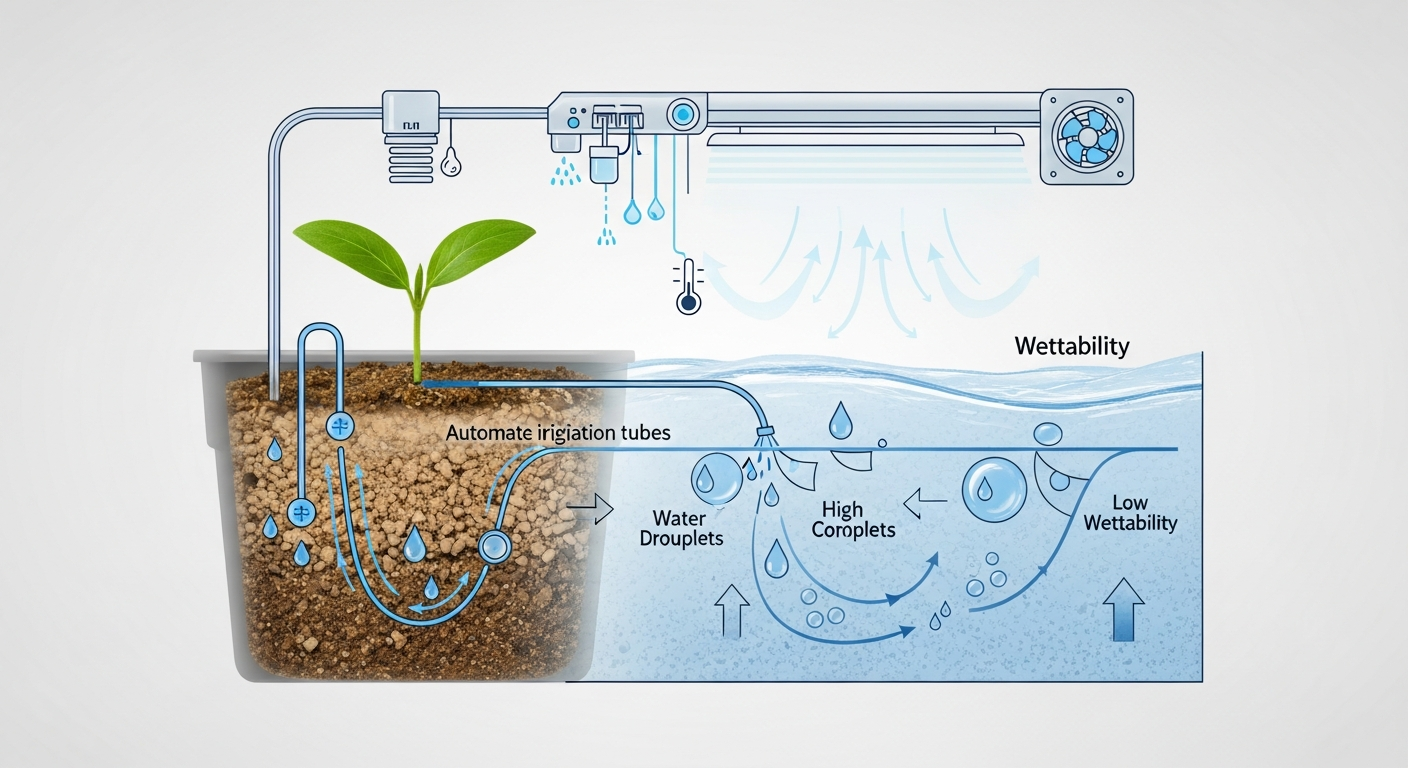
Understanding Contact Angle: Hydrophobic vs. Hydrophilic
The most common way to quantify wettability is through the contact angle. Imagine a droplet of water on a surface:
- If the water spreads out and forms a flat, low-profile bead (a contact angle less than 90 degrees), the surface is considered hydrophilic, or “water-loving.” Water readily wets this material.
- If the water beads up into a tight, spherical droplet (a contact angle greater than 90 degrees), the surface is hydrophobic, or “water-fearing.” This material resists wetting.
Most common substrates, such as peat moss or coco coir, are naturally hydrophilic to varying degrees. However, factors like drying out or decomposition can alter their surface properties, making them temporarily or permanently hydrophobic. This shift has significant implications for substrate hydration and root zone moisture management in your greenhouse.
Capillary Action and Water Retention
Beyond simple surface contact, wettability plays a critical role in capillary action – the ability of water to move through porous materials against the force of gravity. Hydrophilic substrates, with their network of tiny pores, create strong capillary forces that draw water in and hold it. This is essential for proper water distribution and retention, ensuring roots have continuous access to moisture and nutrients. Poor wettability disrupts this crucial process, leading to uneven wetting and compromised water holding capacity.
Challenges of Poor Wettability in Automated Setups
While poor wettability can be a nuisance in any growing environment, it presents particularly complex challenges for automated irrigation systems. The very precision automated systems aim for can be undermined when the substrate isn’t cooperating.
Uneven Wetting and Dry Spots
When a substrate becomes hydrophobic, applied water tends to channel through the path of least resistance rather than spreading evenly. This creates what are known as “dry spots” or “preferential flow paths.” Even with precise drip emitters or nutrient film technique (NFT) systems, if the substrate isn’t adequately wetted, significant portions of the root zone can remain dry. This leads to:
- Inconsistent growth: Plants in dry spots suffer from water and nutrient stress, while others may be adequately hydrated.
- Nutrient lockout: Dry areas prevent roots from absorbing nutrients, even if they are present in the irrigation solution.
- Wasted resources: Water and nutrients flow through the substrate without being effectively utilized, increasing operational costs.
Impact on Sensor Accuracy and Automation Efficiency
Modern automated greenhouses rely heavily on moisture sensors to trigger irrigation cycles. A hydrophobic substrate can severely skew these readings. A sensor might be plunged into a dry pocket, triggering unnecessary irrigation, or it might be in a preferentially wetted channel, indicating adequate moisture while the surrounding substrate remains parched. This leads to:
- Over-irrigation: Leading to waterlogging, root rot, and anaerobic conditions.
- Under-irrigation: Causing plant stress, wilting, and reduced yields.
- Inefficient resource allocation: Compromising the very purpose of precision irrigation and greenhouse climate control.
Specific Substrate Vulnerabilities
Certain soilless cultivation substrates are more prone to wettability issues. Peat moss, for example, is notorious for becoming highly hydrophobic once it dries out completely. Coco coir can also exhibit reduced wettability over time due to mineral buildup or lignin breakdown. Rockwool, while generally stable, can experience issues if not properly pre-soaked or if hard water deposits accumulate.
Strategies for Optimizing Substrate Wettability
Managing wettability effectively in automated setups requires a multi-faceted approach, combining careful substrate selection, pre-treatment, and intelligent irrigation strategies.
1. Substrate Selection and Blending
The first line of defense is choosing the right substrate. Consider:
- Initial Wettability: Some substrates, like perlite or vermiculite, are naturally less prone to hydrophobicity than others.
- Water Holding Capacity & Air Porosity: Aim for a balance. A substrate that holds water well but also provides good aeration prevents both rapid drying and waterlogging.
- Blends: Combining different materials (e.g., peat with perlite and coco coir) can create a medium with improved structural stability, drainage, and more consistent wettability characteristics over time.
Always source high-quality, consistent growing media from reputable suppliers.
2. Pre-Treatment and Conditioning
Before introducing plants, properly prepare your substrates:
- Pre-wetting: Thoroughly soak dry substrates like peat or coco coir before planting. This activates their hydrophilic properties. For peat-based mixes, a slow, sustained wetting can often overcome initial water repellency.
- Wetting Agents/Surfactants: These are chemical compounds that reduce the surface tension of water, allowing it to penetrate hydrophobic surfaces more easily. They are invaluable for re-wetting severely dry or problematic substrates. Add them to your initial irrigation solution or incorporate them into your regular feeding schedule as needed.
- Application Tip: Follow manufacturer recommendations strictly. Overuse can harm beneficial microbes or even plants. Focus on areas where water repellency is historically an issue.
3. Intelligent Irrigation Scheduling
Automated systems offer precise control, so leverage it to your advantage:
- Pulse Irrigation: Instead of one long watering cycle, apply water in short, frequent bursts (pulses). This allows the water to slowly penetrate and spread through the substrate, reducing channeling and improving evenness of wetting, especially for slightly hydrophobic media.
- Start-up Ramps: Begin irrigation cycles with lower flow rates or shorter durations, gradually increasing them. This gentle approach helps “wake up” the substrate’s wettability.
- Drip Emitter Placement: Ensure emitters are positioned strategically to maximize distribution and minimize direct channeling, especially in larger containers.
4. Monitoring and Response
Even with the best planning, continuous monitoring is essential:
- Regular Substrate Inspection: Periodically check random pots or slabs manually. Lift them to gauge weight, feel the moisture content below the surface, and observe the visual appearance of the substrate for dry spots or uneven wetting.
- Calibrate Moisture Sensors: Ensure your soil moisture sensors are calibrated correctly for your specific substrate and regularly verify their readings against manual checks. Consider using multiple sensors per zone or even per plant in critical areas to get a more accurate picture of average root zone moisture.
- Adjusting Irrigation Schedules: Use data from your sensors and manual inspections to fine-tune your automated irrigation schedules. Be prepared to adjust frequencies, durations, or even add wetting agents if persistent dry spots are detected.
Conclusion
The science of wettability is more than just an academic concept; it’s a practical cornerstone of effective moisture management in automated greenhouses. By understanding the interplay between water and your growing medium, recognizing the signs of poor wettability, and implementing strategic solutions, you can dramatically improve the efficiency of your automated setups. Optimizing substrate hydration ensures consistent plant growth, maximizes nutrient uptake, minimizes water waste, and ultimately leads to healthier plants and higher yields. Embrace the science, and your greenhouse will thrive.