
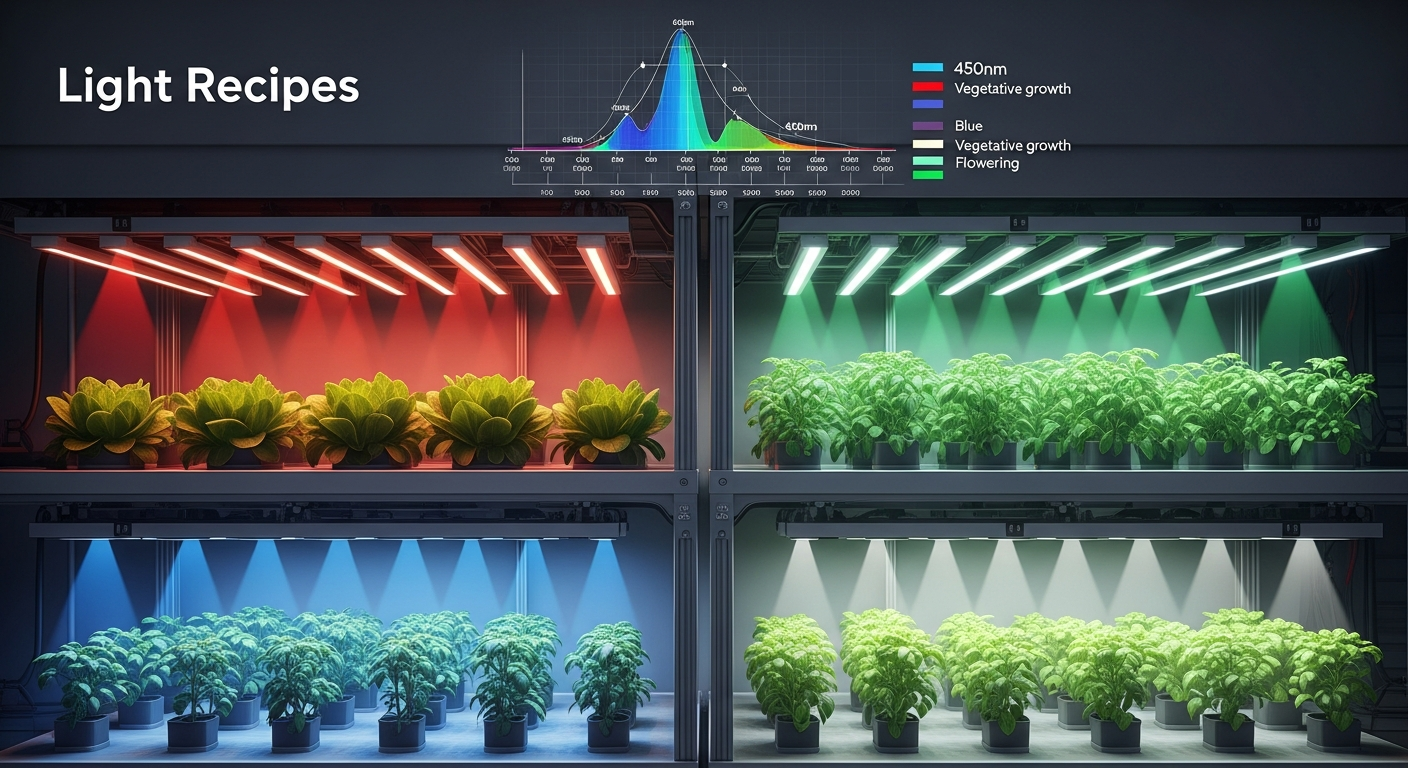
Imagine a chef meticulously crafting a dish, adjusting each spice and ingredient to bring out the perfect flavor and aroma. In the world of modern agriculture, growers are becoming similar artisans, but their primary ingredient is light. The era of simply “on” or “off” grow lights is rapidly fading, replaced by a sophisticated understanding of how specific wavelengths of light—a concept we call “light recipes”—can be precisely tuned to optimize plant growth, enhance nutritional value, and even influence taste and texture for a wide array of crops. This isn’t just about providing enough light; it’s about providing the right kind of light, enabling unprecedented control over plant development in controlled environment agriculture (CEA).
The Fundamental Role of Light in Plant Life
At its core, plant life is inextricably linked to light. Light is not just a source of energy; it’s also a powerful informational signal that guides nearly every aspect of a plant’s existence. Understanding this dual role is the first step in appreciating the power of light recipes.
Photosynthesis: The Engine of Growth
The most widely recognized function of light in plants is photosynthesis, the miraculous process by which plants convert light energy into chemical energy, primarily in the form of sugars. Chlorophyll, the green pigment in plants, plays a central role in absorbing light for this process. Specifically, chlorophyll a and chlorophyll b efficiently absorb light in the blue (around 430-470 nm) and red (around 640-670 nm) regions of the spectrum. These spectral bands are often considered the most crucial for driving biomass accumulation and overall plant growth, forming the backbone of any effective plant light spectrum strategy. However, relying solely on blue and red light overlooks the intricate signaling roles of other wavelengths.
Photomorphogenesis: Shaping Plant Development
Beyond fueling photosynthesis, light acts as an environmental cue, directing a plant’s developmental processes – a phenomenon known as photomorphogenesis. This involves light-sensing proteins (photoreceptors) that detect different wavelengths and trigger specific physiological responses. These responses dictate everything from seed germination and stem elongation to leaf expansion, flowering, and even the synthesis of secondary metabolites that contribute to flavor, aroma, and defense mechanisms. By understanding how different light qualities influence photomorphogenesis, growers can sculpt plants to exhibit desired traits, making customizing spectrums for crops a powerful tool.
Key Photoreceptors and Their Responses
- Phytochromes: These photoreceptors primarily sense red (R) and far-red (FR) light. The ratio of red to far-red light (R:FR ratio) is critical for signaling. A high R:FR ratio (more red) indicates full sun exposure, promoting compact growth and inhibiting stem elongation. A low R:FR ratio (more far-red) mimics shaded conditions, triggering a “shade avoidance response” characterized by stem stretching, larger leaves, and earlier flowering in an attempt to reach more light.
- Cryptochromes: Sensitive to blue and UV-A light, cryptochromes regulate processes like hypocotyl elongation inhibition (keeping seedlings short), stomatal opening (for gas exchange), and the synchronization of circadian rhythms (the plant’s internal clock).
- Phototropins: Also blue and UV-A light sensitive, phototropins are responsible for phototropism (the bending of plants towards light) and chloroplast movement within cells to optimize light capture, as well as stomatal opening.
The interplay of these photoreceptors allows plants to fine-tune their growth and development in response to their light environment, providing the scientific basis for creating precise light recipes.
Deconstructing the Spectrum: What Each Color Does
While often perceived as a single entity, white light is a composite of various colors, each with its own unique impact on plant physiology. Modern LED grow lights allow us to isolate and combine these wavelengths with unprecedented precision, offering growers the ultimate control over their crops.
Blue Light: The Architect of Compactness
Blue light (400-500 nm) is vital for promoting strong, sturdy, and compact vegetative growth. It plays a significant role in chlorophyll production, essential for efficient photosynthesis. High levels of blue light can inhibit stem elongation, leading to shorter plants with thicker leaves and stems – a desirable trait for many indoor crops, especially leafy greens, as it maximizes space utilization. Blue light also influences stomatal opening, thereby affecting transpiration and nutrient uptake. However, too much blue light, particularly in the absence of sufficient red light, can sometimes stunt growth or reduce overall biomass.
Red Light: The Fuel for Biomass and Flowering
Red light (600-700 nm) is perhaps the most efficient wavelength for photosynthesis, driving significant biomass accumulation. It is crucial for stem elongation (in conjunction with far-red light), and more importantly, it strongly promotes flowering and fruiting in many plant species. A high proportion of red light in a horticultural lighting setup is often favored during the reproductive stages of plants like tomatoes, strawberries, and cannabis to maximize yield. The interaction between red and far-red light via phytochromes means that the precise balance of these two wavelengths can profoundly influence plant architecture and the transition to flowering.
Green Light: Often Underestimated
For a long time, green light (500-600 nm) was largely ignored in horticultural lighting, primarily because chlorophyll reflects green light, giving plants their characteristic color. However, recent research suggests that green light is far from inert. While less efficient than red or blue light for direct photosynthesis, green light can penetrate deeper into the plant canopy, reaching lower leaves that might otherwise be shaded. This means it can contribute to overall photosynthetic efficiency across the entire plant. Furthermore, green light can modulate the effects of red and blue light, influencing stem elongation and plant morphology. A small percentage of green light in a spectral tuning strategy can improve canopy penetration and plant health, though its optimal percentage varies by crop.
Far-Red Light: The Elongation Signal
Far-red light (700-800 nm) is often overlooked but incredibly powerful. While it doesn’t directly drive photosynthesis as efficiently as red or blue light, it works in concert with red light through the phytochrome system. A higher proportion of far-red light (low R:FR ratio) promotes stem elongation, leaf expansion, and can accelerate flowering in certain long-day plants. It mimics the light conditions found under a dense canopy, prompting plants to “stretch” to escape shade. For growers looking to increase plant height or speed up flowering, carefully introducing far-red light into a plant light recipe can be highly effective, but excessive far-red can lead to undesirable stretching and weak stems.
UV Light: Enhancing Plant Defenses and Pigmentation
Ultraviolet (UV) light (especially UV-A, 315-400 nm) is found naturally in sunlight and, when used judiciously, can offer significant benefits. While high doses of UV-B (280-315 nm) can be detrimental, targeted UV-A exposure can stimulate the production of secondary metabolites such as anthocyanins (responsible for red/purple coloration in fruits and leaves), flavonoids, and terpenes. These compounds often contribute to a plant’s aroma, flavor, color, and even its medicinal properties. Furthermore, UV exposure can enhance a plant’s natural defense mechanisms, making it more resistant to pests and diseases. For crops where flavor, color, or specific biochemical compounds are paramount (e.g., culinary herbs, cannabis, colorful lettuces), incorporating a controlled amount of UV light into the optimized light spectrum can be a game-changer.
Crafting “Light Recipes”: Tailoring Spectrums for Specific Crops
The true artistry of modern horticultural lighting lies in the ability to combine these individual wavelengths into bespoke “light recipes” for specific crops. This strategic approach moves beyond generic full-spectrum lighting to achieve precise control over plant characteristics.
Understanding Crop-Specific Needs
Every plant species has evolved under a unique set of natural light conditions, and thus, each responds differently to various spectral compositions. What works perfectly for a leafy green like lettuce might be suboptimal for a fruiting plant like a tomato, or an herb valued for its essential oil production.
- Leafy Greens (e.g., Lettuce, Spinach, Kale): Growers typically aim for compact growth, vibrant color, and good leaf texture. A higher blue light component (e.g., 20-30%) combined with a dominant red light (e.g., 70-80%) often yields excellent results. A touch of green light can ensure deeper canopy penetration, leading to more uniform growth throughout the plant. For red varieties of lettuce, adding specific far-red or UV-A can enhance anthocyanin production for richer coloration.
- Fruiting Plants (e.g., Tomatoes, Strawberries, Peppers): The focus shifts to maximizing flowering, fruit set, yield, and flavor. A spectrum rich in red light is paramount for flowering and fruiting. A balanced amount of blue light is still necessary for strong vegetative structure to support the heavy fruit load. Strategic use of far-red light can speed up flowering and increase fruit size, while UV-A can potentially enhance sugar content and secondary metabolites that contribute to flavor and aroma.
- Herbs (e.g., Basil, Mint, Cilantro): The goal is often to maximize biomass, robust flavor, and essential oil content. Blue light plays a key role in stimulating the production of terpenes and other aromatic compounds. A balance of red and blue light, often with a slightly higher blue percentage than for leafy greens, can produce pungent, flavorful herbs with good biomass.
- Cannabis: This crop often receives the most attention regarding cannabis light spectrum customization. During vegetative growth, a higher blue component promotes tight node spacing and strong branching. In flowering, a shift towards a red-dominant spectrum with carefully introduced far-red can accelerate flowering and increase bud size. UV-A is increasingly used during the late flowering stages to boost cannabinoid and terpene synthesis, enhancing potency and aroma.
Beyond Spectrum: Considering Intensity, Photoperiod, and DLI
While the light spectrum is a critical factor in creating effective light recipes, it’s essential to remember that it’s not the only one. Light intensity (measured as Photosynthetic Photon Flux Density or PPFD), photoperiod (the duration of light exposure), and Daily Light Integral (DLI – the total amount of light a plant receives over 24 hours) are equally important co-factors. A perfectly tailored spectrum will only deliver optimal results if the plants also receive the correct intensity and duration of light. For example, a plant might thrive under a specific spectrum at 400 PPFD, but the same spectrum might cause stress or suboptimal growth at 800 PPFD, especially if other environmental factors like CO2 and temperature aren’t also optimized.
Implementing Light Recipes: Practical Considerations and Future Trends
The ability to precisely tailor light recipes opens up exciting possibilities for growers, but successful implementation requires careful planning, the right technology, and a commitment to data-driven decision-making.
Choosing the Right LED Technology
The advent of sophisticated tunable LED grow lights has made light recipes a practical reality. These fixtures allow growers to adjust the intensity of individual color channels (e.g., red, blue, green, far-red, UV-A) throughout the plant’s life cycle. When selecting horticultural LED fixtures, look for:
- Full Spectral Control: The ability to adjust individual spectral bands, not just dim the entire spectrum.
- High Efficiency: Maximizing Photosynthetic Photon Efficacy (PPE) to reduce energy consumption.
- Robustness and Longevity: Investing in durable fixtures built for demanding agricultural environments.
- Connectivity and Control: Compatibility with environmental control systems for automated scheduling and adjustments.
Monitoring and Adjusting Your Recipes
Implementing light recipes isn’t a “set it and forget it” process. It requires ongoing observation and adjustment. Growers should:
- Observe Plant Response: Closely monitor plant morphology, color, growth rate, and any signs of stress.
- Utilize Sensors: Employ PAR meters to measure light intensity (PPFD) and spectrometers to verify the actual light spectrum reaching the plants.
- Log Data: Keep detailed records of light recipes, environmental conditions (temperature, humidity, CO2), and plant responses. This data is invaluable for refining recipes over time.
The Role of AI and Data Analytics
The future of light recipes is undeniably intertwined with artificial intelligence (AI) and data analytics. As more growers collect data on plant responses to specific spectra, AI algorithms can learn to predict optimal light recipes for desired outcomes. This could lead to fully automated, dynamic lighting systems that adjust in real-time based on plant needs, environmental conditions, and desired traits. AI-driven precision agriculture will revolutionize controlled environment agriculture, optimizing yields, nutrient density, and resource efficiency on an unprecedented scale.
Tips for Experimenting with Light Recipes
For growers eager to dive into spectral tuning, here are some practical tips:
- Start Simple: Begin by adjusting a single spectral band (e.g., increasing blue light during vegetative growth) and observe the results before making further changes.
- Document Everything: Meticulously record your light recipes, DLI, environmental parameters, and detailed observations of plant growth and characteristics. This data is your most valuable asset.
- Control Variables: When experimenting, try to change only one variable at a time to accurately attribute plant responses to specific spectral adjustments.
- Consult Research: Stay updated on scientific literature and university research regarding crop-specific spectral responses.
- Prioritize DLI: Always ensure plants are receiving an adequate Daily Light Integral before fine-tuning the spectrum, as overall light quantity is generally more critical than spectrum alone.
Conclusion: Illuminating the Future of Agriculture
The science of “light recipes” represents a paradigm shift in how we approach plant cultivation. By moving beyond generic illumination to the precise customization of light spectrums, growers can unlock unprecedented levels of control over plant growth, development, and the expression of desirable traits. This sophisticated understanding of light’s dual role – as both energy source and informational signal – allows us to not only optimize yield but also to enhance nutritional content, improve flavor profiles, and even bolster plant resilience. As LED technology continues to advance and data analytics become more sophisticated, the ability to craft perfect light recipes will become an indispensable tool for sustainable agriculture, driving efficiency and innovation in vertical farms, greenhouses, and ultimately, contributing to global food security. The future of farming is brightly illuminated, and it’s a future custom-designed, one spectrum at a time.