
Walk into any thriving greenhouse, and you’ll immediately notice the air feels different – often warmer, and distinctly more humid than the outside environment. This isn’t just a coincidence; it’s a testament to the powerful, often unseen, processes occurring within. At the heart of this atmospheric transformation lies a critical scientific phenomenon: evapotranspiration. While often discussed in agricultural contexts, understanding evapotranspiration is paramount for any greenhouse grower looking to master their climate control, optimize plant health, and ensure efficient resource use. It’s the very mechanism through which your plants actively contribute to the very air they breathe, particularly by adding moisture, making them active architects of their own humid world.
What is Evapotranspiration? Breaking Down the Process
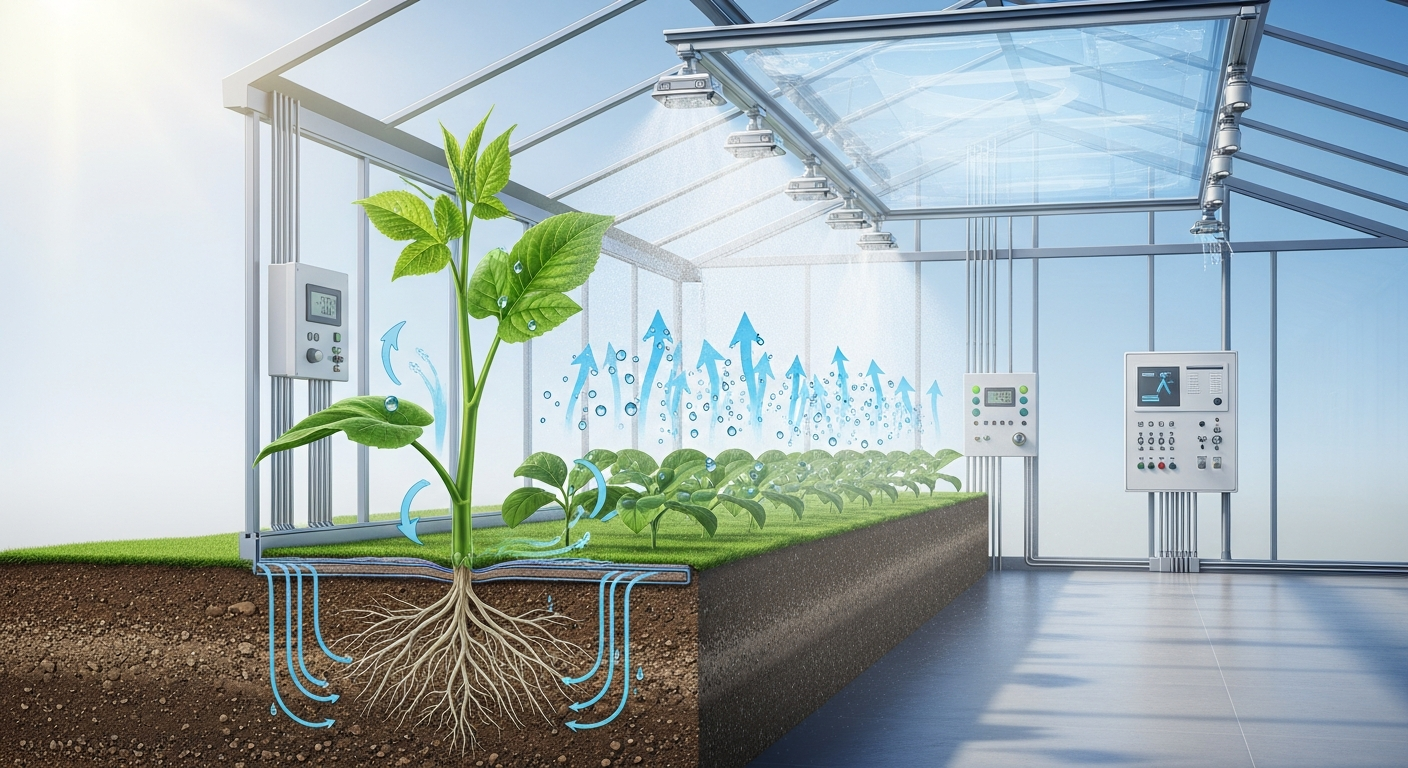
Evapotranspiration (ET) is a combined term that describes the sum of water lost to the atmosphere from two primary sources: evaporation from surfaces and transpiration from plants. While both contribute to atmospheric moisture, their mechanisms are distinct, and understanding each is key to managing your greenhouse environment effectively.
Transpiration: The Plant’s Breath
Transpiration is the process by which plants release water vapor into the atmosphere, primarily through tiny pores on their leaves called stomata. Think of it as the plant “breathing” out water. This isn’t just a passive loss; transpiration serves several vital functions for a plant:
- Nutrient Transport: As water evaporates from the leaves, it creates a negative pressure (like a straw), pulling water and dissolved nutrients from the roots up through the xylem to the rest of the plant.
- Cooling: The evaporation of water from the leaf surface has a cooling effect, helping plants regulate their temperature, especially under intense light or high heat.
- Gas Exchange: Stomata must open for transpiration, but this opening also allows for the crucial intake of carbon dioxide (CO2), which is necessary for photosynthesis.
The rate of transpiration is influenced by both environmental factors and the plant’s physiological state, making it a dynamic and complex process.
Evaporation: Water’s Journey from Surfaces
The other component of evapotranspiration is simple evaporation. This is the process where water changes from a liquid to a gaseous state (vapor) directly from non-plant surfaces within the greenhouse. This includes:
- Soil and Growing Media: Water evaporates directly from the surface of pots, grow beds, and other growing media.
- Benches and Floors: Spills, runoff, or condensation on structural elements and walkways can also contribute to evaporative water loss.
- Water Reservoirs: Any open water sources, such as nutrient solution tanks or humidification systems, will also evaporate.
While often less significant than transpiration in a densely planted greenhouse, evaporation still plays a role in overall humidity levels and water loss, especially in the initial stages of crop growth when plant canopy cover is minimal.
Factors Influencing Evapotranspiration in a Greenhouse
The rate at which evapotranspiration occurs is not constant; it’s a dynamic variable influenced by a complex interplay of environmental and plant-specific factors. Mastering these influences is central to optimal greenhouse climate control.
Environmental Factors
- Temperature: Higher air and leaf temperatures increase the kinetic energy of water molecules, accelerating both evaporation and transpiration. Warmer air can also hold more moisture, increasing the “drying power” of the air if relative humidity is not also high.
- Humidity (Vapor Pressure Deficit – VPD): This is perhaps the most critical environmental factor. Relative humidity (RH) indicates how much water vapor is in the air compared to what it can hold at a given temperature. However, for plants, Vapor Pressure Deficit (VPD) is a more accurate measure of the “drying power” of the air. VPD is the difference between the amount of moisture in the air and how much moisture the air can hold when it is saturated. A high VPD (low humidity) means the air is “thirsty” and will pull water from plants and surfaces more aggressively, leading to higher ET rates. Conversely, a low VPD (high humidity) reduces ET.
- Light Intensity: Light is the primary driver for photosynthesis. Plants open their stomata to take in CO2 when light is present, which inevitably leads to water loss through transpiration. Therefore, higher light intensity generally leads to increased transpiration.
- Air Movement (Wind): Still air around a leaf can become saturated with water vapor, creating a small, humid microclimate that slows down further transpiration. Air movement, even a gentle breeze from circulation fans, constantly sweeps away this humid air, replacing it with drier air, thereby maintaining the vapor pressure gradient and increasing ET.
Plant Factors
- Leaf Area Index (LAI): The total surface area of leaves in relation to the ground area they cover. More leaf surface means more stomata and more area for transpiration, directly increasing ET.
- Stomata Density and Control: Different plant species have varying numbers of stomata per unit of leaf area. Furthermore, plants have sophisticated mechanisms to open and close stomata in response to environmental cues (like light, CO2 levels, and water availability), directly regulating transpiration.
- Plant Species and Cultivar: Some plants are naturally more efficient water users (e.g., succulents, C4 plants), while others transpire heavily (e.g., leafy vegetables). Growth habits and leaf characteristics (e.g., waxy cuticles, hairy leaves) also play a role.
- Growth Stage: Young seedlings with small leaf areas will transpire much less than mature, actively growing plants covered in foliage or plants in their fruiting stage, which have high water demands.
The Role of Evapotranspiration in Greenhouse Humidity and Climate Control
The direct impact of evapotranspiration on greenhouse humidity is profound. As plants transpire and water evaporates from surfaces, they continuously release water vapor into the enclosed greenhouse environment. This constant input of moisture is the primary driver of the naturally higher humidity levels often observed inside greenhouses.
- Direct Humidity Increase: Every gram of water transpired or evaporated directly adds to the absolute humidity of the greenhouse air. In a sealed or semi-sealed environment, this can quickly lead to high relative humidity levels, especially at night when temperatures drop and the air’s capacity to hold moisture decreases.
- Impact on VPD: By increasing the moisture content of the air, ET directly influences the Vapor Pressure Deficit (VPD). As ET adds moisture, the actual vapor pressure in the air increases, which, if temperature remains constant, reduces the VPD. Growers often aim to maintain an optimal VPD range (typically between 0.8 and 1.2 kPa for many crops) to balance healthy transpiration with disease prevention.
- Challenges of High Humidity: While some humidity is crucial, excessive humidity (very low VPD) can lead to several problems:
- Disease Risk: Water lingering on leaf surfaces creates ideal conditions for fungal and bacterial diseases (e.g., botrytis, powdery mildew).
- Reduced Transpiration: If the air is too saturated, the driving force for transpiration diminishes, slowing down nutrient uptake and potentially causing nutrient deficiencies like tip burn (calcium deficiency).
- Poor Fruit Set/Pollen Viability: In some crops, high humidity can impair pollen release and viability, affecting fruit production.
- Benefits of Controlled Humidity: Conversely, maintaining appropriate humidity (optimal VPD) through controlled ET is beneficial:
- Healthy Transpiration: Ensures continuous water and nutrient flow, supporting robust growth.
- Reduced Plant Stress: Prevents desiccation and wilting, especially in young plants or cuttings.
- Enhanced Photosynthesis: Stomata can remain open without excessive water loss, facilitating CO2 uptake.
Practical Implications and Management Strategies for Greenhouse Growers
Understanding the science of evapotranspiration isn’t just academic; it empowers growers to make informed decisions that impact plant health, resource use, and profitability. Here are some actionable strategies:
Monitoring and Measurement
To manage ET effectively, you must measure it. While direct ET measurement is complex, monitoring its influencing factors provides actionable data:
- Relative Humidity (RH) Sensors: Essential for tracking general moisture levels. Often combined with temperature sensors.
- Vapor Pressure Deficit (VPD) Sensors: These are becoming standard in advanced greenhouses. VPD combines temperature and RH into a single, plant-centric metric that directly indicates the plant’s transpiration potential. Growers can use VPD data to trigger environmental controls.
- Substrate Moisture Sensors: Help growers understand water availability at the root zone, informing irrigation decisions that indirectly affect ET.
Practical Tip: Invest in a good psychrometer or an integrated climate sensor that calculates VPD. This single metric offers more insight into plant stress and transpiration potential than RH alone.
Optimizing Humidity for Plant Health
Managing humidity is a delicate balance. Your goal is to keep VPD within the ideal range for your specific crop and growth stage, which typically encourages healthy transpiration without inviting disease.
- Ventilation: The simplest way to reduce humidity. Exhaust fans remove humid air, and intake vents bring in drier outside air. Horizontal Air Flow (HAF) fans ensure even distribution and prevent localized humidity pockets.
- Dehumidification: For periods when outside air is too humid or cold to ventilate, active dehumidifiers can remove moisture from the air. While energy-intensive, they are crucial for maintaining control in challenging conditions.
- Misting and Fogging Systems: These systems add fine water droplets to the air, increasing humidity and reducing VPD, which can be beneficial for propagating young plants or during very dry conditions.
- Bottom Heating: Heating the root zone (e.g., with heated benches) can encourage plants to transpire, even in cooler air temperatures, helping to dry the canopy surface and reduce disease risk.
Practical Tip: At night, when photosynthesis ceases and stomata close, plants still respire, releasing some moisture. Combine gentle ventilation with a slight temperature increase (known as a “vapor pressure deficit dip”) to avoid dew point and condensation, which prevents fungal diseases.
Water Management and Irrigation Efficiency
Evapotranspiration is the primary way plants lose water, meaning understanding ET rates is critical for efficient irrigation. Irrigating based on plant demand (driven by ET) rather than a fixed schedule can significantly conserve water.
- ET-Based Irrigation: Advanced irrigation systems can integrate ET models or real-time climate data to determine when and how much to water. The goal is to replace the water lost through ET.
- Substrate Choice: Different growing media have varying water-holding capacities and aeration properties, influencing how quickly water evaporates from their surface and how well they supply water for transpiration.
- Covering Surfaces: Using mulch or ground covers can reduce evaporation from the soil surface, conserving water and focusing moisture delivery to the plant roots.
Practical Tip: Observe your plants daily. Wilting is a clear sign of high ET and insufficient water supply. However, aim to irrigate *before* visible stress occurs by monitoring your climate and plant needs proactively.
Energy Efficiency Considerations
Managing ET and humidity has direct implications for your greenhouse’s energy consumption.
- Ventilation vs. Dehumidification: Ventilation is generally more energy-efficient for reducing humidity than active dehumidification, especially when outside conditions permit. However, ventilation can also lead to heat loss in cold weather.
- Optimal Setpoints: Fine-tuning your temperature and humidity (VPD) setpoints to meet plant needs precisely can prevent unnecessary heating, cooling, or dehumidification cycles.
- CO2 Enrichment: Since stomata open for CO2 uptake, CO2 enrichment can potentially increase transpiration. However, careful CO2 management can also allow plants to open stomata less, reducing water loss while still photosynthesizing efficiently.
The science of evapotranspiration is far more than an ecological concept; it’s a living, breathing force within your greenhouse, constantly shaping the microclimate. By understanding its components, the factors that influence it, and its direct impact on humidity and plant health, you transform from a passive observer to an active manager of your greenhouse environment. Monitoring, adapting, and optimizing for evapotranspiration allows you to create ideal growing conditions, promote robust plant development, prevent diseases, and ultimately, cultivate a more productive and sustainable greenhouse operation. It’s truly a testament to how deeply connected plant physiology is to the very air we meticulously control for their benefit.