
In a world increasingly turning towards sustainable energy solutions, understanding and accurately measuring the sun’s immense power is paramount. Solar radiation, the fundamental energy source driving our planet’s climate and ecosystems, holds the key to unlocking widespread adoption of renewable technologies. From the meticulous design of photovoltaic (PV) systems to critical climate research and agricultural planning, precise data on solar energy flux is indispensable. This is where the unassuming yet profoundly important instrument known as the pyranometer steps in. As a cornerstone of solar measurement, the pyranometer provides the crucial insights needed to harness the sun’s energy efficiently and effectively. This comprehensive guide will delve into the intricacies of pyranometers, exploring their operational principles, the significance of the data they provide, and best practices for their deployment and maintenance to ensure the highest levels of accuracy in measuring total solar radiation.
Understanding Solar Radiation and Its Significance
Before we explore the instrument itself, it’s essential to grasp what solar radiation entails and why its accurate measurement is so critical. Solar radiation is the radiant energy emitted by the sun, traveling through space as electromagnetic waves. Upon reaching Earth, this radiation interacts with the atmosphere, undergoing absorption, reflection, and scattering before a portion of it finally reaches the Earth’s surface.
Types of Solar Radiation Relevant to Measurement
- Global Horizontal Irradiance (GHI): This is the total amount of shortwave radiation received from above by a surface horizontal to the ground. GHI is the sum of Direct Normal Irradiance (DNI) and Diffuse Horizontal Irradiance (DIF). It is the most commonly measured parameter for solar energy applications, particularly for fixed-tilt solar panels.
- Direct Normal Irradiance (DNI): Also known as beam radiation, DNI is the solar radiation received directly from the sun without being scattered or absorbed by the atmosphere. It is measured by instruments pointed directly at the sun and is crucial for concentrated solar power (CSP) systems and for tracking solar panels.
- Diffuse Horizontal Irradiance (DIF): This is the solar radiation that has been scattered by clouds, aerosols, and air molecules, arriving from all directions of the sky. Even on cloudy days, a significant amount of diffuse radiation reaches the surface.
Why Accurate Solar Radiation Measurement Matters
The ability to precisely measure these components of solar radiation underpins a vast array of scientific, industrial, and agricultural applications:
- Renewable Energy (Photovoltaics and Concentrated Solar Power):
- System Design and Sizing: Accurate GHI data is fundamental for calculating the optimal size and tilt of solar panels to meet specific energy demands. Without reliable solar resource data, PV systems can be undersized, leading to insufficient energy production, or oversized, resulting in unnecessary costs.
- Performance Monitoring and Validation: Pyranometers are indispensable for monitoring the actual performance of operational solar farms and rooftop installations. By comparing the measured solar irradiance with the actual energy output, system efficiency (often expressed as Performance Ratio, PR) can be calculated, allowing for timely identification of faults, degradation, or underperformance.
- Energy Yield Forecasting: Long-term historical solar data, typically gathered by pyranometers, is used to predict future energy production, which is vital for grid integration, financial planning, and power purchase agreements.
- Meteorology and Climate Research:
- Climate Modeling: Solar radiation is the primary driver of Earth’s climate system. Pyranometer data feeds into climate models, helping scientists understand global energy balance, atmospheric processes, and climate change patterns.
- Weather Forecasting: Irradiance data contributes to short-term weather forecasting models, influencing predictions for temperature, cloud cover, and other atmospheric conditions.
- Agriculture and Horticulture:
- Crop Growth Optimization: Solar radiation directly impacts photosynthesis. Farmers use irradiance data to optimize planting schedules, irrigation, and greenhouse climate control for various crops.
- Evapotranspiration Calculations: This data is crucial for estimating water loss from soil and plants, informing efficient irrigation strategies.
- Architecture and Urban Planning:
- Passive Solar Design: Architects use solar radiation data to design buildings that maximize natural light and passive heating/cooling, reducing energy consumption.
- Urban Heat Island Studies: Understanding solar absorption in urban environments helps mitigate the urban heat island effect.
The Pyranometer: A Deep Dive into Its Design and Function
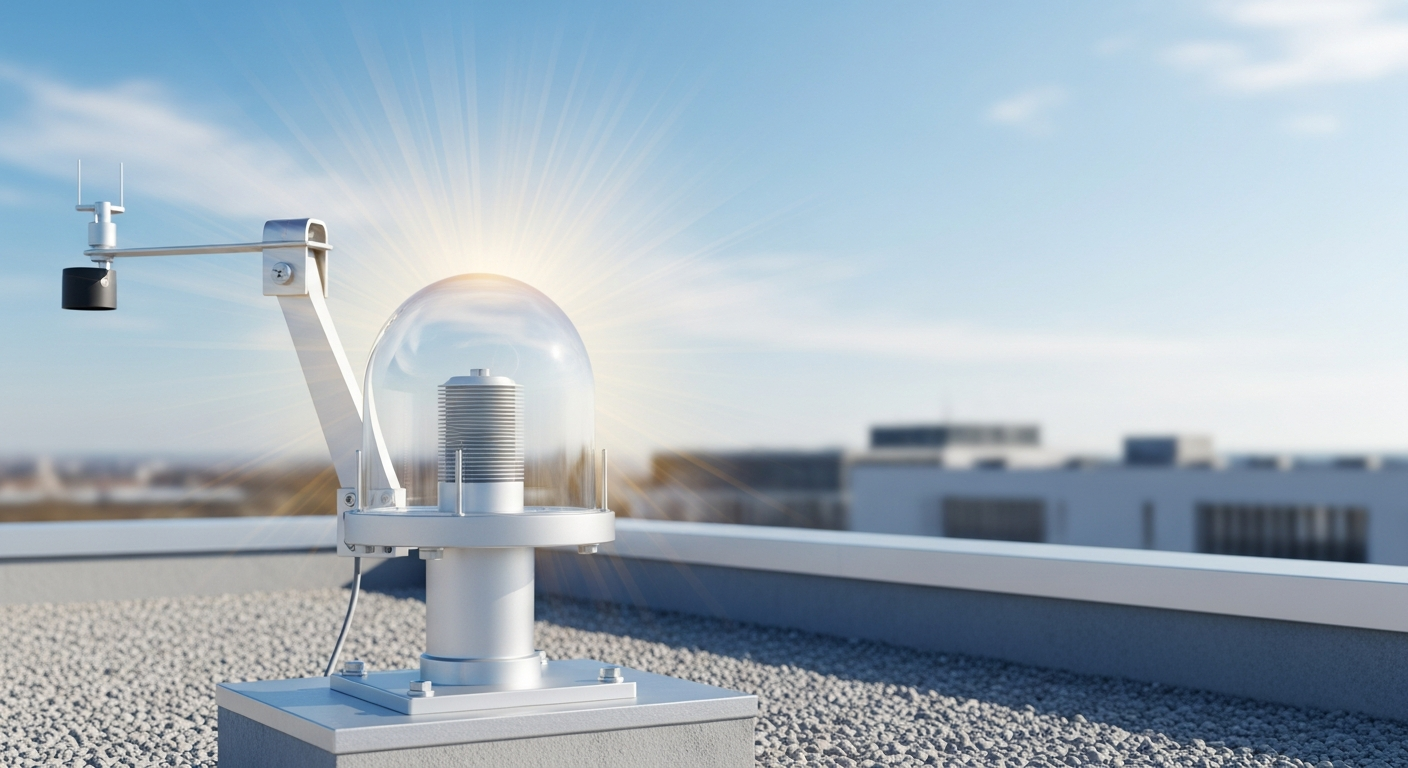
At the heart of total solar radiation measurement lies the pyranometer. Derived from the Greek words “pyro” (fire) and “ano” (above), a pyranometer is an instrument designed to measure the total hemispherical solar radiation incident on a horizontal surface.
What is a Pyranometer?
A pyranometer is a type of radiometer that measures the broadband solar irradiance from a hemispherical field of view. It specifically measures GHI, encompassing both direct and diffuse solar radiation.
How a Pyranometer Works: The Thermopile Principle
The vast majority of accurate pyranometers operate on the thermopile principle:
- Absorption Surface: The core of a pyranometer is a blackened surface, typically a flat thermopile sensor, which efficiently absorbs solar radiation across a wide spectral range. This black coating is designed to absorb nearly all incoming solar energy, converting it into heat.
- Temperature Gradient: When solar radiation hits the black surface, it heats up. The thermopile array underneath is designed to create a temperature difference between the hot, irradiated surface and a cooler, shielded reference junction within the sensor body.
- Seebeck Effect: The thermopile consists of multiple thermocouples connected in series. According to the Seebeck effect, when there is a temperature difference across the junctions of dissimilar metals in a thermocouple, a small voltage is generated. By connecting many thermocouples in series, the small voltages add up, producing a measurable output voltage that is directly proportional to the incident solar radiation.
- Output Signal: This voltage signal, typically in microvolts per Watt per square meter (µV/(W/m²)), is then converted by data loggers into meaningful units of irradiance, usually Watts per square meter (W/m²).
Key Components of a Thermopile Pyranometer
- Glass or Quartz Domes: Pyranometers typically feature one or two concentric domes made of high-quality glass or quartz. These domes serve several critical functions:
- Spectral Filtering: They allow most of the solar spectrum (roughly 300 nm to 2800 nm, which is the range of solar radiation significant at Earth’s surface) to pass through, while protecting the sensor from harsh weather elements like rain, dust, and wind.
- Thermal Insulation: The domes create a sealed air cavity that insulates the thermopile from convection and wind cooling, ensuring that the thermopile’s temperature difference is primarily due to solar radiation.
- Hemispherical View: Their hemispherical shape ensures that the sensor maintains a uniform response to radiation coming from all angles within its 180-degree field of view (cosine response).
- Black Absorber: The critical element that converts solar radiation into heat.
- Thermopile Sensor: The array of thermocouples that generates the voltage signal.
- Leveling Device: An integrated bubble level for accurate horizontal installation.
- Desiccant: A small chamber containing a desiccant material (e.g., silica gel) is often included to absorb any moisture inside the sensor enclosure, preventing condensation on the inner surface of the dome which could interfere with measurements.
- Housing: A robust, weather-resistant metal body protects the internal components.
Types and Classification of Pyranometers
Pyranometers are classified based on their measurement accuracy and performance characteristics, primarily by the International Organization for Standardization (ISO) in ISO 9060. The common classifications are:
- Secondary Standard: The highest accuracy class, used for reference measurements and research. They exhibit excellent cosine response, temperature independence, and spectral flatness.
- First Class: High-quality instruments suitable for most demanding scientific and industrial applications, including PV performance monitoring.
- Second Class: Good for general meteorological applications where slightly less stringent accuracy is acceptable. They are often more cost-effective.
- Silicon-cell Pyranometers (or Photodiode Pyranometers): While not true thermopile pyranometers, these sensors are often used as a lower-cost alternative. They use a photovoltaic cell to generate a current proportional to light intensity. However, they have a limited spectral response (similar to that of a silicon solar cell), making them less spectrally flat than thermopile pyranometers. This means their readings can deviate significantly under different atmospheric conditions (e.g., clear vs. cloudy skies) or when measuring light with a different spectral distribution than sunlight. They are useful for relative measurements and indicative monitoring but are generally not recommended for high-accuracy scientific or performance validation tasks unless their limitations are well understood and accounted for.
Key Factors for Accurate Pyranometer Measurement
The reliability of solar radiation data hinges not only on the quality of the pyranometer itself but also on meticulous installation, calibration, and ongoing maintenance. Neglecting these factors can lead to significant measurement errors, rendering the collected data unreliable and potentially costly.
1. Site Selection: The Unobstructed View
The most critical aspect for accurate GHI measurement is ensuring that the pyranometer has an absolutely unobstructed view of the sky from sunrise to sunset, throughout the entire year.
- Avoid Shading: Any object that casts a shadow on the pyranometer’s dome will drastically reduce its reading. This includes buildings, trees, antennae, utility poles, vents, and even other instruments mounted nearby. When selecting a site, consider the sun’s path at different times of the day and year.
- Horizon Clearance: The sensor should be mounted in a location where the horizon is as clear as possible, ideally with no obstacles higher than 5 degrees above the horizontal plane.
- Reflected Radiation: Be mindful of highly reflective surfaces nearby (e.g., white walls, large bodies of water, or even snow cover) that could cause artificially high readings by reflecting additional solar radiation onto the sensor.
- Mounting Height: Mount the pyranometer at a sufficient height to avoid localized ground reflections and keep it away from potential sources of heat or cold that could affect its temperature.
Practical Tip: Use a sun path calculator or a simple physical model (like holding a stick at the sensor’s location) to visualize potential shading throughout the year. For critical applications, a “fisheye” photographic survey from the sensor’s perspective can reveal all potential obstructions.
2. Mounting and Leveling: The Horizontal Imperative
For measuring GHI, the pyranometer must be mounted perfectly horizontal.
- Sturdy Mounting: Use a robust pole or tripod that minimizes vibrations, especially in windy conditions. Movement can affect the sensor’s leveling and potentially damage the instrument.
- Precise Leveling: Almost all pyranometers come with an integrated bubble level. Use this to ensure the sensor’s plane is perfectly parallel to the ground. Small deviations from horizontal can introduce significant cosine errors, especially when the sun is low in the sky.
- Orientation: While the primary measurement for GHI is insensitive to azimuth (compass direction), orienting the cable towards the nearest pole or away from the sun’s path can sometimes reduce heating effects on the cable, minimizing potential errors.
3. Calibration: The Gold Standard for Accuracy
Even the best pyranometers will drift over time. Regular calibration is essential to maintain measurement accuracy.
- Traceability: Calibrations should be traceable to international standards, typically the World Radiometric Reference (WRC) maintained by the World Radiation Center (WRC) in Davos, Switzerland.
- Frequency: Most manufacturers recommend recalibrating pyranometers every 1-2 years. For critical applications, annual calibration is advisable.
- Impact of Drift: An uncalibrated sensor can lead to cumulative errors in long-term data, impacting energy yield estimates and climate models. A 2% error in GHI measurement over a 20-year solar farm project can translate to millions of dollars in lost or miscalculated revenue.
Actionable Advice: Maintain a calibration schedule and ensure your instruments are sent to accredited calibration laboratories. Keep detailed records of all calibrations, including the date, calibration constant, and any observed changes.
4. Maintenance: Keeping It Clean and Clear
The integrity of the pyranometer’s dome is paramount for accurate measurements.
- Dome Cleaning: Dust, dirt, pollen, bird droppings, dew, frost, and snow on the dome surface will block incoming radiation, leading to underestimates. Regular cleaning with a soft cloth and deionized water (or a mild cleaning solution recommended by the manufacturer) is crucial. The frequency depends heavily on the local environment – daily cleaning might be necessary in dusty areas.
- Desiccant Check: Periodically check the desiccant (if present). If it changes color (e.g., from blue to pink/white), it indicates moisture saturation and needs replacement or regeneration. This prevents condensation inside the dome.
- Cable and Connections: Ensure cables are securely connected, free from damage, and properly shielded to prevent electrical interference.
Practical Tip: For remote locations or high-accuracy applications, consider pyranometers with ventilation units or heated domes to prevent dew, frost, and minimize accumulation of debris. Automated cleaning systems are also available for large solar installations.
5. Environmental Considerations and Sensor Characteristics
- Temperature Effects: Pyranometer output can be slightly affected by ambient temperature. High-quality instruments are designed to minimize this, but for extreme temperature ranges, temperature compensation circuits or corrections might be necessary.
- Spectral Response: A good pyranometer should have a “spectrally flat” response, meaning it measures radiation uniformly across the entire solar spectrum (from UV through visible to near-infrared).
- Cosine Response: This refers to how accurately the pyranometer measures radiation coming from different angles. Ideally, the sensor should have a perfect cosine response, meaning its output is proportional to the cosine of the angle of incidence of the solar radiation. Deviations (cosine error) are usually most significant at low solar elevation angles (sunrise/sunset).
Practical Applications and Data Interpretation
The raw voltage output from a pyranometer is converted into W/m² by a data logger using the instrument’s calibration constant. This data, often recorded at intervals of 1 to 10 minutes, then becomes the foundation for numerous applications.
1. Solar Energy Systems: Performance and Optimization
Pyranometer data is the benchmark against which solar PV system performance is measured.
- Performance Ratio (PR) Calculation: PR is a key metric for PV system efficiency, representing the ratio of actual energy yield to the theoretically possible energy yield under ideal conditions. It’s calculated using actual energy output and the GHI measured by a co-located pyranometer. A declining PR indicates system degradation, soiling, or faults.
- Troubleshooting: If a solar array is underperforming, comparing its output to the measured GHI can help determine if the problem lies with the panels themselves (e.g., degradation, module failure) or external factors (e.g., excessive soiling, inverter issues).
- Warranty Validation: Pyranometer data provides objective evidence for warranty claims regarding panel performance or inverter efficiency.
Actionable Advice: When monitoring PV systems, ensure the pyranometer is mounted at the same tilt and azimuth as the solar panels for direct comparison (plane-of-array irradiance), or horizontally for GHI, which can be used to model expected performance of fixed-tilt arrays.
2. Meteorology and Climate Research: Unraveling Earth’s Energy Budget
Pyranometers are vital components of weather stations and climate observatories globally.
- Energy Balance Studies: Data contributes to understanding the Earth’s radiative budget, how much energy enters and leaves the atmosphere, and its impact on temperature and weather patterns.
- Model Validation: Climate and atmospheric models are constantly refined using real-world data from pyranometers and other meteorological instruments.
- Long-Term Trends: Decades of pyranometer data help scientists identify long-term trends in solar radiation, which can be influenced by factors like cloud cover, atmospheric aerosols, and volcanic activity.
3. Agriculture: Precision Farming
In agriculture, pyranometer data supports more informed decision-making.
- Crop Water Use: Irradiance data, alongside temperature and humidity, is used in models to estimate crop evapotranspiration rates, optimizing irrigation schedules and conserving water resources.
- Greenhouse Management: In controlled environments, pyranometers help regulate supplemental lighting and shading to ensure optimal growing conditions for plants.
4. Data Logging and Analysis: Making Sense of the Numbers
Modern pyranometers are integrated with sophisticated data acquisition systems.
- Automated Data Collection: Data loggers record irradiance values at specified intervals (e.g., 1 minute, 10 minutes), storing it for later retrieval and analysis.
- Software Analysis: Specialized software packages allow users to visualize, analyze, and interpret pyranometer data. This includes plotting daily and seasonal irradiance profiles, calculating daily or monthly energy totals, and comparing actual versus expected values.
- Identifying Anomalies: Analyzing data trends can help identify unusual events like prolonged cloud cover, periods of sensor soiling, or system malfunctions.
Practical Tip: Implement robust data backup procedures. Regularly review data for consistency and plausibility. Sudden drops or spikes in readings that don’t correlate with weather events could indicate a sensor issue or soiling.
Conclusion
The humble pyranometer stands as an indispensable tool in our quest to understand and harness solar energy. From the smallest rooftop solar installation to vast utility-scale solar farms, and from detailed climate research to precision agriculture, accurate measurement of total solar radiation is the bedrock upon which progress is built. By converting invisible radiant energy into measurable electrical signals, pyranometers provide the critical data needed for system design, performance monitoring, scientific modeling, and resource management.
However, the efficacy of this vital instrument is not solely dependent on its inherent quality. It hinges equally on meticulous site selection, precise installation, stringent calibration protocols, and diligent ongoing maintenance. Neglecting any of these aspects can compromise data integrity, leading to misinformed decisions and potentially significant financial or scientific setbacks. As the global shift towards renewable energy accelerates, and as our understanding of climate dynamics becomes ever more critical, the role of the pyranometer will only continue to grow in importance. Investing in high-quality instruments and adhering to best practices in their deployment ensures that the insights gained from measuring the sun’s power are as accurate and reliable as possible, paving the way for a more sustainable and energy-efficient future.