
The sun, a colossal nuclear furnace, bathes our planet in a constant stream of energy, a force that shapes everything from weather patterns and climate to the very potential of renewable energy systems. Understanding and quantifying this solar bounty is not merely an academic exercise; it’s a critical endeavor for scientists, engineers, agriculturists, and urban planners alike. Yet, accurately measuring the vast, dynamic flow of solar radiation presents a unique set of challenges. This is where the unassuming but incredibly vital device known as the pyranometer steps into the spotlight, serving as our indispensable eye on the sun’s terrestrial power. Join us as we delve into the intricate world of pyranometers and uncover their pivotal role in precisely measuring total solar radiation, unlocking insights crucial for a sustainable future.
Understanding Solar Radiation: The Earth’s Primary Energy Source
Solar radiation refers to the energy emitted by the sun in the form of electromagnetic waves, spanning a broad spectrum from gamma rays to radio waves, though primarily consisting of visible light, ultraviolet (UV), and infrared (IR) radiation at the Earth’s surface. This relentless influx of energy is the fundamental driver of nearly all life on Earth, powering photosynthesis, influencing weather systems, and fueling the planet’s hydrological cycle.
When solar radiation reaches Earth, it interacts with our atmosphere. Some radiation is absorbed by gases and clouds, some is scattered, and a significant portion reaches the Earth’s surface. For practical purposes, particularly in fields like renewable energy and meteorology, we are often interested in what is known as Total Solar Radiation, often referred to as Global Horizontal Irradiance (GHI). GHI is the total amount of shortwave radiation received from above by a surface horizontal to the ground. It is the sum of Direct Normal Irradiance (DNI), which comes directly from the sun, and Diffuse Horizontal Irradiance (DHI), which is scattered by the atmosphere and clouds and comes from all directions.
Measuring GHI is paramount for several reasons:
- Solar Energy Systems: It directly impacts the performance and efficiency of photovoltaic (PV) panels and concentrated solar power (CSP) plants. Accurate GHI data is essential for site selection, system design, performance monitoring, and energy yield prediction.
- Climate Change Research: Solar radiation data helps scientists understand energy balance, atmospheric processes, and climate models, contributing to our knowledge of global warming and climate change.
- Meteorology: Essential for weather forecasting, understanding cloud cover impacts, and surface temperature predictions.
- Agriculture: Crucial for optimizing crop growth, predicting evaporation rates, and scheduling irrigation.
- Building Design: Informing passive solar design strategies and daylighting for energy-efficient buildings.
Without precise measurements of this pervasive energy, our ability to harness its potential and understand its profound impact on our planet would be severely limited. This is precisely the gap that pyranometers fill, providing the essential data needed for a multitude of critical applications.
Pyranometers: The Architects of Solar Measurement
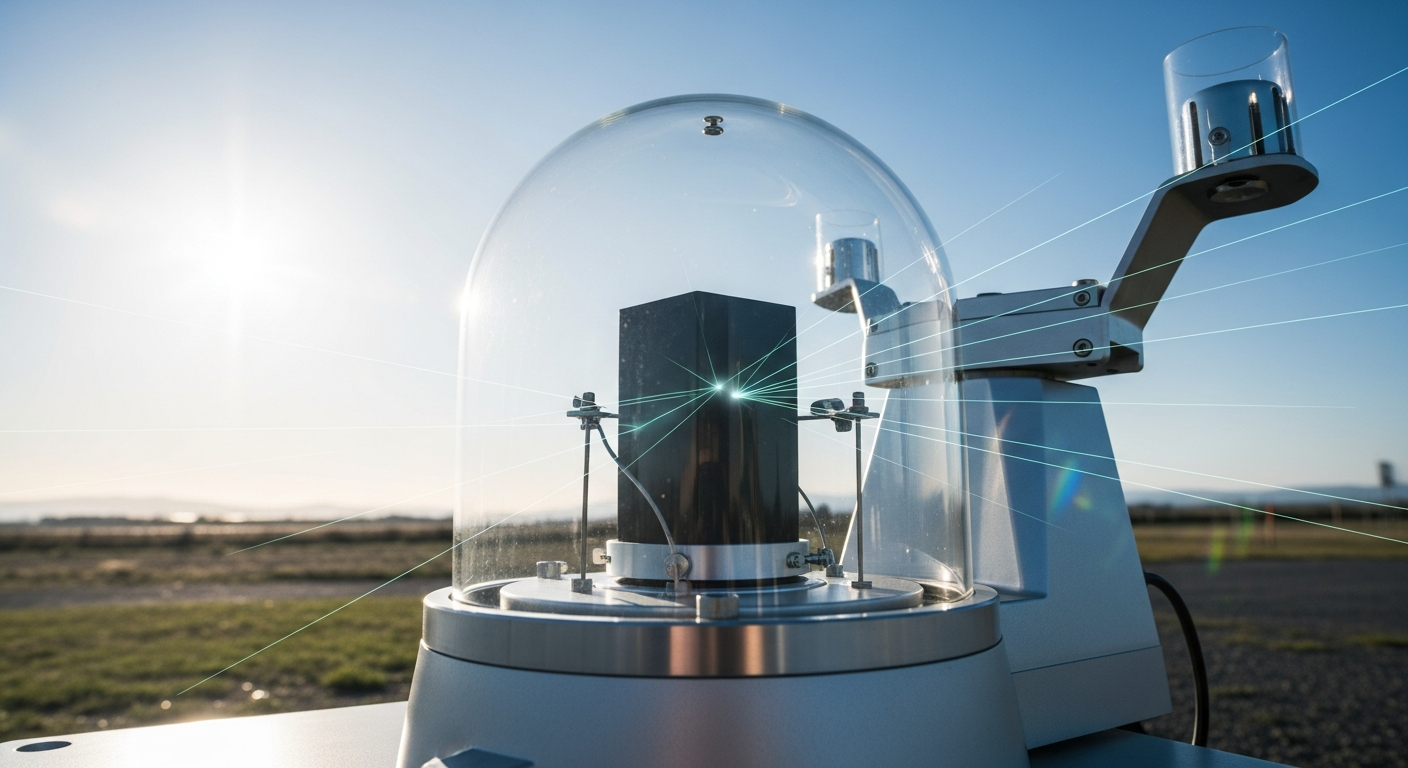
A pyranometer is a type of radiometer designed to measure the total solar irradiance on a planar surface and is a key instrument for capturing the sum of direct and diffuse solar radiation. The term “pyranometer” is derived from the Greek words “pyr” (fire) and “ano” (above), essentially meaning “fire from above” meter.
How Pyranometers Work: The Thermopile Principle
The fundamental principle behind most pyranometers is the thermopile. A thermopile is a sensor that converts thermal energy into electrical energy. Here’s a breakdown of its operation:
- Black Absorber: The heart of a pyranometer is a horizontal, flat sensor surface coated with a highly absorptive black material. This coating is designed to absorb nearly all incoming solar radiation across a wide spectral range.
- Thermal Conversion: When solar radiation strikes this black surface, its energy is absorbed and converted into heat.
- Thermopile Junctions: The black absorber is thermally connected to a thermopile. A thermopile consists of multiple thermocouples connected in series. Each thermocouple is made of two dissimilar metals joined at two points (junctions). One set of junctions is located directly beneath the heated black surface (hot junctions), while the other set is connected to the pyranometer’s body, which acts as a reference temperature (cold junctions).
- Voltage Generation: According to the Seebeck effect, a temperature difference between the hot and cold junctions creates a small voltage. Since multiple thermocouples are in series, these small voltages add up to produce a measurable output voltage.
- Direct Proportionality: The magnitude of this output voltage is directly proportional to the amount of solar radiation (irradiance) hitting the black absorber. The greater the solar radiation, the hotter the absorber becomes relative to the cold junctions, and thus, the higher the voltage output.
Key Components and Their Functions
Beyond the thermopile, a pyranometer incorporates several other critical components to ensure accurate and reliable measurements:
- Glass Domes: Pyranometers typically feature one or two transparent glass domes. These domes serve several vital purposes:
- Spectral Filtering: They allow shortwave solar radiation (0.3 to 3.0 µm, which includes UV, visible, and near-infrared) to pass through while blocking longwave infrared radiation (heat emitted by the instrument itself or the surroundings) from reaching the sensor, ensuring only solar radiation is measured.
- Thermal Isolation: They create an insulated air cavity around the thermopile, reducing the influence of wind and ambient temperature fluctuations on the sensor’s temperature.
- Environmental Protection: They protect the delicate black coating and thermopile from dust, dirt, moisture, and physical damage.
- Desiccant: Inside the pyranometer housing, a desiccant (often silica gel) is present. Its role is to absorb any moisture that might enter the instrument, preventing condensation on the inner surface of the domes, which could impair readings.
- Leveling Mechanism: Since pyranometers measure GHI on a horizontal plane, it’s crucial that they are perfectly level. Most units come with an integrated spirit level and adjustable leveling screws for precise installation.
- Body/Housing: A robust, weather-resistant housing protects the internal components and provides a stable platform for mounting.
Types of Pyranometers: ISO Classification
Pyranometers are classified according to their accuracy and performance characteristics, primarily by the International Organization for Standardization (ISO) in standard ISO 9060. The common classes include:
- Secondary Standard: The highest accuracy class, used for reference measurements, scientific research, and calibrating other pyranometers. They exhibit excellent spectral response, temperature dependence, and response time.
- First Class: High-performance instruments suitable for demanding applications like performance monitoring of large solar power plants, precise meteorological measurements, and research. They offer good accuracy with manageable temperature dependence and response time.
- Second Class: Entry-level instruments, more economical, suitable for general meteorological measurements, agricultural applications, or less critical solar energy monitoring where absolute precision is not the primary requirement. They have wider tolerances for spectral response and temperature dependency.
Choosing the right class depends on the specific application’s accuracy requirements and budget.
Applications Across Industries: Where Pyranometers Shine
The versatility and accuracy of pyranometers make them indispensable tools across a wide array of sectors. Their ability to precisely quantify total solar radiation underpins critical decisions and advancements in numerous fields.
Solar Energy Sector
This is arguably where pyranometers have the most profound impact. The solar energy industry relies heavily on accurate solar resource assessment at every stage of a project lifecycle.
- Site Selection and Feasibility Studies: Before investing in a solar power plant, developers use pyranometers to collect long-term irradiance data at potential sites. This data helps assess the solar resource availability, estimate annual energy yield, and determine the economic viability of a project.
- Performance Monitoring: Once a solar PV or CSP plant is operational, pyranometers are installed alongside the panels to continuously monitor the actual incident solar radiation. By comparing the measured irradiance with the plant’s power output, operators can calculate the actual performance ratio and identify any underperformance issues, such as soiling, degradation, or system malfunctions.
- Forecasting and Grid Management: Real-time and forecasted GHI data from pyranometers are crucial for predicting solar power generation, allowing grid operators to manage intermittent renewable energy sources effectively and maintain grid stability.
- Research and Development: Pyranometers are vital in testing new PV technologies, panel designs, and mounting configurations to evaluate their efficiency and durability under various irradiance conditions.
Meteorology and Climate Research
For meteorologists and climate scientists, pyranometers provide essential data points for understanding atmospheric processes and predicting weather patterns.
- Weather Forecasting: GHI data contributes to models that predict cloud cover, surface temperatures, and potential for solar heating, impacting local weather forecasts.
- Climate Modeling: Long-term records of solar radiation are fundamental for climate scientists to study variations in Earth’s energy balance, understand the effects of aerosols and greenhouse gases on radiation transmission, and refine climate models that predict future climate scenarios.
- Atmospheric Studies: Researchers use pyranometers to investigate atmospheric turbidity, ozone depletion, and the effects of pollution on solar radiation reaching the surface.
Agriculture and Hydrology
In agriculture, solar radiation is a primary factor influencing plant growth, water usage, and crop yields.
- Crop Optimization: Farmers and agronomists use pyranometer data to determine optimal planting times, assess light availability for different crops, and manage greenhouse environments for maximum yield.
- Irrigation Scheduling: Solar radiation directly influences evapotranspiration rates (the sum of evaporation and plant transpiration). Pyranometer data helps calculate these rates, allowing for more efficient irrigation practices and water resource management.
- Disease Prevention: Understanding solar radiation levels can also aid in predicting conditions favorable for certain plant diseases.
Architecture and Building Design
Architects and building designers leverage solar radiation data to create more energy-efficient and comfortable living and working spaces.
- Passive Solar Design: Pyranometer data informs the orientation, window sizing, and shading strategies of buildings to maximize natural daylighting and heating in winter while minimizing overheating in summer.
- Energy Efficiency: Helps in selecting appropriate glazing materials and insulation strategies to control solar heat gain and loss, reducing the need for artificial lighting and HVAC systems.
- Urban Planning: Used to assess solar access in urban environments, ensuring adequate sunlight for public spaces and preventing excessive shadowing from new constructions.
Material Science and Industrial Applications
Pyranometers also play a role in evaluating the durability of materials exposed to sunlight.
- Material Testing: Used in laboratories and outdoor test sites to assess the degradation of paints, plastics, textiles, and other materials when exposed to UV and visible solar radiation over time.
- Product Development: Aids manufacturers in developing products that can withstand prolonged solar exposure without significant wear or damage.
From powering our homes to predicting our weather and growing our food, pyranometers provide the foundational data that empowers innovation and informed decision-making across an astonishing range of human endeavors.
Ensuring Accuracy and Reliability: Calibration and Maintenance
The utility of a pyranometer hinges entirely on the accuracy and reliability of its measurements. Even the most sophisticated instrument can produce erroneous data if not properly calibrated and maintained. This section delves into the critical practices that ensure a pyranometer consistently delivers dependable results.
The Critical Role of Calibration
Calibration is the process of comparing the readings of a pyranometer against a known standard to determine its measurement accuracy and adjust its output if necessary. It establishes the sensor’s sensitivity (measured in µV per W/m²), which is crucial for converting the voltage output into meaningful irradiance values (W/m²).
- Why it’s Crucial:
- Accuracy Assurance: Ensures that the data collected is true and comparable to other instruments and standards.
- System Performance: For solar energy systems, inaccurate pyranometer data can lead to misjudgments of plant performance, financial losses, or incorrect maintenance decisions.
- Compliance: Many industry standards, particularly in solar energy and meteorology, require regular calibration to maintain certification and validity of data.
- Drift Compensation: Over time, sensor sensitivity can drift due to environmental exposure, material aging, or component wear. Calibration accounts for this drift.
- Calibration Frequency: It is generally recommended to calibrate pyranometers every 1-2 years, or more frequently if used in harsh environments, for critical applications, or if there’s any suspicion of damage or drift.
- Calibration Standards: Calibration is typically performed under controlled conditions against a reference pyranometer that has been calibrated to a primary standard, such as the World Radiometric Reference (WRR) maintained by the World Radiation Center (WRC) in Davos, Switzerland. ISO 9847 specifies the method for calibrating field pyranometers.
Practical Tip: Always send your pyranometers to an accredited calibration laboratory that can provide traceability to national and international standards. Keep detailed records of all calibration certificates.
Essential Maintenance Practices
Regular maintenance is key to prolonging the life of a pyranometer and ensuring its continuous accuracy. Neglecting maintenance can lead to significant measurement errors, regardless of the instrument’s initial quality.
- Cleaning the Dome: This is arguably the most critical and frequent maintenance task. Dust, dirt, pollen, bird droppings, frost, or snow on the glass dome can significantly reduce the amount of solar radiation reaching the sensor, leading to underestimation of GHI.
- Actionable Advice: Clean the outer dome surface regularly (daily or weekly, depending on the environment) using a soft, lint-free cloth or lens tissue moistened with distilled water or isopropyl alcohol. Avoid abrasive materials that could scratch the glass.
- Checking the Desiccant: The desiccant inside the pyranometer prevents internal condensation. Most desiccants change color when saturated (e.g., from blue to pink/clear).
- Actionable Advice: Periodically inspect the desiccant cartridge. Replace or regenerate the desiccant when it indicates saturation, typically every 6-12 months.
- Verifying Leveling: Any tilt in the pyranometer will cause it to measure a component of the GHI rather than the true GHI on a horizontal plane, leading to inaccurate readings.
- Actionable Advice: Regularly check the integrated spirit level and adjust the leveling screws as needed to ensure the pyranometer is perfectly horizontal. This is especially important after strong winds or physical disturbances.
- Cable and Connector Inspection: Ensure all cables are secure, free from damage (fraying, cracks), and that connectors are clean and tight. Loose or damaged connections can introduce electrical noise or complete signal loss.
- Avoiding Shading: Ensure no objects (trees, buildings, other instruments, mounting poles, or even the pyranometer’s own mounting hardware) cast shadows on the sensor at any time of the day or year.
- Actionable Advice: Conduct a horizon scan at the installation site and review the solar path throughout the year to identify potential shading issues. Mount the pyranometer in an area with a clear, unobstructed view of the sky.
Common Challenges and Troubleshooting
- Drifting Readings: Could indicate a need for recalibration, internal moisture, or aging components.
- Low or Zero Readings: Check cable connections, power supply (if active sensor), and for heavy soiling or obstruction.
- Inconsistent Readings: May point to unstable mounting, intermittent electrical connections, or rapid temperature changes affecting the sensor.
By diligently adhering to a rigorous calibration schedule and implementing routine maintenance practices, users can maximize the lifespan and accuracy of their pyranometers, ensuring the integrity of their solar radiation data for years to come.
Selecting the Right Pyranometer and Best Practices for Deployment
Choosing the appropriate pyranometer and deploying it correctly are crucial steps to ensure the integrity and relevance of your solar radiation data. A mismatch between the instrument’s capabilities and the application’s requirements, or a poorly executed installation, can negate the benefits of even the highest-quality device.
Factors to Consider When Selecting a Pyranometer
Before purchasing, carefully evaluate your specific needs against the available options:
- Accuracy Requirements (ISO Class):
- For high-precision research, calibration, or financial-grade performance monitoring of large solar farms, a Secondary Standard or First Class pyranometer is essential.
- For general meteorological applications, agricultural studies, or non-critical solar installations, a Second Class pyranometer might suffice, offering a more cost-effective solution.
- Spectral Response: Ensure the pyranometer’s spectral response matches the range of solar radiation you intend to measure. Standard pyranometers are designed for the shortwave solar spectrum (0.3 to 3.0 µm).
- Temperature Dependence: All pyranometers have some degree of temperature dependence, meaning their sensitivity can change with ambient temperature. High-quality pyranometers minimize this effect or include built-in compensation. If your application involves wide temperature swings, consider models with superior temperature stability or integrated temperature correction.
- Response Time: This refers to how quickly the pyranometer reacts to changes in solar radiation. For measuring rapidly changing irradiance (e.g., during partly cloudy conditions), a fast response time is desirable. Most pyranometers have response times ranging from a few seconds to tens of seconds.
- Cost and Budget: Higher accuracy and better performance generally come with a higher price tag. Balance your accuracy needs with your budgetary constraints.
- Output Signal and Data Logging Compatibility:
- Most pyranometers output a low-voltage analog signal (mV). Ensure your data logger or monitoring system can accurately read this signal.
- Some modern pyranometers offer digital outputs (e.g., Modbus RTU via RS-485), which can simplify integration and reduce noise.
- Consider the power requirements of the pyranometer and your data logger.
- Environmental Robustness: Assess the environmental conditions at the deployment site (extreme temperatures, humidity, dust, salinity). Choose a pyranometer built to withstand these conditions, with appropriate IP ratings for dust and water ingress protection.
Best Practices for Pyranometer Deployment
Proper installation is paramount for obtaining representative and accurate data.
- Unobstructed View:
- The pyranometer must have a complete, unobstructed hemispherical view of the sky (180 degrees from horizon to horizon).
- Actionable Advice: Perform a “horizon survey” to identify any potential obstructions (buildings, trees, mountains, utility poles, antennas, other sensors) that could shade the pyranometer at any time of day or year. Account for the sun’s path throughout the seasons.
- Optimal Mounting Location:
- Mount the pyranometer on a stable, vibration-free mast or platform. Vibrations can cause sensor noise.
- Avoid mounting near surfaces that reflect significant solar radiation (e.g., light-colored walls, large bodies of water) unless specifically trying to measure reflected radiation.
- Ensure easy accessibility for routine cleaning and maintenance.
- Precise Leveling:
- As previously mentioned, the pyranometer must be perfectly level to measure Global Horizontal Irradiance (GHI).
- Actionable Advice: Use the integrated spirit level and adjustment screws to fine-tune the instrument’s horizontal alignment. Re-check periodically, especially after severe weather events.
- Cable Management:
- Route cables securely to prevent damage from wind, animals, or personnel.
- Use UV-resistant cable ties and conduits where necessary.
- Avoid running sensor cables parallel to power cables to minimize electromagnetic interference.
- Integrating with Data Acquisition Systems:
- Ensure the data logger’s input range matches the pyranometer’s output signal range.
- Configure the data logger to sample data at an appropriate interval (e.g., 1-minute averages are common for solar energy applications).
- Program the data logger with the pyranometer’s sensitivity factor (from its calibration certificate) to convert raw voltage readings into W/m².
- Regular Data Review:
- Continuously monitor the collected data for anomalies. Sudden drops, prolonged zeros, or unusually high readings can indicate an issue with the sensor, cabling, or data logger.
- Actionable Advice: Implement automated data quality checks within your monitoring software to flag potential problems.
By carefully considering these selection criteria and adhering to best deployment practices, you can maximize the accuracy and reliability of your solar radiation measurements, providing a solid foundation for your research, energy projects, or environmental monitoring efforts.
Conclusion
The sun’s ceaseless energy is a gift, and understanding its magnitude at Earth’s surface is foundational to a host of critical applications. From the colossal solar farms powering our grids to the subtle shifts in atmospheric science, the pyranometer stands as the silent guardian of this vital data. We’ve explored how these ingenious devices, rooted in the thermopile principle, meticulously capture total solar radiation, providing the backbone for decision-making across solar energy, meteorology, agriculture, and sustainable design. The choice of pyranometer and its deployment are not trivial considerations; they are pivotal steps in ensuring the integrity of the data. With proper selection, rigorous calibration, and diligent maintenance, these instruments continue to provide the indispensable insights we need to harness solar power efficiently, forecast our climate accurately, and build a more sustainable future. As our reliance on solar energy grows, so too does the enduring and essential role of the pyranometer in illuminating our path forward.