
In the intricate world of greenhouse cultivation, where every drop of water and nutrient counts, achieving perfect uniformity in irrigation is often the holy grail. Imagine a greenhouse where some plants thrive with ample hydration while others languish from thirst or suffer from overwatering – an all-too-common scenario that leads to uneven growth, wasted resources, and diminished yields. This challenge becomes particularly pronounced in larger operations, on sloped terrains, or with lengthy irrigation lines. Fortunately, a sophisticated solution exists: pressure compensating (PC) emitters. These ingenious devices are revolutionizing how growers deliver water, ensuring that every single plant, regardless of its position in the irrigation line, receives the exact amount of water and nutrients it needs, precisely when it needs it.
Understanding the Challenge: Why Uniformity Matters (and Why it’s Hard)
The success of any greenhouse operation hinges significantly on the health and vigor of its plants, and at the core of this health lies consistent, adequate hydration. Non-uniform water distribution can lead to a cascade of problems that undermine productivity and profitability.
The Consequences of Uneven Watering
- Inconsistent Plant Growth and Yields: Some plants will be stunted, while others might suffer from root rot, leading to a patchwork of health across your crops. This directly impacts harvest quality and quantity.
- Wasted Resources: Over-watering in some areas means valuable water and expensive nutrients literally go down the drain. This not only increases operational costs but also raises environmental concerns regarding runoff.
- Increased Disease Risk: Patches of consistently wet soil can create ideal conditions for fungal diseases and pest infestations, requiring more aggressive (and costly) interventions. Conversely, drought-stressed plants are also more susceptible to certain diseases.
- Labor Inefficiency: Growers often resort to manual adjustments, spot watering, or longer irrigation cycles to compensate for non-uniformity, consuming valuable labor hours that could be better spent elsewhere.
The Root Causes of Non-Uniformity
Several factors conspire against achieving perfect water distribution with conventional irrigation systems:
- Pressure Fluctuations: This is the primary culprit. As water travels through long lines, friction causes pressure loss. Additionally, elevation changes mean higher pressure at lower points and lower pressure at higher points. Standard emitters deliver more water at higher pressures and less at lower pressures, leading to significant variations.
- Lengthy Irrigation Runs: The longer the drip line, the greater the potential for pressure loss from one end to the other.
- Elevation Changes: Even slight inclines or declines in a greenhouse can cause notable pressure differences, affecting emitter output.
- Manifold Design: Poorly designed mainlines and sub-mainlines can lead to uneven distribution of water to different irrigation zones.
Traditional, non-pressure compensating emitters are simply unable to overcome these challenges, delivering inconsistent flow rates that directly translate into inconsistent plant health.
The Genius of Pressure Compensating Emitters: How They Work
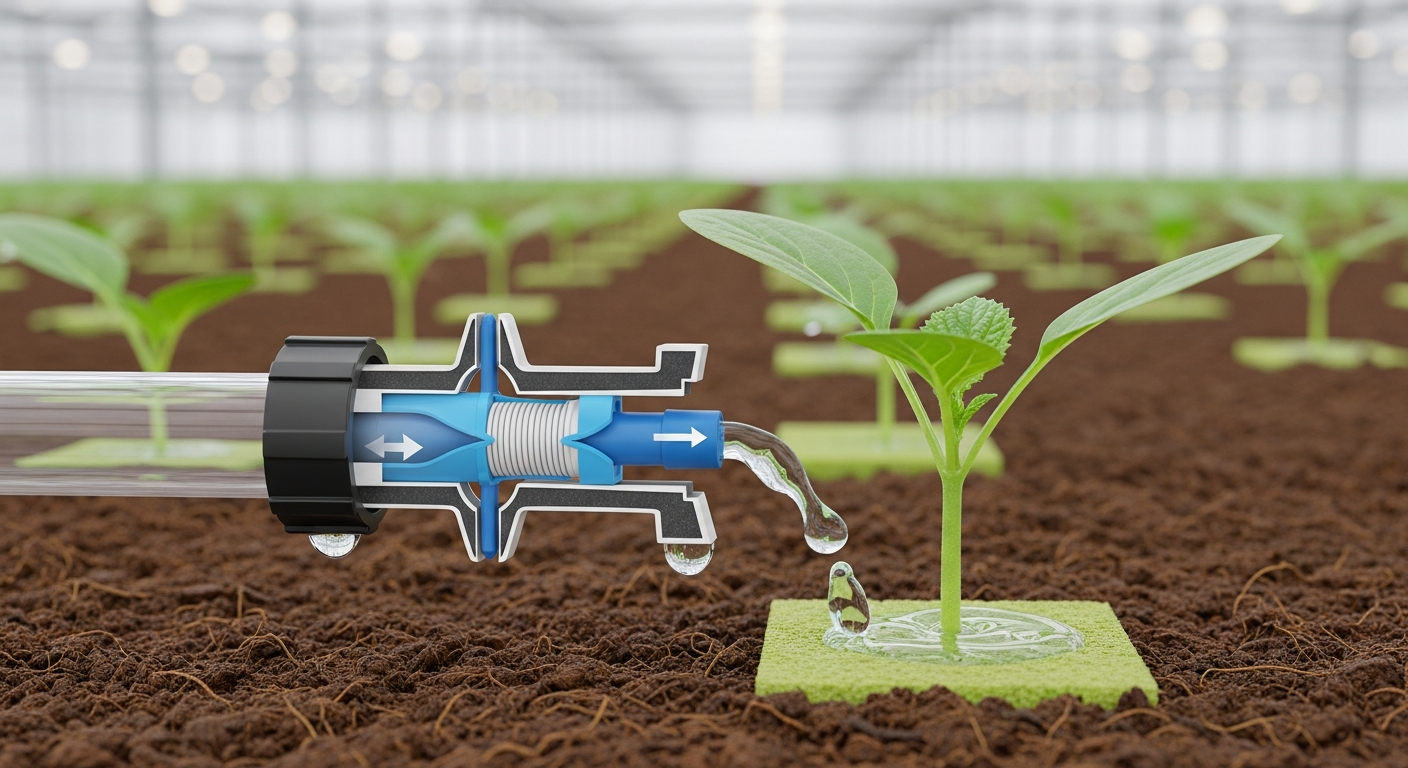
At the heart of a pressure compensating (PC) emitter lies a simple yet ingenious mechanism designed to defy the laws of varying pressure. Unlike conventional emitters, which merely have a fixed orifice, PC emitters incorporate a flexible, self-regulating diaphragm or a complex labyrinth pathway.
The Inner Workings
When water enters a PC emitter, it encounters this specialized component. Here’s how it typically functions:
- At Lower Pressures: The flexible diaphragm or labyrinth expands slightly, effectively widening the internal flow path. This allows the water to pass through with less resistance, helping to maintain a consistent flow rate even when the overall system pressure is lower.
- At Higher Pressures: Conversely, when the system pressure is higher, the diaphragm compresses or the labyrinth contracts, narrowing the flow path. This increased resistance restricts the flow, preventing an excessive amount of water from being delivered.
This dynamic adjustment ensures that the emitter delivers a predefined, consistent flow rate (e.g., 0.5 GPH, 1 GPH) across a wide range of incoming water pressures. Most PC emitters are rated for a specific operating pressure range, within which they will maintain their advertised flow rate with remarkable precision. This consistency is what sets them apart, making them an indispensable tool for uniform water distribution.
Distinguishing Features and Types
Beyond the core pressure compensating mechanism, PC emitters come in various forms to suit different greenhouse setups:
- Drip Emitters: These are the most common type, delivering water directly to the root zone slowly. They can be
online emitters (punched into the main drip line) orinline emitters (integrated within the drip line itself). - Self-Flushing Mechanism: Many PC emitters are designed with a self-flushing feature, which helps to clear out small particles at the beginning and end of each irrigation cycle, significantly reducing the risk of clogging and ensuring long-term reliability.
- Anti-Drain Back (Check Valve) Options: Some advanced PC emitters include a check valve that prevents water from draining out of the dripper line when the system shuts off. This is particularly useful in systems with elevation changes, as it prevents water from rushing to the lowest points and ensures the system fills evenly upon startup.
Understanding these mechanisms highlights how PC emitters effectively neutralize the impact of pressure variations, providing a foundational technology for precise greenhouse irrigation.
Key Benefits of Integrating PC Emitters in Your Greenhouse
The strategic implementation of pressure compensating emitters offers a multitude of advantages that translate directly into enhanced operational efficiency and superior crop performance in any greenhouse climate control strategy.
Optimal Plant Health and Yield
- Consistent Growth: By ensuring every plant receives the same amount of water and nutrients, PC emitters promote uniform growth patterns, leading to a more homogenous crop. This makes harvesting easier and improves overall product consistency.
- Reduced Plant Stress: Eliminating areas of over- or under-watering drastically reduces plant stress, making plants healthier, more resilient, and less susceptible to environmental challenges.
- Maximized Yield Potential: When plants are consistently watered and fed optimally, they can dedicate more energy to growth and fruit production, leading to higher yields and better quality produce.
Water and Nutrient Efficiency
- Significant Water Savings: With precise control over water delivery, there’s no wasteful runoff or evaporation from over-application. This is crucial in regions with water restrictions or for growers focused on sustainability.
- Efficient Nutrient Delivery: PC emitters are ideal for
fertigation – the delivery of nutrients through the irrigation water. By ensuring uniform water delivery, you guarantee that every plant receives an equal share of costly fertilizers, maximizing their uptake and minimizing waste. - Reduced Leaching: Precise application prevents excess water from flushing valuable nutrients below the root zone, keeping them available for plant uptake.
Labor and Cost Savings
- Less Manual Adjustment: The self-regulating nature of PC emitters reduces the need for constant monitoring and manual intervention to balance water distribution.
- Fewer Plant Losses: A uniform environment means fewer plants suffering from water-related issues, reducing replacement costs and improving overall crop success rates.
- Optimized Fertilizer Use: By eliminating nutrient waste through efficient delivery, growers can often reduce their overall fertilizer expenditure.
- Energy Savings: In some cases, more efficient water usage can translate to less pumping time, indirectly saving energy costs.
System Flexibility and Longevity
- Adaptability to Topography: PC emitters shine in greenhouses with uneven terrain, allowing a single irrigation zone to effectively water plants at different elevations without compromising uniformity.
- Longer Drip Lines: They enable the use of much longer drip lines than conventional emitters, simplifying system design and reducing the number of sub-mainlines required, which can save on materials and installation time.
- Reduced Clogging: Many PC emitters incorporate self-flushing mechanisms, which significantly extend their operational life and reduce maintenance requirements.
By investing in PC emitters, growers are not just upgrading their irrigation system; they are investing in the overall health, productivity, and sustainability of their greenhouse operations.
Choosing and Implementing PC Emitters: Practical Considerations
While the benefits of pressure compensating emitters are clear, successful integration requires thoughtful planning and execution. Here’s practical advice for selecting and deploying these crucial components.
Selecting the Right PC Emitters
The market offers a variety of PC emitters, and choosing the best fit depends on your specific greenhouse setup and plant requirements:
- Flow Rate: Emitters are available in various flow rates (e.g., 0.5 GPH, 1 GPH, 2 GPH). Your choice should align with the water requirements of your specific crops and the water retention capabilities of your growing medium. Plants in coco coir may require higher flow rates and more frequent applications than those in rockwool or soil.
- Emitter Spacing: Determine the ideal spacing based on your plant density, root zone spread, and the water spread pattern of the chosen emitter. For closely spaced plants, closer emitter spacing or multi-outlet emitters might be necessary.
- Online vs. Inline:
- Online Emitters: These are punched directly into the drip tubing. They offer flexibility for custom spacing and can be easily replaced or added. Ideal for individual pots or widely spaced plants.
- Inline Emitters: These are built into the drip tubing itself at fixed intervals. They are convenient for row crops or continuous planting beds where consistent spacing is desired.
- Self-Flushing and Anti-Drain Back Features: Prioritize emitters with self-flushing capabilities, especially if your water source is prone to sediment. Anti-drain back features are highly beneficial for systems with significant elevation changes, preventing uneven draining and ensuring rapid, uniform watering upon restart.
System Design Considerations
Effective integration goes beyond just the emitters themselves:
- Water Source and Filtration: PC emitters are durable, but clean water is paramount. Install a robust filtration system (e.g., screen filter, disc filter) appropriate for your water source to prevent clogging, even with self-flushing emitters. Regularly clean or backflush your filters.
- Pressure Regulation: While PC emitters handle pressure variations, maintaining an optimal and stable system pressure within their recommended operating range is still crucial for peak performance. Install a pressure regulator at the head of your irrigation zones.
- Main and Lateral Line Sizing: Properly size your main lines and lateral lines to minimize excessive pressure loss before the water reaches the emitters. Consult flow charts and irrigation design principles to ensure adequate pressure and flow to all zones.
- Zone Design: Divide your greenhouse into manageable irrigation zones based on plant water needs, sun exposure, and elevation changes. This allows for precise control over watering schedules.
Maintenance Tips for Longevity
- Regular Flushing: Even with self-flushing emitters, periodically flush your drip lines by removing end caps to clear any accumulated debris.
- Inspect for Clogs: Visually inspect emitters for blockages or reduced flow. Algae, sediment, or mineral buildup can occur over time.
- Acid Treatment (if necessary): If you have hard water, mineral buildup can be an issue. Periodically flushing with a mild acid solution (specifically formulated for irrigation systems) can help prevent or clear blockages.
- Winterization: In colder climates, properly drain and winterize your irrigation system to prevent freeze damage to emitters and tubing.
By paying attention to these practical aspects, you can ensure your PC emitter system operates flawlessly, providing consistent uniform water distribution for years to come.
Conclusion: The Smart Choice for Sustainable Greenhouse Cultivation
In the dynamic and demanding environment of greenhouse cultivation, precision is not just a luxury; it’s a necessity. The role of pressure compensating emitters in achieving truly uniform water distribution cannot be overstated. By intelligently mitigating the challenges of pressure fluctuations, long runs, and varied topography, these innovative devices empower growers to deliver consistent hydration and nutrition to every plant, every time.
The benefits are clear and compelling: from fostering optimal plant health and maximizing yields to significantly conserving valuable water and nutrient resources, PC emitters are a cornerstone of efficient and sustainable greenhouse operations. They reduce labor, minimize disease risk, and provide the flexibility needed for modern, high-tech growing environments. For any greenhouse enthusiast or commercial grower committed to excellence, investing in a well-designed irrigation system featuring pressure compensating emitters is a smart, strategic decision that pays dividends in productivity, profitability, and environmental stewardship.