
In the controlled environment of a modern greenhouse, every variable plays a crucial role in plant health and productivity. Among the most fundamental are light and water. While their individual importance is widely understood, their intricate relationship – particularly how light intensity directly influences a plant’s demand for water – is a cornerstone of advanced greenhouse management. For those utilizing automated watering systems, understanding this dynamic isn’t just beneficial; it’s essential for optimizing growth, conserving resources, and preventing common cultivation issues. Let’s delve into how the sun’s (or your grow lights’) energy dictates how thirsty your plants truly are.
The Core Connection: Light, Photosynthesis, and Transpiration
At the heart of a plant’s existence are two vital processes: photosynthesis and transpiration. Light intensity acts as a primary trigger and accelerator for both, directly impacting a plant’s physiological water needs.
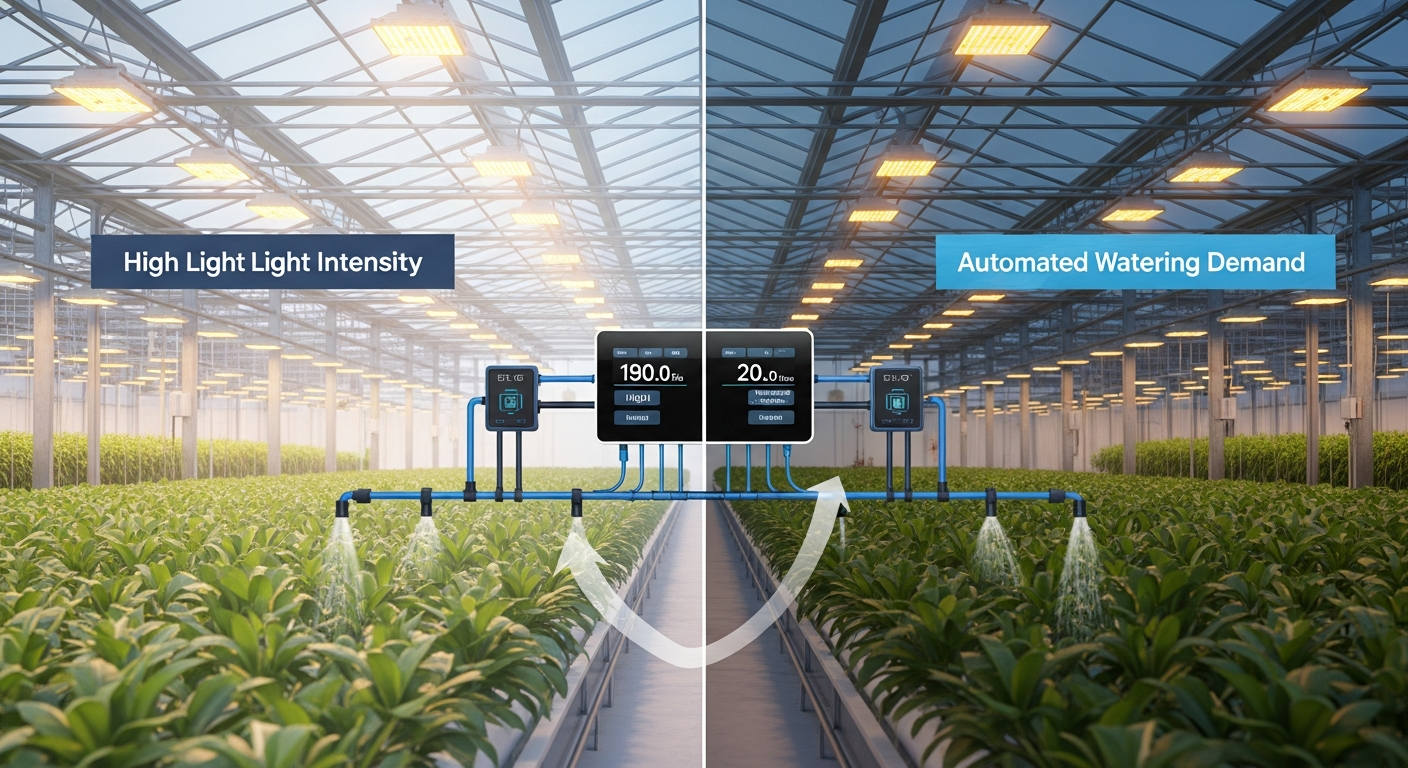
Light’s Role in Photosynthesis
Photosynthesis is the process by which plants convert light energy into chemical energy, creating sugars they use for growth and development. This incredible transformation requires carbon dioxide (CO2) from the air and water (H2O) from the soil. The brighter the light (up to a saturation point specific to the plant), the more efficiently a plant can photosynthesize, assuming other factors like CO2 and nutrients are adequate. Increased photosynthetic activity means a higher demand for CO2, which in turn means the plant needs to open its stomata more frequently or for longer durations.
Transpiration: The Plant’s Cooling System and Water Mover
Transpiration is the process where water vapor exits the plant, primarily through tiny pores on its leaves called stomata. This process serves several critical functions: it pulls water and dissolved nutrients from the roots to the leaves, and it helps cool the plant, much like sweating cools animals. When stomata open to take in CO2 for photosynthesis, water inevitably escapes. Therefore, a direct correlation exists: the more light, the more photosynthesis, the more open stomata, and thus, the higher the rate of transpiration and subsequent water loss.
Factors like Vapor Pressure Deficit (VPD), air temperature, and humidity also heavily influence transpiration rates, but light intensity often acts as the initial trigger for stomatal opening, setting the stage for increased water movement.
How Light Intensity Influences Water Demand
The impact of light on watering demand isn’t just theoretical; it translates directly into practical considerations for your automated irrigation system.
Direct Impact: More Light, More Water Uptake
As established, higher light levels stimulate greater photosynthetic activity and increased transpiration. This means plants are actively pulling more water from the growing medium to facilitate these processes. If your automated watering system doesn’t account for these increased demands, plants can quickly become stressed, leading to wilting, nutrient lockout, and stunted growth. Conversely, overwatering can occur during periods of low light, leading to root rot and fungal issues.
Indirect Impact: Temperature and Humidity
Light intensity also has significant indirect effects. Strong light, especially direct sunlight, contributes to increased ambient temperatures within the greenhouse. Higher temperatures can accelerate evaporation from the growing medium and increase the plant’s metabolic rate, both contributing to higher water demand. Furthermore, as temperatures rise, relative humidity often drops, increasing the Vapor Pressure Deficit (VPD) between the leaf and the air, which further drives transpiration.
The Importance of Daily Light Integral (DLI)
While instantaneous light intensity (measured in micromoles per square meter per second, µmol/m²/s, or footcandles) is important for short-term responses, for determining daily watering needs, the Daily Light Integral (DLI) is a more comprehensive metric. DLI measures the total amount of photosynthetically active radiation (PAR) received by a plant over a 24-hour period (expressed in mol/m²/day). A higher DLI generally means higher cumulative photosynthetic activity and, therefore, a greater overall water requirement for that day. Automated watering systems that can integrate DLI data offer a far more accurate and responsive approach to irrigation than those relying solely on a fixed schedule or basic soil moisture sensors.
Integrating Light Data into Automated Watering Systems
For truly optimized greenhouse climate control, automated watering systems must move beyond simple timers or even just soil moisture probes. Integrating light data creates a more intelligent, responsive, and efficient irrigation strategy.
Essential Sensors for Smart Watering
- PAR Sensors (Light Intensity/DLI): These sensors measure the light spectrum most useful for photosynthesis. By tracking these readings over time, your system can calculate DLI and understand the cumulative light exposure plants are receiving.
- Soil Moisture Sensors: While not directly measuring light, these are critical feedback mechanisms. They tell the system the *actual* water content in the root zone, allowing it to adjust watering events based on real-time plant uptake and evaporation.
- Temperature and Humidity Sensors: These are vital for calculating VPD, which, as discussed, is a key driver of transpiration alongside light.
Advanced Control Strategies
Modern automated irrigation systems can leverage data from these sensors in sophisticated ways:
- Light-Driven Scheduling: Instead of fixed schedules, watering can be triggered or adjusted based on DLI thresholds. For instance, if the DLI hits a certain level by midday, the system might anticipate higher water demand and initiate an irrigation cycle.
- Transpiration-Based Models: By combining light intensity, temperature, humidity (VPD), and even CO2 levels, advanced systems can estimate actual plant transpiration rates. This allows for ‘predictive watering’ – giving plants water *before* they show signs of stress, precisely when they need it.
- Volumetric Water Content (VWC) Targets: Soil moisture sensors provide VWC data. An intelligent system can use light data to *adjust* the target VWC or the frequency/duration of watering events needed to maintain optimal VWC levels. For example, during high-light periods, the system might tolerate a slightly lower VWC before irrigating, knowing the plant is actively pulling water, or it might initiate more frequent, smaller irrigation events.
Practical Strategies for Optimizing Watering Based on Light
Implementing a light-responsive watering strategy can significantly enhance plant health and resource efficiency. Here are actionable tips for greenhouse enthusiasts:
Calibrate Your Sensors Regularly
The accuracy of your automated system hinges on the accuracy of its sensors. Regularly calibrate your PAR, soil moisture, temperature, and humidity sensors according to manufacturer guidelines. Inaccurate readings can lead to either over- or under-watering, negating the benefits of automation.
Monitor Plant Health Closely
Even with the most sophisticated automated systems, visual inspection remains invaluable. Look for signs of stress: wilting (underwatering), yellowing leaves, edema, or algae growth on the medium (overwatering). Your plants are the ultimate indicators of whether your system is effectively meeting their needs. Use this feedback to fine-tune your light-driven watering parameters.
Adjust Watering Schedules Seasonally or with Grow Light Changes
Natural light intensity and duration change dramatically with seasons. If you rely primarily on natural light, your automated watering schedules should be dynamic. Similarly, if you introduce or adjust supplemental grow lights, remember that you are significantly increasing the DLI, and your watering strategy must adapt accordingly. Manually override or adjust your system’s parameters to reflect these changes.
Consider Crop-Specific Needs
Different plant species have varying light requirements and water-use efficiencies. A cactus will respond very differently to high light and increased water than a leafy green. Program your automated system with profiles tailored to the specific crops you are growing, recognizing their individual DLI and watering thresholds.
Utilize Predictive Models and Weather Data
Advanced systems can integrate local weather forecasts (for natural light levels) to anticipate future DLI and adjust watering proactively. This predictive capability can prevent stress events before they even begin, especially during unexpected cloudy spells or sudden heatwaves.
Conclusion
The relationship between light intensity and automated watering demand is not just a biological curiosity; it’s a critical operational consideration for any modern greenhouse. By understanding how light drives photosynthesis and transpiration, and by leveraging smart environmental sensors, growers can move beyond guesswork to implement highly efficient, data-driven irrigation strategies. Optimizing this relationship leads to healthier plants, reduced water waste, lower energy consumption (by preventing over-drying or over-saturating growing media), and ultimately, more robust and productive harvests. Embrace the synergy of light and automated watering, and watch your greenhouse thrive.