
In the world of greenhouses, where precise climate control can make the difference between thriving flora and struggling plants, understanding insulation is paramount. It’s not just about keeping the heat in during winter or out during summer; it’s about creating a stable, energy-efficient environment that fosters optimal growth while keeping your utility bills manageable. At the heart of this understanding lies a crucial concept: R-value. While often discussed in home construction, its principles are equally vital for greenhouse enthusiasts looking to optimize their structures. Join us as we delve into the physics of R-value, unraveling what makes a material an effective insulator and how you can harness this knowledge to build or upgrade a more efficient greenhouse.
What is R-Value? The Foundation of Thermal Resistance
Simply put, R-value is a measure of thermal resistance. It quantifies a material’s ability to resist the flow of heat. The “R” stands for resistance, and a higher R-value indicates greater insulating power. This means that a material with an R-value of R-10 will resist heat flow twice as effectively as a material with an R-value of R-5, assuming the same thickness.
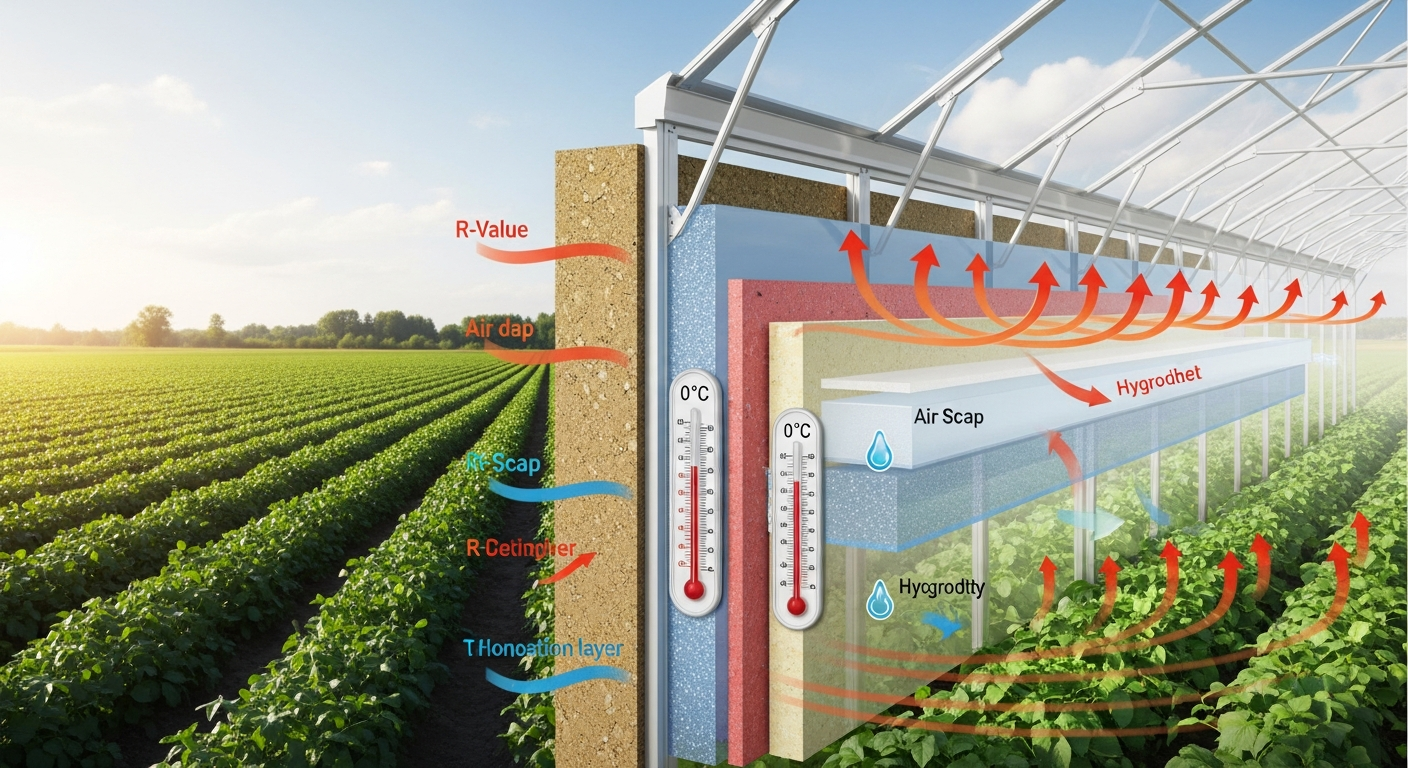
Understanding R-value is critical for greenhouse owners because heat always moves from warmer areas to colder areas. In winter, heat generated inside your greenhouse wants to escape to the colder outdoor air. In summer, the scorching sun’s heat wants to penetrate your cooler interior. Good insulation, characterized by a high R-value, slows down this transfer, maintaining your desired internal temperature more effectively and reducing the energy demands on your heating or cooling systems.
While the specific units for R-value can vary (e.g., US units of ft²·°F·h/BTU vs. metric units of m²·K/W), the underlying principle remains universal: a higher number signifies better insulation performance. When evaluating greenhouse materials, comparing their stated R-values is your first step towards understanding their thermal efficiency.
The Physics Behind R-Value: Conduction, Convection, and Radiation
To truly grasp how R-value works, we need to understand the three primary modes of heat transfer that insulation aims to combat:
Conduction: Heat Through Solids
Conduction is the transfer of heat through direct contact between molecules. Imagine touching a hot stove – heat is conducted directly to your hand. In a greenhouse, heat conducts through the solid materials of your walls, roof, and foundation. Materials with tightly packed molecules that vibrate easily, like metals, are excellent conductors and poor insulators. Materials with more space between molecules, or those that trap air, are poor conductors and good insulators.
- How R-value combats it: Insulation materials are often designed with a low thermal conductivity. They slow down the movement of heat through their physical structure. For instance, multi-wall polycarbonate panels have air pockets that impede direct heat transfer compared to solid glass.
Convection: Heat Through Fluids (Air and Liquids)
Convection involves the transfer of heat through the movement of fluids (liquids or gases). In a greenhouse, warm air inside rises, touches the cooler roof or wall, transfers some heat, cools, and then sinks, creating a convection current. This continuous circulation carries heat away from your growing space.
- How R-value combats it: The most effective insulators trap air or other gases within their structure, preventing it from circulating freely. A sealed, stagnant layer of air is an excellent insulator. This is why double-pane glass or multi-wall polycarbonate with sealed air spaces provides significantly better insulation than single panes – the trapped air greatly reduces convective heat loss.
Radiation: Heat Through Waves
Radiation is the transfer of heat through electromagnetic waves, much like the warmth you feel from the sun or a campfire. All objects emit thermal radiation, and warmer objects emit more. Inside a greenhouse, plants, benches, and the air itself radiate heat, and this radiant energy can pass through transparent materials or be absorbed by opaque surfaces and re-radiated outwards.
- How R-value combats it: Some insulation materials, particularly those with shiny, reflective surfaces (like foil-backed insulation or thermal blankets), are designed to reflect radiant heat rather than absorbing and re-emitting it. These low-emissivity coatings can significantly reduce heat transfer via radiation, reflecting interior heat back into the greenhouse or deflecting exterior solar heat away.
An effective insulation material achieves its R-value by addressing one or more of these heat transfer mechanisms. Understanding this allows you to make informed decisions about material choices for different parts of your greenhouse structure.
Applying R-Value to Your Greenhouse: Materials and Strategies
Knowing the physics is one thing; applying it is another. Here’s how R-value considerations translate into practical choices for your greenhouse:
Common Greenhouse Materials and Their R-Values:
- Single-Pane Glass or Polycarbonate: Typically have very low R-values (around R-0.9 to R-1.5). While they offer excellent light transmission, they are poor insulators, leading to significant heat loss.
- Double-Layer Films (Polyethylene): When inflated with an air gap, two layers of greenhouse film can achieve an R-value of R-1.7 to R-2.0. The trapped air layer significantly improves insulation over a single layer.
- Multi-Wall Polycarbonate (Twin-wall, Triple-wall, Five-wall): These panels feature multiple layers separated by sealed air chambers. As the number of walls increases, so does the R-value.
- Twin-wall (6mm): R-value approx. R-1.5 to R-1.7
- Triple-wall (8mm-16mm): R-value approx. R-2.0 to R-2.8
- Five-wall (16mm-25mm): R-value approx. R-3.0 to R-3.5+
The trapped air in the chambers is key to their superior thermal performance.
- Insulated Panels (Foundation/North Wall): Opaque sections of your greenhouse, especially the foundation and north-facing wall, can benefit from much higher R-values. Materials like rigid foam insulation (polyisocyanurate, extruded polystyrene) can offer R-values of R-4 to R-7 per inch of thickness. An R-15 to R-20 wall can significantly reduce heat loss.
- Bubble Wrap Insulation: While often temporary, horticultural bubble wrap with large, sealed air pockets can provide an effective, albeit lower, R-value (around R-1.5 to R-2.0) for seasonal insulation, particularly for interior lining.
Strategic Insulation Practices:
- Double Glazing or Multi-Wall Panels: If you’re building a new greenhouse or renovating an old one, prioritize double-layer or multi-wall glazing for all transparent surfaces. This is the single most impactful upgrade for improving overall greenhouse insulation efficiency.
- Insulate the Foundation: Heat loss through the ground can be substantial. Burying rigid foam insulation (skirt insulation) around the perimeter of your foundation, extending down 1-2 feet and out 1 foot, creates a thermal break, preventing heat from leaching into the soil.
- Opaque Wall Insulation: For sections of your greenhouse that don’t require light (e.g., the north wall in colder climates, tool shed sections), use highly insulated solid panels. Maximizing the R-value here can drastically cut down on heating costs.
- Seal Air Leaks: Even the highest R-value materials are undermined by drafts. Thoroughly seal all gaps and cracks around doors, vents, and panel seams with weatherstripping, caulk, and sealants. This is crucial for preventing convective heat loss (air infiltration).
- Thermal Curtains/Shades: During cold nights or intense summer days, deploying thermal blankets or reflective shade cloths can significantly enhance your greenhouse’s R-value temporarily. These act as an additional insulating layer and often have reflective properties to combat radiant heat transfer.
Investing in higher R-value materials and smart insulation strategies upfront may seem like an added cost, but it quickly pays for itself through reduced energy consumption, healthier plants, and a more stable growing environment.
Beyond R-Value: Factors for Optimal Greenhouse Climate Control
While R-value is a cornerstone of greenhouse insulation, it’s just one piece of the puzzle. A truly energy-efficient and climate-controlled greenhouse considers several other interconnected factors:
Air Leakage (Infiltration)
As mentioned earlier, drafts and uncontrolled air exchange can negate much of the benefit of high R-value materials. R-value measures heat flow *through* a material, not *around* it. Poorly sealed doors, vents, and panel joints allow warm air to escape and cold air to enter, leading to significant heat loss that isn’t accounted for by R-value alone. Prioritize airtight construction.
Solar Gain
A greenhouse’s primary function is to capture solar energy. During daylight hours, especially on sunny winter days, the sun can provide substantial passive heating. Balancing this solar gain with heat loss is key. While high R-value prevents heat escape, materials must still allow sufficient light penetration. This is where the choice between glass and multi-wall polycarbonate often comes down to balancing light needs with insulation.
Thermal Mass
Materials within your greenhouse that can absorb and store heat during the day and release it slowly at night are called thermal mass. Water barrels painted dark, stone walls, or even dense concrete floors can help stabilize temperatures, effectively “flattening” temperature swings and reducing the demand on your heating system. This isn’t directly related to R-value but works in conjunction with good insulation.
Heating and Cooling System Efficiency
Even with excellent insulation, an inefficient heating or cooling system will waste energy. Ensure your systems are properly sized for your insulated greenhouse, regularly maintained, and use energy-efficient technologies (e.g., high-efficiency heaters, evaporative coolers, geothermal systems). A well-insulated greenhouse allows a smaller, more efficient system to do the job.
Humidity Control and Condensation
High humidity within a greenhouse can lead to condensation on cooler surfaces. This moisture can reduce the effective R-value of some materials, especially if it saturates fibrous insulation. Furthermore, condensation drips can encourage fungal diseases. Proper ventilation and sometimes supplemental dehumidification are necessary to manage humidity, even though ventilation also entails some heat loss.
By considering all these factors in concert with R-value, you can design and operate a greenhouse that is truly optimized for plant health, energy efficiency, and long-term sustainability.
Conclusion
The R-value is more than just a number; it’s a fundamental principle guiding efficient greenhouse design and operation. By understanding the physics of heat transfer—conduction, convection, and radiation—and how various materials resist these processes, you can make informed decisions about your greenhouse’s construction and insulation strategies. From choosing multi-wall polycarbonate over single-pane glazing to insulating your foundation and sealing every air leak, prioritizing a higher R-value across your greenhouse envelope will lead to substantial energy savings, a more stable growing environment for your plants, and reduced operational costs. Remember, an efficient greenhouse is not only good for your plants but also for your wallet and the planet. Embrace the physics of R-value, and cultivate success in your climate-controlled sanctuary.