
Light is much more than just what meets the eye. It is a fundamental energy source, a catalyst for life, and a complex phenomenon governed by the laws of physics. Yet, our perception and measurement of light can vary drastically depending on its intended application. For millennia, humanity has relied on sunlight, instinctively understanding its vital role. With the advent of artificial lighting, especially in controlled environments and advanced horticultural settings, the science of light measurement has evolved to a critical precision. Two terms frequently arise in this discourse, often leading to confusion: Photon Flux Density (PFD) and Luminous Flux. While both describe aspects of light, they address entirely different phenomena – one focused on the raw quantum energy driving processes like photosynthesis, and the other centered on how that energy is perceived by the human eye. Understanding the nuanced differences between these concepts is not merely an academic exercise; it is essential for anyone involved in lighting design, plant cultivation, or fundamental light research. This article will delve deep into the physics underlying PFD and Luminous Flux, elucidating their definitions, measurement paradigms, and practical applications to empower you with the knowledge to speak the language of light with clarity and precision.
Understanding Light: The Dual Nature and Its Measurement Paradigms
Light as Energy and Particles
At its core, light is a form of electromagnetic radiation, exhibiting a fascinating dual nature: it can behave both as a wave and as a particle. When we speak of light as particles, we refer to discrete packets of energy called photons. Each photon carries a specific amount of energy, which is inversely proportional to its wavelength – shorter wavelengths (like blue light) carry more energy per photon than longer wavelengths (like red light). This understanding of light as a stream of photons is crucial for processes that involve the absorption of light quanta, such as photosynthesis in plants.
The entire spectrum of electromagnetic radiation ranges from radio waves to gamma rays, with visible light occupying only a small segment. However, for specific biological and perceptual processes, different parts of this spectrum hold unique significance. For plants, the Photosynthetically Active Radiation (PAR) spectrum, typically defined as wavelengths between 400 and 700 nanometers, is particularly vital. For humans, the peak sensitivity of our eyes lies within the green-yellow portion of the spectrum, around 555 nanometers, which heavily influences our perception of brightness.
Radiometry vs. Photometry: The Foundational Divide
The distinction between PFD and Luminous Flux fundamentally stems from two different approaches to light measurement: radiometry and photometry. This is perhaps the most critical concept to grasp for understanding why these two metrics diverge so significantly.
- Radiometry: This branch of optical physics deals with the measurement of radiant energy, including light, across the entire electromagnetic spectrum. Radiometric measurements are objective and quantitative, based purely on the physical properties of the light source and its radiation. They quantify the absolute energy or number of photons, regardless of how any observer (human, plant, or sensor) might perceive them. Units like watts (for radiant power) or watts per square meter (for irradiance) are radiometric. When discussing PFD, we are firmly in the radiometric domain, counting the actual photons regardless of their perceived “brightness.”
- Photometry: In contrast, photometry is concerned with the measurement of light as perceived by the human eye. It takes into account the varying sensitivity of the human eye to different wavelengths of light. The human eye does not perceive all colors with equal brightness, even if they carry the same amount of radiant energy. Photometric measurements are weighted by a standardized spectral sensitivity curve known as the CIE photopic luminosity function, V(λ). This curve describes the average human eye’s response to light under normal daylight conditions. Units like lumens (for luminous flux) and lux (for illuminance) are photometric. Luminous Flux, therefore, is a photometric measure.
This foundational divide highlights that while radiometry offers a universal, physical measurement of light, photometry provides a human-centric one. The choice between these paradigms dictates which metric is appropriate for a given application.
Delving into Photon Flux Density (PFD) and PPFD: The Plant Perspective
What is PFD? The Quantum of Light
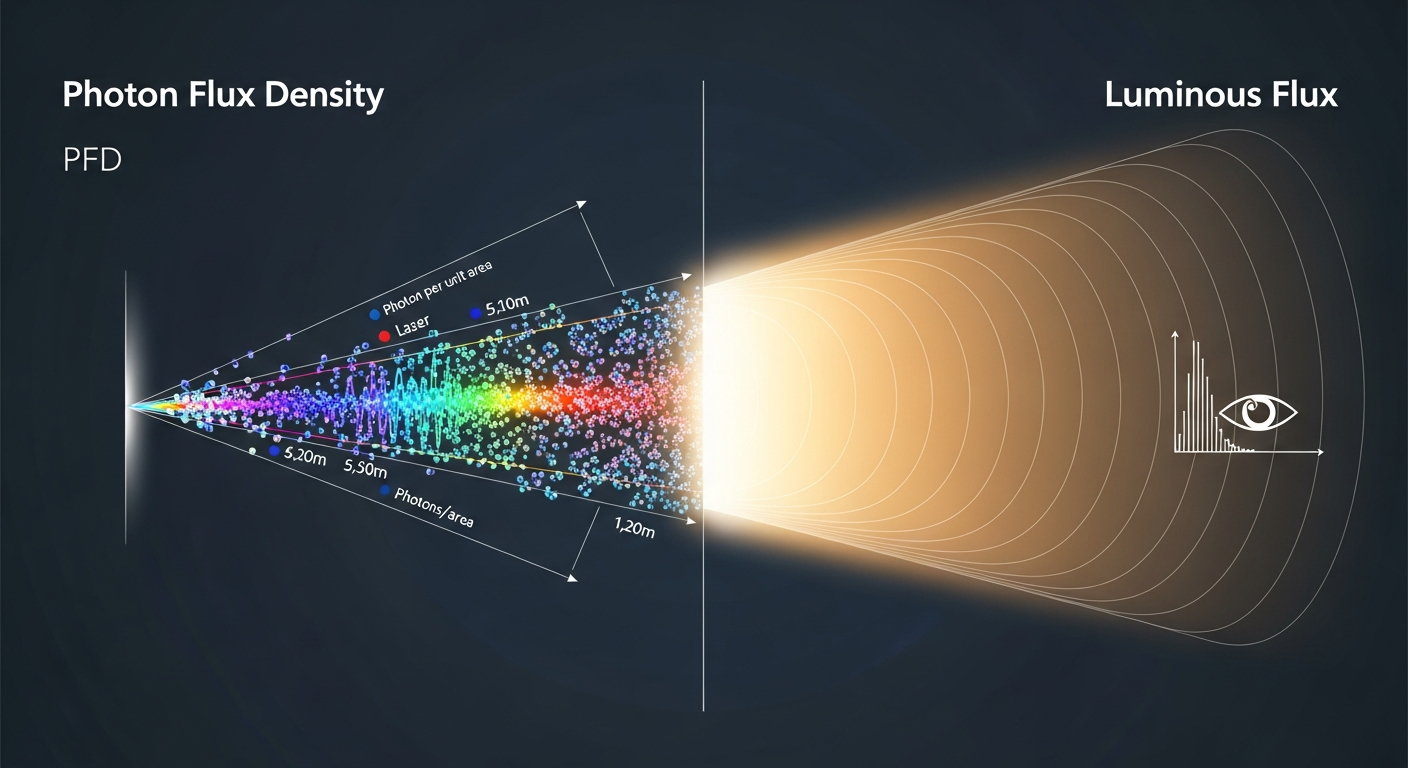
Photon Flux Density (PFD) is a radiometric measure that quantifies the number of photons striking a specific surface area per unit of time. Unlike measures of energy (e.g., Watts/m²), PFD counts the individual light quanta – the photons themselves. This is crucial because many photochemical reactions, especially photosynthesis in plants, depend on the absorption of discrete photons, not just the total energy. Each absorbed photon can trigger a chemical reaction, regardless of its energy level within the photosynthetically active range.
The standard unit for PFD is micromoles per square meter per second (µmol/m²/s). To understand this unit:
- A mole is an SI unit representing a very large number of discrete entities (like atoms or molecules), specifically Avogadro’s number (approximately 6.022 x 10²³).
- A micromole (µmol) is one-millionth of a mole (6.022 x 10¹⁷ photons).
- Thus, µmol/m²/s indicates how many micromoles of photons are landing on one square meter of a surface every second. This provides a direct count of the “light packets” available for biological processes.
PFD is a versatile metric that can be applied to any range of wavelengths. However, when we narrow its focus to the spectrum relevant for plants, we transition to a more specific and widely used term: Photosynthetic Photon Flux Density (PPFD).
The Critical Role of Photosynthetic Photon Flux Density (PPFD)
Photosynthetic Photon Flux Density (PPFD) is a specialized form of PFD that specifically measures the photon flux density within the Photosynthetically Active Radiation (PAR) range, typically defined as wavelengths between 400 and 700 nanometers. This range is critical because it encompasses the wavelengths of light that chlorophyll and other accessory pigments in plants primarily absorb to drive photosynthesis.
Why is PPFD so important for plant growth?
- Direct Correlation to Photosynthesis: PPFD directly quantifies the number of photons available to be captured by plant pigments for photosynthesis. Higher PPFD generally translates to a higher rate of photosynthesis, assuming other environmental factors (CO2, water, nutrients, temperature) are not limiting.
- Spectral Independence within PAR: While the energy content of individual photons varies across the PAR spectrum, plants utilize photons within this range relatively similarly for the initial light-dependent reactions of photosynthesis. Therefore, counting all photons within 400-700 nm provides a robust metric for photosynthetic potential.
- Measurement Tools: PPFD is measured using specialized instruments called quantum sensors or spectroradiometers. Quantum sensors are calibrated to count photons within the 400-700 nm range, providing direct µmol/m²/s readings. Spectroradiometers offer more detailed data, breaking down photon counts by specific wavelengths, which is useful for fine-tuning spectral recipes.
- Daily Light Integral (DLI): PPFD is often integrated over time to calculate the Daily Light Integral (DLI), expressed in moles per square meter per day (mol/m²/day). DLI represents the total number of photosynthetically active photons delivered to a plant canopy over a 24-hour period. It is a critical metric for growers, allowing them to match light delivery with the specific DLI requirements of different crops for optimal growth and yield.
Practical Applications of PFD/PPFD in Horticulture
For modern horticulture, especially in controlled environment agriculture (CEA), indoor farms, and greenhouses, PPFD is the unequivocal standard for evaluating and designing lighting systems. Here are some practical applications:
- Optimizing Grow Lights: When selecting LED grow lights, high-pressure sodium (HPS) lamps, or other horticultural fixtures, growers should prioritize lights with high PPF (Photosynthetic Photon Flux – the total PPFD emitted by the fixture) and excellent PPFD distribution over the plant canopy. A light that outputs high total PPF but distributes it unevenly will lead to inconsistent plant growth.
- Crop-Specific Lighting Recipes: Different plants have different light requirements at various growth stages. By accurately measuring PPFD, growers can tailor lighting schedules and intensities to meet the specific DLI needs of their crops, from propagation to flowering. For instance, leafy greens might thrive at 15-20 DLI, while cannabis or tomatoes might require 30-40 DLI or more.
- Energy Efficiency and Cost Savings: Understanding PPFD allows growers to calculate the Photosynthetic Photon Efficacy (PPE) of a light fixture, expressed in µmol/Joule (micromoles per Joule, or micromoles per Watt-second). A higher PPE means more photosynthetically active photons are produced per unit of electrical energy consumed, leading to greater energy efficiency and lower operational costs.
- Canopy Uniformity and Spacing: PPFD mapping across the grow area helps identify hot spots and low light areas, allowing growers to adjust light fixture height, spacing, or add supplementary lighting to ensure uniform light delivery to all plants.
Practical Tip for Growers: Do not rely solely on wattage or “lumens” when purchasing grow lights. Always demand and compare PPFD data, ideally presented in a PPFD map or chart showing measurements at different distances and across a defined area. Look for the manufacturer’s reported PPF and PPE values to assess the fixture’s true horticultural performance and efficiency.
Exploring Luminous Flux: The Human Vision Standard
What is Luminous Flux? The Human Perception of Brightness
Luminous Flux is a photometric measure that quantifies the total perceived power of light, as adjusted for the sensitivity of the human eye. In simpler terms, it measures how bright a light source appears to a typical human observer. It does not measure the absolute energy or photon count but rather the “visible light” as interpreted by our biological sensors.
The standard unit for Luminous Flux is the lumen (lm). One lumen is defined as the luminous flux of light produced by a point source of one candela of luminous intensity radiating uniformly in a unit solid angle (steradian). This definition is weighted by the CIE photopic luminosity function, V(λ), which peaks at 555 nm (green-yellow light) and tapers off towards the red and blue ends of the visible spectrum. This means that a light source emitting 1 Watt of pure green light (555 nm) will produce significantly more lumens than a light source emitting 1 Watt of pure blue light (450 nm) or pure red light (650 nm), even though all three emit the same amount of radiant energy.
The human eye’s peak sensitivity around 555 nm is an evolutionary adaptation, as green-yellow light is abundant in natural environments during daylight hours and provides good contrast. Our eyes are simply not as efficient at converting red or blue light into the sensation of brightness.
Related Photometric Units: Illuminance (Lux) and Luminous Intensity (Candela)
Luminous Flux is often confused or used interchangeably with related photometric units. Understanding these distinctions is important:
- Luminous Intensity (Candela – cd): This measures the luminous flux emitted by a light source in a particular direction per unit solid angle. It tells you how “bright” a light appears from a specific viewpoint. A high-intensity flashlight might have a relatively low total luminous flux but a very high luminous intensity in its beam direction.
- Illuminance (Lux – lx): This measures the luminous flux received per unit area on a surface. It’s essentially “lumens per square meter” (lm/m²). Lux is used to describe how brightly a surface is illuminated. For example, a well-lit office might aim for 500-1000 lux on a desktop, while a dimly lit restaurant might have 100 lux. It tells you about the light falling on a surface, not the light emitted by the source itself.
These units are all interconnected and derive from the fundamental concept of luminous flux, all weighted by human visual perception.
Limitations and Misconceptions of Luminous Flux for Plant Applications
Given the strong reliance on the human eye’s sensitivity curve, it becomes clear why Luminous Flux (lumens) and its derivatives (lux) are largely inappropriate and misleading metrics for assessing light for plant growth. Here’s why:
- Plants Don’t See Like Humans: Plants primarily use red and blue light for photosynthesis. Their photosynthetic efficiency is highest in these regions. However, the human eye perceives these wavelengths as significantly dimmer than green-yellow light. A light source rich in blue and red (ideal for plants) might have a relatively low lumen output, while a light source rich in green-yellow (less efficient for photosynthesis) could have a very high lumen output.
- Misleading Comparisons: Comparing two grow lights based on their lumen output is fundamentally flawed. A standard incandescent bulb might have a high lumen rating, but most of its energy is wasted as heat, and its spectral output is poor for photosynthesis. A highly efficient LED grow light with a spectrum tailored for plants might have a lower lumen output but deliver significantly more photosynthetically active photons.
- Historical Context: Historically, before the widespread adoption of LEDs and the boom in controlled environment agriculture, many growers used general-purpose lighting, and lumen ratings were the only widely available metric. This led to a common misconception that “more lumens = better growth.” This is simply not true.
Practical Tip: Never use lumens or lux to evaluate or compare grow lights or to plan lighting strategies for plants. These metrics are designed for human comfort and visibility, not plant photobiology. Any manufacturer promoting their grow lights primarily by lumens is likely misinformed or attempting to mislead.
The Critical Distinction: Why it Matters and When to Use Which
Direct Comparison: PFD vs. Luminous Flux
To summarize the fundamental differences and underline why this distinction is critical, let’s compare PFD (specifically PPFD) and Luminous Flux side-by-side:
- Purpose:
- PPFD: Quantifies photons for photochemical reactions (e.g., photosynthesis). Relevant for plants, algae, bacteria, and photochemistry.
- Luminous Flux: Quantifies light as perceived by the human eye. Relevant for general illumination, human comfort, and visibility.
- Units:
- PPFD: Micromoles per square meter per second (µmol/m²/s).
- Luminous Flux: Lumens (lm).
- Spectral Weighting:
- PPFD: Counts all photons between 400-700 nm relatively equally.
- Luminous Flux: Heavily weighted by the human eye’s peak sensitivity around 555 nm (green-yellow).
- Application Area:
- PPFD: Horticulture, plant science, photobiology, controlled environment agriculture, research.
- Luminous Flux: Residential and commercial lighting, architectural lighting, human-centric lighting design, streetlights.
- Underlying Measurement Paradigm:
- PPFD: Radiometric (objective, physical measurement).
- Luminous Flux: Photometric (subjective, human-perception based measurement).
The core principle is simple: if you are interested in how light affects biological processes in plants or other organisms, use PPFD. If you are interested in how bright light appears to people, use Luminous Flux (or lux for illuminance).
Efficacy and Efficiency: Redefining Metrics
The concepts of “efficacy” and “efficiency” also take on different meanings depending on whether we are using radiometric or photometric standards:
- Photosynthetic Photon Efficacy (PPE): This is the radiometric measure of a grow light’s efficiency. It quantifies how many photosynthetic photons (in µmol) a light fixture produces per second for every Watt of electrical power it consumes (µmol/Joule or µmol/W). A higher PPE means more useful photons for plant growth per unit of electricity, which is critical for minimizing operational costs in horticulture. Modern LED grow lights can achieve PPE values exceeding 2.5-3.0 µmol/J, while older HPS lamps typically range from 1.0-1.7 µmol/J.
- Luminous Efficacy: This is the photometric measure of general lighting efficiency. It quantifies how many lumens a light source produces per Watt of electrical power it consumes (lumens/Watt). This metric is important for general illumination, where the goal is to provide sufficient brightness for human activities with minimal energy consumption. For example, an LED bulb might have a luminous efficacy of 100-150 lumens/Watt, significantly higher than an incandescent bulb’s 10-20 lumens/Watt.
It’s crucial to understand that a light with high luminous efficacy (many lumens/Watt) does not necessarily have high photosynthetic photon efficacy (many µmol/J), and vice-versa. A high lumen light might be very green, which is poor for photosynthesis. A high PPE light might be heavily biased towards red and blue, appearing dim to the human eye but highly effective for plants.
Navigating the Lighting Landscape: Practical Advice
Armed with this comprehensive understanding, you can make informed decisions in various lighting scenarios:
- For Growers and Horticulturists:
- Prioritize PPFD and DLI: Always ask for, measure, and manage your lighting based on PPFD and DLI. Invest in a quality quantum sensor to verify manufacturer claims and optimize your light delivery.
- Consider Spectral Power Distribution (SPD): While PPFD counts total PAR photons, the specific mix of colors (SPD) can influence plant morphology, flavor, and secondary metabolite production. A spectroradiometer can provide this detailed information.
- Focus on PPE: When comparing fixtures, PPE (µmol/Joule) is your key metric for energy efficiency and long-term cost savings.
- For General Lighting Designers and Consumers:
- Look at Lumens and Lux: These are the appropriate metrics for evaluating indoor and outdoor lighting for human comfort, visibility, and compliance with lighting standards.
- Color Temperature and CRI: Beyond lumens, consider the color temperature (e.g., 2700K warm white, 5000K cool white) and Color Rendering Index (CRI) for aesthetic appeal and accurate color perception.
- For Research and Development:
- Specificity is Key: Clearly define whether you are working with radiometric or photometric units and why. Avoid mixing them.
- Precision Measurement: Use calibrated spectroradiometers for comprehensive data on both photon count and spectral distribution.
General Rule of Thumb: Be wary of any product description or marketing material that conflates lumens with plant growth. This is a tell-tale sign of a lack of understanding of plant science or an attempt to capitalize on consumer unfamiliarity.
Conclusion
The world of light measurement is rich and diverse, presenting distinct challenges and opportunities depending on the target recipient of that light. The journey through Photon Flux Density (PFD), particularly its manifestation as Photosynthetic Photon Flux Density (PPFD), versus Luminous Flux reveals not just a difference in units, but a fundamental schism in perspective: one rooted in the objective, quantum mechanics of light interactions with matter, and the other grounded in the subjective, biological perception of light by the human eye. Understanding this critical distinction is paramount for accuracy, efficiency, and success in numerous fields, from cutting-edge plant science and controlled environment agriculture to ergonomic lighting design.
By grasping that PPFD is the language of plants and photosynthesis, quantifying the very packets of energy that drive life on Earth, and Luminous Flux is the language of human vision, describing our subjective experience of brightness, we empower ourselves to make informed decisions. We move beyond outdated misconceptions and embrace the precision offered by modern light science. Whether you are a grower striving for optimal crop yields, a lighting engineer designing efficient indoor spaces, or simply a curious mind exploring the intricacies of light, the ability to differentiate and correctly apply these metrics is a testament to a deeper, more nuanced appreciation of one of the universe’s most captivating phenomena.