
The world of horticultural lighting has undergone a revolutionary transformation with the advent of Light Emitting Diodes (LEDs). No longer are growers confined to the bulky, heat-intensive, and energy-hungry traditional lighting systems. LEDs offer unparalleled control, longevity, and efficiency. However, with this technological leap comes a new language of metrics, often leaving even seasoned cultivators scratching their heads. While lumens and wattage were once the go-to figures, for plant growth, these tell only a fraction of the story. To truly understand and harness the power of modern LED grow lights, one must delve into a more precise and plant-centric metric: micromoles per Joule (µmol/J). This isn’t just a technical term for engineers; it’s the ultimate indicator of how efficiently an LED system converts electricity into light usable by plants, directly impacting energy costs, plant health, and ultimately, yield. Join us as we explore the fascinating physics behind LED efficiency and demystify the critical importance of µmol/J.
The Fundamental Physics of Light Production in LEDs
To appreciate the efficiency of LEDs, it’s essential to first understand how they produce light, and how this process differs fundamentally from older lighting technologies. At its core, an LED is a semiconductor device that emits light through a phenomenon called electroluminescence.
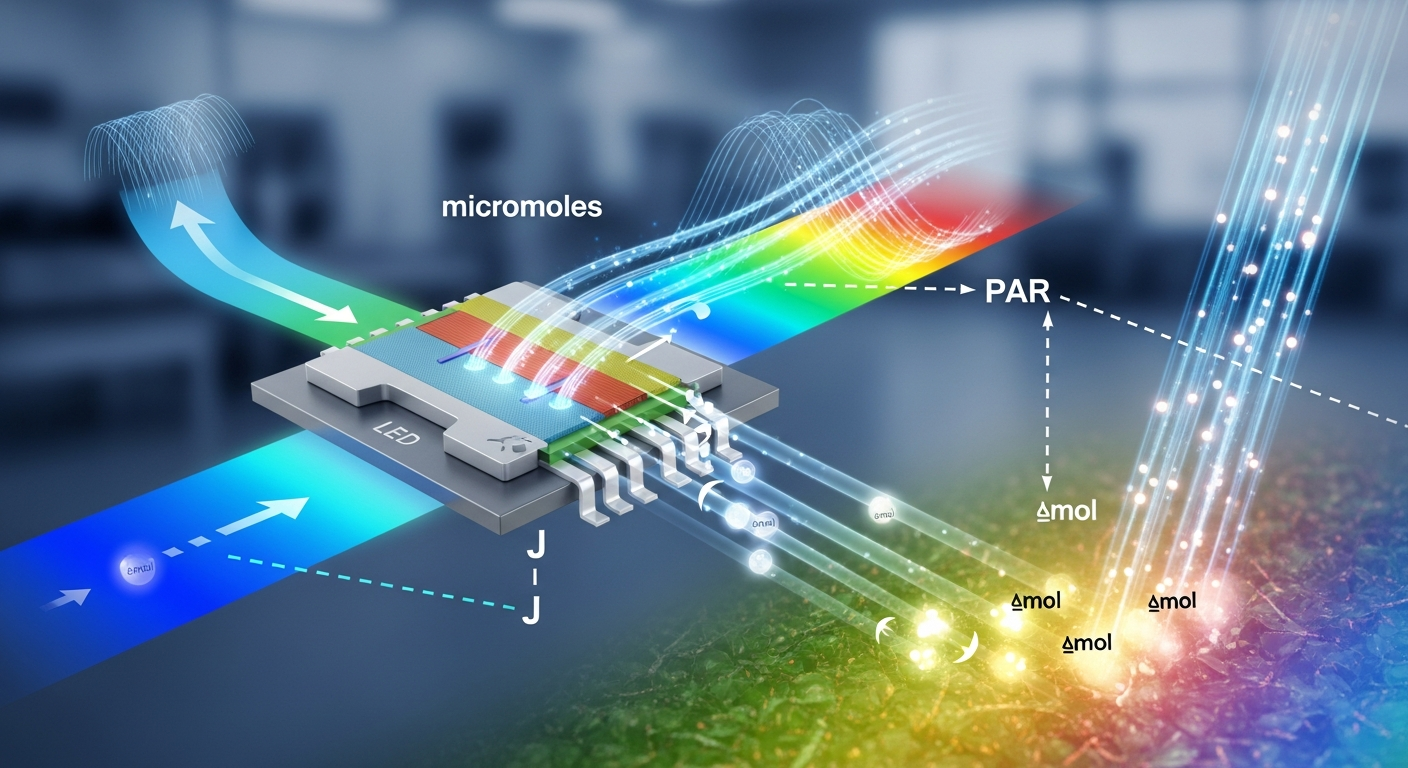
Electroluminescence: A Direct Conversion
Unlike incandescent bulbs, which generate light by heating a filament until it glows (a process that wastes immense energy as heat), or fluorescent lamps, which use electricity to excite gases that emit ultraviolet (UV) light, subsequently converted to visible light by a phosphor coating, LEDs operate on a much more direct principle. An LED consists of a semiconductor chip, typically made from materials like gallium arsenide (GaAs), gallium nitride (GaN), or indium gallium nitride (InGaN), containing a “p-n junction.” This junction is formed by doping semiconductor materials to create regions with an excess of positive charge carriers (holes, the “p-type” material) and regions with an excess of negative charge carriers (electrons, the “n-type” material).
When an electrical current is applied across this p-n junction in the correct direction (forward bias), electrons from the n-type material are pushed towards the p-type material, and holes from the p-type material move towards the n-type material. At the junction, electrons and holes recombine. This recombination process involves an electron falling from a higher energy level to a lower energy level, releasing the excess energy in the form of a photon – a particle of light. The energy of the emitted photon, and thus the color (wavelength) of the light, is determined by the “band gap” of the semiconductor material used.
- Incandescent Lights: Inefficiently convert electricity into heat, with light as a byproduct.
- Fluorescent Lights: Convert electricity into UV light, which then needs to be down-converted to visible light, involving multiple energy transformations and some losses.
- LEDs: Directly convert electrical energy into light energy, minimizing waste heat and maximizing efficiency.
This direct energy conversion is the fundamental reason why LEDs are inherently more efficient than their predecessors. Less energy is wasted as heat, meaning a larger proportion of the input electrical energy is converted directly into light, specifically photons.
Understanding Light Measurement: From Lumens to PAR and PPF
For decades, the brightness of artificial light sources was predominantly measured in lumens. However, lumens are a metric designed for human vision, taking into account the varying sensitivity of the human eye to different wavelengths of light. Our eyes are most sensitive to green-yellow light (around 555 nm) and less sensitive to red and blue light. For plants, this human-centric measurement is largely irrelevant and can be misleading when assessing the effectiveness of a grow light.
Photosynthetically Active Radiation (PAR)
Plants “see” light very differently than humans do. Their primary interaction with light is through photosynthesis, the process by which they convert light energy into chemical energy to fuel their growth. The specific portion of the electromagnetic spectrum that drives photosynthesis is known as Photosynthetically Active Radiation (PAR). This range typically spans from 400 nanometers (blue light) to 700 nanometers (red light). Within this PAR range, different wavelengths contribute to different photomorphogenic responses and photosynthetic rates, but all are potentially useful.
Therefore, when evaluating grow lights, we need metrics that quantify the amount of light within this crucial PAR spectrum.
Photosynthetic Photon Flux (PPF)
This brings us to Photosynthetic Photon Flux (PPF). PPF is a measure of the total number of PAR photons emitted by a light source per second. It is expressed in micromoles per second (µmol/s). One micromole of photons contains approximately 6.022 x 10¹⁷ photons. By quantifying light in terms of photons, PPF provides a direct measure of the “fuel” available for photosynthesis, regardless of human visual perception. A higher PPF value indicates that a light fixture is emitting more photons in the PAR range, making more light available for the plants.
It is crucial to differentiate PPF from Photosynthetic Photon Flux Density (PPFD), which measures the number of PAR photons falling on a specific surface area per second (µmol/m²/s). While PPF tells you how much light a fixture produces, PPFD tells you how much of that light reaches your plants at a certain distance and coverage area. Both are important, but PPF is the starting point for understanding the light source’s inherent capability.
The shift from lumens to PPF represents a fundamental change in how we evaluate horticultural lighting, moving from a human-centric view to a plant-centric one. However, PPF alone doesn’t tell us how efficiently a light produces those photons. For that, we turn to µmol/J.
Deciphering Micromoles per Joule (µmol/J): The Ultimate Efficiency Metric
If PPF tells us how many usable photons a light source emits, then micromoles per Joule (µmol/J) tells us how efficiently it does so. This metric is also commonly referred to as PPF Efficacy. It quantifies the number of PAR photons produced for every Joule of electrical energy consumed by the fixture.
What µmol/J Represents
Simply put, µmol/J is calculated by dividing the total Photosynthetic Photon Flux (PPF) of a fixture by its total power consumption in Watts (which is equivalent to Joules per second).
Efficacy (µmol/J) = PPF (µmol/s) / Power (Watts or J/s)
Therefore, a fixture with an efficacy of 2.5 µmol/J means it produces 2.5 micromoles of PAR photons for every single Joule of electrical energy it consumes. A higher µmol/J value indicates a more efficient LED grow light system. This is the gold standard for comparing the energy efficiency of different horticultural lighting solutions.
Why µmol/J is Superior for Plant Growth Applications
- Energy Cost Savings: This is arguably the most significant practical benefit. A higher µmol/J means you get more plant-usable light for the same amount of electricity. Over the lifespan of a grow light system, especially in large-scale operations, these savings can be substantial, directly impacting the profitability of a cultivation business.
- Reduced Heat Load: Electrical energy not converted into light is primarily dissipated as heat. More efficient fixtures (higher µmol/J) waste less energy as heat. This reduces the burden on HVAC systems, further cutting energy costs and simplifying environmental control within the grow space.
- Environmental Sustainability: Using less electricity to achieve the same or better plant growth reduces the carbon footprint associated with indoor cultivation.
- Optimized Resource Allocation: By knowing the true efficiency, growers can make more informed decisions about equipment purchases, ensuring they invest in solutions that offer the best return on energy investment.
Factors Influencing µmol/J
The overall µmol/J of an LED grow light fixture isn’t just about the LED chips themselves. It’s a cumulative measure of the efficiency of several components working in harmony:
- LED Chip Efficiency: The primary determinant. Better semiconductor materials, manufacturing processes, and chip designs lead to higher internal quantum efficiency (how well electrons convert to photons) and extraction efficiency (how well photons exit the chip).
- LED Driver Efficiency: The driver converts AC power from the wall into the DC power required by the LEDs. An inefficient driver wastes energy as heat, reducing the overall system efficacy. High-quality drivers can achieve efficiencies well over 90%.
- Thermal Management: LEDs generate some heat, and excessive heat degrades performance and shortens lifespan. Effective heat sinks and cooling solutions ensure the LED chips operate at optimal temperatures, maintaining their efficacy. Poor thermal management leads to a phenomenon called “thermal droop,” where photon output decreases as temperature rises.
- Optical Efficiency: Lenses and reflectors are used to direct light where it’s needed. Any light absorbed or misdirected by these components reduces the overall useful light output, thus lowering the effective µmol/J.
When comparing LED grow lights, it’s vital to look for the system efficacy (µmol/J) of the complete fixture, not just the efficacy of the individual LED chips, as the latter doesn’t account for driver losses, thermal issues, or optical inefficiencies.
Practical Applications and Choosing Efficient LED Grow Lights
Understanding µmol/J is more than just academic; it has direct, tangible implications for anyone investing in or operating LED grow light systems. It’s the cornerstone of making economically sound and horticulturally effective decisions.
Why High µmol/J Matters in Practice
For commercial growers, hobbyists, and research facilities alike, higher µmol/J values translate directly into:
- Significant Energy Savings: This is often the largest operational cost for indoor growers. A fixture with 2.8 µmol/J will provide 12% more usable light than a 2.5 µmol/J fixture for the exact same electricity cost. Over years of operation, this compounds into thousands of dollars saved.
- Optimized Yields: With more efficient light conversion, growers can either achieve the same yield with less energy, or potentially increase yields by providing more light for the same energy budget. This direct relationship between light and biomass accumulation makes efficacy paramount.
- Reduced HVAC Costs: Less wasted energy means less heat rejection into the grow environment. This directly reduces the need for extensive cooling, further cutting electricity consumption and simplifying climate control.
- Sustainable Cultivation: As the demand for indoor-grown produce rises, energy consumption is a major environmental consideration. High-efficacy LEDs contribute to a more sustainable and responsible cultivation practice.
What to Look For on Spec Sheets and Beyond
When evaluating LED grow lights, don’t just glance at the wattage or the price tag. Dive into the specifications with an eye for efficacy:
- The µmol/J Rating: This should be prominently displayed. Look for independent, certified testing (e.g., by agencies like UL, ETL, or specific horticultural lighting test labs) to ensure accuracy. Be wary of manufacturers who only provide chip efficacy, not whole-fixture efficacy.
- PPF Output (µmol/s): While µmol/J is about efficiency, PPF tells you the total amount of light output. High PPF combined with high µmol/J is the ideal scenario.
- Power Consumption (Watts): Understand the actual power draw of the fixture. Efficacy is meaningless without knowing the input power.
- Spectral Distribution: While µmol/J measures the quantity of PAR photons, the quality (color spectrum) of those photons is also critical. A light could have high µmol/J but a suboptimal spectrum for a specific plant type or growth stage. Most modern full-spectrum grow lights aim for a balanced spectrum with peaks in red and blue.
- PPFD Uniformity: Remember that PPF is total output, and µmol/J is efficacy. PPFD measures the light density on the canopy. A highly efficient fixture is only truly effective if it delivers that light uniformly across the plants without hot spots or shadowed areas. Look for PPFD maps or light distribution patterns from the manufacturer.
- Thermal Management: Good thermal design extends the life and maintains the efficacy of the fixture. Check for robust heat sinks, passive cooling designs, or quality fan systems.
- Driver Quality: A high-quality, dimmable driver not only improves efficiency but also offers flexibility in light intensity, further optimizing energy use throughout the plant’s life cycle.
Actionable Advice for Growers
- Calculate Your ROI: Don’t just look at the upfront cost. Compare the total cost of ownership, including purchase price, expected lifespan, and projected energy consumption based on the µmol/J rating. A more expensive, highly efficient fixture often pays for itself quickly through energy savings.
- Ask for Photometric Reports: Reputable manufacturers should provide comprehensive photometric reports (often called “IES files” or similar), which detail PPF, µmol/J, spectral distribution, and PPFD mapping. This transparency is a sign of quality.
- Match Light to Plant Needs: While high µmol/J is universally good, combine it with a spectrum and PPFD level appropriate for your specific crops and their growth stages. Over-lighting is wasteful; under-lighting limits potential.
- Monitor and Adjust: Once installed, use a PAR meter if possible to measure actual PPFD at canopy level and adjust light height or intensity settings to optimize for plant response and energy usage.
Conclusion
The journey from incandescent bulbs to sophisticated LED grow lights has revolutionized indoor cultivation, offering unprecedented control and efficiency. At the heart of this revolution lies the metric of micromoles per Joule (µmol/J). Far more meaningful than traditional lumens or simple wattage, µmol/J serves as the ultimate benchmark for assessing how effectively an LED system converts electrical energy into photosynthetically active light for plants. By understanding the fundamental physics of light production, the distinctions between human and plant light perception, and the practical implications of high efficacy, growers can make informed decisions that lead to significant energy savings, reduced operational costs, and ultimately, healthier plants and higher yields. Embracing µmol/J is not just about adopting a new technical term; it’s about unlocking the full potential of modern horticultural lighting for a more sustainable and productive future in agriculture.