
In the intricate world of greenhouse cultivation, efficient water management is not just a luxury but a fundamental necessity. While overhead watering might seem intuitive, many advanced growers are turning to a seemingly magical force to nourish their plants from below: capillary action. This natural phenomenon, often invisible to the naked eye, is the underlying principle behind highly efficient bottom-up irrigation systems, promising healthier root zones, reduced water waste, and optimized nutrient delivery. Understanding the physics behind capillary action is key to unlocking the full potential of these innovative watering methods, transforming how you manage your greenhouse climate and plant hydration.
Understanding Capillary Action: The Invisible Force at Work
At its heart, capillary action is the ability of a liquid to flow in narrow spaces against the force of gravity, seemingly defying natural laws. This phenomenon is a complex interplay of three primary forces:
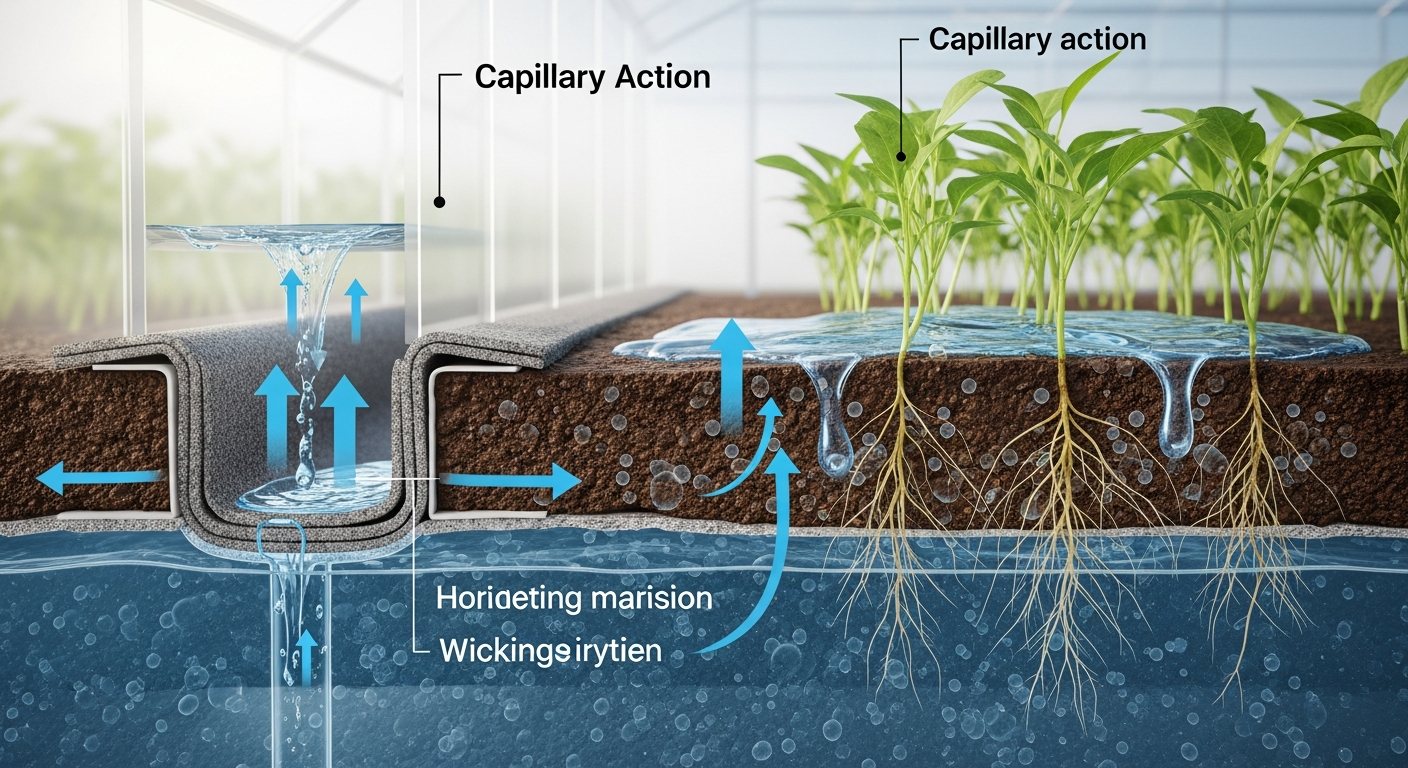
- Adhesion: The attraction between water molecules and the surfaces of other materials (like the particles in your growing media or the walls of a narrow tube). Water “sticks” to these surfaces.
- Cohesion: The attractive force between water molecules themselves. Water molecules “stick” together, creating a continuous column.
- Surface Tension: The cohesive forces among liquid molecules are responsible for the phenomenon of surface tension, which makes the liquid surface behave like a stretched elastic membrane. This tension helps to pull the column of water upwards.
When these forces combine in a narrow space, such as the tiny pores within your growing media, the adhesive forces pull the water molecules up the sides of the pores. The cohesive forces then pull other water molecules along, creating a continuous upward movement. This is precisely how water, and dissolved nutrients, are drawn upwards from a reservoir or flood table into the root zone of your plants, acting as a natural pump that continually replenishes moisture as it’s absorbed or evaporates.
Advantages of Capillary-Based Bottom-Up Irrigation Systems
Harnessing capillary action through bottom-up irrigation offers a wealth of benefits for greenhouse operations, contributing significantly to optimal plant health and resource efficiency:
- Exceptional Water Efficiency: By delivering water directly to the root zone from below, evaporation from the soil surface is drastically reduced. This means less water is wasted, leading to substantial savings and a more sustainable approach to greenhouse climate control.
- Uniform Moisture Distribution: Capillary action ensures a remarkably even distribution of moisture throughout the growing media. Unlike top-down watering, where water might channel or drain unevenly, bottom-up systems allow the media to absorb water precisely as needed, preventing both waterlogged and dry pockets.
- Reduced Foliar Disease: Keeping plant foliage dry is crucial for preventing fungal diseases like powdery mildew and botrytis. Bottom-up irrigation eliminates overhead watering, which often wets leaves, creating a less hospitable environment for pathogens.
- Optimized Nutrient Delivery: Nutrients dissolved in the irrigation water are transported directly to the roots via capillary action. This method ensures that nutrients are consistently available to the plant, promoting robust growth and efficient uptake.
- Labor Savings: Automated bottom-up systems, such as ebb and flow tables or large wick systems, significantly reduce the manual labor associated with watering, freeing up time for other critical greenhouse tasks.
- Healthy Root Development: Plants tend to develop stronger, deeper root systems when they “reach” for water drawn up through capillary action, rather than relying on surface moisture. This encourages better anchorage and nutrient absorption.
Factors Influencing Capillary Rise in Growing Media
The effectiveness of capillary action in your bottom-up irrigation system is heavily dependent on the characteristics of your growing media. Understanding these factors is crucial for successful implementation:
- Pore Size Distribution: This is arguably the most critical factor.
- Fine-textured media (e.g., peat moss, fine coir) with many small pores exhibit strong capillary action, allowing water to rise higher and hold more moisture.
- Coarse-textured media (e.g., perlite, large bark chips) with larger pores have weaker capillary action, meaning water won’t rise as high and will drain more quickly.
- A balanced mix is often ideal, providing good drainage and aeration while maintaining sufficient capillary lift.
- Wetting Properties of the Media: Some media are naturally more hydrophilic (water-attracting) than others. Media that readily wets will facilitate better adhesion and thus stronger capillary action. Dry, hydrophobic media (which can happen with very dry peat) might resist initial wetting.
- Height of Lift Required: The distance water needs to travel against gravity directly impacts the system’s performance. Capillary action can only lift water so high; taller containers or deeper media will require stronger capillary forces.
- Water Surface Tension: While largely a property of water itself, additives like wetting agents (surfactants) can reduce water’s surface tension, potentially aiding penetration into certain media, though this effect can be complex and isn’t always beneficial for capillary rise itself.
- Temperature: Temperature has a minor effect, primarily by influencing the viscosity and surface tension of water, but these effects are generally negligible in typical greenhouse environments.
Designing and Optimizing Your Capillary-Based System
Implementing a successful bottom-up system requires careful consideration of design and media choice. Here are some popular methods and practical tips:
Common Bottom-Up Systems:
- Wick Systems: These are among the simplest. A wick (made of felt, nylon, or fiberglass) is placed with one end in a water reservoir and the other end embedded in the growing media. Capillary action draws water up the wick and into the plant’s root zone. They are ideal for individual plants or small-scale setups.
- Capillary Mats: Similar to wick systems but on a larger scale. Plants in pots are placed directly on a saturated capillary mat, which draws water from a reservoir below or around it. The mat then transfers moisture via capillary action to the bottom of the pots. This is excellent for propagation trays or benches of potted plants.
- Ebb and Flow (Flood and Drain) Systems: These sophisticated systems periodically flood a grow tray with nutrient solution, allowing the growing media to absorb water and nutrients via capillary action. After a set period, the solution drains back into a reservoir. The key here is the initial saturation and subsequent capillary action holding moisture in the media until the next flood cycle.
- Sub-Irrigation Planters: Many modern self-watering planters incorporate a reservoir at the bottom and a wicking element or perforated platform that allows the growing media to draw water upwards as needed.
Practical Tips for Optimization:
- Choose the Right Growing Media: For capillary mats and wick systems, use a media with a good balance of fine and coarse particles (e.g., a quality potting mix with peat, coir, and some perlite). Avoid overly coarse media that won’t wick effectively.
- Ensure Good Contact: For capillary mats, ensure the bottom of your pots makes firm, even contact with the mat. Air gaps will prevent proper wicking. For wick systems, ensure the wick is well-embedded in the media.
- Level Surfaces: For ebb and flow tables and capillary mat systems, ensure your benches or trays are perfectly level. This guarantees even water distribution during flooding and consistent wicking across the entire area.
- Monitor Moisture Levels: While these systems are efficient, it’s still crucial to monitor soil moisture, especially when first setting up. Use a moisture meter or simply feel the weight of pots to gauge hydration.
- Manage Nutrient Concentrations: Bottom-up systems can sometimes lead to salt buildup on the surface of the growing media due to constant evaporation. Regular flushing with plain water (or a periodic top-down flush) can help mitigate this. Adjust your nutrient solution EC accordingly.
Troubleshooting Common Issues and Best Practices
Even with the best design, issues can arise. Here’s how to troubleshoot and maintain your capillary-based irrigation system:
- Overwatering/Underwatering:
- Issue: Media is consistently too wet or too dry.
- Solution: Adjust the frequency or duration of flooding in ebb and flow systems. For wick systems, check if the wick is adequately sized and making good contact. Ensure your media has proper drainage. Sometimes, media that has dried out completely can become hydrophobic, requiring a thorough top-down soak to re-establish capillary action.
- Salt/Nutrient Buildup:
- Issue: White crusts appearing on the surface of the growing media or stunted plant growth.
- Solution: This is common due to evaporation at the surface. Periodically flush your pots with plain, pH-balanced water (or a very dilute nutrient solution) from the top. In ebb and flow, ensure your reservoir solution is regularly refreshed and monitored for EC.
- Algae Growth:
- Issue: Green slime on capillary mats, reservoir walls, or media surface.
- Solution: Algae thrives in light and moisture. Cover reservoirs to block light. For mats, consider using black plastic sheeting over the mat in areas not covered by pots. Introduce beneficial microbes or use algaecides cautiously. Improve air circulation to reduce humidity.
- Wicking Failure:
- Issue: Pots are dry despite the reservoir being full.
- Solution: Check for good contact between the pot and the mat, or the wick and the media. Ensure the wick isn’t clogged or deteriorating. If using capillary mats, they might need cleaning or replacement if heavily soiled with mineral deposits or algae.
- Media Choice Impact:
- Issue: Different plants or stages of growth requiring different moisture levels.
- Solution: Consider grouping plants with similar water needs on the same mat or flood table. Adjust your growing media blends to suit specific plant requirements for moisture retention and drainage.
Conclusion
Mastering the physics of capillary action is a powerful step towards creating a more efficient, sustainable, and productive greenhouse environment. By understanding how water moves against gravity, driven by adhesion, cohesion, and surface tension, you can design and manage bottom-up irrigation systems that deliver precise hydration and nutrition directly to your plants’ roots. From conserving precious water resources to reducing disease and labor, the benefits are clear. Embrace the invisible forces at play, and watch your greenhouse thrive with smarter, more effective water management.