
In the vibrant world of greenhouse cultivation, where life bursts forth in a symphony of green, there’s an unseen, often underestimated element that plays a pivotal role in plant health and productivity: air. Specifically, the exchange of air. While we meticulously manage light, nutrients, and temperature, the critical task of removing excess moisture through effective air exchange is paramount. Too much humidity creates a haven for diseases, stunts growth, and can significantly reduce yields. Understanding the fundamental physics behind air movement and being able to calculate the necessary rates for moisture removal isn’t just a technical detail; it’s a cornerstone of successful greenhouse management. Join us as we demystify the science and provide you with the tools to optimize your greenhouse climate.
Why Air Exchange is Critical for Greenhouse Health
Imagine a tropical rainforest – lush, humid, and teeming with life. Now imagine that same humidity trapped indefinitely around your delicate greenhouse crops. This scenario, unfortunately, is a recipe for disaster. Plants naturally release vast amounts of water vapor through a process called transpiration. While essential for nutrient uptake and cooling, this constant release can quickly saturate the greenhouse air, leading to a host of problems:
- Fungal and Bacterial Diseases: High relative humidity (RH) provides the ideal breeding ground for pathogens like powdery mildew, botrytis, and various bacterial blights. Water lingering on leaf surfaces is an open invitation for infection.
- Reduced Transpiration: When the air around a plant is already saturated with moisture, the plant struggles to release more water. This reduces the “pull” that brings water and nutrients up from the roots, effectively slowing growth.
- Calcium and Nutrient Deficiencies: Impaired transpiration can also hinder the transport of essential nutrients, particularly calcium, to rapidly growing tissues, leading to disorders like tip burn in lettuce or blossom end rot in tomatoes.
- Poor Pollination: Excessive moisture can interfere with pollen release and viability, impacting fruit set for crops that rely on insect or wind pollination.
- Weak, Leggy Growth: Plants in consistently high humidity may develop weaker cell walls and become more susceptible to lodging or physical damage.
The solution? Air exchange. By actively replacing moisture-laden internal air with drier external air, we mitigate these risks, promote robust plant health, and create a more productive growing environment. It’s not just about moving air; it’s about moving moisture out.
The Fundamental Physics of Air Exchange
At its core, air exchange in a greenhouse is about managing vapor pressure differences and airflow. Let’s break down the key physical principles:
- Relative Humidity (RH): This is the most commonly understood metric. RH tells us how much water vapor is currently in the air compared to the maximum amount it can hold at a given temperature. Warm air can hold more moisture than cold air. When RH is high, the air is closer to saturation.
- Vapor Pressure Deficit (VPD): A more precise and arguably more important metric for plant health, VPD measures the difference between the amount of moisture the air can hold and how much it is holding. A higher VPD means the air is “thirsty” and will draw more moisture from the plants, encouraging transpiration. A low VPD (high humidity) means the air is nearly saturated, hindering transpiration.
- Air Density: Humid air is less dense than dry air at the same temperature. This is why warm, moist air tends to rise, a principle exploited in natural ventilation systems.
- Convection: The natural movement of fluids (like air) due to differences in density. In a greenhouse, warm, humid air rises, and cooler, drier air sinks, creating natural circulation if openings are present.
- Mass Transfer: This is the fundamental process we’re aiming for. It’s the movement of water vapor from a region of higher concentration (inside the greenhouse) to a region of lower concentration (outside the greenhouse) via air movement.
Effective air exchange leverages these principles. By introducing drier air and expelling humid air, we actively lower the RH and increase the VPD within the greenhouse, facilitating healthy plant function and preventing moisture-related issues. The challenge lies in doing this efficiently, without excessive heat loss during colder months.
Calculating Air Exchange Rates: The Basics
The primary goal of calculating air exchange rates for moisture removal is to replace the entire volume of air within the greenhouse a certain number of times per hour. This is expressed as Air Changes per Hour (ACH). The rate depends heavily on the crop, the season, the external climate, and the amount of moisture your plants are releasing.
The Basic Formula for Ventilation Rates
To determine the required airflow volume, you first need to calculate the total volume of your greenhouse:
Greenhouse Volume = Length (L) x Width (W) x Height (H)
If you’re using feet, your volume will be in cubic feet (ft³). If meters, then cubic meters (m³).
Once you have the volume, you can calculate the required airflow rate. The industry standard for fan capacities is often given in Cubic Feet per Minute (CFM) or Cubic Meters per Hour (m³/hr).
- For CFM (Cubic Feet per Minute):
Required CFM = (Greenhouse Volume in ft³ × Desired ACH) / 60 minutes - For m³/hr (Cubic Meters per Hour):
Required m³/hr = Greenhouse Volume in m³ × Desired ACH
Example:
Let’s say your greenhouse is 30 ft long, 10 ft wide, and has an average height of 8 ft. You want 5 air changes per hour (ACH).
- Calculate Volume: 30 ft × 10 ft × 8 ft = 2400 ft³
- Calculate CFM: (2400 ft³ × 5 ACH) / 60 min = 12000 / 60 = 200 CFM
So, you would need ventilation equipment capable of moving at least 200 CFM to achieve 5 air changes per hour.
Typical ACH Recommendations
Recommended ACH values vary widely:
- Basic Ventilation (Minimal Moisture/Heat): 0.5 – 2 ACH (e.g., for very dry climates, or non-transpiring plants).
- Moderate Moisture Control/Cooling: 3 – 5 ACH (common for many vegetable and ornamental crops).
- High Moisture Removal/Cooling (Hot & Humid Climates, High Transpiration Crops): 6 – 10+ ACH (e.g., leafy greens in peak growth, intense summer heat).
It’s crucial to remember that these are starting points. The ideal ACH for your greenhouse will depend on factors like your specific crop’s transpiration rate, the external ambient humidity, temperature differentials, and whether you are also using ventilation for cooling.
Accounting for Plant Transpiration and External Conditions
For more advanced calculations, you might consider the actual moisture load produced by your plants. Estimating plant transpiration is complex, as it varies with light, temperature, humidity, and plant stage. However, as a rule of thumb, understand that a dense canopy of actively growing plants can release significant amounts of water – several liters per square meter per day! This moisture must be removed.
Furthermore, the outside air conditions are vital. If the outside air is already very humid, simply bringing it in won’t effectively reduce internal humidity. In such cases, or in closed-loop systems, supplemental dehumidification might be necessary.
Practical Tip: Regularly monitor your greenhouse’s internal RH using reliable sensors. This real-time data is invaluable for fine-tuning your ventilation strategy. Aim to keep RH within the optimal range for your specific crop (often 50-70% depending on growth stage).
Practical Strategies for Optimized Moisture Removal
Calculating the rates is one thing; implementing them effectively is another. Here’s how to put the physics into practice:
Ventilation Systems
- Natural Ventilation: This relies on convection and wind pressure.
- Roof Vents (Ridge Vents): Warm, humid air naturally rises and escapes through vents at the highest point of the greenhouse.
- Side Vents/Roll-up Sides: Cooler, drier air enters through lower openings, pushing the warm, humid air upwards and out through the ridge. This creates a powerful “stack effect.”
Natural ventilation is energy-efficient but less controllable than forced systems and dependent on external weather.
- Forced Ventilation: Uses fans to actively move air.
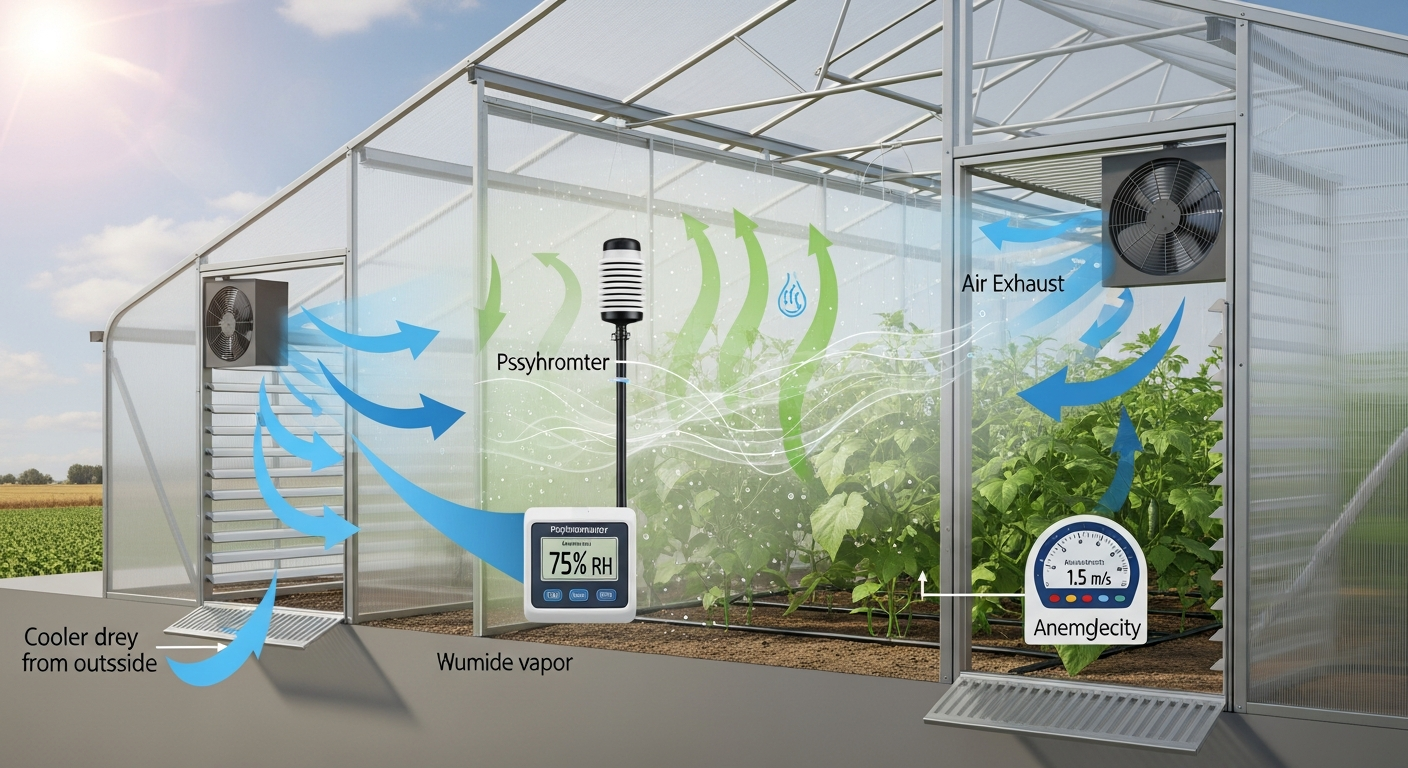
- Exhaust Fans: Typically placed on one end wall, they pull air out of the greenhouse, creating negative pressure that draws in fresh air from opposite inlet vents (louvers). Size your fans to meet your calculated CFM/m³/hr requirements.
- Circulation Fans (HAF – Horizontal Air Flow): These don’t exchange air with the outside but move air *within* the greenhouse. They break up stagnant air pockets, equalize temperature and humidity, and help dry leaf surfaces, significantly aiding moisture management even without direct air exchange.
- Dehumidifiers: For situations where external air is too humid, or during cold periods when opening vents would cause too much heat loss, dedicated dehumidifiers extract moisture from the air without altering its temperature significantly. This is common in highly controlled, sealed environments.
Environmental Controls
Modern greenhouses benefit immensely from automated control systems. Integrating your ventilation fans, circulation fans, and even heaters with sensors (thermostats, humidistats) allows for dynamic adjustment of air exchange based on real-time conditions. Setting target RH levels will trigger fans to activate when humidity rises too high, providing precise and energy-efficient moisture removal.
Tips for Effective Implementation
- Strategic Placement: Ensure inlet vents are opposite exhaust fans for optimal airflow across the entire greenhouse length. Place circulation fans to create a gentle, continuous air movement pattern throughout the canopy.
- Staging Ventilation: Rather than opening everything all at once, use automated controls to gradually open vents or increase fan speed. This allows for more precise climate control and prevents sudden temperature drops.
- Balance Heat & Humidity: In cooler climates, airing out for moisture removal also means heat loss. Consider “heating and venting” – briefly running heaters while ventilating to create a warm, dry air mass that efficiently removes humidity without excessive cooling of the plants.
- Monitor and Adjust: Your calculated rates are a starting point. Continuously monitor your greenhouse’s RH and plant health. Observe how your ventilation system responds to different weather conditions and adjust your settings as needed.
Conclusion
The physics of air exchange for moisture removal is a fundamental aspect of successful greenhouse management. By understanding the principles of humidity, vapor pressure, and airflow, and by applying basic calculations for air changes per hour, growers can proactively prevent disease, enhance plant transpiration, and foster robust growth. Whether through the natural dance of convection or the powerful push of forced ventilation, mastering the movement of air translates directly into healthier, more productive plants. Invest in understanding and optimizing your greenhouse’s air exchange rates, and you’ll breathe new life into your cultivation efforts, ensuring a thriving and resilient environment for years to come.