
In the controlled environments of modern greenhouses, growers constantly seek to optimize conditions for maximum plant vitality and yield. While factors like light, temperature, and nutrients are widely understood, the role of carbon dioxide (CO2) often takes center stage in advanced cultivation strategies. CO2 enrichment, the practice of supplementing ambient CO2 levels, is a powerful tool for accelerating photosynthesis and boosting plant growth. However, its influence extends beyond mere sugar production, profoundly impacting critical physiological processes such as stomatal conductance and, consequently, the delicate balance of humidity within your greenhouse. Understanding this intricate relationship is key to harnessing the full benefits of CO2 enrichment while avoiding potential pitfalls.
Understanding CO2 Enrichment and Plant Respiration
At its core, photosynthesis is the process by which plants convert light energy, water, and carbon dioxide into glucose (sugar) and oxygen. CO2 is a fundamental raw material for this process, acting as a crucial building block for plant tissue. In open-air environments, atmospheric CO2 levels hover around 400-420 parts per million (ppm). Within a sealed or semi-sealed greenhouse, especially during periods of active photosynthesis, plants can rapidly deplete CO2 levels, limiting their growth potential. This is where CO2 enrichment comes into play.
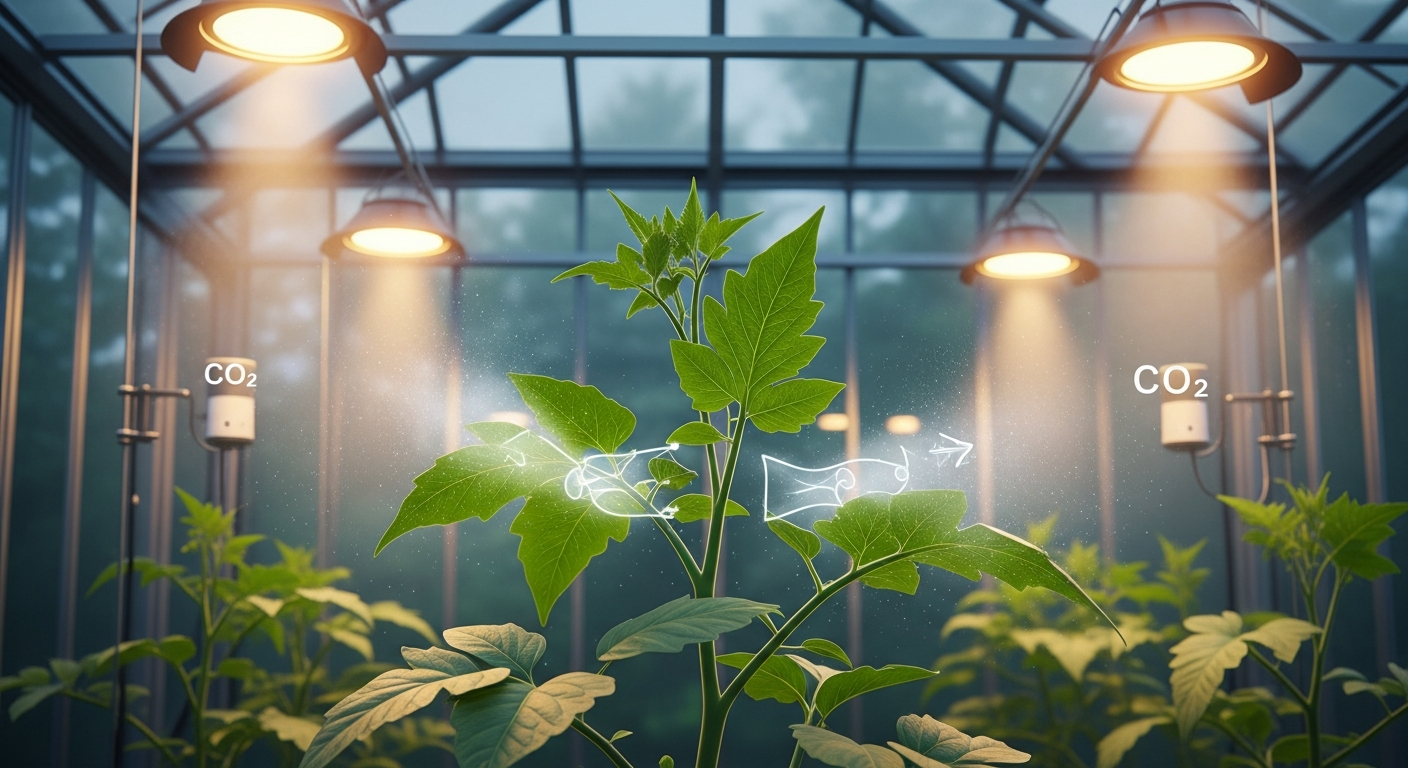
By artificially increasing CO2 concentrations, typically to 800-1200 ppm, growers aim to saturate the plant’s photosynthetic machinery, allowing it to operate at peak efficiency. The benefits are numerous: faster growth rates, increased biomass, earlier flowering, improved fruit quality, and higher overall yields. Sources of CO2 typically include CO2 generators (burning natural gas or propane), bottled CO2, or even captured industrial CO2. However, introducing higher CO2 levels into a greenhouse isn’t a standalone strategy; it sets off a cascade of physiological responses, particularly concerning the plant’s tiny gatekeepers: the stomata.
The Stomata: Tiny Gates, Big Impact
To truly grasp the impact of CO2 enrichment, we must first understand the unsung heroes of plant gas exchange: the stomata. These microscopic pores, primarily located on the underside of plant leaves, are flanked by two specialized cells called guard cells. These guard cells regulate the opening and closing of the stomata, acting as critical gateways for the plant’s interactions with its atmospheric environment.
The primary functions of stomata include:
- CO2 Intake: Allowing carbon dioxide to enter the leaf for photosynthesis.
- Oxygen Release: Expelling oxygen, a byproduct of photosynthesis, from the leaf.
- Water Vapor Release: Releasing water vapor through a process known as transpiration. This evaporative cooling helps regulate plant temperature and creates a “pull” that draws water and nutrients up from the roots.
The degree to which stomata are open is measured by stomatal conductance. High stomatal conductance means the stomata are wide open, facilitating rapid gas exchange and transpiration. Low stomatal conductance indicates they are more closed, restricting gas exchange and conserving water. Plants constantly adjust stomatal conductance in response to various environmental cues, including light intensity, water availability, temperature, and, critically, CO2 concentration.
CO2 Enrichment’s Direct Effect on Stomatal Conductance
Here’s where the plot thickens. When plants are exposed to elevated CO2 levels through enrichment, their stomata respond in a fascinating and beneficial way: they tend to partially close.
This physiological response is a survival mechanism. In an environment rich with CO2, the plant doesn’t need to open its stomata as wide to capture sufficient carbon dioxide for photosynthesis. By partially closing, the plant achieves several key advantages:
- Reduced Water Loss: The primary benefit is a significant reduction in plant transpiration. Since less water vapor escapes through the partially closed stomata, the plant conserves water.
- Improved Water Use Efficiency (WUE): This conservation leads to a higher water use efficiency, meaning the plant produces more biomass (growth) for every unit of water it consumes. This is particularly valuable in water-scarce regions or for optimizing irrigation.
- Maintained Photosynthesis: Despite the partial closure, the higher ambient CO2 concentration ensures that enough carbon dioxide still diffuses into the leaf to support high rates of photosynthesis.
Essentially, CO2 enrichment allows plants to be more “choosy” about when and how much they transpire, making them more resilient and efficient. For greenhouse growers, this translates to potentially less irrigation and healthier plants under the right conditions.
The Ripple Effect: Stomatal Conductance and Greenhouse Humidity
While reduced stomatal conductance and improved water use efficiency are clear benefits, they introduce a significant consideration for greenhouse climate control: humidity. Since less water vapor is being released by the plants through transpiration, the overall amount of moisture being added to the greenhouse air decreases.
However, the effect on relative humidity (RH) is complex and depends heavily on other environmental controls. If the greenhouse ventilation and dehumidification systems are not adjusted to compensate for this change, an unexpected situation can arise: a tendency for higher relative humidity within the greenhouse environment. While plants are transpiring less individually, the cumulative effect of hundreds or thousands of plants transpiring slowly can still contribute to overall humidity levels, especially if there’s no active removal of moisture.
Impact on Vapor Pressure Deficit (VPD)
Understanding Vapor Pressure Deficit (VPD) becomes crucial here. VPD is the difference between the amount of moisture in the air and how much moisture the air can hold when it’s saturated. A high VPD means the air is “dry” and can pull a lot of water from the plants, encouraging transpiration. A low VPD means the air is “wet” and closer to saturation, reducing the plant’s ability to transpire efficiently.
When stomatal conductance is reduced due to CO2 enrichment, and if greenhouse humidity rises as a result, the VPD within the plant canopy can decrease. A VPD that is too low can lead to several problems:
- Reduced Transpiration: While CO2 enrichment reduces the *need* for wide-open stomata, excessively low VPD further hinders transpiration. This can slow down nutrient delivery to the upper parts of the plant, potentially leading to deficiencies (e.g., calcium deficiencies manifesting as tip burn).
- Increased Disease Risk: High relative humidity and low air movement create an ideal breeding ground for fungal pathogens like Botrytis (gray mold) and powdery mildew, which thrive in moist conditions.
- Stagnant Growth: If plants can’t transpire effectively, their metabolic processes can slow down, impacting overall growth despite optimal CO2 levels.
Practical Management for Greenhouse Growers
Successfully integrating CO2 enrichment requires an adaptive approach to your entire climate control strategy. Here are practical tips for managing the impact on stomatal conductance and humidity:
- Monitor Everything: Implement robust environmental monitoring systems that track not only CO2 and temperature but also relative humidity (RH) and VPD at multiple points within the canopy. Consistent data is your best friend.
- Adjust Ventilation and Air Exchange: Your ventilation strategy needs to evolve. While you want to keep CO2 in, you also need to purge excess humidity. Consider intelligent ventilation systems that can briefly vent to reduce humidity without completely depleting CO2 levels, or cycle ventilation with CO2 supplementation.
- Invest in Dehumidification: Active dehumidifiers can be a game-changer. These systems remove moisture from the air, allowing you to maintain higher CO2 levels and ideal humidity/VPD ranges simultaneously.
- Ensure Good Air Circulation: Even with reduced transpiration, good horizontal airflow fans (HAFs) are essential. They help break up humid microclimates around leaves, equalize temperature, and prevent stagnant air pockets where diseases thrive.
- Optimize Irrigation: With improved water use efficiency, you might find you need to irrigate less frequently or with smaller volumes. Monitor plant moisture levels closely and adjust your irrigation schedule accordingly to avoid overwatering, which exacerbates humidity issues.
- Know Your Crop: Different plant species and even varieties within a species have varying tolerances for humidity and VPD. Tailor your climate settings to the specific needs of your cultivated crop.
- Balance CO2 with Other Factors: Remember, CO2 enrichment works best when all other factors (light, temperature, nutrients) are also optimized. A slight increase in temperature might be necessary to support the higher metabolic rates fueled by CO2, which can also help lower RH.
By understanding the physiological responses of plants to elevated CO2, particularly concerning stomatal behavior and its downstream effects on greenhouse humidity, growers can proactively manage their environments. The goal is to create a harmonious balance where the benefits of accelerated photosynthesis are fully realized without compromising plant health due to excessive moisture.
Conclusion
The practice of CO2 enrichment is a powerful tool for boosting plant growth and yields in controlled greenhouse environments. However, its influence extends far beyond a simple increase in photosynthetic rate. By prompting a partial closure of plant stomata, elevated CO2 levels significantly reduce transpiration and improve water use efficiency, which are highly beneficial outcomes. The critical challenge for greenhouse operators lies in managing the subsequent impact on relative humidity and vapor pressure deficit within the growing space. A proactive and integrated approach to environmental control – encompassing precise monitoring, intelligent ventilation, and strategic dehumidification – is essential to harness the full potential of CO2 enrichment while maintaining optimal conditions for robust, healthy plant development. Mastering this intricate dance between CO2, stomatal conductance, and humidity is a hallmark of advanced greenhouse cultivation, leading to more productive and resilient crops.