
Embarking on the journey of hydroponic cultivation opens a world of possibilities for efficient, accelerated plant growth. However, the true success of any hydroponic venture hinges critically on the precise management of its lifeblood: the nutrient solution. Beyond simply supplying nutrients, a sophisticated understanding of technical layouts for nutrient delivery and recovery systems is paramount. These intricate designs dictate how your plants receive their vital sustenance and how efficiently valuable resources are managed, impacting everything from plant health and yield to operational costs and environmental footprint. This comprehensive guide will delve into the technical intricacies, practical considerations, and diverse layouts that underpin effective nutrient management in hydroponics, empowering cultivators to design and optimize systems for peak performance.
Understanding the Fundamentals of Hydroponic Nutrient Management
At its core, hydroponics replaces soil with an inert growing medium, requiring cultivators to provide all essential plant nutrients directly in a water-based solution. The method of delivering this solution to the plant roots and subsequently handling any excess or runoff is what defines the nutrient delivery and recovery system. A well-designed system ensures plants receive a consistent, perfectly balanced diet, preventing deficiencies or toxicities that could stunt growth or even kill crops.
Key Components of Any System
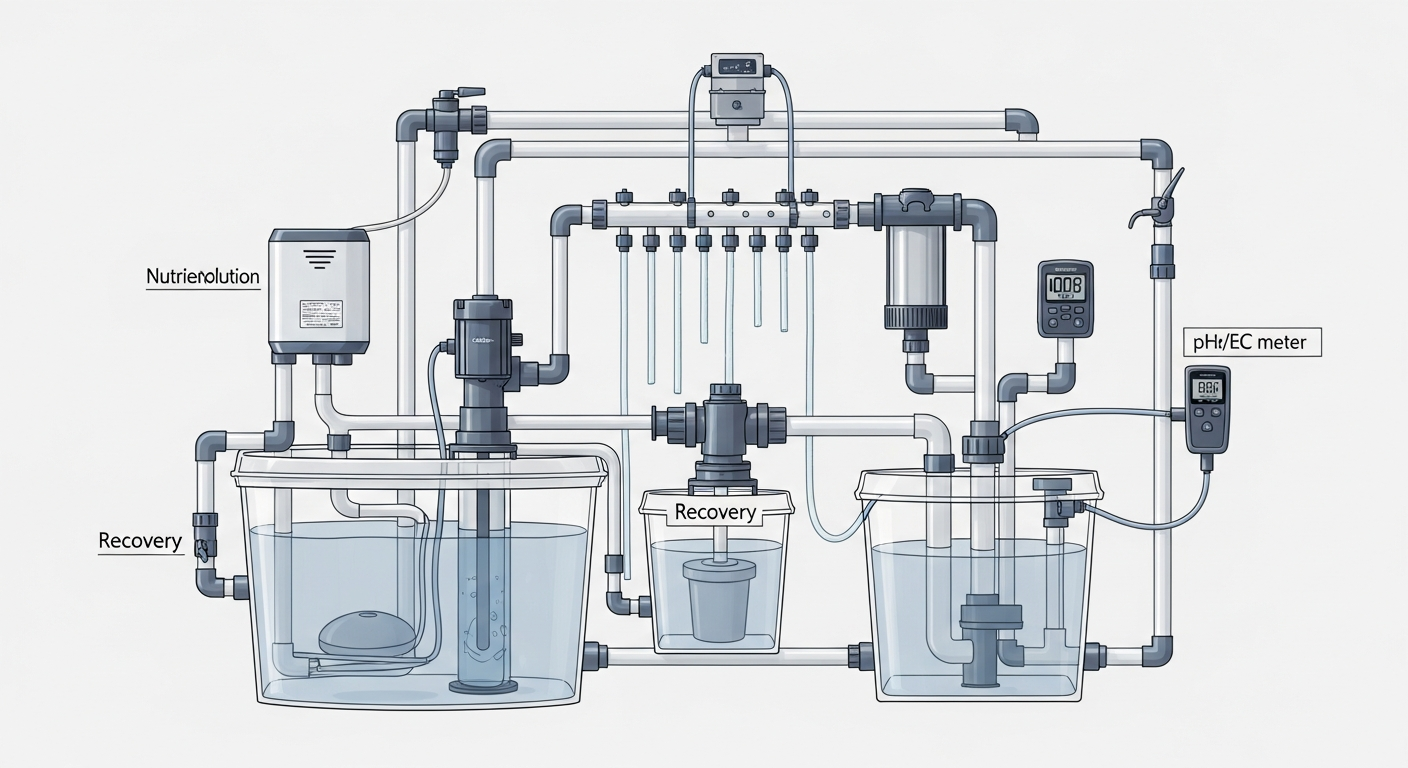
While specific layouts vary, several fundamental components are present in most hydroponic nutrient management systems:
- Nutrient Reservoir: This primary tank stores the prepared nutrient solution. Its size is crucial, needing to be large enough to minimize frequent refills and maintain stable nutrient concentrations and temperatures.
- Pumps: Essential for moving the nutrient solution. Submersible pumps are common for drawing solution from the reservoir, while peristaltic dosing pumps are used for precise pH adjusters or concentrated nutrient additions.
- Delivery Lines and Emitters: Tubing and drippers or sprayers that convey the nutrient solution from the pump to the individual plants or grow trays. Uniform delivery is key to prevent uneven growth.
- Recovery or Drainage Lines: In systems that collect runoff, these lines channel the excess solution back to a reservoir or to a waste collection point. Proper sloping and diameter are critical for efficient flow.
- Filtration: Screens or filters are often employed to remove particulate matter, preventing blockages in emitters and protecting pumps. This is especially vital in recirculating systems.
- Monitoring Equipment: Sensors for Electrical Conductivity (EC) or Total Dissolved Solids (TDS) measure nutrient concentration, while pH sensors track acidity/alkalinity. Temperature probes are also vital.
- Aeration System: In systems where roots are submerged (e.g., Deep Water Culture), air stones and air pumps provide crucial oxygen to the root zone, preventing root rot.
The optimal functioning of these components in unison creates a harmonious environment for plant development. Paying close attention to the quality and proper installation of each part is a cornerstone of a robust hydroponic system design.
Technical Layouts: Open-Loop (Non-Recirculating) Systems
Open-loop systems, often referred to as “drain-to-waste” (DTW) systems, are characterized by their straightforward approach: nutrient solution is delivered to the plants, and any excess runoff is collected and discarded, never to be reused by the system. This design offers a unique set of advantages and considerations for hydroponic growers.
Drain-to-Waste (DTW) Explained
In a typical DTW setup, a pump draws nutrient solution from a main reservoir and delivers it to individual plants via drippers, sprayers, or drip lines. The growing medium (such as rockwool, coco coir, perlite, or inert hydroton) holds onto a portion of the solution, while the excess drains away through the bottom of the grow pots or trays. This runoff is collected in a separate drain pan or channel and directed out of the system.
Common Applications: DTW systems are highly favored for crops grown in inert media that require precise nutrient delivery and minimal risk of pathogen spread. They are particularly popular for cannabis cultivation, large-scale commercial vegetable operations (e.g., tomatoes, cucumbers in rockwool slabs), and situations where managing recirculating nutrient solution complexities is undesirable.
Advantages:
- Simplicity: Fewer components and less complex nutrient management compared to recirculating systems.
- Disease Control: Since nutrient solution is not reused, the risk of spreading waterborne pathogens from one plant to another is significantly reduced. Each plant effectively receives a fresh, sterile solution.
- Nutrient Precision: Growers have ultimate control over the nutrient profile delivered to the plants at each feeding. Nutrient imbalances, salt buildup, and pH drift are less problematic within the root zone.
- Predictability: Nutrient adjustments are simpler, as there’s no need to constantly monitor and rebalance a returning solution.
Disadvantages:
- Water and Nutrient Waste: This is the most significant drawback. A substantial amount of nutrient solution (typically 20-30% of what’s delivered) is wasted, leading to higher operational costs and environmental impact.
- Disposal Issues: Disposing of nutrient-rich wastewater can be challenging, especially for large-scale operations, due to environmental regulations.
- Higher Running Costs: Increased consumption of water and nutrients translates to higher recurring expenses.
Design Considerations for DTW
When designing an open-loop system, several factors ensure efficiency and prevent issues:
- Drainage Slope: Ensure all grow trays or channels have an adequate slope (typically 1-2%) to facilitate efficient runoff collection and prevent standing water around plant roots, which can lead to root rot.
- Emitter Placement and Flow Rate: Position emitters accurately to deliver solution directly to the plant’s root zone. Calibrate flow rates and irrigation cycles to provide sufficient moisture without excessive runoff, minimizing waste. A general rule is to aim for 15-25% runoff per irrigation cycle.
- Buffer Tanks: While the primary reservoir holds the active nutrient solution, a separate, larger buffer tank can be used for mixing large batches of solution, allowing it to stabilize before being introduced to the main reservoir.
- Waste Management: Plan for the responsible collection and disposal of the effluent. Options include disposing into municipal wastewater systems (check local regulations), using it to irrigate conventional gardens, or specialized treatment.
Practical Tip: To minimize waste in a DTW system, conduct regular runoff EC measurements. If your runoff EC is significantly higher than your input EC, it indicates nutrient buildup in the medium; if it’s much lower, you might be over-irrigating. Adjust your feeding schedule and solution strength accordingly to achieve the ideal 15-25% runoff with a slightly higher EC than input.
Technical Layouts: Closed-Loop (Recirculating) Systems
Closed-loop or recirculating systems are the epitome of efficiency in hydroponics. In these setups, the nutrient solution delivered to the plants is collected after drainage, reconditioned, and then returned to the main reservoir for reuse. This approach significantly reduces water and nutrient consumption, making them highly sustainable and cost-effective in the long run.
The Recirculation Principle
The core concept is to close the loop: nutrient solution flows from the reservoir, irrigates the plants, drains into collection channels, and then is pumped back to the reservoir. Before reuse, the solution is typically filtered and often re-aerated. Monitoring and adjusting pH and EC levels in the returning solution are critical to maintain optimal plant nutrition. While highly efficient, these systems demand more sophisticated monitoring and management.
Advantages:
- Water and Nutrient Efficiency: Dramatically reduces water and nutrient consumption, making them environmentally friendly and significantly lowering operational costs over time.
- Sustainability: Aligns with sustainable agriculture practices by conserving resources.
- Reduced Waste: Eliminates the need for large-scale wastewater disposal.
Disadvantages:
- Complex Monitoring: Requires constant monitoring of pH, EC, and often dissolved oxygen, as these parameters can fluctuate more rapidly due to plant uptake and evaporation.
- Disease Spread Risk: Pathogens, if introduced, can quickly circulate throughout the entire system, potentially affecting all plants. Robust sterilization measures are often necessary.
- Nutrient Imbalance: Specific nutrient ions can accumulate or deplete over time, leading to imbalances. This necessitates periodic solution changes or advanced rebalancing strategies.
- Root Zone Temperature Control: Maintaining consistent root zone temperature is crucial, as the entire solution recirculates.
Common Recirculating System Designs
Nutrient Film Technique (NFT)
In NFT, plants sit in channels through which a very shallow, continuous film of nutrient solution flows. The roots absorb nutrients and oxygen from this film, with the majority of the root mass exposed to air. The solution then flows back to the main reservoir via gravity.
- Layout Considerations: Channels must have a precise, gentle slope (e.g., 1:30 to 1:40) to ensure uniform flow without puddling or excessive velocity. Sufficient aeration at the reservoir and proper spacing between plants are vital.
Deep Water Culture (DWC) / Raft Systems
DWC systems involve suspending plant roots directly into a nutrient solution held in a reservoir or grow tray. Air stones connected to an air pump constantly oxygenate the solution, preventing root suffocation. Raft systems are a scaled-up version, where plants sit in holes on a floating raft above a large body of nutrient solution.
- Layout Considerations: Excellent oxygenation is non-negotiable. Maintain consistent solution temperature (typically 65-72°F or 18-22°C) to prevent root rot and enhance oxygen solubility. Reservoir volume should be substantial to minimize rapid fluctuations in pH and EC.
Ebb and Flow (Flood and Drain)
Ebb and Flow systems periodically flood a grow tray containing plants and growing medium with nutrient solution from a reservoir. After a set period, the solution drains back into the reservoir by gravity, exposing the roots to air. This cycle repeats multiple times a day.
- Layout Considerations: Precise timing of flood and drain cycles is essential, controlled by a timer and a submersible pump. An overflow standpipe in the grow tray prevents over-flooding. Ensure the grow tray is perfectly level for even flooding and drainage.
Recirculating Drip Irrigation (RDWC)
Similar to DTW drip systems, but instead of discarding runoff, the excess solution is collected and returned to the main reservoir. This combines the precise delivery of drip irrigation with the efficiency of recirculation.
- Layout Considerations: Requires robust filtration of the returning solution to prevent emitter blockages. Regular monitoring and adjustment of the nutrient profile in the main reservoir are crucial as plants selectively absorb nutrients.
Key Elements for Closed-Loop Efficiency
- Robust Filtration: Crucial for removing organic debris, root exudates, and suspended solids that can clog pumps and emitters, and provide breeding grounds for pathogens. Options include mechanical filters (screen, media), biological filters, and UV sterilizers.
- Aeration and Temperature Control: Maintain high dissolved oxygen levels in the reservoir and root zone. Use chillers or heaters to keep solution temperature within optimal ranges (e.g., 65-72°F / 18-22°C) to support root health and nutrient uptake.
- Automated pH and EC Dosing: Integrating automated dosing pumps linked to pH and EC sensors can precisely maintain desired parameters, reducing manual labor and ensuring stable conditions.
- Buffer Tanks and Mixing: Large reservoir volumes and consistent circulation within the reservoir prevent nutrient stratification and pH/EC fluctuations.
Practical Tip: Even with automated systems, regularly calibrate your pH and EC sensors. Consider a weekly or bi-weekly “system flush” where you drain and replace a percentage (e.g., 25-50%) of your reservoir solution to prevent the buildup of undesirable elements and restore a balanced nutrient profile.
Advanced Considerations and Automation
As hydroponic systems become more sophisticated, the integration of advanced technologies and automation further refines nutrient delivery and recovery, optimizing efficiency and reducing labor.
- Sensor Technology: Beyond basic pH and EC, advanced systems incorporate sensors for dissolved oxygen (DO), oxidation-reduction potential (ORP), and even specific ion analysis (e.g., nitrate, potassium). These sensors provide granular data, enabling more precise nutrient management and early detection of potential issues.
- Automated Dosing Systems: Peristaltic pumps connected to intelligent controllers can automatically dose pH adjusters and individual nutrient components (e.g., Cal-Mag, Bloom, Micro) based on real-time sensor readings. This maintains stable nutrient profiles around the clock, critical for demanding crops.
- Data Logging and Analytics: Modern hydroponic controllers can log sensor data over time, providing valuable insights into plant uptake patterns, system stability, and potential areas for improvement. This data-driven approach allows for continuous optimization.
- Integration with Environmental Controls: Seamless integration with HVAC, lighting, and CO2 enrichment systems creates a fully optimized grow environment where nutrient delivery is perfectly synchronized with other environmental parameters.
- Redundancy and Fail-safes: For critical or large-scale operations, implementing backup pumps, secondary sensors, and alarm systems can prevent catastrophic crop loss due to equipment failure or power outages.
- Scalability: Designing layouts with future expansion in mind can save significant time and money. Use modular components, accessible plumbing, and centralized control systems that can be easily scaled up.
The convergence of precise technical layouts with smart automation transforms hydroponics from a labor-intensive hobby into a highly efficient, data-driven agricultural science.
Choosing the right technical layout for a hydroponic nutrient delivery and recovery system is a foundational decision that impacts every aspect of a cultivation operation. Whether opting for the simplicity and disease control of an open-loop drain-to-waste system, or the resource efficiency and sustainability of a closed-loop recirculating design, a thorough understanding of their principles, components, and practical considerations is essential. From meticulously designing drainage slopes to implementing advanced filtration and automation, each technical detail plays a vital role in creating an environment where plants can thrive. By carefully planning and executing these layouts, growers can achieve optimal plant health, maximize yields, minimize waste, and embark on a path toward truly successful and sustainable hydroponic cultivation.