
In the intricate world of greenhouse cultivation, every drop of water plays a critical role. For growers relying on the precision and efficiency of automatic emitters, maintaining impeccable water quality isn’t just a best practice—it’s an absolute necessity. These sophisticated irrigation systems, designed for optimal nutrient delivery and water conservation, are incredibly sensitive to impurities. A single speck of unwelcome debris can throw off your entire operation, leading to costly repairs, reduced plant health, and significant yield losses. This article will delve into the vital importance of water quality and the specific filtration requirements necessary to keep your automatic emitters running smoothly, ensuring the continued success of your greenhouse environment.
Why Pristine Water is Non-Negotiable for Automatic Emitters
Automatic emitters, whether they are drip lines, micro-sprinklers, or foggers, are engineered with tiny orifices designed for precise water and nutrient delivery. This precision is their greatest strength, but also their Achilles’ heel when it comes to water quality. Unlike flood irrigation or overhead sprinklers with larger apertures, automatic emitters are highly susceptible to clogging. Even microscopic particles can accumulate over time, blocking the flow or altering the emitter’s discharge rate.
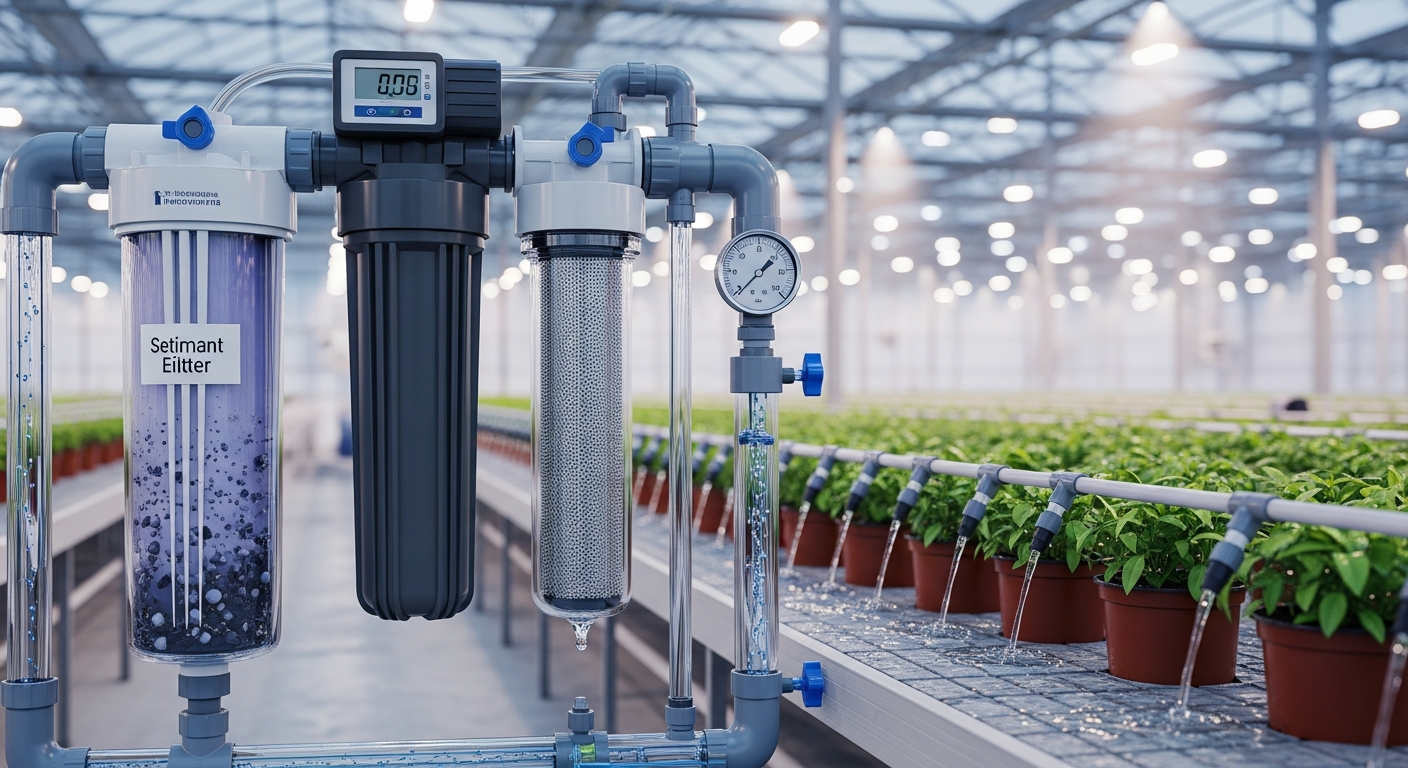
The consequences of poor water quality are far-reaching in a greenhouse setting:
- Clogged Emitters: This is the most immediate and common problem. Blockages lead to uneven watering and nutrient distribution, resulting in stressed plants, stunted growth, and inconsistent yields across your crop.
- Reduced System Efficiency: Clogged emitters force the irrigation system to work harder, increasing pressure on pumps and potentially shortening their lifespan. It also wastes water and nutrients by delivering them inefficiently or not at all to affected plants.
- Increased Maintenance Costs: Clearing clogged emitters is a time-consuming and often frustrating task. Manual flushing, chemical treatments, or even replacing entire sections of irrigation lines add significantly to operational expenses.
- Spread of Diseases: Unfiltered water can carry pathogens like bacteria and fungi, introducing them directly into your plants’ root zones or foliar surfaces, posing a severe threat to plant health and potentially leading to widespread crop loss.
- Nutrient Imbalance: If emitters are partially clogged, they may deliver less water and, consequently, fewer nutrients. This creates localized nutrient deficiencies that are difficult to diagnose and correct.
- Damage to Equipment: Abrasive particles can wear down internal components of pumps, valves, and emitters, leading to premature failure and replacement costs.
Investing in robust water filtration for your greenhouse irrigation system isn’t an expense; it’s a critical investment in the longevity of your equipment and the health of your crops.
Identifying the Enemy: Common Water Contaminants
To effectively filter your greenhouse water, you first need to understand what you’re up against. Water sources, whether municipal, well, pond, or rainwater, can harbor a variety of contaminants. A comprehensive water analysis is always the crucial first step.
Here are the primary culprits that threaten automatic emitters:
Physical Contaminants:
- Sediment/Suspended Solids: Sand, silt, clay, and other soil particles are common in well or surface water sources. Even municipal water can carry rust flakes from aging pipes. These are the most frequent cause of physical blockages.
- Organic Matter: Algae, plant debris, decaying leaves, and biofilm can grow in reservoirs, pipes, or even within the emitters themselves. Algae growth is particularly problematic as it can be tenacious and reproduce rapidly.
Chemical Contaminants:
- Dissolved Minerals: Hard water, rich in calcium and magnesium, can precipitate out and form scale deposits within pipes and emitters, especially at higher temperatures or after chemical treatments. Iron can also cause staining and blockages.
- Chemical Residues: Herbicides, pesticides, or industrial runoff can be present in surface water sources. While less likely to clog, these can be detrimental to plant health.
Biological Contaminants:
- Bacteria, Fungi, and Viruses: These microorganisms can be present in most non-sterilized water sources. While some might contribute to biofilm formation and clogging, others pose direct threats to plant health, causing diseases.
Understanding the specific contaminants in your water will dictate the type and level of filtration required.
Filtration Arsenal: A Deep Dive into Technologies
Choosing the right filter for your automatic emitters involves matching the contaminant profile of your water source with the appropriate filtration technology. The goal is to remove particles larger than the smallest orifice in your irrigation system.
1. Screen Filters: The First Line of Defense
Screen filters are perhaps the most common and economical choice for basic filtration. They consist of a woven mesh screen (made of stainless steel or plastic) that physically blocks particles larger than its openings. Screen filters are effective for removing inorganic suspended solids like sand and grit.
- Mechanism: Water flows through the screen, leaving solid particles behind.
- Advantages: Simple design, easy to clean (often by flushing or removing and rinsing), relatively inexpensive.
- Limitations: Not effective against soft organic matter or algae that can deform and pass through, or sticky particles that cling to the screen. Can clog quickly with high loads of fine sediment.
- Micron Rating: Typically range from 40 to 200 mesh (375 to 74 microns). For automatic emitters, you’ll generally need finer screens, often 120-200 mesh.
2. Disc Filters: Robust and Efficient
Disc filters offer a superior alternative to screen filters, especially when dealing with higher loads of organic matter or finer particles. They are composed of a stack of grooved, micron-sized plastic discs compressed together. Water passes through the intricate network of grooves, trapping particles.
- Mechanism: The grooves create a tortuous path for water, allowing for depth filtration where particles are trapped both on the surface and within the disc stack.
- Advantages: More efficient at trapping organic matter and a wider range of particle sizes than screen filters. Less prone to blinding or bypass. Available with semi-automatic or fully automatic backflushing options.
- Limitations: More expensive than screen filters. Cleaning can be more involved if not equipped with automatic backflushing.
- Micron Rating: Similar to screen filters, disc filters are rated by mesh size, usually from 40 to 200 mesh (375 to 74 microns).
3. Sand Media Filters: Heavy-Duty Solution
For water sources with very high levels of suspended solids, organic matter, or algae (e.g., pond water or recycled nutrient solutions), sand media filters are often the most effective solution. These large tanks contain layers of specially graded sand and gravel.
- Mechanism: Water flows down through the filter media bed. Particles are trapped within the spaces between the sand grains through a combination of straining, sedimentation, and absorption.
- Advantages: Extremely effective at removing high loads of fine suspended solids, organic matter, and even some algae. Can handle large flow rates. Fully automatic backflushing is common and highly efficient.
- Limitations: High initial cost, larger footprint, and require a significant amount of water for backflushing.
- Micron Rating: Generally provides filtration down to 20-50 microns, depending on the media size.
Multi-Stage Filtration: Layered Protection
Often, the best approach for comprehensive water quality management in a greenhouse is a multi-stage filtration system. This involves combining different filter types in series, with coarser filters placed upstream of finer ones. For example, a sand media filter could be followed by a disc filter, then a fine screen filter, providing progressively finer filtration before the water reaches your sensitive automatic emitters.
Selecting Your Guardian: Key Factors for Filter Choice
Choosing the ideal filtration system for your greenhouse involves a careful assessment of several critical factors:
1. Water Source Analysis: Know Your Water
This is paramount. A professional water test will identify the types and concentrations of contaminants in your water. Key parameters to look for include:
- Total Suspended Solids (TSS): Indicates the amount of physical particulate matter.
- Turbidity: Measures the cloudiness of the water, often correlating with TSS.
- Organic Load: Identifies algae, decaying plant matter, and other organic material.
- pH and Electrical Conductivity (EC): Important for overall plant health and potential for mineral precipitation.
- Mineral Content (e.g., Calcium, Magnesium, Iron): Reveals potential for scaling.
Without this analysis, you’re essentially guessing, which can lead to inadequate filtration or unnecessary over-investment.
2. Emitter Type and Orifice Size (Micron Rating)
The smallest opening in your automatic emitters dictates the required filtration level. Most drip emitters or micro-sprinklers have orifice sizes ranging from 50 to 200 microns. Your filter’s micron rating must be significantly finer than this to prevent clogging.
- General Rule: Select a filter with a micron rating at least 1/10th the size of the smallest emitter orifice. For example, if your smallest emitter has a 100-micron opening, aim for a filter that screens down to 10 microns (or 150-200 mesh). Many manufacturers recommend 75-micron (200 mesh) filtration as a minimum for drip irrigation.
3. Flow Rate and Pressure
The filter must be sized to handle the maximum flow rate of your irrigation system without a significant pressure drop. Undersized filters will cause excessive pressure loss, potentially reducing emitter performance, and will require frequent cleaning. Ensure the filter can operate effectively within your system’s pressure range.
4. Maintenance Requirements and Automation
Consider how often the filter will need cleaning and the labor involved. Automatic backflushing filters, though a higher initial investment, can significantly reduce maintenance labor and ensure consistent filtration, especially for larger operations. Manual filters are suitable for smaller systems or where labor is readily available.
5. Budget and Longevity
While cost is a factor, prioritizing upfront savings over effective filtration can lead to far greater expenses down the line in terms of emitter replacement, crop loss, and labor. Consider the filter’s durability and expected lifespan.
Beyond Installation: Maintaining Peak Performance
Installing the right filter is only half the battle; consistent maintenance is crucial to ensure its long-term effectiveness and the health of your automatic emitters.
- Regular Cleaning/Backflushing: Establish a routine for cleaning or backflushing your filters. The frequency will depend on your water quality and filter type. For manual filters, check pressure gauges daily and clean when a significant pressure differential (typically 5-10 PSI) is observed across the filter. Automatic filters should be programmed for optimal backflushing cycles.
- Monitor Pressure Differentials: Install pressure gauges before and after your filter. A noticeable increase in the pressure difference indicates that the filter is accumulating debris and needs cleaning.
- Seasonal Checks: At the beginning of each growing season, thoroughly inspect all filtration components. Clean out any accumulated scale or organic matter, and check screens or discs for damage.
- Flush Mainlines and Laterals: Even with excellent filtration, some fine particles can still get through. Periodically flush your main irrigation lines and emitter laterals to remove any accumulated sediment.
- Consider Chemical Treatments: For persistent issues like algae or biofilm, periodic chemical treatments (e.g., chlorine injection) in conjunction with filtration can be beneficial. Always ensure these treatments are compatible with your filter media and irrigation components.
- Keep Records: Document cleaning schedules, pressure readings, and any observed issues. This data can help you fine-tune your maintenance protocol and predict future needs.
Conclusion: Clear Water, Thriving Plants
The success of automatic emitters in a modern greenhouse hinges on an often-overlooked yet critically important factor: water quality. By understanding the common contaminants in your water, employing the appropriate filtration technologies, and committing to a diligent maintenance schedule, you can protect your valuable irrigation equipment, prevent costly downtime, and, most importantly, ensure a consistent and optimal growing environment for your plants. Investing in superior water filtration is not just about keeping your emitters clear; it’s about safeguarding your entire greenhouse operation and cultivating a future of thriving, healthy crops. Clear water truly leads to clear growth.