
In the world of controlled environment agriculture, precision is paramount. Gone are the days of simply guessing when and how much to water your valuable crops. For too long, growers have relied on fixed schedules, intuition, or rudimentary timers, often leading to overwatering, underwatering, wasted resources, and compromised plant health. But what if your irrigation system could understand your plants’ real-time water needs, adapting dynamically to environmental changes inside your greenhouse? Enter Evapotranspiration (ET) data – a powerful metric that’s revolutionizing automated watering schedules and bringing a new level of efficiency to greenhouse climate control.
Integrating ET data into your automated watering system isn’t just about saving water; it’s about optimizing growth, enhancing nutrient uptake, minimizing disease risk, and ultimately, boosting your bottom line. This article will delve into what ET is, why it’s critical for modern greenhouses, how to acquire and interpret this valuable data, and practical steps to implement it for a smarter, more sustainable watering strategy.
Understanding Evapotranspiration (ET) in a Greenhouse Context
At its core, Evapotranspiration (ET) represents the total amount of water removed from the soil and plant surfaces and returned to the atmosphere. It’s a combined process comprising two distinct components:
- Evaporation: This is the direct loss of water from the soil surface, growing media, and any wet surfaces within the greenhouse (e.g., floors, benches, plant leaves after misting).
- Transpiration: This is the process where plants absorb water through their roots and then release water vapor through microscopic pores (stomata) on their leaves. Transpiration is essentially the plant’s way of cooling itself and drawing nutrients up from the soil.
Why is understanding ET so crucial in a greenhouse? Unlike outdoor environments where rainfall contributes significantly to water availability, a greenhouse is a controlled bubble. Every drop of water must be intentionally supplied. The rate of ET is not static; it’s a dynamic variable influenced by several key environmental factors:
- Temperature: Higher temperatures generally increase both evaporation and transpiration.
- Humidity: Lower humidity (drier air) increases the vapor pressure deficit, accelerating water loss from both surfaces and plants. Higher humidity slows it down.
- Light Intensity: Stronger light levels increase plant photosynthesis and consequently, transpiration rates.
- Air Movement (Wind Speed): Increased airflow helps to remove humid air around plant leaves, encouraging further transpiration.
- Crop Type and Growth Stage: Different plants have varying transpiration rates based on their leaf area, stomatal density, and overall physiological activity. A young seedling will transpire far less than a mature, fruiting plant.
By accurately measuring or estimating ET, growers gain a precise understanding of how much water their crops are actually consuming and losing to the atmosphere under current conditions. This knowledge is the cornerstone of truly efficient and responsive irrigation.
The Power of ET Data in Automated Watering Schedules
Traditional watering methods often rely on fixed timers, subjective visual inspection, or simple soil moisture sensors. While these have their place, they often fall short in providing the precision needed for optimal plant health and resource efficiency. Fixed schedules, for example, don’t account for a sudden sunny day that dramatically increases plant water demand, nor do they adjust for a cloudy, humid week where water needs plummet.
Integrating ET data transforms your automated watering system from a rigid timer into an intelligent, responsive water manager. Instead of watering based on a pre-set calendar, your system waters based on actual plant water use and environmental demand. Here’s how this paradigm shift benefits your greenhouse operation:
- Optimal Plant Health: By replenishing exactly the amount of water lost through ET, you ensure plants receive sufficient moisture without ever becoming waterlogged or drought-stressed. This promotes robust root development, efficient nutrient uptake, and reduces susceptibility to water-related diseases.
- Significant Water Savings: Overwatering is a common and costly problem. ET-based irrigation eliminates wasteful runoff and deep percolation, leading to substantial reductions in water consumption. This is not only environmentally responsible but also lowers operational costs.
- Reduced Nutrient Leaching: When water leaches out of the growing media, it often takes valuable nutrients with it. Precise watering keeps nutrients in the root zone where plants can access them, leading to better fertilizer efficiency and less environmental impact.
- Energy Efficiency: Pumping water requires energy. By reducing the overall volume of water used, you also decrease your energy consumption for pumping.
- Labor Savings: Automated systems, especially those driven by intelligent data, reduce the need for manual inspection and adjustments, freeing up valuable labor for other tasks.
- Consistent Yield and Quality: Plants that are consistently well-hydrated without stress tend to produce higher quality and more consistent yields.
Methods for Obtaining and Calculating ET Data
To leverage ET data, you first need to acquire it. There are several approaches, ranging from direct measurement within your greenhouse to utilizing external data sources.
On-Site Greenhouse Sensors and Weather Stations
The most precise way to determine ET for your specific greenhouse environment is through an on-site mini-weather station. This typically involves a suite of sensors that feed real-time data into your climate control or irrigation management system:
- Pyranometer: Measures solar radiation, a primary driver of both evaporation and transpiration.
- Temperature/Humidity Sensor: Provides crucial data for calculating vapor pressure deficit, which directly impacts transpiration.
- Anemometer: Measures air speed, helping to quantify how quickly humid air is removed from around plants.
- Dataloggers: Collect and store all sensor data for analysis and integration.
These sensors allow your system to calculate “reference evapotranspiration” (ETo) or “potential evapotranspiration” specifically for your greenhouse conditions. Sophisticated climate controllers often have built-in algorithms to perform these calculations.
Utilizing Local Weather Data and APIs
If an on-site weather station is not feasible, you can sometimes tap into external data sources. Many agricultural extension services and meteorological agencies provide free or subscription-based access to local weather station data. Some smart irrigation controllers can even connect to online weather APIs (Application Programming Interfaces) to pull in relevant data like temperature, humidity, and solar radiation for your geographical area. While this provides ETo for an open field, it’s a good starting point and can be adjusted for your greenhouse environment.
Understanding Reference ET (ETo) and Crop ET (ETc)
It’s important to distinguish between Reference Evapotranspiration (ETo) and Crop Evapotranspiration (ETc). ETo represents the ET from a hypothetical reference crop (like short, green grass) under specific conditions. To translate ETo into the actual water needs of your specific crop, you need to introduce the Crop Coefficient (Kc).
The Kc value is a multiplier that accounts for the specific characteristics of your crop, such as its growth stage, leaf area, and canopy architecture. For instance, a young plant will have a lower Kc than a mature, fruiting plant. The formula is straightforward: ETc = ETo x Kc. Research and agricultural extension services provide Kc values for a wide range of crops at different growth stages. By incorporating the appropriate Kc, you move from a generic water loss estimate to a highly precise calculation of your crop’s actual water demand.
Integrating ET Data into Your Automated System
Once you have a reliable source of ET data, the next step is to integrate it seamlessly into your greenhouse’s automated watering infrastructure. This involves software, control systems, and a bit of calibration.
Software and Control Systems
Modern greenhouse climate control systems and advanced irrigation controllers are increasingly designed to accept and process ET data. These systems can:
- Receive Sensor Input: Directly connect to your on-site weather sensors.
- Process External Data: Integrate with weather APIs or allow manual input of ETo data.
- Apply Crop Coefficients: Allow you to input and update Kc values for different crops and growth stages.
- Calculate Water Deficit: Monitor the accumulated ET since the last irrigation cycle and calculate the precise amount of water needed to replenish the growing media.
- Trigger Irrigation: Automatically activate pumps and valves when a predefined water deficit threshold is reached or at scheduled times with ET-adjusted volumes.
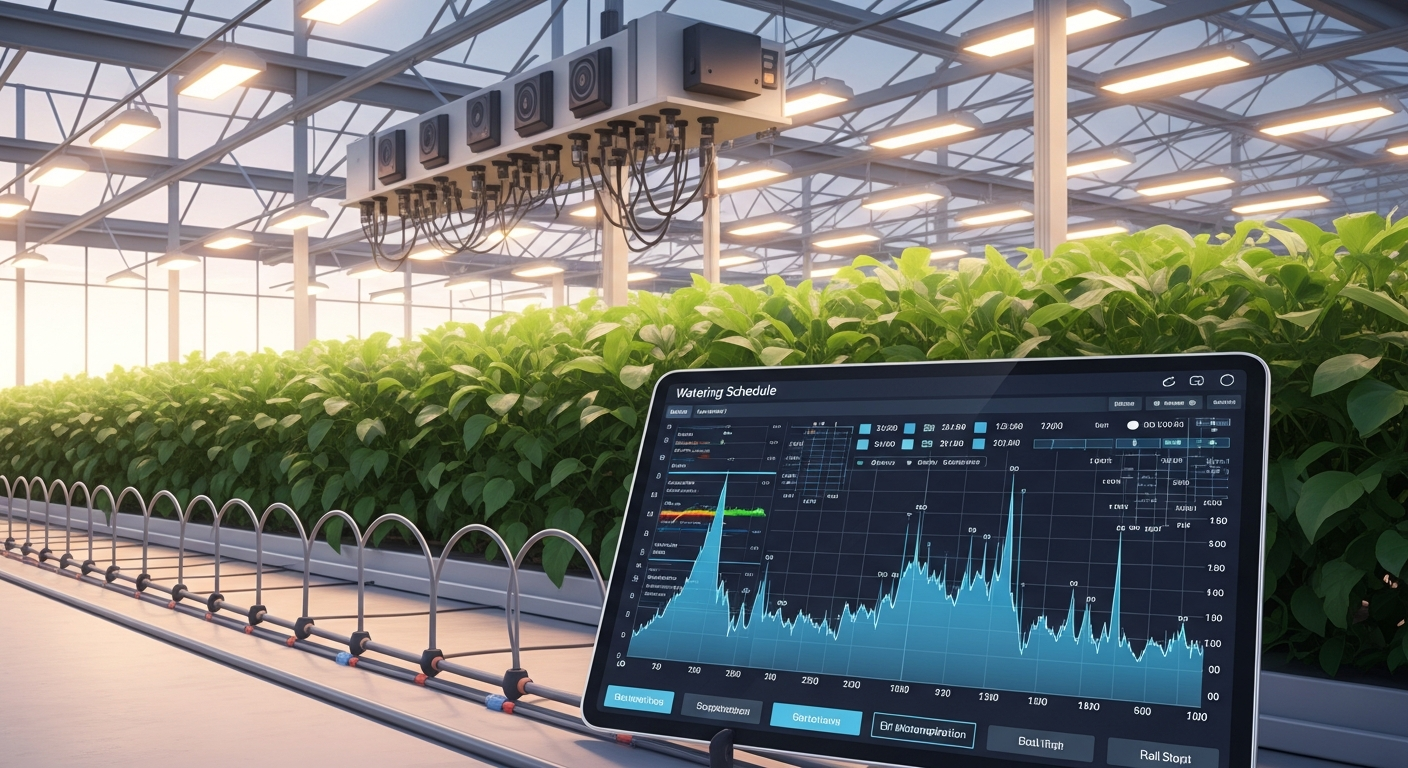
Many systems also offer advanced features like graphical data logging, remote access, and alert notifications, giving you unprecedented control and insight into your irrigation strategy.
Calibration and Fine-Tuning
Implementing an ET-based system isn’t a “set it and forget it” operation. Initial calibration and ongoing fine-tuning are crucial for optimal performance:
- Start with Known Kc Values: Use reliable Kc values for your crops, but be prepared to adjust them based on your specific greenhouse environment and growing practices.
- Combine with Soil Moisture Sensors: While ET tells you how much water *should* have been lost, soil moisture sensors provide direct feedback on the actual water content in your growing media. Combining both data sources creates a robust and highly accurate feedback loop, allowing your system to learn and adapt.
- Monitor Runoff: Even with ET-based irrigation, a small amount of intentional runoff (leaching fraction) may be necessary to prevent salinity buildup, especially in soilless culture. Your system should account for this.
- Observe Plant Response: Ultimately, the plants themselves are the best indicators. Monitor for signs of stress (wilting, nutrient deficiencies) or overwatering (algae growth, stunted roots) and adjust your parameters accordingly.
Practical Tips for Successful Implementation
- Invest in Quality Sensors: Accurate data is paramount. Choose reliable, calibrated sensors designed for greenhouse conditions.
- Understand Your Crop’s Needs: Research the specific Kc values and optimal growth conditions for each crop you grow.
- Phased Implementation: If you have a large operation, consider implementing ET-based watering in a smaller zone first to gain experience before rolling it out across the entire greenhouse.
- Regular Maintenance: Keep sensors clean and calibrated. Ensure your irrigation system (emitters, drippers) is functioning correctly to deliver water as intended.
- Data Analysis: Regularly review your ET data, watering records, and plant health metrics. This helps you identify trends, optimize settings, and continuously improve your watering strategy.
- Consider Evaporative Cooling: If your greenhouse uses evaporative cooling (e.g., pad and fan systems), remember that this will significantly impact the internal humidity and temperature, directly affecting ET rates. Your ET calculation method should ideally account for this.
Integrating Evapotranspiration data into your automated watering schedules is a significant leap forward for any greenhouse operator striving for efficiency, sustainability, and superior plant health. It transitions watering from an art to a precise science, empowering growers with the data-driven insights needed to thrive in modern agriculture.
The future of greenhouse cultivation is intelligent, and ET-driven irrigation is a cornerstone of that future. By embracing this technology, you’re not just watering plants; you’re nurturing an ecosystem with unparalleled precision, conserving precious resources, and cultivating a more resilient and productive growing environment for years to come.