
In the intricate world of modern agriculture, precision is paramount. As growers increasingly adopt fertigation—the practice of injecting fertilizers directly into the irrigation water—the stakes for accurate nutrient delivery rise significantly. A well-designed fertigation network doesn’t just deliver water; it delivers a precisely tailored nutrient solution, directly to the plant’s root zone. However, without meticulous flow control and pressure regulation, even the most sophisticated systems can fall short, leading to uneven crop growth, nutrient waste, and diminished yields. This article delves into the critical importance of these two pillars in fertigation, exploring the technologies, strategies, and best practices that ensure your plants receive exactly what they need, when they need it, every time.
The Indispensable Role of Flow Control in Fertigation Networks
Flow control is the cornerstone of effective fertigation. It dictates the volume of water and dissolved nutrients delivered to specific areas of a crop, ensuring uniformity and preventing both under-fertilization and nutrient runoff. Without precise flow management, your investment in fertilizers and advanced irrigation technology can quickly become inefficient and wasteful.
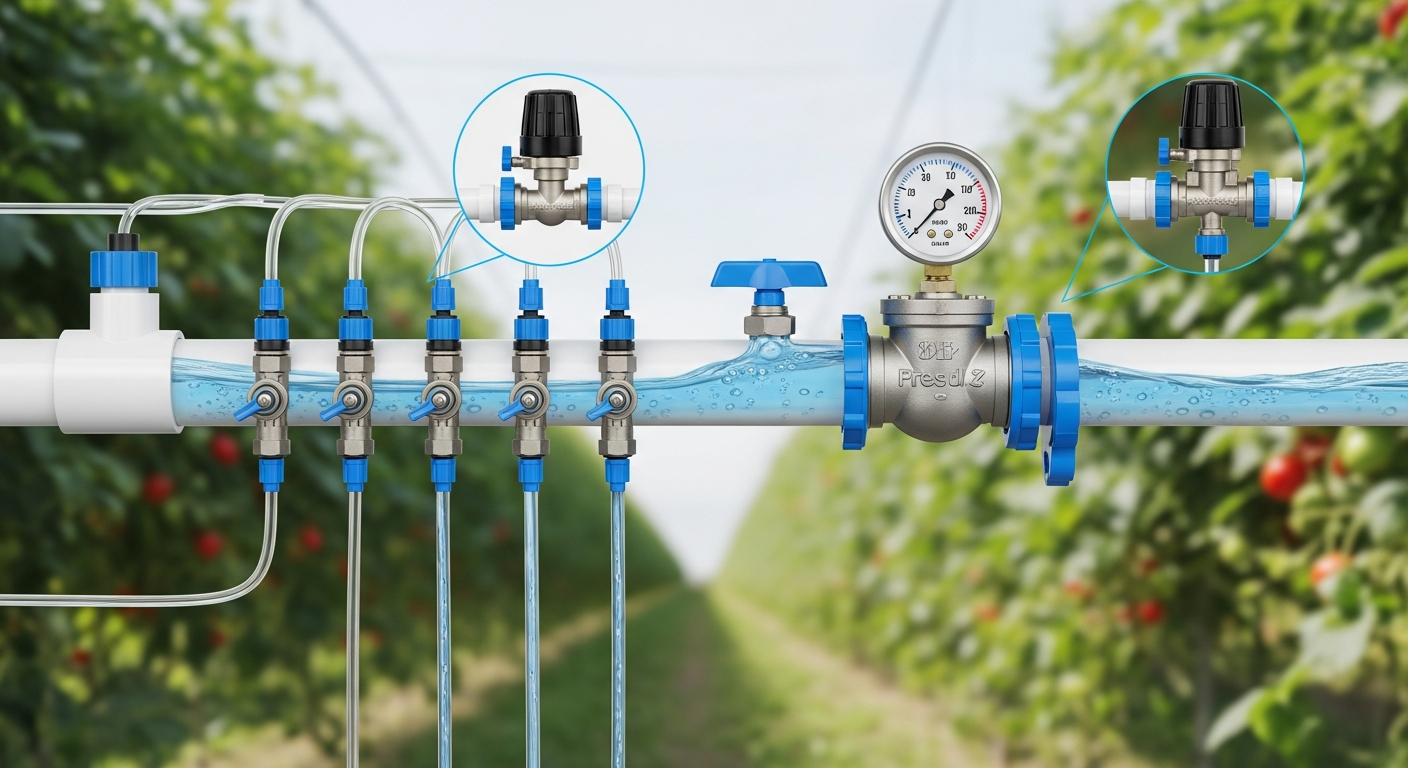
Why Flow Control Matters for Nutrient Uniformity
- Even Distribution: Consistent flow rates across all emitters within a zone are crucial for uniform nutrient delivery. Variations can lead to some plants receiving too much fertilizer, causing burning or toxicity, while others receive too little, resulting in nutrient deficiencies and stunted growth.
- Resource Efficiency: Accurate flow control minimizes the waste of costly fertilizers and water. By preventing over-application, growers save money on inputs and reduce the environmental impact of runoff.
- Optimized Crop Yields: When every plant receives its optimal nutrient dose, it promotes healthier, more vigorous growth, leading to higher quality produce and increased yields across the entire field or greenhouse.
- System Integrity: Managing flow helps protect irrigation components from excessive wear and tear, prolonging the lifespan of pumps, pipes, and emitters.
Key Components for Effective Flow Control
Achieving superior flow control relies on a combination of technologies:
- Flow Meters: These devices are essential for monitoring and quantifying the exact volume of water and fertilizer solution passing through specific points in the system. They range from simple paddle wheel sensors to highly accurate magnetic or ultrasonic flow meters. Regular calibration and data logging from flow meters are vital for system optimization and record-keeping.
- Control Valves:
- Manual Valves: Ball valves, gate valves, and globe valves allow operators to manually adjust or shut off flow to specific zones or lines.
- Automatic Solenoid Valves: These electrically operated valves can be opened or closed remotely or through an automated controller, enabling precise scheduling and zone management.
- Motorized Valves: Offering finer control than solenoid valves, motorized valves can be precisely positioned to regulate flow rate incrementally, often integrated into sophisticated automation systems.
- Variable Speed Drives (VSDs): Also known as Variable Frequency Drives (VFDs), these devices control the speed of irrigation pumps. By adjusting pump speed, VSDs can precisely match the system’s flow demand, leading to significant energy savings and superior flow regulation, especially in systems with varying demands or changing operational pressures.
- Pressure Compensating (PC) Emitters/Drip Lines: While primarily associated with pressure regulation, PC emitters also contribute to flow uniformity by maintaining a consistent flow rate over a wide range of inlet pressures, effectively counteracting pressure variations across a long drip line or undulating terrain.
Practical Tip: Integrate a flow meter after your fertilizer injector to confirm the correct amount of solution is being applied. Regularly cross-reference these readings with the amount of fertilizer concentrated product consumed to ensure injection accuracy.
Mastering Pressure Regulation for Optimal Fertigation Performance
Just as critical as flow control, pressure regulation ensures the entire fertigation network operates within its optimal design parameters. Inconsistent or incorrect pressure can wreak havoc on an irrigation system, compromising flow uniformity, damaging components, and leading to inefficient nutrient delivery.
The Imperative of Consistent Pressure
- Emitters Operating at Peak Efficiency: Most drip emitters, sprinklers, and micro-sprayers are designed to operate optimally within a specific pressure range. Outside this range, their spray pattern, droplet size, and flow rate can be significantly altered, leading to poor coverage and uneven nutrient application.
- Preventing System Damage: Excessively high pressure can cause pipe bursts, fitting failures, and premature wear on emitters and other components. Conversely, excessively low pressure can lead to inadequate coverage and poor performance.
- Energy Conservation: Maintaining the correct pressure avoids the waste of energy associated with running pumps at unnecessarily high pressures, which often occurs when trying to compensate for system inefficiencies.
- Extending System Lifespan: Operating within specified pressure limits reduces stress on all system components, thereby extending the overall life of your fertigation network and reducing maintenance costs.
Essential Components for Robust Pressure Regulation
A well-regulated system typically incorporates several key components:
- Pressure Regulators (PRVs): These devices are designed to maintain a constant downstream pressure regardless of fluctuations in upstream pressure. They are available in various types:
- Mainline Regulators: Installed at the head of the system or main zones to reduce high incoming pressure to a more manageable level for the entire distribution network.
- Zone Regulators: Placed at the entrance of specific irrigation zones to fine-tune pressure for different types of emitters or crop requirements.
- Inline Regulators: Small, compact units often installed directly before individual emitters or groups of emitters, particularly in drip systems.
- Pressure Compensating (PC) Emitters and Drip Lines: These specialized emitters contain an internal diaphragm or labyrinth that adjusts to varying inlet pressures, maintaining a consistent flow rate (and thus uniform nutrient delivery) over a broad pressure range. They are indispensable for achieving high uniformity in long laterals or undulating terrain.
- Pressure Relief Valves: These safety devices automatically open to release excess pressure when it exceeds a set limit, protecting the system from damage due to pressure surges or blockages.
- Pressure Gauges: Strategically placed pressure gauges throughout the network provide real-time feedback on system pressure, allowing operators to monitor performance and identify potential issues quickly. They are crucial for both initial setup and ongoing troubleshooting.
Practical Tip: When selecting pressure regulators, ensure they are rated for the flow range of your specific zone or mainline. An oversized or undersized regulator will not perform effectively.
Integrating Flow and Pressure for System Harmony and Advanced Control
The true power of an optimized fertigation system design emerges when flow control and pressure regulation are integrated seamlessly. They are two sides of the same coin, with each influencing the other to achieve overall system uniformity and efficiency.
Designing for Uniformity: The Synergy
Achieving maximum uniformity requires a holistic approach:
- Hydraulic Balancing: The network should be hydraulically balanced, meaning that friction losses, elevation changes, and pipe sizing are all considered to ensure that pressure and flow rates are as consistent as possible across all irrigation zones and emitters. This often involves careful calculations during the design phase.
- Zoning Strategies: Dividing the overall irrigation area into smaller, manageable zones, each with its own flow and pressure regulation, allows for tailored application based on specific crop needs, soil types, or topographical variations. This is particularly important for large-scale operations.
- Pipe Sizing and Layout: Proper sizing of mainlines, sub-mains, and laterals is fundamental. Undersized pipes lead to excessive friction loss and pressure drops, while oversized pipes can be unnecessarily expensive. An efficient layout minimizes pipe runs and elevation changes where possible.
Leveraging Automation and Sensors
Modern fertigation networks benefit immensely from automation and advanced sensing technologies:
- Smart Controllers: Advanced irrigation controllers can integrate data from flow meters, pressure transducers, and soil moisture sensors to dynamically adjust irrigation schedules and fertilizer injection rates.
- Pressure Transducers: These sensors provide continuous electronic feedback on system pressure, allowing controllers to monitor pressure fluctuations in real-time and trigger corrective actions, such as adjusting pump speeds via a VSD or signaling an alert.
- Automated Valves: Integration with a central control system allows for precise, automated opening and closing of valves, facilitating complex fertigation schedules and zone switching.
- SCADA (Supervisory Control and Data Acquisition) Systems: For very large or complex fertigation networks, SCADA systems offer comprehensive monitoring, control, and data logging capabilities, enabling operators to manage the entire system from a central interface.
The combination of robust hardware and intelligent software creates a responsive and adaptive fertigation environment, capable of delivering nutrients with unparalleled precision and efficiency.
Practical Implementation and Maintenance Tips for Fertigation Networks
Successful implementation of flow control and pressure regulation in fertigation networks extends beyond initial design; it requires diligent installation, ongoing monitoring, and proactive maintenance.
System Design Considerations
- Detailed Site Assessment: Before design, conduct a thorough assessment of topography, soil type, water source quality, and crop requirements. These factors significantly influence pipe sizing, zoning, and component selection.
- Hydraulic Design Calculations: Invest in professional hydraulic design. Accurate calculations for friction loss, elevation changes, and required flow rates are essential for selecting the correct pipe diameters, pump size, and pressure regulation devices.
- Component Matching: Ensure all components—pumps, filters, valves, regulators, and emitters—are compatible and rated for the anticipated flow and pressure ranges of your system. Incompatible components can lead to inefficiencies or premature failure.
- Zoning: Plan for logical zones based on varying crop needs, sun exposure, soil conditions, or elevation differences. Each zone should ideally have its own dedicated pressure regulation and flow control mechanisms.
Installation Best Practices
- Clean Installation: Prevent debris from entering pipes during installation, as it can clog emitters or damage control valves and regulators. Flush lines thoroughly after installation.
- Correct Placement: Install pressure regulators and flow meters in easily accessible locations for monitoring and maintenance. Ensure regulators are installed in the correct direction of flow.
- Secure Connections: Use proper sealing techniques for all pipe connections and fittings to prevent leaks, which can significantly impact pressure and flow uniformity.
- Sensor Installation: Install pressure gauges and flow meters at strategic points (e.g., after the pump, before/after filters, at the head of each zone) to provide comprehensive system monitoring.
Ongoing Maintenance and Troubleshooting
- Regular Inspections: Periodically check all valves, pressure regulators, emitters, and drip lines for signs of wear, leaks, or blockages. Replace worn components promptly.
- Filter Cleaning: Maintain clean filters. Clogged filters dramatically reduce flow and pressure downstream, impacting uniformity and stressing the pump.
- Calibration: Routinely calibrate flow meters and pressure gauges to ensure accuracy. This is crucial for precise nutrient delivery.
- Pressure Checks: Use a handheld pressure gauge to verify pressure at various points across a zone, especially at the furthest emitters, to confirm uniform operation.
- Leak Detection: Regularly walk the system to identify and repair any leaks, no matter how small. Leaks waste water and nutrients and disrupt system hydraulics.
- Seasonal Checks: Perform thorough checks before and after each growing season. This includes flushing lines, cleaning components, and proper winterization procedures where applicable.
- Monitor Crop Health: The ultimate indicator of your fertigation system’s performance is the health and uniformity of your crops. Uneven growth patterns are often the first sign of underlying issues with flow or pressure.
By adhering to these practical guidelines, growers can significantly enhance the reliability and efficiency of their fertigation networks, leading to healthier crops and better economic outcomes.
Conclusion
Implementing effective flow control and pressure regulation is not merely an optional upgrade; it is a fundamental requirement for any successful fertigation network. These twin pillars ensure that every plant receives its precise share of water and nutrients, leading to unparalleled uniformity in crop growth, maximized yields, and significant savings in water and fertilizer resources. From the careful selection of components like flow meters and pressure regulators to the strategic integration of automation and smart sensors, every step contributes to a more efficient, sustainable, and profitable agricultural operation. By investing in robust design, meticulous installation, and proactive maintenance, growers can unlock the full potential of their fertigation systems, cultivating not just crops, but also a future of precision agriculture.