
A thriving greenhouse environment hinges on precise climate control. While many factors contribute to keeping your plants happy, from ventilation to shading, one of the unsung heroes of a successful cooling strategy, especially for evaporative cooling systems, is the water pump. It’s the heart that circulates life-giving water to your cooling pads, driving the entire temperature regulation process. But simply grabbing any pump off the shelf can lead to inefficiencies, wasted energy, or inadequate cooling. Understanding how to properly size a water pump for your greenhouse cooling system is not just about moving water; it’s about optimizing performance, conserving resources, and ensuring your plants always enjoy their ideal climate.
Why Proper Pump Sizing Matters for Greenhouse Cooling
An incorrectly sized water pump can undermine your entire greenhouse cooling strategy. If the pump is too small, it won’t deliver enough water to adequately saturate your cooling pads, leading to dry spots and inefficient evaporation. This results in higher greenhouse temperatures, stressed plants, and potentially wasted energy as your ventilation fans work harder to compensate for the lack of effective cooling.
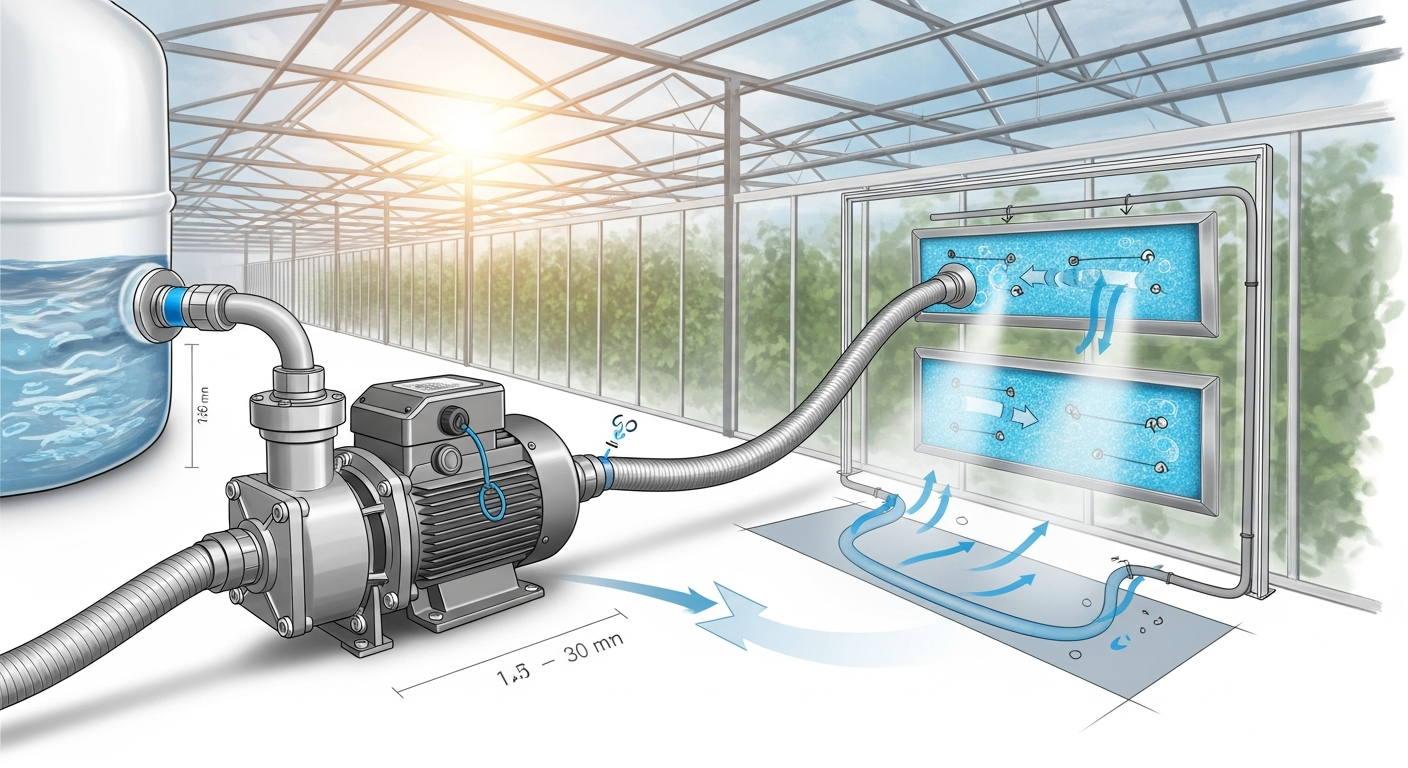
Conversely, an oversized pump isn’t a better solution. While it might provide plenty of water, it will consume excessive electricity, increasing your operating costs unnecessarily. It can also lead to premature wear and tear on the pump due to constant cycling or operating outside its optimal efficiency range. An oversized pump might also cause splashing or overflow at your cooling pads, leading to water waste and potential moisture issues around the greenhouse.
Proper water pump sizing ensures:
- Optimal Cooling Performance: Full and even saturation of cooling pads for maximum evaporative effect.
- Energy Efficiency: The pump operates at its most efficient point, reducing electricity consumption.
- System Longevity: Prevents premature wear on the pump and associated components.
- Resource Conservation: Minimizes water waste and ensures every drop contributes to cooling.
- Consistent Climate Control: A stable and predictable internal environment for your plants.
Understanding the Fundamentals: Flow Rate and Head Pressure
To accurately size a water pump for your greenhouse cooling system, you need to understand two critical specifications: flow rate and head pressure. These two metrics, when considered together, define a pump’s capacity and suitability for a given application.
Flow Rate (GPM)
Flow rate refers to the volume of water the pump can move over a specific period, typically measured in gallons per minute (GPM) or liters per minute (LPM). For greenhouse evaporative cooling systems, the flow rate is crucial because it dictates how much water reaches your cooling pads to facilitate evaporation. Too little flow, and your pads won’t fully wet; too much, and you’re wasting energy.
The required flow rate is primarily determined by the type and length of your cooling pads. Manufacturers often specify a recommended flow rate per linear foot or meter of cooling pad. This ensures consistent saturation across the entire pad surface.
Head Pressure (TDH)
Head pressure, also known as Total Dynamic Head (TDH), represents the total resistance the pump must overcome to move water through your system. It’s expressed in feet or meters of water column and accounts for two main components:
- Static Head: This is the vertical distance the water needs to be lifted. In a greenhouse cooling system, it’s the measurement from the surface of the water in your sump or reservoir to the highest point where the water is discharged (e.g., the top of your distribution pipe above the cooling pads).
- Friction Loss: As water moves through pipes, fittings (elbows, tees, valves), and even screens, it encounters resistance. This resistance causes a loss of pressure, which the pump must overcome. Friction loss is influenced by:
- Pipe Diameter: Smaller pipes cause more friction.
- Pipe Material: Smoother materials (like PVC) have less friction than rougher ones.
- Pipe Length: Longer pipes mean more friction.
- Number and Type of Fittings: Each elbow, valve, or connector adds to friction loss.
- Flow Rate: Higher flow rates result in greater friction loss.
The sum of the static head and all friction losses in your system gives you the Total Dynamic Head (TDH). This is the specific “pressure” requirement your pump needs to meet.
Calculating Your Greenhouse Cooling System’s Requirements
Now that we understand the basics, let’s walk through the steps to calculate your specific needs for a water pump. This is the most crucial part of selecting the right unit.
Step 1: Determine the Required Flow Rate (GPM)
This calculation depends on the dimensions of your cooling pads and manufacturer recommendations.
- Measure your cooling pads: Note the linear footage (or meters) of all your cooling pads combined.
- Consult manufacturer specifications: Cooling pad manufacturers typically recommend a specific flow rate per linear foot (e.g., 0.5 GPM per linear foot for 4-inch thick pads, or 1 GPM per linear foot for 6-inch thick pads). If you can’t find specific data, a common rule of thumb is 0.5 to 0.75 GPM per linear foot for standard 4-inch pads and 1.0 to 1.5 GPM per linear foot for 6-inch pads.
- Calculate Total GPM: Multiply the total linear footage of your pads by the recommended GPM per foot.
Example: If you have 50 linear feet of 6-inch cooling pads requiring 1 GPM/foot, your total required flow rate is 50 GPM.
Step 2: Calculate Total Dynamic Head (TDH)
This is where we account for both vertical lift and all frictional resistance.
- Measure Static Head:
- Measure the vertical distance from the water level in your sump or reservoir to the highest point where water exits the distribution pipe above your cooling pads. This is your static head.
Example: If your pump sits in a sump and the distribution pipe is 5 feet above the water level, your static head is 5 feet.
- Measure the vertical distance from the water level in your sump or reservoir to the highest point where water exits the distribution pipe above your cooling pads. This is your static head.
- Estimate Friction Loss: This is often the trickiest part, but online calculators and charts make it easier.
- Identify Pipe Details: Note the total length of your main supply pipe, its diameter (e.g., 1.5-inch PVC), and the number and type of fittings (e.g., two 90-degree elbows, one T-junction, one valve).
- Use Friction Loss Charts/Calculators: Many pump manufacturers and plumbing supply sites offer friction loss charts for different pipe materials, diameters, and flow rates. These charts will tell you the equivalent feet of head loss for a certain length of pipe and each fitting at your calculated flow rate.
As a rough estimate for small to medium greenhouse systems (e.g., under 100 GPM, 1.5-inch PVC pipe, 50-100 ft total run), total friction loss might range from 5 to 15 feet. For larger or more complex systems, accurate calculation is essential. - Sum up Friction Loss: Add the friction loss from all pipe segments and fittings.
- Calculate TDH: Add your static head and total friction loss.
Example: Static Head (5 ft) + Friction Loss (10 ft) = Total Dynamic Head (15 ft).
Step 3: Add a Safety Margin
It’s always wise to add a safety margin to your calculations. Consider adding an extra 10-20% to both your required flow rate and total dynamic head. This accounts for minor inaccuracies in measurement, future system expansion, or unexpected resistance. For example, if you calculated 50 GPM and 15 ft TDH, look for a pump that can deliver approximately 55-60 GPM at 16.5-18 ft TDH.
Selecting the Right Pump Type and Features
Once you have your target GPM and TDH, you can start looking at pumps. You’ll encounter a few common types and features relevant to greenhouse cooling.
- Submersible Pumps: These pumps are designed to operate completely submerged in water (e.g., in your sump). They are generally quieter, self-priming, and less prone to cavitation. Many come with built-in filters to prevent debris from entering.
- External (Inline) Pumps: These pumps sit outside the water source and draw water in through an inlet pipe. They are easier to access for maintenance and can often handle higher flow rates and heads for larger systems. However, they require priming and careful placement to avoid issues.
- Corrosion-Resistant Materials: Given constant exposure to water (and potentially nutrients or chemicals), look for pumps made from corrosion-resistant materials like stainless steel, cast iron with protective coatings, or high-grade plastics.
- Energy Efficiency: Check the pump’s wattage and GPM/TDH performance curves. A more efficient pump might have a higher upfront cost but will save significantly on electricity over its lifespan. Look for pumps with strong performance at lower wattage.
- Pump Curve: Always refer to the manufacturer’s pump curve (a graph that shows the pump’s GPM output at various head pressures). You’ll want to find a pump where your calculated GPM and TDH intersect within the pump’s most efficient operating range.
- Amperage and Voltage: Ensure the pump’s electrical requirements match your greenhouse’s power supply. Always use a Ground Fault Circuit Interrupter (GFCI) outlet for safety.
Practical Tips for Pump Installation and Maintenance
Beyond sizing, proper installation and regular maintenance are key to the longevity and efficiency of your water pump and cooling system.
- Install a Pre-Filter: Even if your pump has a built-in screen, adding an external coarse filter before the pump inlet can significantly extend its life by preventing larger debris (leaves, algae, grit) from entering.
- Secure and Level Placement: Ensure your pump is installed securely and, for external pumps, on a level surface to prevent vibration and ensure proper operation. Submersible pumps should be elevated slightly off the bottom of the sump to avoid sucking up sludge.
- Minimize Elbows and Fittings: During system design, try to keep the piping runs as direct as possible, minimizing the number of 90-degree elbows and unnecessary valves, as each adds to friction loss.
- Regular Cleaning: Periodically clean your pump’s impeller and housing, as well as the sump or reservoir, to remove sediment, algae, and mineral buildup. Clogged impellers drastically reduce efficiency.
- Check for Leaks: Regularly inspect all connections and pipes for leaks. Even small drips can impact flow rate and waste water.
- Monitor Performance: Pay attention to your cooling system’s performance. If cooling pads are drying out, or if the pump sounds unusual, investigate promptly.
Sizing a water pump for your greenhouse cooling system isn’t a task to be rushed or guessed. By meticulously calculating your required flow rate and total dynamic head, and then selecting a pump that meets those specifications with a slight safety margin, you’re investing in the efficiency, longevity, and overall success of your greenhouse climate control. A well-chosen pump is the difference between struggling to maintain temperature and enjoying consistently perfect conditions for your cherished plants. Take the time, do the math, and watch your greenhouse thrive!