
The success of any greenhouse operation hinges on the meticulous control of its internal climate. While many growers diligently manage temperature and humidity as separate entities, the truth is they are inextricably linked. An effective cooling strategy can inadvertently wreak havoc on your humidity levels, just as humidity management can impact the perceived temperature. Achieving optimal plant health, preventing disease, and maximizing yields requires a sophisticated understanding and, more importantly, a seamless integration of your cooling systems with your humidity controllers. This article will guide you through the principles and practical steps to harmonize these crucial environmental controls, ensuring your greenhouse maintains the perfect balance for thriving cultivation.
The Interplay of Temperature and Humidity in a Greenhouse
In a greenhouse, temperature and humidity are two sides of the same coin, constantly influencing each other and, in turn, your plants. High temperatures naturally lead to increased plant transpiration, where plants release water vapor into the air. This process, while essential for plant physiology, also rapidly elevates the relative humidity within the enclosed space. If left unchecked, this can create a hot, muggy environment ripe for fungal diseases like powdery mildew, botrytis, and various blights. Conversely, excessively low humidity can cause plants to stress, reducing their growth rates and potentially leading to wilting or nutrient deficiencies.
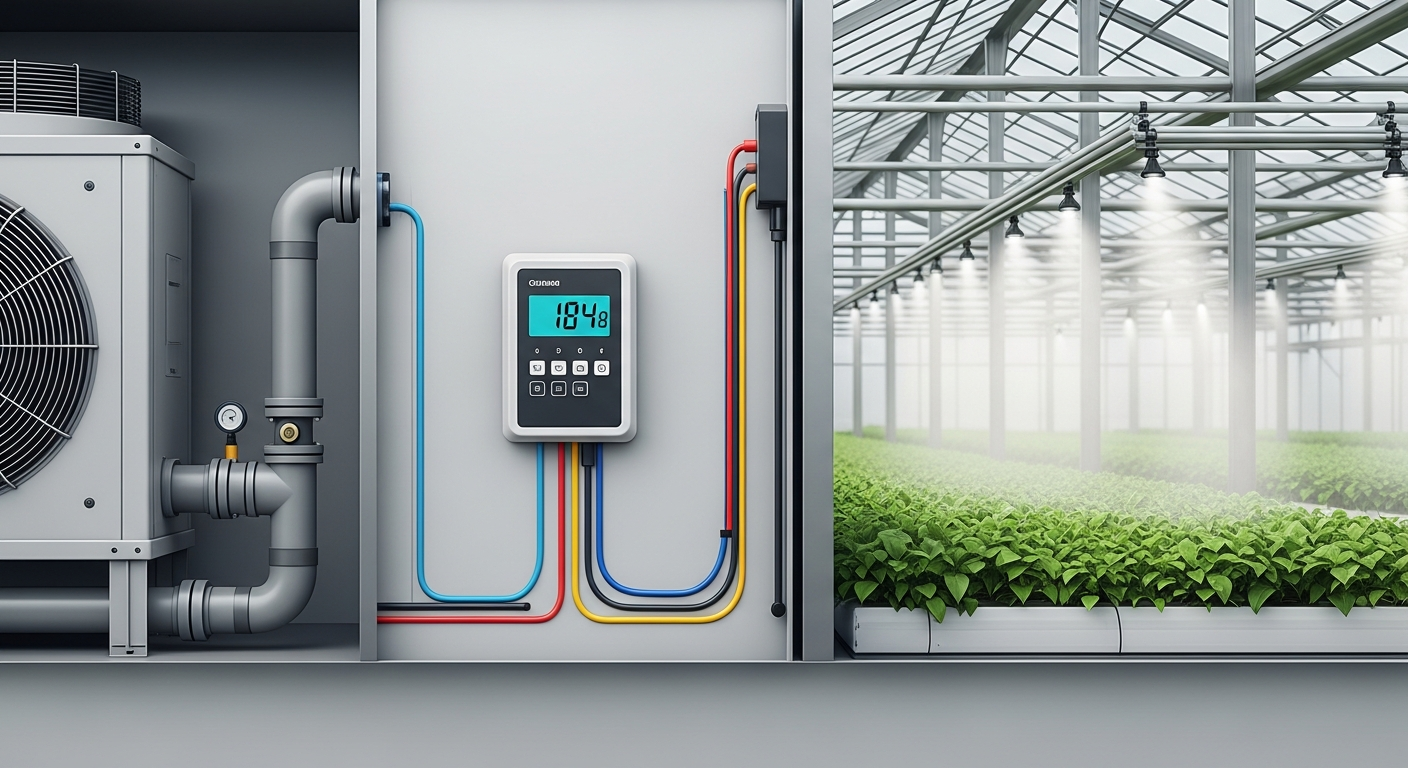
Understanding this relationship is paramount for effective greenhouse climate control. Many cooling methods, while effective at bringing down the air temperature, have a direct and significant impact on humidity. For instance, evaporative cooling methods actively introduce moisture into the air to achieve a cooling effect. If your humidity controller isn’t aware of this, or isn’t integrated to compensate, you could end up with an overly humid environment despite cooler temperatures. Conversely, some advanced cooling systems, like certain air conditioning units or dry dehumidifiers, can drastically reduce humidity, necessitating careful monitoring to prevent desiccation.
The goal is to maintain an ideal balance, often quantified by VPD, which measures the difference between the amount of moisture in the air and how much moisture the air can hold when saturated. A proper VPD ensures plants can efficiently transpire and absorb nutrients, leading to robust growth and higher yields. Achieving this balance requires systems that communicate and react in concert.
Understanding Your Cooling Systems and Their Humidity Impact
Before you can integrate, you must understand the specific characteristics of your cooling systems and how each impacts the greenhouse’s humidity profile.
Evaporative Cooling Systems (Fan-and-Pad, Foggers/Misters)
- How they work: These systems leverage the principle of evaporative cooling. As water evaporates, it absorbs heat from the surrounding air, causing a temperature drop. Fan-and-pad systems draw air through wet pads, while foggers and misters release fine water droplets directly into the air.
- Humidity Impact: By their very nature, evaporative cooling methods increase the relative humidity in the greenhouse. This is their primary cooling mechanism. While highly energy-efficient for cooling, they demand vigilant humidity monitoring to prevent over-saturation.
- Integration Challenge: The main challenge is preventing excessively humid conditions. Your humidity controller must be programmed to override or modulate evaporative cooling if humidity levels climb too high, potentially activating ventilation instead.
Ventilation and Shading
- How they work:
- Ventilation: Natural ventilation uses roof and side vents to allow hot, humid air to escape and cooler, drier air to enter. Mechanical ventilation uses exhaust fans to actively pull hot air out, often combined with intake shutters or fans to draw in fresh air.
- Shading: Shade cloth, liquid shade, or automated shade systems block solar radiation, preventing heat buildup in the first place.
- Humidity Impact: Ventilation actively removes humid air from the greenhouse, replacing it with ambient outdoor air (which may be more or less humid depending on conditions). Shading indirectly reduces humidity by lowering temperatures and thus reducing plant transpiration.
- Integration Advantage: These are often the first line of defense in an integrated system, as they are generally the most energy-efficient ways to manage both temperature and humidity (by removing humid air). They work synergistically: cooling through shading reduces the need for ventilation, and ventilation reduces humidity.
Air Conditioning (and Dehumidifiers)
- How they work: Traditional air conditioning units use refrigeration cycles to cool air. As a byproduct, they also condense moisture out of the air. Dedicated dehumidifiers operate similarly but focus solely on moisture removal.
- Humidity Impact: Both air conditioning and dehumidifiers reduce humidity by removing water vapor from the air. This can be highly beneficial in climates where outdoor humidity is consistently high, or when precise humidity control is critical for specific crops.
- Integration Consideration: While effective at both cooling and dehumidifying, these systems are typically more energy-intensive. Their use needs to be carefully balanced with the energy costs and the specific needs for dehumidification alongside cooling. They can be integrated to activate when other cooling methods fail to reduce humidity sufficiently or when very specific low humidity targets are required.
The Role of Advanced Humidity Controllers
A humidity controller, or humidistat, is the brain behind your greenhouse’s humidity management. Modern controllers go far beyond simple on/off switches, offering sophisticated capabilities essential for seamless integration with cooling systems.
- Precision Sensing: High-quality controllers feature accurate digital sensors that provide real-time humidity readings. Many can also integrate temperature data, allowing for calculations like VPD.
- Intelligent Control Logic: Beyond basic setpoints, advanced controllers can be programmed with complex algorithms. For example, they can be configured to activate different systems based on a hierarchy:
- If humidity is too high, first activate exhaust fans.
- If humidity remains high, open vents fully.
- If humidity still persists, activate a dehumidifier (if available) or override evaporative cooling.
- Multi-Zone Capabilities: In larger greenhouses or those with different crops, controllers can manage distinct humidity zones, allowing for varied setpoints and system activation schedules.
- Data Logging and Analysis: Many controllers record historical data on temperature and humidity, allowing growers to identify trends, troubleshoot issues, and optimize their settings over time. This data is invaluable for fine-tuning your integrated system.
- Remote Monitoring and Control: Internet-connected controllers offer the ability to monitor and adjust your greenhouse climate from anywhere via a smartphone or computer, providing peace of mind and immediate response capabilities.
The key to integration is selecting a controller that can not only read humidity but also send signals to and receive feedback from your various cooling devices, orchestrating their operation based on predefined climate parameters.
Strategies for Seamless Integration: Practical Steps
Integrating your cooling and humidity control systems is an ongoing process of setup, monitoring, and adjustment. Here’s a practical guide:
Sensor Placement is Key
Accurate readings are the foundation of effective control. Place humidity sensors (and temperature sensors) in representative areas of your greenhouse, away from direct sunlight, water sources (like misters or evaporative pads), and localized drafts. For larger greenhouses, consider multiple sensors to detect microclimates and ensure uniform control. Calibrate your sensors regularly to ensure accuracy.
Prioritize Your Systems (The "Hierarchy of Control")
To optimize energy efficiency and create a stable environment, establish a logical sequence for system activation:
- Passive Cooling/Ventilation First: When temperatures rise or humidity becomes too high, your controller should first activate natural ventilation (opening vents) or mechanical ventilation (exhaust fans). This is typically the most energy-efficient method for both cooling and humidity reduction.
- Shading: If ventilation alone isn’t sufficient for cooling, deploy shade cloth or activate liquid shade to reduce solar gain. This helps reduce the overall heat load, indirectly aiding humidity management.
- Active Cooling (Evaporative): If temperatures continue to climb *and* humidity is within an acceptable range, then activate evaporative cooling systems. Your humidity controller must be ready to suspend or modulate these if humidity spikes.
- Dehumidification/AC Last Resort: If humidity becomes excessively high (especially in conjunction with high temperatures) and ventilation isn’t effectively lowering it, then engage a dehumidifier or air conditioning unit. Use these sparingly due to their higher energy consumption, or reserve them for critical growth stages where precise humidity is non-negotiable.
Program Logic and Setpoints
This is where the "integration" truly happens. Your environmental control system or advanced humidity controller needs clear instructions:
- Temperature Setpoints: Define your desired high and low temperature limits.
- Humidity Setpoints: Establish your target high and low relative humidity (RH) levels.
- Interlocking Logic: Program conditions that link systems. For example:
IF Temperature > 80°F AND RH < 70%, THEN activate Fan-and-Pad.IF RH > 80% AND Temperature > 75°F, THEN activate Exhaust Fans.(Overrides evaporative cooling if it's active)IF RH > 85% for 30 minutes, THEN activate Dehumidifier for 1 hour OR until RH < 75%.
- Consider VPD: For advanced growers, program your controller to maintain a specific Vapor Pressure Deficit (VPD). This requires integrating both temperature and humidity sensors, as VPD considers both to indicate how "thirsty" your plants are. Controllers capable of VPD calculations can make more nuanced decisions about when to cool, humidify, or dehumidify.
Monitor, Analyze, and Adjust
Climate control is not a "set it and forget it" process. Regularly review the data logged by your controller. Look for patterns:
- Are certain systems running too frequently?
- Are there persistent periods of high or low humidity that your system isn't adequately addressing?
- Do your plants show signs of stress despite your setpoints?
Seasonal changes, crop growth stages, and even daily weather patterns will necessitate adjustments to your setpoints and control logic. Treat your greenhouse as a living laboratory and continuously fine-tune your integration for peak performance.
Consider Centralized Environmental Control Systems
For larger or commercial operations, investing in a centralized environmental control system (ECS) is highly recommended. These systems are designed from the ground up to integrate all aspects of greenhouse climate control – heating, cooling, ventilation, humidity, CO2 enrichment, and even irrigation – under a single, intelligent platform. An ECS simplifies programming, provides comprehensive data, and ensures all systems work together harmoniously to achieve optimal growing conditions.
Conclusion
Achieving a truly optimal greenhouse environment is an art and a science, demanding a sophisticated approach to climate control. By understanding the intricate relationship between temperature and humidity and thoughtfully integrating your cooling systems with advanced humidity controllers, you can transcend basic environmental management. This holistic approach not only leads to healthier plants, faster growth cycles, and higher yields but also contributes to significant energy savings and reduced disease pressure. Investing in smart integration is an investment in the long-term success and sustainability of your greenhouse operation, creating a vibrant, perfectly balanced microclimate where your plants can truly flourish.