
Maintaining the ideal climate within your greenhouse is paramount for healthy plant growth and maximum yields. As temperatures rise, particularly during warmer months, managing heat build-up becomes a critical challenge. Two of the most common and effective evaporative cooling strategies available to growers are fogging and misting systems. While both methods utilize water to lower temperatures, they operate on different principles and offer distinct advantages. Choosing the right system for your specific greenhouse environment can significantly impact your energy consumption, plant health, and overall operational success. This article will delve into the nuances of foggers and misters, helping you make an informed decision for optimal greenhouse climate control.
Understanding the Basics: Foggers vs. Misters
At their core, both foggers and misters work by introducing fine water droplets into the air, which then evaporate and absorb heat from the surroundings. This process, known as evaporative cooling, effectively lowers the ambient temperature. However, the key differentiator lies in the size of the water droplets they produce and the pressure at which they operate.
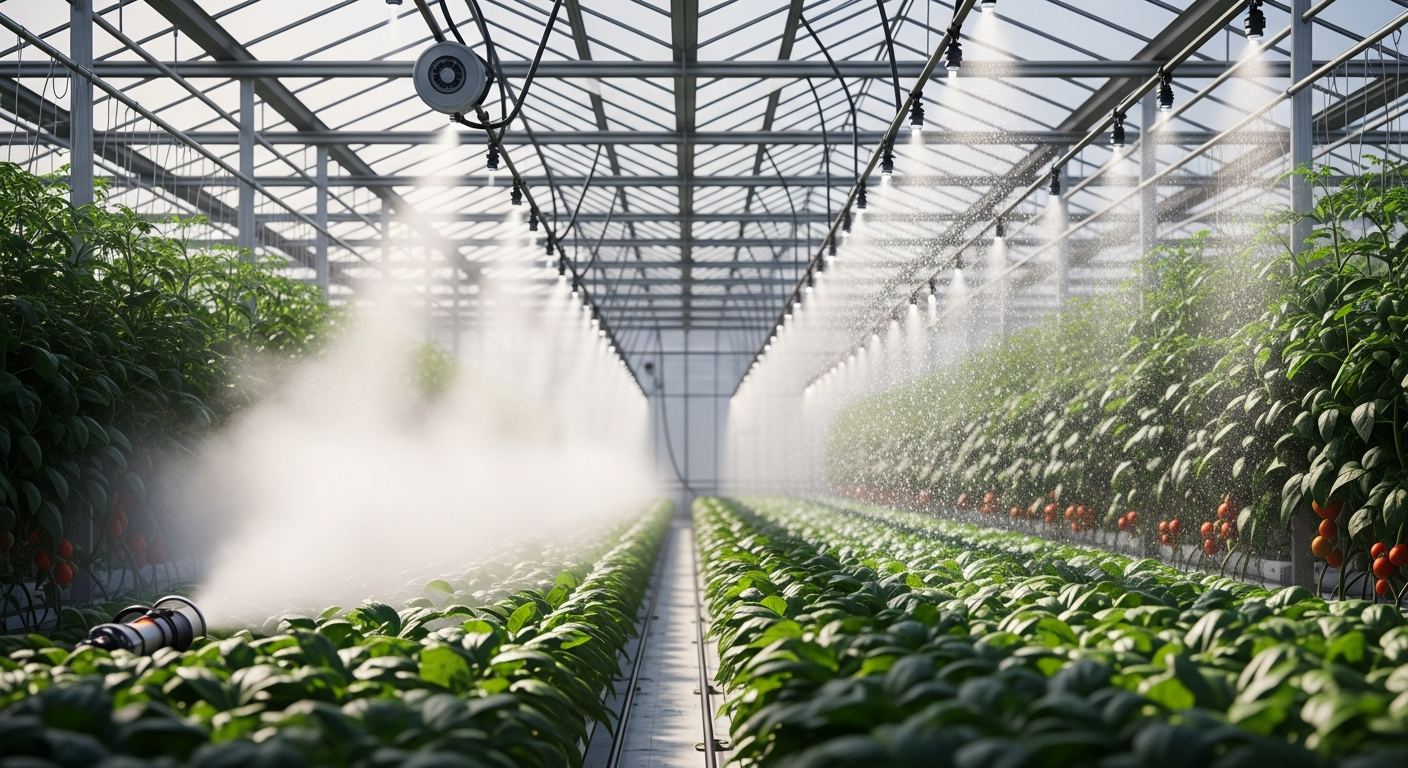
What are Misters?
Misting systems typically operate at lower pressures, ranging from 40-100 PSI (pounds per square inch). They produce relatively larger water droplets, often visible to the naked eye, that are generally between 50 and 100 microns in diameter. Because these droplets are larger, they take a bit longer to evaporate and can sometimes result in visible moisture or wetness on plants and surfaces if not properly managed. Misters are often used for localized cooling or when a slight increase in humidity and some wetting is acceptable or even desired for certain plant types.
What are Foggers?
Fogging systems, conversely, are high-pressure systems, often operating at 500 PSI or more, sometimes reaching over 1000 PSI. This high pressure forces water through incredibly tiny nozzles, creating micro-fine water droplets, usually less than 10-20 microns in diameter – often referred to as “dry fog.” These extremely small droplets evaporate almost instantly upon release, creating a noticeable cooling effect without leaving significant wetness on plants or surfaces. This rapid evaporation is what makes fogging incredibly efficient for evaporative cooling and precise humidity control.
The Science of Cooling: Evaporation at Work
The magic behind both foggers and misters is the principle of evaporative cooling. When water changes from a liquid to a gaseous state (vapor), it absorbs a significant amount of heat energy from its surroundings. This absorbed energy is known as the latent heat of vaporization. The more efficiently water can evaporate, the more heat it removes from the greenhouse air.
The size of the water droplet is crucial to this efficiency. Smaller droplets have a much larger surface area-to-volume ratio compared to larger droplets. This means they can absorb heat and evaporate much faster. This is why high-pressure fogging systems, with their ultra-fine droplets, are far more effective at rapid, “dry” evaporative cooling and humidity management than low-pressure misters. With foggers, the goal is often to achieve full evaporation before the droplets have a chance to settle, thus preventing saturation of the air or wetting of plants. Misters, while still providing cooling, might rely on some of the larger droplets settling to create a cooling effect over time, or they might be used to specifically wet down surfaces or plants.
The ambient humidity also plays a vital role. Evaporative cooling works best in drier climates, where the air has a greater capacity to absorb moisture. In already very humid environments, the cooling potential of both systems will be reduced because the air is already close to saturation.
Key Factors to Consider When Choosing Your System
Selecting between a fogger and a mister isn’t a one-size-fits-all decision. Several critical factors should influence your choice to ensure you get the most effective and efficient greenhouse cooling solution for your specific needs.
Greenhouse Size and Layout
- Smaller Greenhouses (Hobbyist to Small Commercial): Misters can be a cost-effective solution for smaller spaces, especially if localized cooling or a slight increase in humidity is sufficient.
- Larger Commercial Greenhouses: Fogging systems are generally preferred for large-scale operations due to their ability to provide uniform cooling and humidity control across vast areas without significant wetness.
- Ventilation: Proper ventilation is crucial for both systems to remove humid air and bring in drier air, maximizing cooling efficiency.
Crop Type and Humidity Needs
- High Humidity Lovers (e.g., Orchids, Tropical Plants, Cuttings): Foggers excel here, providing precise humidity control without drenching foliage, which can prevent fungal diseases. Misters can also work but require careful management to avoid over-wetting.
- Crops Sensitive to Wetness (e.g., Tomatoes, Peppers, Some Herbs): Fogging systems are almost always the better choice as they produce a “dry” fog, minimizing the risk of foliar diseases caused by prolonged leaf wetness.
- Crops Tolerant of Wetness or Needing Period Wetting (e.g., Benches for germinating seeds): Misters might be suitable where some wetting is not detrimental or even beneficial.
Desired Cooling Effect and Temperature Drop
- Significant Temperature Drop (10-20°F or more): High-pressure fogging systems are superior for achieving substantial and rapid temperature reduction, especially in drier climates.
- Moderate Temperature Drop (5-10°F): Misters can provide this, often effectively in conjunction with good ventilation.
Local Climate and Ambient Humidity
- Dry Climates (Arid or Semi-Arid): Fogging systems will provide the most dramatic cooling effect due to the air’s high capacity to absorb moisture. Misters will also work well, but perhaps with less efficiency for the same water volume.
- Humid Climates: The effectiveness of evaporative cooling is reduced in already humid conditions. Foggers might still be useful for slight cooling and targeted humidity bumps, but their overall cooling power will be diminished. Mechanical cooling might be considered as an alternative or supplement.
Water Quality and Availability
- Water Quality: Both systems benefit from filtered water to prevent nozzle clogging, but foggers, with their extremely fine nozzles, are far more susceptible to clogging from hard water minerals or impurities. Reverse osmosis (RO) systems are often recommended or even necessary for high-pressure fogging.
- Water Usage: While foggers evaporate more efficiently, a large-scale fogging system can consume a significant amount of water. Consider your water source and costs.
Budget and Operating Costs
- Initial Investment: Misting systems generally have a lower initial purchase and installation cost due to simpler pumps and less complex nozzle technology. Fogging systems, with their high-pressure pumps and specialized components, represent a higher upfront investment.
- Energy Consumption: High-pressure fogging pumps will consume more electricity than low-pressure misting pumps.
- Maintenance Costs: Both systems require regular maintenance, including nozzle cleaning/replacement. Foggers, with their ultra-fine nozzles, may require more frequent cleaning or specialized water treatment to prevent clogging.
Maintenance and Complexity
- Installation: Misting systems are typically easier to install for DIY enthusiasts. Fogging systems often benefit from professional installation due to the high-pressure components and precision required.
- Maintenance: Regular cleaning of nozzles and filters is essential for both. Fogging nozzles are more delicate and prone to clogging if water quality isn’t pristine.
When to Choose a Mister System
You might lean towards a mister system if:
- You have a smaller hobby greenhouse or limited budget.
- Your plants are tolerant of some leaf wetness or even benefit from it (e.g., ferns, certain propagations).
- You primarily need localized cooling for specific areas.
- You are looking for a simpler, more straightforward installation and maintenance process.
- Your goal is a moderate temperature drop and perhaps a slight humidity boost.
When to Choose a Fogging System
A fogging system is likely your best bet if:
- You operate a large commercial greenhouse where uniform cooling and humidity are critical.
- You grow high-value crops that are sensitive to leaf wetness (e.g., cut flowers, tomatoes, orchids).
- You require precise humidity control to prevent disease or optimize plant physiological processes.
- You need to achieve a significant temperature drop, especially in a dry climate.
- You prioritize maximum cooling efficiency with minimal wetness.
- You have access to high-quality filtered water or are willing to invest in a water purification system.
Conclusion
Choosing between a fogger and a mister for your greenhouse cooling needs boils down to understanding the specific demands of your plants, your local climate, and your operational capabilities. Fogging systems offer superior, “dry” evaporative cooling and precise humidity control, making them ideal for larger operations and sensitive crops, albeit with a higher initial investment and stricter water quality requirements. Misting systems, on the other hand, provide an effective and more economical cooling solution for smaller setups or when some wetting is acceptable. By carefully evaluating the factors discussed, you can select the perfect greenhouse cooling system that ensures optimal climate conditions, promoting robust plant health and maximizing your growing success. Invest wisely in your greenhouse’s climate control, and your plants will thank you with thriving growth.