
The landscape of indoor horticulture has been revolutionized by LED technology, offering growers unprecedented control over light spectrum, intensity, and duration. This precision allows for optimized plant growth, increased yields, and reduced energy consumption compared to traditional lighting solutions. However, the world of LED grow lights is not monolithic; it encompasses various technologies, each with its own strengths and applications. Among the most prevalent and often debated are COB (Chip On Board) and SMD (Surface Mount Device) LEDs. Understanding the fundamental differences between these two core technologies is crucial for any grower looking to make informed decisions about their lighting setup. This technical overview will dissect COB and SMD LEDs, exploring their design principles, performance characteristics, and practical implications for cultivating a thriving indoor garden.
Understanding LED Technology: The Foundation of Modern Horticulture
Before diving into the specifics of COB and SMD, it’s essential to grasp the basics of what an LED is and why it has become the preferred choice for horticultural lighting. An LED, or Light Emitting Diode, is a semiconductor device that emits light when an electric current passes through it. Unlike incandescent bulbs that generate light through heat (incandescence), LEDs produce light through electroluminescence, making them significantly more energy-efficient and cooler in operation. This efficiency directly translates to lower electricity bills and less heat stress on plants, reducing the need for extensive cooling systems.
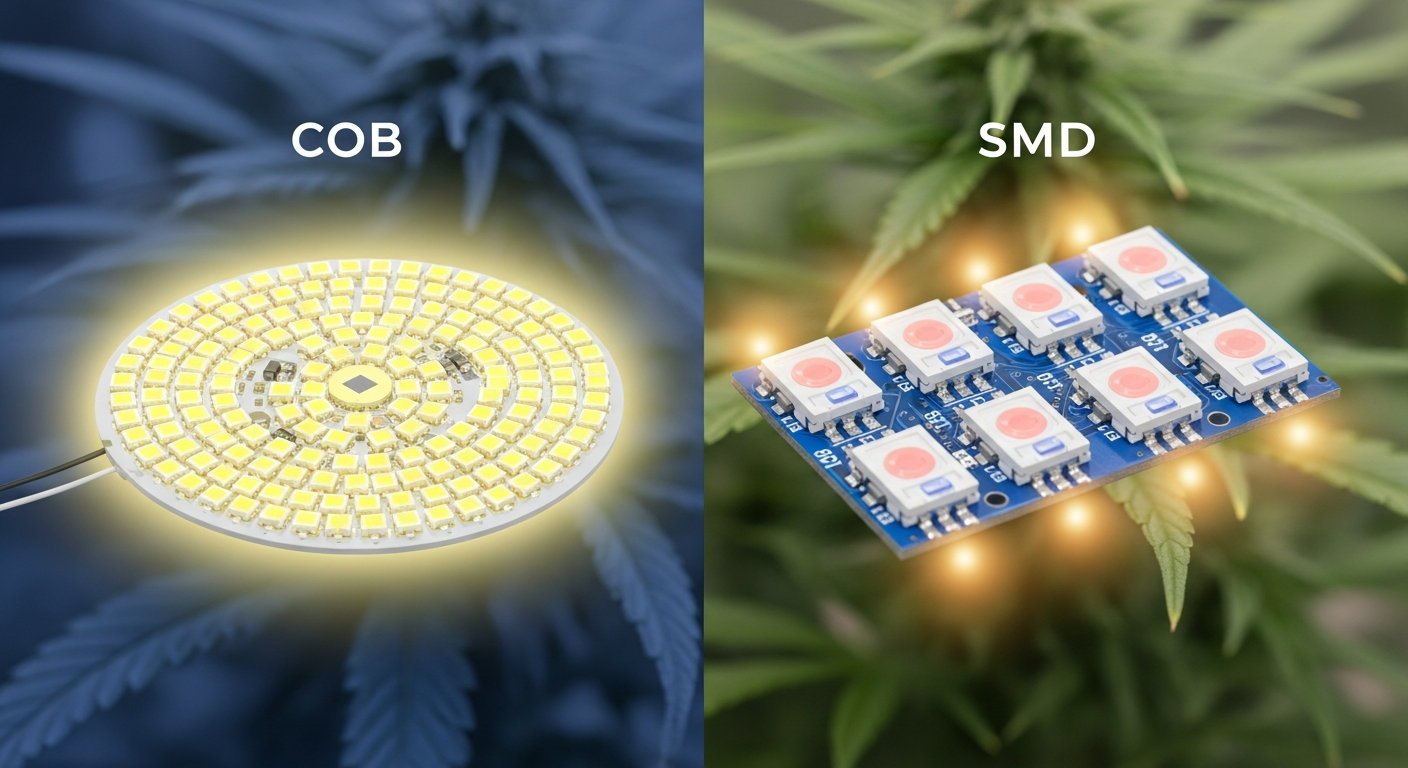
For growers, the ability to control the spectral output of LEDs is perhaps their most significant advantage. Plants utilize specific wavelengths of light for different physiological processes, such as photosynthesis, germination, and flowering. LEDs can be engineered to emit precise wavelengths (e.g., blue for vegetative growth, red for flowering), allowing growers to tailor the light spectrum to the exact needs of their crops throughout their life cycle. Key metrics like PAR (Photosynthetically Active Radiation) and PPFD (Photosynthetic Photon Flux Density) become paramount when evaluating LED grow lights, as they measure the amount of light available for photosynthesis. The choice between COB and SMD often boils down to how these technologies deliver and distribute that crucial PAR to the plant canopy.
Decoding SMD LED Technology: Precision and Uniformity
What are SMD LEDs?
SMD stands for Surface Mount Device. In the context of LEDs, SMD technology involves mounting individual, small LED chips directly onto a printed circuit board (PCB). These chips are often encapsulated in a protective resin, forming a distinct package. Each SMD package typically contains one to three tiny light-emitting diodes, often with dedicated circuitry for each color. This design allows for a high degree of flexibility and scalability. You’ll find SMD LEDs in almost all modern electronics, from televisions and smartphones to general home lighting and, crucially, a vast array of LED grow lights.
Characteristics and Advantages for Growers
SMD grow lights are characterized by their distributed nature. A single grow light fixture often comprises hundreds, if not thousands, of individual SMD LED chips spread across a panel. This design offers several compelling advantages for indoor cultivation:
- Superior Light Distribution: The most significant benefit of SMD LEDs is their ability to provide highly uniform light distribution across the plant canopy. By spreading many smaller light sources over a larger area, SMDs minimize hot spots and shadows, ensuring that all plants, or parts of a single plant, receive consistent light levels. This uniformity is crucial for even growth and consistent yields across the entire grow area.
- Fine-Grained Spectral Control: SMD technology excels at spectral customization. Because each individual LED chip can be a different color (e.g., royal blue, deep red, far red, white), manufacturers can precisely blend various wavelengths to create a custom spectrum optimized for specific plant stages or species. This allows for tailored light recipes that can significantly impact plant morphology, cannabinoid production, or vegetable yield.
- Excellent Thermal Management: Since the heat generated is distributed among many small chips spread over a larger surface area, thermal management for SMD panels is generally easier. Each individual chip produces less heat, and the heat can dissipate more effectively through the PCB and heatsinks. This contributes to longer LED lifespans and more stable performance.
- Scalability and Flexibility: SMD panels can be designed in virtually any shape or size, from small supplemental bars to large, square fixtures. This modularity makes them highly adaptable for various grow spaces, from vertical farms to multi-tier setups.
- Redundancy: While thousands of individual points of failure might seem like a disadvantage, the sheer number of SMDs means that if a few individual diodes fail, the overall light output and functionality of the fixture are usually not significantly compromised.
Disadvantages and Considerations for Growers
Despite their many benefits, SMD LEDs also present certain limitations:
- Lower Light Intensity per Point: Each individual SMD chip produces relatively less light intensity compared to a COB. While this is mitigated by having many chips, it means that achieving very high light penetration into dense canopies can sometimes be a challenge without getting the fixture extremely close to the plants, or using a large number of SMDs.
- Potential for More Components and Solder Joints: A panel with thousands of SMD LEDs means thousands of individual solder joints. While manufacturing quality has improved immensely, this can theoretically introduce more points of potential failure over the long term, though robust designs mitigate this.
- Cost for High Power: While individual SMD chips are inexpensive, designing and manufacturing high-power, high-quality SMD fixtures with excellent thermal management and advanced spectral capabilities can still be a significant investment.
Practical Tip for SMD Users: When selecting an SMD fixture, pay close attention to the spatial distribution of the diodes and the inclusion of specific wavelength diodes. A balanced spread of red, blue, and white (full-spectrum) SMDs is crucial for complete plant development. Look for fixtures with a high component count and good thermal design to ensure even light and longevity.
Unpacking COB LED Technology: Power and Penetration
What are COB LEDs?
COB stands for Chip On Board. In contrast to SMD, COB technology involves mounting multiple small LED chips directly onto a single substrate (often ceramic or metal) to form one large, powerful light source. These chips are then covered by a common phosphor layer and lens, making the entire cluster appear as a single, intensely bright “chip” when illuminated. Think of it as a miniature array of tiny LEDs all working together from one central point.
Characteristics and Advantages for Growers
COB grow lights are known for their concentrated power output and ability to deliver high intensity light from a single source:
- High Light Intensity and Penetration: This is the primary advantage of COB LEDs. By packing many LED chips into a small area, COBs generate an extremely high PPFD from a single point. This intense, collimated light is excellent for deep canopy penetration, especially beneficial for taller, denser plants or when trying to maximize light delivery to lower branches.
- Simpler Design and Fewer Components: A COB fixture often uses fewer COB units compared to an SMD fixture with equivalent total wattage. This can lead to a simpler circuit design, fewer solder points (per COB unit), and a more robust overall build for the light-emitting component itself.
- Efficiency at High Power: COBs can be highly efficient, especially when run at their optimal current. Their concentrated nature allows them to deliver substantial light output with relatively fewer units compared to an equivalent SMD setup, potentially simplifying the overall fixture design for very high-power applications.
- Less Shadowing from Fixture Structure: Since COBs emit light from a single, compact source, the fixture itself tends to cast fewer structural shadows on the canopy compared to spread-out SMD arrays where parts of the fixture structure might block light paths.
Disadvantages and Considerations for Growers
While powerful, COB LEDs come with their own set of challenges:
- Challenging Thermal Management: The biggest drawback of COB technology is heat generation. Because many powerful LED chips are concentrated in a very small area, they produce a significant amount of heat in one localized spot. This requires robust and often bulky heatsinks, active cooling (fans), or advanced thermal dissipation solutions to prevent the COB from overheating, which can drastically reduce its lifespan and efficiency.
- Less Uniform Light Distribution (Potential for Hot Spots): The highly concentrated light from a COB can lead to less uniform coverage across a large canopy, creating “hot spots” directly under the COB and dimmer areas towards the edges. This can be mitigated with secondary optics (lenses) or by using multiple COBs spread out, but it’s a fundamental characteristic of a single-point light source.
- Less Granular Spectral Control: While full-spectrum COBs (using a mix of phosphor coatings) are common and effective, achieving highly customized spectral blends (e.g., precise ratios of blue, red, green, UV, IR) can be more challenging with a single COB unit compared to the individual control offered by discrete SMD chips. While multi-chip COBs exist that combine different colored LEDs, they are often more complex and expensive.
- More Pronounced Shadows: Due to their point-source nature, COBs can create sharper, more defined shadows under the plant canopy. While some growers argue this mimics natural sunlight, excessive shadowing can limit light penetration to lower leaves.
Practical Tip for COB Users: When deploying COB grow lights, invest in good quality fixtures with excellent heatsinking and active cooling. Consider using secondary optics (lenses) to help spread the light more evenly if uniformity is a concern. Multiple COB units, spaced appropriately, will always provide better coverage than a single, ultra-powerful COB for larger areas.
COB vs. SMD: A Direct Comparison for Optimal Growing Strategies
Choosing between COB and SMD isn’t about identifying a universally “better” technology; it’s about understanding which technology best suits your specific growing goals, plant types, and grow space. Here’s a direct comparison of key factors:
1. Light Distribution and Penetration
- SMD: Offers superior light uniformity across the canopy. Ideal for even growth in multi-tier setups, vertical farms, or large grow tents where consistent light levels are paramount for every plant. Its spread-out nature ensures minimal hot spots but might not penetrate extremely dense canopies as effectively as a COB from a distance.
- COB: Provides intense, concentrated light that excels at deep canopy penetration. Best suited for single-layer cultivation of tall, dense plants (like flowering cannabis) where getting light to lower bud sites is crucial. However, this intensity can create localized hot spots if not managed.
2. Spectral Control and Customization
- SMD: Unrivaled for spectral tunability. Growers can achieve highly specific light recipes by combining individual diodes of various wavelengths (e.g., precise ratios of blue, red, far red, UV, and white). This is invaluable for advanced research or growers aiming for very specific plant responses.
- COB: Typically offers a broader, full-spectrum output (often achieved by phosphor coating). While effective for general growth, it offers less granular control over specific wavelength ratios within a single COB unit. Some advanced COBs incorporate multi-color chips, but individual SMD control generally remains superior.
3. Thermal Management
- SMD: Generally easier to manage heat, as it’s spread across a larger surface area. This often allows for passive cooling or smaller, less noisy fans, contributing to longer component life.
- COB: Requires robust and often larger heatsinks and/or active cooling (fans) due to the concentrated heat generated in a small area. Proper thermal management is critical for the efficiency and longevity of COB units; poor cooling will severely degrade performance and lifespan.
4. Efficiency and Output (PAR/PPFD)
- Both technologies can achieve very high efficiencies (micromoles per Joule, µmol/J) depending on the quality of the chips and the overall fixture design.
- SMD: Delivers PPFD more evenly across the footprint. High-end SMD fixtures (e.g., using Samsung LM301B/H or similar) are among the most efficient on the market, offering excellent PPFD per watt.
- COB: Excels at delivering extremely high PPFD directly beneath the light source, making it ideal for maximizing intensity over a smaller area or for deep light penetration.
5. Cost and Longevity
- Cost: Individual SMD chips are very inexpensive, but building a high-quality, high-power SMD fixture with excellent thermal and driver components can be costly. COB units are often more expensive per individual chip-on-board unit, but fewer might be needed for a comparable high-power setup. Initial investment varies greatly with quality and brand for both.
- Longevity: Both can have very long lifespans (50,000+ hours) if properly engineered and thermally managed. Poor heat dissipation, especially with COBs, will drastically shorten their useful life.
Practical Applications and Hybrid Systems
The best approach for many modern growers often involves a hybrid system. Many high-end grow lights now integrate both COB and SMD technologies to harness the strengths of each:
- SMDs for broad coverage and spectrum: A base layer of full-spectrum SMD diodes provides uniform coverage and tunable spectral options across the entire canopy.
- COBs for intensity and penetration: Strategically placed COBs can then be used to add intense light to specific areas, or to enhance deep penetration during the flowering phase, ensuring even light reaches lower bud sites without sacrificing overall uniformity.
When to choose SMD-dominant fixtures:
- Vertical farming and multi-tier racks: Where evenness and close proximity to plants are key.
- Propagation and delicate seedlings: Where gentle, uniform light is preferred.
- Broad canopy coverage: For ensuring every plant in a large tent gets consistent light without hot spots.
- Growers prioritizing spectral tunability: For specific plant recipes or research.
When to choose COB-dominant fixtures:
- High-intensity flowering: Especially for light-hungry plants in the blooming phase.
- Deep canopy penetration: For tall, dense plants where light needs to reach lower branches.
- Smaller, intense grow spaces: Where maximum light output from a compact source is needed.
- Growers seeking a simpler, more robust fixture (if cooling is well-designed).
Conclusion
The choice between COB and SMD LED technologies is not a matter of one being definitively superior to the other; rather, it’s about aligning the technology with your specific cultivation goals. SMD LEDs offer exceptional uniformity and precise spectral control, making them ideal for broad, even coverage and tailored light recipes, particularly valuable in multi-tier or vertical setups. COB LEDs, conversely, provide concentrated intensity and superior canopy penetration, making them a powerful choice for maximizing yields in dense, flowering plants. Many innovative manufacturers are now combining both technologies into hybrid fixtures, leveraging the even spread and spectral flexibility of SMDs with the piercing intensity of COBs to create truly optimized lighting solutions.
Ultimately, a successful grower will consider factors such as their grow space dimensions, the type and density of plants being cultivated, desired light intensity, budget, and preference for spectral control. By understanding the technical nuances and practical implications of both COB and SMD LED technologies, you are empowered to select a lighting system that not only meets but exceeds the demands of your indoor garden, leading to healthier plants and more abundant harvests.