
In the world of commercial and even advanced hobby greenhouses, effective irrigation isn’t just about watering plants; it’s about precision, efficiency, and consistent delivery. High-demand greenhouse irrigation cycles – those requiring substantial water volume, pressure, or rapid delivery across multiple zones – demand a robust and accurately sized pump system. An undersized pump leads to uneven watering, stressed plants, and system inefficiencies, while an oversized one wastes energy and can damage delicate components. This comprehensive guide will demystify the process of calculating the ideal pump capacity for your high-demand greenhouse, ensuring your plants receive exactly what they need, every time.
Why Accurate Pump Sizing is Crucial for High-Demand Greenhouse Systems
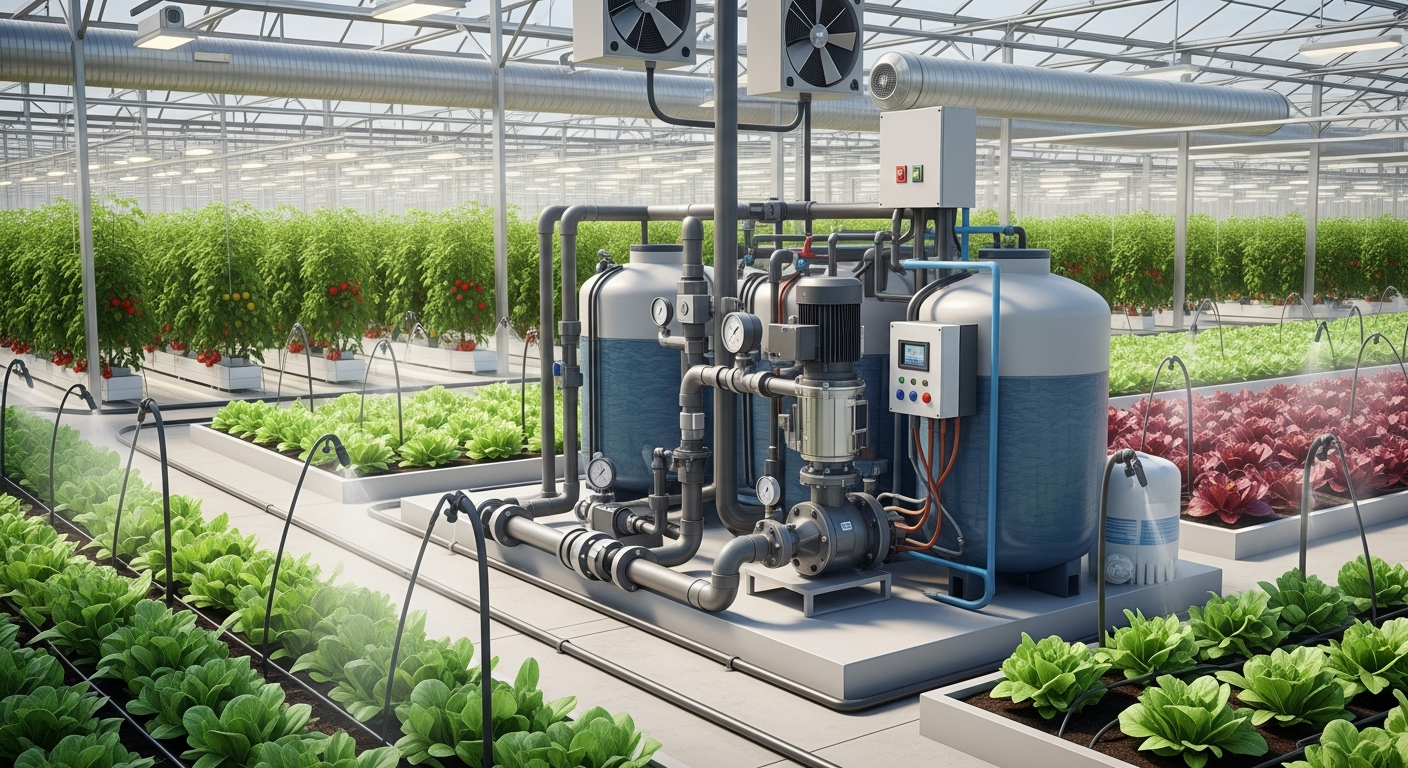
For operations that rely on advanced hydroponics, expansive drip systems, or frequent fertigation cycles, the pump is the heart of the entire irrigation network. Getting its capacity right is paramount for several reasons:
- Optimized Plant Health and Yield: Consistent and adequate water delivery across all plants prevents wilting, nutrient lockout, and promotes uniform growth. High-demand systems often mean specialized crops or extensive plant counts where uniformity is non-negotiable.
- Energy Efficiency: A correctly sized pump operates within its most efficient range, consuming less electricity. An undersized pump works overtime, while an oversized one cycles on and off unnecessarily, both leading to higher energy bills.
- System Longevity: Pumps that are properly matched to the system’s needs experience less wear and tear. Components like pipes, emitters, and filters also last longer when not subjected to inconsistent pressure or flow rates.
- Water Conservation: Precise irrigation minimizes runoff and waste, a critical factor in sustainable greenhouse operations.
- Automation and Control: Modern greenhouse climate control systems integrate deeply with irrigation. A well-sized pump ensures that automated schedules and sensor-driven activations perform as intended.
Without careful calculation, you risk significant operational headaches, financial losses, and ultimately, a detrimental impact on your valuable crops. Let’s delve into the core metrics that dictate your pump’s requirements.
Key Metrics for Calculating Your Greenhouse Pump Capacity
Calculating pump capacity involves understanding two primary metrics: flow rate and pressure (or head). These two figures determine the pump’s “sweet spot” on its performance curve.
1. Total Flow Rate (GPM or LPM)
The flow rate is the volume of water your irrigation system needs to deliver per unit of time. For high-demand systems, this usually means the peak flow when all necessary zones or emitters are operating simultaneously.
- Identify Emitter Flow Rates: Start by cataloging every emitter type (drip emitters, sprayers, misters, flood tables) and their individual flow rates, usually specified in Gallons Per Hour (GPH) or Liters Per Hour (LPH) by the manufacturer.
- Determine Simultaneous Operation: Decide which zones or sections of your greenhouse will irrigate at the same time during peak demand. You might run multiple benches concurrently, or perhaps a single large hydroponic system.
- Calculate Zone Flow Rate: For each simultaneously operating zone, multiply the number of emitters by the individual emitter flow rate. Convert GPH/LPH to GPM/LPM by dividing by 60.
- Sum for Total Peak Flow Rate: Add the flow rates of all zones or components that will be running at the same time to get your system’s total peak flow rate.
Practical Tip: Always factor in a small buffer (e.g., 10-15%) for future expansion or slight variances in emitter performance. Round up to the nearest convenient GPM/LPM.
2. Total Dynamic Head (TDH)
Total Dynamic Head is the total resistance a pump must overcome to deliver water from its source to the farthest or highest point in your irrigation system, at the required pressure. It’s expressed in feet or meters of head and is comprised of three main components:
- Static Head: This is the vertical distance the water needs to be lifted.
- Suction Static Head: The vertical distance from the water source surface (e.g., pond, reservoir) to the center of the pump’s impeller.
- Discharge Static Head: The vertical distance from the center of the pump’s impeller to the highest point where water is delivered in your system (e.g., the top of a hanging basket, the highest point in a drip line).
- Total Static Head: Discharge Static Head + Suction Static Head (if the pump is above the water source). If the pump is below the water source, subtract suction static head.
- Friction Loss Head: This is the resistance caused by water flowing through pipes, fittings (elbows, tees, valves), filters, and other components. Longer pipes, smaller diameters, rougher pipe materials, and more fittings all increase friction loss.
- Estimating friction loss can be complex but crucial. You’ll need pipe material (PVC, poly), diameter, total length, and the number/type of fittings. Use friction loss charts (available online or in plumbing handbooks) or dedicated irrigation design software.
- Practical Tip: For simpler systems, a general rule of thumb is to allow 2-5 PSI for friction loss per 100 feet of main line, but this is a rough estimate. For high-demand systems, detailed calculation is vital.
- Pressure Requirements: This is the minimum operating pressure required at the furthest or highest emitter for optimal performance. Manufacturers specify the recommended operating pressure for their emitters. This pressure needs to be converted into feet or meters of head (1 PSI ≈ 2.31 feet of head; 1 Bar ≈ 10.2 meters of head).
Total Dynamic Head (TDH) = Total Static Head + Friction Loss Head + Pressure Requirements (converted to head)
The Calculation Process: Step-by-Step for Your Greenhouse
Let’s put these concepts into a practical calculation workflow.
Step 1: Map Your Irrigation Zones and Components
Draw a detailed diagram of your greenhouse showing your water source, pump location, main lines, sub-mains, lateral lines, and all emitters/fixtures. Note pipe diameters, lengths, and all fittings. Identify which zones will operate simultaneously during peak demand.
Step 2: Determine Peak Flow Rate Per Zone/System
Calculate the GPM or LPM for each individual emitter, then multiply by the number of emitters operating within a single zone. Sum these values for all zones that will run concurrently to get your overall system peak flow rate.
- Example: You have 500 drip emitters, each rated at 0.5 GPH, all operating simultaneously.
- Total GPH = 500 emitters * 0.5 GPH/emitter = 250 GPH.
- Total GPM = 250 GPH / 60 minutes/hour = 4.17 GPM.
- If you also have a flood table requiring 10 GPM at the same time, your total peak flow rate would be 4.17 GPM + 10 GPM = 14.17 GPM.
Step 3: Calculate Total Static Head
Measure the vertical distance from your water source’s lowest level to the center of your pump. Then measure from the pump’s center to the highest point of water delivery in your system. Add these together, considering if the pump is above or below the water source.
- Example: Pump is 5 feet above reservoir surface (suction static head = 5 ft). Highest emitter is 10 feet above pump (discharge static head = 10 ft).
- Total Static Head = 5 ft + 10 ft = 15 feet.
Step 4: Estimate Friction Loss Head
This is where precision pays off. Use a reliable friction loss calculator or chart. Input your pipe material (e.g., Schedule 40 PVC), internal diameter, total length of each pipe segment, and the type/number of fittings. Remember that smaller pipes and higher flow rates result in greater friction loss. Sum the friction loss for the longest or most restrictive path water takes through your system.
- Example: After calculations using charts for your pipe network (main line, sub-mains, laterals, filters, valves), you determine the total friction loss for the most demanding path is 20 PSI.
Step 5: Add Required Operating Pressure (converted to head)
Identify the minimum operating pressure required by your most critical or highest emitter. Convert this PSI (or Bar) into feet of head.
- Example: Your drip emitters require a minimum of 15 PSI to function correctly.
- Required Pressure in Head = 15 PSI * 2.31 feet/PSI = 34.65 feet.
Step 6: Combine for Total Dynamic Head (TDH)
Add your Total Static Head, Friction Loss Head, and Required Operating Pressure (in head) to get your Total Dynamic Head.
- Example (continuing from above):
- Total Static Head = 15 feet
- Friction Loss (20 PSI converted to head) = 20 PSI * 2.31 feet/PSI = 46.2 feet
- Required Operating Pressure (converted to head) = 34.65 feet
- Total Dynamic Head (TDH) = 15 + 46.2 + 34.65 = 95.85 feet.
Now you have your two critical numbers: Peak Flow Rate (e.g., 14.17 GPM) and Total Dynamic Head (e.g., 95.85 feet). You can take these to a pump supplier or use them to evaluate pump performance curves.
Choosing the Right Pump Type and Factors Beyond the Numbers
Once you have your calculated flow rate and TDH, you’re ready to select a pump. Here are some common types and additional considerations for high-demand greenhouse environments:
- Centrifugal Pumps: Common, versatile, and suitable for drawing water from reservoirs or tanks and boosting pressure. Often used for larger greenhouse irrigation systems.
- Submersible Pumps: Ideal for deep wells or large submerged reservoirs. They push water rather than pulling it, often more efficient in certain scenarios.
- Booster Pumps: Primarily designed to increase existing pressure in a water line, not to draw water from a source. Useful if your municipal supply has sufficient flow but insufficient pressure.
Beyond the raw numbers, consider:
- Energy Efficiency: Look for pumps with high efficiency ratings (e.g., NEMA Premium Efficient motors) to reduce long-term operating costs.
- Material Durability: In corrosive fertigation environments, choose pumps with stainless steel or other chemical-resistant components.
- Voltage and Phase: Ensure the pump’s electrical requirements match your greenhouse’s power supply (single-phase vs. three-phase).
- Automation Compatibility: Does the pump integrate easily with your existing greenhouse climate control or irrigation controller? Variable frequency drives (VFDs) can offer significant energy savings and precise pressure control for fluctuating demand.
- Noise Level: In certain greenhouse layouts, a quieter pump might be desirable.
- Maintenance and Reliability: Research brands known for durability and availability of spare parts.
Practical Tip: It’s often wise to choose a pump that can comfortably exceed your calculated TDH and flow rate by 5-10%. This provides a safety margin for system variations, aging components, and future minor expansions without overspending on a drastically oversized unit.
Conclusion
Calculating the correct pump capacity for your high-demand greenhouse irrigation cycles is a critical step towards achieving optimal plant health, maximizing yields, and ensuring operational efficiency. By carefully determining your peak flow rate and total dynamic head, you lay the foundation for a reliable and sustainable watering system. Don’t rush this process; accurate planning and selection will pay dividends in energy savings, reduced maintenance, and ultimately, a flourishing greenhouse. When in doubt, consulting with an irrigation specialist or a knowledgeable pump supplier can provide invaluable expertise, ensuring your greenhouse climate control system is perfectly tailored to your needs.