
As a greenhouse enthusiast or commercial grower, you know that maintaining optimal climate conditions is paramount for healthy plant growth and maximum yield. But what often goes unsaid, or perhaps overlooked until the heating bill arrives, is the significant role of heat loss. Understanding and quantifying how heat escapes your greenhouse isn’t just an academic exercise; it’s a critical step toward achieving energy efficiency, reducing operational costs, and ensuring consistent environmental control. This technical guide will walk you through the essential calculations and factors involved in determining your greenhouse’s heat loss, empowering you to make informed decisions about construction, insulation, and heating system design. Let’s demystify the numbers and build a more energy-efficient future for your growing endeavors.
Why Calculate Heat Loss? The Foundation of Efficiency
Before diving into formulas and figures, let’s establish why greenhouse heat loss calculations are indispensable. Every degree of warmth lost costs you money in heating fuel or electricity. By accurately assessing heat loss, you can:
- Optimize Energy Consumption: Pinpoint areas of inefficiency and implement targeted improvements, leading to substantial savings on your heating bills.
- Precisely Size Heating Systems: Avoid oversizing (which is inefficient and costly) or undersizing (which leads to inadequate heating and potential crop damage) your heating equipment.
- Enhance Climate Control: A greenhouse with minimal heat loss is easier to regulate, maintaining stable temperatures crucial for sensitive crops.
- Improve Structural Integrity: Understanding how different materials perform under thermal stress can inform better design and construction choices.
- Promote Sustainability: Reducing energy consumption lessens your environmental footprint, aligning with modern sustainable agriculture practices.
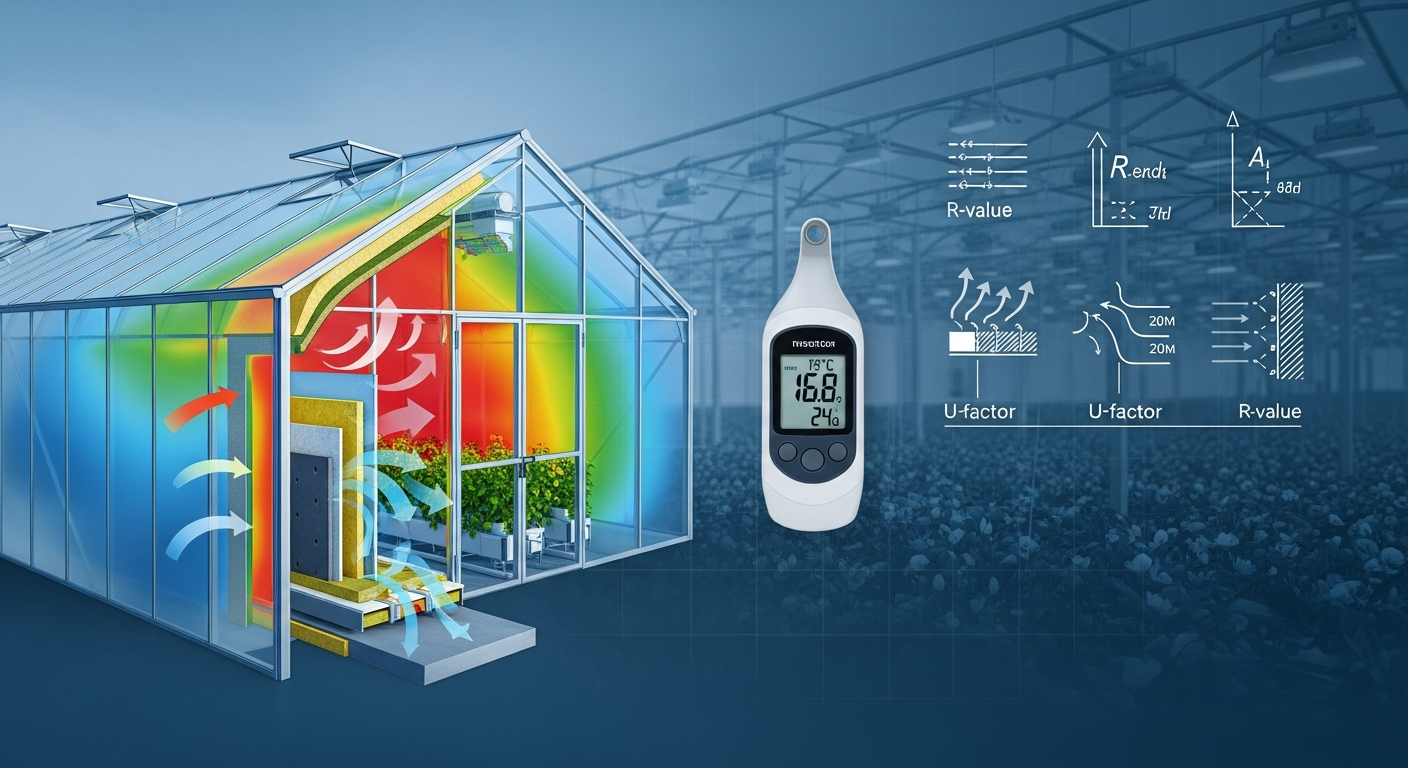
At the heart of heat loss calculation lies the concept of the U-value (overall heat transfer coefficient) and its inverse, the R-value (thermal resistance). These values quantify how well a material or assembly resists the flow of heat, and they are foundational to understanding your greenhouse’s thermal performance.
Understanding the Core Components of Heat Loss
Heat escapes your greenhouse through three primary mechanisms: conduction, convection, and radiation. For practical heat loss calculations, we primarily focus on conduction and convection (specifically infiltration).
1. Conduction: Heat Transfer Through Materials
Conduction is the transfer of heat through direct contact, from warmer regions to cooler ones, typically through your greenhouse’s glazing, walls, roof, and foundation. The rate of conductive heat loss depends on three factors: the material’s thermal properties (U-value), the surface area, and the temperature difference across the material.
The fundamental formula for conductive heat loss (Q_conduction) is:
Q = U * A * ΔT
- Q: Heat loss rate (BTU/hour or Watts)
- U: Overall Heat Transfer Coefficient (BTU/hr·ft²·°F or W/m²·K). A lower U-value indicates better insulation.
- A: Surface Area (ft² or m²) of the material through which heat is lost.
- ΔT: Temperature Differential (°F or °C). The difference between the desired inside temperature and the coldest expected outside temperature.
U-values for Common Greenhouse Glazing Materials (approximate):
- Single-layer Glass/Polyethylene: 1.1 – 1.2 BTU/hr·ft²·°F (U-value)
- Double-layer Polyethylene (inflated): 0.65 – 0.75 BTU/hr·ft²·°F
- Double-pane Glass: 0.45 – 0.60 BTU/hr·ft²·°F
- 8mm Twin-wall Polycarbonate: 0.58 – 0.65 BTU/hr·ft²·°F
- 16mm Triple-wall Polycarbonate: 0.35 – 0.45 BTU/hr·ft²·°F
Remember, the R-value is simply 1/U-value. So, a material with a U-value of 0.7 has an R-value of approximately 1.43.
2. Convection: Heat Transfer Through Air Movement (Infiltration)
Convective heat loss primarily occurs due to air infiltration – cold outside air leaking into the greenhouse and warm inside air escaping through cracks, gaps, poorly sealed vents, doors, and overlaps in covering materials. Wind speed significantly exacerbates infiltration.
Calculating infiltration heat loss (Q_infiltration) is often done using the “air changes per hour” (ACH) method:
Q = 0.018 * V * ACH * ΔT
- Q: Heat loss rate (BTU/hour)
- 0.018: A constant combining the density of air and specific heat (BTU/ft³·°F).
- V: Total volume of the greenhouse (ft³). Calculate this by multiplying the length, width, and average height of your structure.
- ACH: Air Changes per Hour. This factor estimates how many times the entire volume of air in the greenhouse is replaced by outside air within one hour.
- ΔT: Temperature Differential (°F).
Typical ACH values for Greenhouses:
- Very Tight (new construction, well-sealed): 0.5 – 1.0 ACH
- Average (some gaps, typical wear): 1.0 – 2.0 ACH
- Drafty (poorly sealed, older structure): 2.0 – 4.0+ ACH
Practical Tip: A good strategy to minimize convective losses is to regularly inspect and seal all potential air leakage points. Use weatherstripping, caulk, greenhouse tape, and ensure doors and vents close tightly.
3. Radiation: Direct Heat Transfer
Radiant heat loss occurs when warmth radiates directly from warmer objects (plants, soil, internal surfaces) to cooler objects (the glazing, the night sky). While less dominant than conduction and infiltration in basic calculations, it’s particularly noticeable on clear, cold nights. Many U-values for glazing materials implicitly account for some radiant heat transfer, but advanced calculations might include specific adjustments or the use of infrared-blocking films.
The Step-by-Step Heat Loss Calculation Process
Step 1: Gather Your Greenhouse Specifications
Measure and record the following for your greenhouse:
- Dimensions: Length, width, and average height.
- Surface Areas: Calculate the area of each distinct surface (e.g., south wall, north wall, east gable, west gable, roof, foundation walls). Be precise about the materials used for each.
- Glazing Types: Identify the specific glazing material for each section (e.g., 8mm twin-wall polycarbonate on roof, double-layer poly on sidewalls).
- Construction Materials: Note if foundation walls are insulated, what frame material is used, etc.
Step 2: Determine U-Values for Each Component
Based on the materials identified in Step 1, assign the appropriate U-value to each surface. Refer to the approximate U-values provided earlier or consult manufacturer specifications for your specific materials. For opaque walls (e.g., insulated foundation), research the U-value of the entire wall assembly (insulation + framing + cladding).
Step 3: Define Temperature Differential (ΔT)
This is crucial for accurate calculation:
- Desired Indoor Temperature (T_inside): The minimum temperature you want to maintain inside your greenhouse (e.g., 65°F / 18°C).
- Outdoor Design Temperature (T_outside): The coldest expected average temperature for your region during the heating season. This is typically not the absolute record low, but a temperature that your heating system needs to handle consistently. Local climate data or agricultural extension offices can provide this.
Calculate ΔT = T_inside - T_outside.
Step 4: Calculate Conductive Heat Loss for Each Surface (Q_conduction)
Apply the formula Q = U * A * ΔT to each individual surface of your greenhouse. Sum these individual losses to get your total conductive heat loss.
Example:
Let’s say your greenhouse has:
- Roof: 500 sq ft, 8mm twin-wall polycarbonate (U = 0.6 BTU/hr·ft²·°F)
- Sidewalls: 300 sq ft, double-layer polyethylene (U = 0.7 BTU/hr·ft²·°F)
- End walls (non-door sections): 200 sq ft, single-layer glass (U = 1.1 BTU/hr·ft²·°F)
- Foundation/Insulated Walls: 100 sq ft, R-10 insulation (U = 0.1 BTU/hr·ft²·°F)
And ΔT = 65°F - 20°F = 45°F
- Roof: 0.6 * 500 * 45 = 13,500 BTU/hr
- Sidewalls: 0.7 * 300 * 45 = 9,450 BTU/hr
- End walls: 1.1 * 200 * 45 = 9,900 BTU/hr
- Foundation: 0.1 * 100 * 45 = 450 BTU/hr
Total Conductive Heat Loss = 13,500 + 9,450 + 9,900 + 450 = 33,300 BTU/hr
Step 5: Estimate Infiltration Heat Loss (Q_infiltration)
First, calculate the volume (V) of your greenhouse. Then, choose an appropriate ACH value based on your greenhouse’s construction quality.
Example (continued):
If your greenhouse is 40 ft long, 20 ft wide, and has an average height of 10 ft:
- Volume (V) = 40 ft * 20 ft * 10 ft = 8,000 ft³
- Assume an “average” tightness: ACH = 1.5
Q_infiltration = 0.018 * 8,000 * 1.5 * 45 = 9,720 BTU/hr
Step 6: Sum All Heat Losses for Total (Q_total)
Add your total conductive heat loss and your estimated infiltration heat loss.
Example (continued):
Total Heat Loss (Q_total) = 33,300 BTU/hr (conductive) + 9,720 BTU/hr (infiltration) = 43,020 BTU/hr
This final number represents the maximum heat your heating system needs to generate per hour to maintain your desired indoor temperature under the specified outdoor design conditions. It’s often wise to add a 10-20% safety factor to this calculation to account for unforeseen cold snaps, system inefficiencies, or door openings.
Beyond the Numbers: Optimizing for Minimal Heat Loss
Calculating heat loss is only the first step. The real value comes from using this information to make your greenhouse more efficient. Here are some actionable strategies:
- Upgrade Glazing: If you’re using single-layer materials, consider upgrading to double-layer poly, twin-wall polycarbonate, or insulated glass. The initial investment often pays for itself quickly in energy savings.
- Seal All Gaps: Regularly inspect for and seal any cracks around foundations, vents, doors, and where glazing meets the frame. Use durable, UV-resistant greenhouse tape or caulk.
- Insulate Foundation and North Wall: The foundation is a major source of heat loss to the ground. Insulating it can significantly reduce thermal bridging. Similarly, insulating the north wall (especially if opaque) can reflect light back into the greenhouse while reducing heat loss.
- Install Energy Curtains: Retractable thermal blankets can be pulled over plants at night to create an insulated air gap, dramatically reducing radiant and conductive heat loss through the roof.
- Consider Windbreaks: Trees or fences strategically placed on the prevailing wind side of your greenhouse can reduce convective heat loss by lowering wind pressure on the structure.
- Utilize Thermal Mass: Incorporate elements like water barrels, concrete floors, or stone walls inside the greenhouse to absorb heat during the day and release it slowly at night, moderating temperature fluctuations.
- Automate Vents and Doors: Ensure that vents and doors close properly and are not accidentally left open, especially during cold periods. Automated systems can prevent human error.
Conclusion
Calculating your greenhouse’s heat loss factors is more than just a technical exercise; it’s an investment in your greenhouse’s future efficiency and profitability. By systematically analyzing conductive and convective losses, you gain the knowledge to select appropriate materials, implement effective sealing strategies, and size your heating system correctly. This proactive approach will not only shrink your energy bills but also contribute to a more stable, productive, and sustainable growing environment. Embrace these calculations as a powerful tool in your climate control arsenal, and watch your greenhouse thrive while your operational costs diminish.