
Automated overhead irrigation systems have revolutionized how large-scale commercial greenhouses manage their watering needs. Moving beyond the labor-intensive chore of manual watering, these systems promise efficiency, consistency, and significant cost savings. However, while the concept of automation is inherently appealing, the reality of achieving truly uniform water distribution across expansive growing areas presents a complex and persistent challenge. Growers quickly discover that simply turning on a system doesn’t guarantee every plant receives its ideal share. In large greenhouses, subtle variations can lead to significant discrepancies in plant growth, nutrient uptake, and overall crop health, negating many of the benefits automation aims to provide. This article delves into the intricacies of these uniformity challenges and explores practical strategies to overcome them, ensuring your automated system truly delivers on its promise.
The Promise and Pitfall of Automated Overhead Irrigation
The allure of automated overhead irrigation is undeniable for large-scale greenhouse operations. These systems offer numerous advantages, including reduced labor costs, consistent watering schedules, minimized human error, and improved water and nutrient management. By delivering water and often fertilizers (fertigation) directly to the crop canopy, they can significantly boost operational efficiency. Imagine acres of plants receiving precisely timed and measured irrigation without a single human hand involved – it’s a vision of modern horticulture.
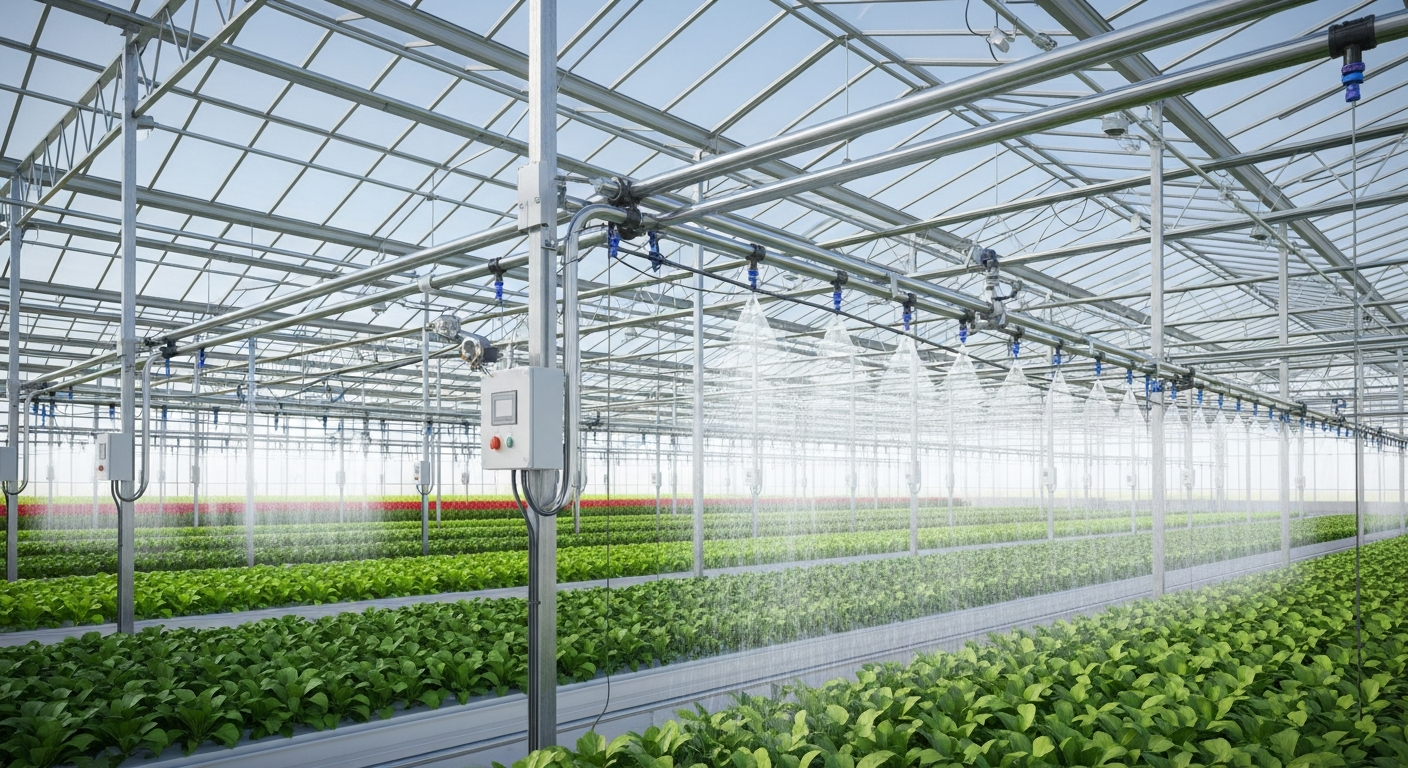
However, the primary pitfall lies in achieving true uniformity of water distribution. In theory, every plant should receive the same amount of water, but in practice, this is rarely the case, especially in large greenhouses. Non-uniform irrigation leads to a cascade of problems: some plants become stressed due to insufficient water, while others suffer from over-watering, leading to root diseases and nutrient leaching. This inconsistency results in uneven crop growth, delayed harvesting, increased susceptibility to pests and diseases, and ultimately, reduced yields and profitability. It also contributes to significant water and fertilizer waste, undermining the very efficiency automation aims to provide. Understanding the factors that contribute to this lack of uniformity is the first step towards mitigating it.
Understanding the Factors Affecting Irrigation Uniformity
Achieving a perfectly even distribution of water across a large greenhouse footprint is akin to solving a complex puzzle. Numerous interacting factors influence where and how much water actually lands on the growing media. Identifying these variables is crucial for effective system design and management.
Nozzle Selection and Placement
- Spray Patterns: Different nozzles create distinct spray patterns (full cone, hollow cone, flat fan, impact sprinklers). Mismatched patterns or improper overlap can create ‘hot spots’ (over-watered areas) and ‘dry spots’ (under-watered areas).
- Droplet Size: Nozzles produce varying droplet sizes. Finer droplets are more susceptible to wind drift and evaporation, while larger droplets can lead to soil compaction or splashing.
- Placement and Height: Incorrect spacing between nozzles or an inappropriate height above the canopy can significantly impact the distribution pattern. Nozzles placed too low might not cover adequately, while those too high increase drift potential.
Water Pressure and System Design
- Inconsistent Pressure: Water pressure naturally decreases with distance from the pump and with elevation changes. Significant pressure drops across a long mainline can cause nozzles at the beginning of the line to emit more water than those at the end, leading to unevenness.
- Pipe Sizing: Undersized pipes can restrict flow and cause dramatic pressure drops, exacerbating uniformity issues.
- Pump Capacity: An improperly sized pump may struggle to maintain consistent pressure throughout the entire system, especially during peak demand.
Environmental Conditions and Greenhouse Structure
- Air Movement: Even subtle internal air currents, caused by ventilation fans, circulation fans, or natural convection, can significantly distort spray patterns and cause water drift, especially with finer droplets.
- Temperature and Humidity: High temperatures and low humidity increase evaporation rates, meaning less water reaches the plants, particularly during longer irrigation cycles or when using fine sprays.
- Greenhouse Obstructions: Structural elements like support columns, hanging baskets, light fixtures, heating pipes, and even dense plant canopies can physically block spray patterns, creating ‘rain shadows’ that result in dry areas.
Plant Canopy Development
As plants grow and their canopy develops, they intercept water, preventing it from reaching the substrate or smaller plants below. This dynamic factor means that an irrigation system optimized for young plants may become inefficient as the crop matures, requiring adjustments to watering times or patterns.
Strategies and Technologies for Enhanced Uniformity
Mitigating the challenges of irrigation uniformity in large greenhouses requires a multi-faceted approach, combining careful design with smart technology and ongoing management. Here are key strategies:
Precision Nozzle Selection and Optimization
- Matched Precipitation Rate (MPR) Nozzles: These nozzles are designed to apply water at a uniform rate, regardless of the spray pattern or arc, simplifying design and improving uniformity when used correctly.
- Regular Inspection and Replacement: Nozzles wear out over time, especially with hard water or abrasive particles, leading to distorted spray patterns and reduced uniformity. Regular cleaning and replacement are essential maintenance tasks.
- Experiment with Heights and Angles: Adjusting the height of irrigation lines and the angle of spray can dramatically improve coverage. Catch can tests (detailed below) are invaluable for this optimization.
Advanced System Design and Pressure Management
- Pressure Regulators: Installing small, in-line pressure regulators at individual zones or even specific nozzle clusters can ensure consistent pressure delivery to each emitter, regardless of its position in the system.
- Looping Mainlines and Sub-mainlines: Designing the main water lines in a loop configuration or using strategically sized sub-mainlines can help equalize pressure distribution throughout the entire greenhouse.
- Variable Frequency Drives (VFDs): Integrating VFDs with your pump system allows it to maintain constant pressure even as the demand for water fluctuates, improving overall system stability.
Zonal Irrigation and Sectioning
Dividing a large greenhouse into smaller, independently controllable irrigation zones is one of the most effective strategies. This allows growers to:
- Tailor irrigation schedules and volumes based on specific crop types, growth stages, light exposure, or observed microclimates within different sections.
- Isolate and address uniformity issues in smaller areas without affecting the entire operation.
- Implement precision irrigation, conserving water and nutrients by applying them only where and when needed.
Sensor-Based Feedback Systems
Integrating sensors provides real-time data to inform and adjust irrigation decisions, moving from scheduled watering to needs-based watering:
- Soil Moisture Sensors: Placed at various locations and depths, these sensors measure the actual water content in the growing media, triggering irrigation only when moisture levels drop below a set threshold.
- Environmental Sensors: Wind sensors (even subtle internal air flow), temperature, and humidity sensors can provide data to micro-adjust irrigation events, compensating for increased evaporation or drift.
- Crop Canopy Sensors: Advanced systems can monitor plant health and growth, detecting stress before it’s visible to the human eye, prompting targeted irrigation.
Calibration and Monitoring with Catch Can Tests
Perhaps the most critical tool for assessing and improving uniformity is the humble catch can test. This involves placing an array of identical containers (e.g., tuna cans or measuring cups) across the irrigated area during a typical watering cycle. By measuring the volume of water collected in each can, growers can quantitatively assess the distribution uniformity (DU) and identify specific dry or wet spots. Regular catch can tests are indispensable for:
- Verifying initial system design.
- Identifying issues caused by worn nozzles, pressure fluctuations, or obstructions.
- Optimizing nozzle selection, placement, and irrigation duration.
- Making informed adjustments to achieve the highest possible irrigation efficiency.
Practical Tips for Maximizing Overhead Irrigation Uniformity
Beyond advanced technologies, consistent management and keen observation are vital for maintaining optimal irrigation uniformity.
- Perform Regular Maintenance: Make it a routine to inspect all nozzles for clogs, wear, and proper function. Check for leaks in lines and fittings, and ensure pressure regulators are operating correctly. A single malfunctioning nozzle can significantly impact an entire zone’s uniformity.
- Conduct Seasonal Adjustments: Greenhouse environments are dynamic. As external weather changes, internal climate control settings shift, and crops grow, the optimal irrigation strategy will also evolve. Re-evaluate settings and potentially re-test uniformity periodically throughout the growing season.
- Embrace Catch Can Testing: Don’t underestimate the power of this simple yet effective method. Perform catch can tests regularly – upon initial setup, after making system changes, or when starting a new crop cycle. Document the results to track improvements and identify persistent problem areas.
- Observe Your Plants Closely: Your plants are the ultimate indicators of irrigation uniformity. Look for subtle differences in growth rate, leaf size, color, or signs of stress (wilting, nutrient deficiencies) across different sections of your greenhouse. These visual cues can often pinpoint areas of uneven watering before they become critical problems.
- Analyze Water Use Data: If your system includes flow meters, regularly review water usage data. Unexpected spikes or drops can indicate leaks, clogs, or issues with your automated controls that impact uniformity.
- Consult with Experts: Don’t hesitate to seek advice from irrigation specialists or greenhouse consultants. Their expertise in hydraulic design, nozzle technology, and system optimization can be invaluable for large-scale operations struggling with uniformity challenges.
Conclusion
Automated overhead irrigation systems are an indispensable tool for modern greenhouse production, offering substantial benefits in labor savings and operational efficiency. However, achieving genuine irrigation uniformity in large-scale environments is a nuanced challenge that demands careful planning, informed design, and continuous vigilance. By understanding the various factors that influence water distribution – from nozzle mechanics and water pressure to environmental conditions and plant canopy development – growers can implement strategic solutions. Leveraging precision technologies, intelligent system design, zonal control, sensor-based feedback, and routine catch can testing are critical steps. Ultimately, maximizing irrigation uniformity is not just about saving water; it’s about optimizing plant health, boosting yields, and ensuring the long-term sustainability and profitability of your greenhouse operation. It’s a journey of continuous improvement, where attention to detail transforms the promise of automation into a reality of precision growing.