
Imagine your greenhouse, a verdant sanctuary where every plant thrives, each leaf glistening with just the right amount of moisture. This idyllic vision hinges on one often-overlooked hero: consistent water pressure. While you might focus on the pump and main lines, a silent adversary lurks within your irrigation system, capable of sabotaging even the best intentions. This adversary is hydraulic friction loss, and understanding it is absolutely critical to ensuring adequate pressure at the furthest emitter in your intricate watering network.
Without proper attention, friction loss can lead to a tale of two plants: one near the water source, lush and overwatered, and its distant sibling, parched and struggling. For greenhouse enthusiasts striving for uniformity and efficiency, mastering friction loss isn’t just about technical knowledge; it’s about guaranteeing the health and productivity of every single plant under your care. Let’s delve into this essential concept and equip you with the knowledge to conquer it.
What is Hydraulic Friction Loss? The Unseen Drain on Your System
At its core, hydraulic friction loss refers to the reduction in water pressure or “head” that occurs as water flows through pipes, fittings, and other components of an irrigation system. Think of it like this: when you push a ball across a smooth floor, it travels easily. Now imagine pushing that same ball through a long, rough tunnel; it takes more effort, and its speed decreases due to resistance. Water experiences a similar resistance as it rubs against the inner surfaces of pipes and encounters changes in direction or diameter.
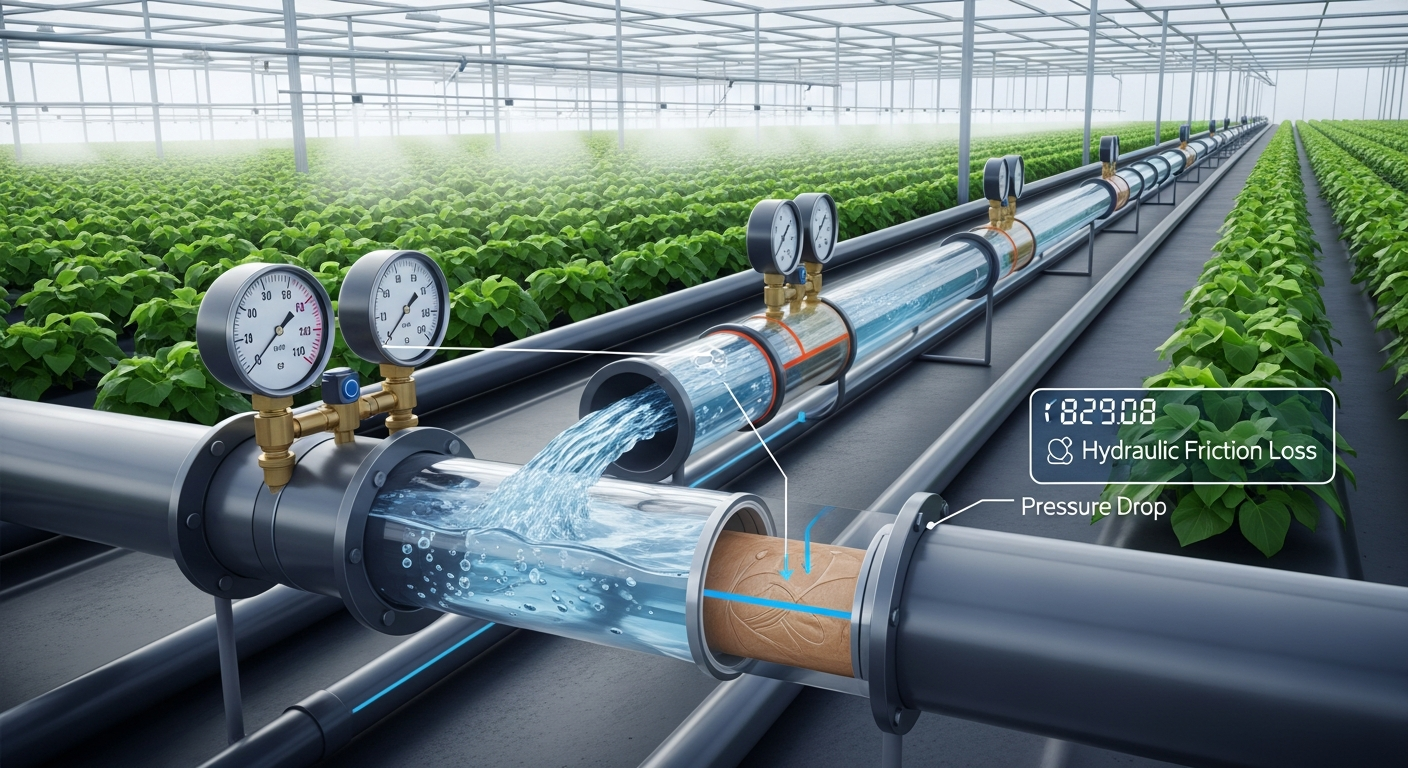
This resistance converts some of the water’s kinetic energy into heat, resulting in a measurable drop in pressure. The higher the friction loss, the less pressure is available at the end of the line. This is why a perfectly functioning pump might deliver excellent pressure at the beginning of your system, but by the time the water reaches the furthest emitter, the pressure can be significantly diminished, sometimes to the point where the emitter barely drips or sprays.
Understanding this concept is fundamental because it directly impacts the ability of your irrigation system to deliver water uniformly. If the pressure at the furthest point is too low, those plants will inevitably be underwatered, leading to stress, reduced growth, and potentially lower yields. Conversely, if you try to compensate by increasing overall system pressure without addressing friction loss, you might overwater plants closer to the source and waste valuable resources.
Key Factors Influencing Friction Loss in Your Greenhouse Irrigation
Several variables contribute to the extent of hydraulic friction loss in any water delivery system. By understanding these factors, you gain the power to design and optimize your greenhouse irrigation for peak performance and uniform distribution.
- Pipe Diameter: This is arguably the most critical factor. Smaller pipe diameters mean the water is forced through a tighter space, increasing its velocity and the contact area with the pipe walls relative to the volume of water. This dramatically increases friction. Doubling the pipe diameter can reduce friction loss by a factor of 32 for the same flow rate! This is why mainlines should always be sufficiently sized.
- Pipe Length: The longer the pipe, the more surface area water has to rub against, and thus, the greater the cumulative friction loss. A long run of small diameter pipe will experience far more pressure drop than a shorter run of the same pipe.
- Flow Rate (Velocity): The speed at which water moves through the pipes has a significant impact. Friction loss increases exponentially with the velocity of the water. If you double the flow rate, friction loss can quadruple or even more, depending on the pipe type. High flow rates in undersized pipes are a recipe for substantial pressure drops.
- Pipe Material and Roughness: The smoothness of the pipe’s interior surface directly affects friction. Materials like PVC and smooth polyethylene generally have lower friction coefficients than older, rougher materials. Even tiny imperfections or build-up inside pipes (e.g., mineral deposits, algae) can increase friction over time.
- Fittings and Valves: Every elbow, T-junction, reducer, valve, or filter within your system creates additional turbulence and resistance to water flow, contributing to localized friction loss. While often necessary, minimizing their use and selecting low-loss designs can help.
By considering these factors during the design and maintenance phases of your greenhouse irrigation system, you can proactively mitigate friction loss and protect your pressure integrity.
The Real-World Impact: Why Uniform Pressure Matters for Your Plants
Neglecting hydraulic friction loss can have far-reaching and detrimental consequences for your greenhouse operation. The problem isn’t just a technical inefficiency; it directly translates to plant health and operational costs.
- Uneven Water Distribution: This is the most immediate and visible effect. Plants closer to the pump receive more water and nutrients, potentially leading to waterlogging, nutrient leaching, and root diseases. Conversely, the furthest emitter struggles, leaving plants at the end of the line dry, stressed, and undernourished. This non-uniformity compromises your entire crop.
- Stressed and Underperforming Plants: Plants that consistently receive insufficient water suffer from drought stress. This can manifest as wilting, stunted growth, reduced flowering and fruiting, and increased susceptibility to pests and diseases. The quality and quantity of your yield will inevitably suffer.
- Wasted Resources: To compensate for low pressure at the system’s end, some growers might increase pump pressure or extend watering times for the entire zone. This leads to overwatering closer to the source, wasting water, energy for pumping, and expensive nutrients that are washed away. It’s an inefficient and unsustainable approach.
- Compromised Emitter Performance: Drip emitters, micro-sprinklers, and other precision irrigation devices are engineered to operate within a specific pressure range for optimal performance. When pressure deviates too much due to friction loss, their flow rates become inaccurate, droplet sizes change (for sprays), and distribution patterns are compromised, defeating the purpose of precision irrigation.
- Nutrient Delivery Imbalance: If you’re using a fertigation system, inconsistent water flow due to pressure variations means inconsistent nutrient delivery. Some plants get too much, others too little, leading to nutrient deficiencies or toxicities within the same grow zone.
Ultimately, a system riddled with unmanaged friction loss is a system that cannot deliver on its promise of an optimized growing environment. Your goal should always be to achieve adequate and uniform pressure throughout your entire irrigation network, particularly at the most distant points.
Strategies to Minimize and Manage Friction Loss for Optimal Performance
While you can’t eliminate friction loss entirely, you can certainly manage and minimize it through smart design, careful component selection, and diligent maintenance. Here are practical strategies to ensure consistent pressure and a thriving greenhouse:
1. Proper Pipe Sizing: The Golden Rule
This is the single most impactful decision. Always size your mainlines and sub-mainlines generously. It’s often better to go one size up than to undersize. Utilize friction loss charts or online calculators (often based on the Hazen-Williams or Darcy-Weisbach equations) to determine the appropriate pipe diameter for your desired flow rate and acceptable pressure drop. Consider future expansion or increased flow demands when sizing. Remember, smaller pipes save on upfront material costs but lead to higher operational energy costs and reduced uniformity over time.
2. Optimize Layout to Minimize Length and Fittings
Design your irrigation layout to have the shortest possible pipe runs from the water source to the plants. Avoid unnecessary turns, elbows, and T-junctions. A more direct path means less cumulative friction. For larger greenhouses, consider centralizing your pumping station or dividing the greenhouse into multiple irrigation zones, each with its own, shorter mainline.
3. Select Low-Loss Components
When choosing fittings, valves, and filters, opt for those designed for minimal head loss. For example, full-port ball valves offer less restriction than gate valves. Use sweep elbows instead of sharp 90-degree elbows where possible in larger lines. Ensure all components are clean and free of obstructions.
4. Manage Flow Rates Through Zoning
Instead of trying to water your entire greenhouse from a single massive zone, divide it into smaller, manageable zones. This allows you to reduce the peak flow rate through individual lines, thereby significantly lowering friction loss. Each zone can then be watered independently, ensuring consistent pressure for a smaller group of emitters.
5. Integrate Pressure Regulators
For drip irrigation systems, pressure regulators are indispensable. While proper pipe sizing minimizes friction loss, regulators ensure that the pressure delivered to your drip lines and emitters remains within their optimal operating range, typically 10-30 PSI (0.7-2.1 bar), regardless of slight pressure fluctuations in the mainline. Install them at the beginning of each drip zone or lateral line to achieve precise and uniform flow from every emitter.
6. Consider Looping Mainlines
In larger, rectangular layouts, “looping” your mainline (connecting the end of the mainline back to its beginning) can help equalize pressure throughout the system. Water can then flow from two directions to any given point, effectively reducing the distance water needs to travel and balancing pressure distribution.
7. Regular System Audits and Maintenance
Periodically check the pressure at various points in your system, especially at the furthest emitter. Use a pressure gauge to identify areas where pressure is unacceptably low. Flush your lines regularly to remove sediment, algae, or mineral build-up that can increase pipe roughness and restrict flow. Inspect for leaks, as even small leaks can contribute to pressure drops.
Conclusion: The Foundation of a Thriving Greenhouse
Hydraulic friction loss might be an invisible force, but its impact on your greenhouse operation is anything but. By understanding how water resistance affects pressure and by proactively implementing smart design and maintenance strategies, you gain the power to create an irrigation system that delivers water uniformly and efficiently to every single plant, from the closest to the furthest emitter.
Investing time in proper pipe sizing, optimizing your layout, and utilizing pressure regulation isn’t just a technical exercise; it’s an investment in your plants’ health, your greenhouse’s productivity, and the sustainable use of precious resources. Conquer friction loss, and you lay the foundation for a truly thriving and consistently productive greenhouse environment.