
In the controlled environment of a greenhouse, every drop of water counts. Optimizing irrigation isn’t just about supplying moisture; it’s about delivering it in a way that maximizes plant health, nutrient uptake, and overall growth while conserving resources. A critical factor in achieving this balance is how thoroughly and evenly your growing medium, or substrate, becomes saturated. Today, we’re diving deep into two prominent watering strategies: pulse watering and continuous flow, exploring their mechanics, benefits, drawbacks, and ultimately, their profound impact on substrate saturation and your plants’ success.
Understanding Substrate Saturation: The Foundation of Plant Health
Before comparing methods, let’s define what we mean by optimal substrate saturation. It’s the point where your growing medium has absorbed sufficient water to meet plant needs, with enough air pockets remaining for root respiration, and excess water has drained away. Achieving this balance is crucial because:
- Nutrient Availability: Water is the vehicle for nutrient delivery. Even saturation ensures nutrients reach all parts of the root zone.
- Root Respiration: Roots need oxygen. Over-saturation (waterlogging) displaces air, leading to anaerobic conditions, root rot, and stunted growth. Under-saturation leaves dry pockets, limiting nutrient and water uptake.
- Capillary Action: Proper saturation allows for efficient capillary action, where water moves within the substrate, making it available to the roots.
- pH and EC Stability: Consistent moisture levels help maintain stable pH and Electrical Conductivity (EC) within the root zone, preventing nutrient lockout or toxicity.
The challenge lies in the dynamic nature of substrates, plant water demands, and environmental factors. Different irrigation techniques approach this challenge in distinct ways.
Continuous Flow Irrigation: A Direct Approach
The continuous flow method, sometimes referred to as ‘drench’ or ‘flood and drain’ in some contexts (though primarily referring to the application method, not necessarily recirculating systems), involves applying a steady, uninterrupted stream of nutrient solution or water to the substrate until runoff is achieved. This is a common and often simpler method, particularly for larger pots or certain soil-based systems.
How it Works
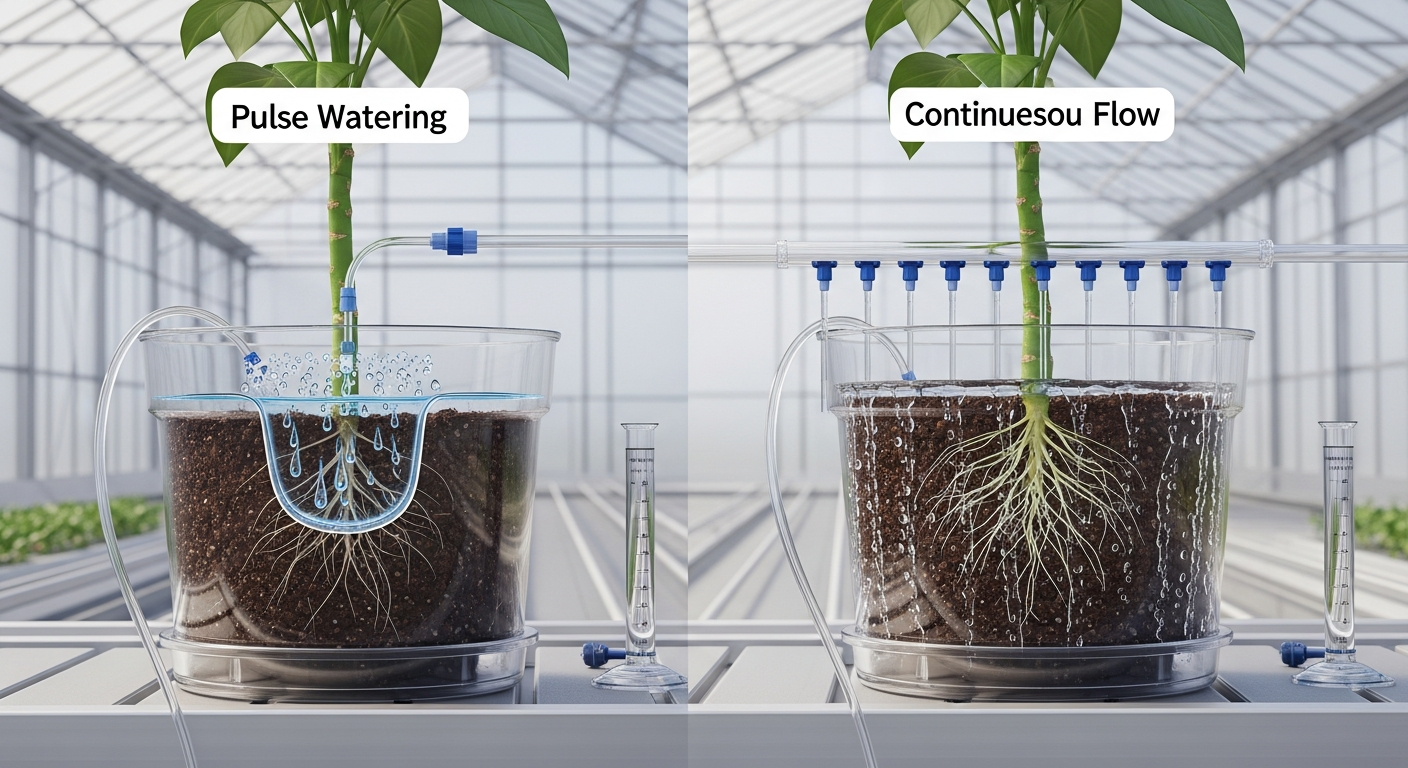
Water is delivered from an emitter (drip, spray) at a consistent flow rate for a single, extended duration. The goal is to fully wet the substrate, allowing gravitational pull to move water downwards, often resulting in significant drainage from the bottom of the container.
Advantages of Continuous Flow
- Simplicity: Often requires less complex irrigation controllers compared to pulse systems.
- Rapid Initial Delivery: Can quickly rehydrate a very dry substrate, especially those with good drainage.
- Leaching Salts: The high volume of water can effectively flush out accumulated salts from the root zone, which can be beneficial in certain situations or with poor water quality.
Disadvantages and Impact on Saturation
- Uneven Saturation: Water tends to follow the path of least resistance. In heterogeneous substrates or larger containers, this can lead to “fingering” – channels where water flows rapidly, leaving significant dry pockets. The top of the substrate might appear wet, while the core remains dry.
- Excessive Runoff and Waste: A common characteristic is significant runoff (20-30% or more) to ensure full saturation. This wastes water, nutrients, and increases disposal costs.
- Anaerobic Risk: If drainage is poor or the substrate retains too much water, the prolonged saturation can lead to oxygen depletion, stifling root respiration.
- Nutrient Leaching: While beneficial for salt removal, excessive flushing can also leach away valuable nutrients before plants can absorb them, especially with highly soluble fertilizers.
- Root Disease: Constantly wet conditions, coupled with oxygen deprivation, create an ideal environment for pathogenic fungi and bacteria.
When to Consider Continuous Flow: For very well-draining, inert media like specific rockwool blocks or coco coir used in recirculating systems where runoff is captured and reused, or in situations where salt buildup is a primary concern and a strong flush is needed. It’s also often found in less automated, smaller-scale setups.
Pulse Watering: The Precision Approach
Pulse watering, also known as short-cycle irrigation or “fertigation events,” involves applying water in several short, discrete bursts with pauses in between, rather than one long, continuous application. This method is gaining significant traction in modern controlled environment agriculture due to its precision and efficiency.
How it Works
Instead of a single, long watering event, a pulse system delivers small volumes of water (e.g., 30 seconds of watering) followed by a short pause (e.g., 5-10 minutes). This cycle repeats multiple times until the desired total volume has been delivered, or a specific level of runoff is achieved. These cycles are precisely timed and often triggered by environmental factors or substrate moisture sensors.
Advantages and Impact on Saturation
- Superior and Even Saturation: The key benefit. The pauses between pulses allow water to fully absorb and spread laterally through capillary action before the next pulse arrives. This ensures a much more uniform wetting front throughout the entire substrate profile, eliminating dry pockets.
- Reduced Runoff and Water Efficiency: By allowing the substrate to fully absorb water, pulse watering significantly reduces the amount of excess runoff. This conserves water and nutrients, leading to substantial cost savings.
- Improved Root Aeration: The intermittent pauses allow air to re-enter the substrate pore spaces, ensuring roots have access to vital oxygen. This actively prevents anaerobic conditions and promotes robust root health.
- Enhanced Nutrient Uptake: With more consistent moisture and oxygen levels, plants can more efficiently absorb available nutrients from the solution. This can lead to better growth rates and higher yields.
- Minimized Disease Risk: Healthier, aerated roots are less susceptible to root diseases. The lack of prolonged waterlogging also deters pathogens.
- Precision Control: Highly adaptable. Growers can fine-tune the duration, frequency, and volume of pulses based on plant size, growth stage, substrate type, and environmental conditions.
Disadvantages of Pulse Watering
- System Complexity: Requires more sophisticated irrigation controllers and potentially more emitters per plant to ensure even distribution of the smaller water volumes.
- Initial Setup: Can involve a steeper learning curve for programming and calibration.
- Drying Out: If pulse cycles are too short or infrequent, certain substrates might dry out too quickly between pulses, especially in high evaporative environments.
When to Consider Pulse Watering: Ideal for most modern greenhouse setups, especially those growing in inert media like rockwool, coco coir, or soilless mixes. It excels in optimizing nutrient delivery, maximizing water efficiency, and promoting superior root development.
Key Factors Influencing Your Choice
Deciding between pulse and continuous flow isn’t a one-size-fits-all answer. Several factors should guide your decision:
- Substrate Type:
- Highly Absorbent & Retentive (e.g., Peat-based mixes): Might tolerate continuous flow better initially but can still benefit from pulse to prevent compaction and anaerobic zones.
- Inert & Well-Draining (e.g., Rockwool, Perlite, Coco Coir): These media often thrive with pulse watering, as their structure benefits from intermittent wetting and drying cycles for aeration.
- Plant Species and Growth Stage:
- Young Plants/Seedlings: Delicate roots can be easily damaged by overwatering; precision of pulse watering is often beneficial.
- Mature Plants: Larger root systems may demand more frequent, precise irrigation, making pulse watering highly effective.
- Water-Sensitive Plants: Plants prone to root rot will significantly benefit from the improved aeration of pulse watering.
- Level of Automation and Budget:
- Manual/Basic Systems: Continuous flow is simpler to implement.
- Automated/Advanced Systems: Pulse watering requires smart controllers, moisture sensors, and potentially more precise emitters, demanding a higher upfront investment but offering greater long-term efficiency and control.
- Environmental Conditions:
- High Heat/Low Humidity: Plants transpire more rapidly, requiring more frequent watering. Pulse watering can be adjusted to provide smaller, more frequent doses to keep up.
- Low Light/Cool Temperatures: Less water is needed; pulse watering allows for minimal delivery to avoid overwatering.
- Water Quality and Nutrient Solution:
- High TDS/Salinity Water: Continuous flow can help flush salts, but pulse with strategic flushing cycles can achieve the same with less waste.
- Specialized Nutrient Regimes: Pulse watering allows for precise delivery of nutrient solutions, ensuring plants get what they need when they need it.
Practical Tips for Optimizing Substrate Saturation
Regardless of your chosen method, ongoing monitoring and adjustment are paramount:
- Use Substrate Moisture Sensors: These are invaluable tools for real-time data on moisture levels, allowing you to trigger irrigation precisely when needed and avoid guesswork.
- Monitor Runoff: Visually inspect runoff for clarity and volume. Excessive runoff indicates inefficiency; no runoff might mean under-saturation. Aim for 10-20% runoff with pulse watering for most crops.
- Check Substrate Weight: Lift pots to gauge their weight when fully saturated versus when dry. This provides a tactile reference point.
- Observe Your Plants: Wilting, discolored leaves, or stunted growth are often indicators of watering issues. Learn to “read” your plants.
- Periodically Hand-Water: Even with automated systems, a periodic manual watering (especially for pulse systems) can help identify if any areas are consistently dry or if emitters are clogged.
- Calibrate Emitters Regularly: Ensure all emitters are delivering the intended amount of water. Clogging or variations can lead to inconsistent saturation.
- Adjust Watering Strategy Seasonally: Plant needs change with light, temperature, and humidity. Be prepared to adapt your watering frequency and duration.
Conclusion
The choice between pulse watering and continuous flow significantly impacts substrate saturation, directly influencing root health, nutrient uptake, and ultimately, the success of your greenhouse operation. While continuous flow offers simplicity, pulse watering, with its nuanced application, provides unparalleled precision, water efficiency, and promotes a more consistent, aerobic root environment. Investing in the understanding and implementation of the optimal watering strategy for your specific setup is not merely a cost-saving measure; it’s a fundamental step towards cultivating healthier, more productive plants and a thriving greenhouse climate.