
In the controlled sanctuary of a greenhouse, every environmental factor plays a pivotal role in plant health and productivity. While temperature, light, and CO2 often take center stage, the subtle yet profound influence of humidity, especially during the nighttime hours, is frequently underestimated. Many greenhouse growers focus diligently on their daytime watering routines, but few realize the critical ripple effect that irrigation timing has on the very air their plants breathe after sunset. Understanding and mastering this delicate balance is not just about preventing problems; it’s about unlocking the full potential of your crops, creating an environment where they don’t just survive, but truly thrive.
The Critical Balance of Nighttime Greenhouse Humidity
Nighttime in a greenhouse is a period of rest and recovery for plants, but it’s also a crucial window for specific physiological processes. During these hours, without the active process of photosynthesis driven by light, plants still respire, and their water relations become particularly sensitive to the surrounding atmosphere. The level of humidity, or more precisely, the Vapor Pressure Deficit (VPD), can significantly impact how plants interact with their environment.
Understanding VPD and Dew Point
VPD is the difference between the amount of moisture in the air and how much moisture the air can hold when it’s saturated. A low VPD indicates high humidity, meaning the air is close to saturation. A high VPD indicates low humidity, meaning the air is relatively dry. At night, especially, a very low VPD (high humidity) is often detrimental. When the air temperature drops, the relative humidity can increase, potentially reaching the dew point. The dew point is the temperature at which the air becomes saturated with moisture, leading to condensation on surfaces, including plant leaves.
Leaf wetness, caused by condensation or persistent high humidity, is a primary gateway for many fungal and bacterial diseases. Pathogens like Botrytis cinerea (grey mold), powdery mildew, downy mildew, and various bacterial blights thrive in prolonged periods of leaf wetness. These diseases can quickly decimate a crop, leading to significant yield losses and increased fungicide use. Beyond disease, excessively high nighttime humidity can also inhibit calcium uptake, as transpiration rates slow dramatically. Since calcium is transported primarily through the transpiration stream, reduced transpiration means less calcium reaching rapidly growing tissues, leading to disorders like blossom end rot in tomatoes or tip burn in lettuce.
Conversely, extremely low nighttime humidity can also be problematic, leading to excessive water loss through transpiration, even at night, stressing plants and potentially leading to wilting or reduced growth if the root zone cannot keep up with demand. However, in most greenhouse scenarios, the challenge during nighttime hours leans more towards managing and mitigating high humidity.
Irrigation Timing: A Hidden Driver of Nighttime Moisture
The time of day you choose to irrigate your crops might seem like a simple logistical decision, but its influence on the greenhouse climate, particularly nighttime humidity, is profound. When water is applied, it doesn’t just disappear into the substrate; a significant portion of it evaporates, adding moisture to the surrounding air. This process continues long after the irrigation event, acting as a continuous humidifier in your greenhouse.
The Evaporation Effect
Consider watering late in the afternoon or early evening. The plants take up some of the water, but much of the excess moisture remains in the growing media, on the surface of benches, and in pathways. As the greenhouse environment cools down after sunset, this standing water and saturated media continue to evaporate. With reduced ventilation and often closed vents to conserve heat, this evaporated moisture has nowhere to go. It accumulates, causing the relative humidity within the greenhouse to climb steadily. This effect is compounded if your growing media has a high water holding capacity or if drainage is suboptimal.
Furthermore, plants themselves contribute to humidity through transpiration. While transpiration rates naturally decrease in the dark, they don’t cease entirely. If plants are overwatered or watered too close to nightfall, their root systems are saturated, and the leaves continue to release water vapor, albeit at a slower rate, further contributing to the overall moisture load in the enclosed environment. This dual action—evaporation from surfaces and continued transpiration—can create a dangerously humid microclimate around your plants, especially in the crucial hours when temperatures are dropping and condensation risks are highest.
Optimal Irrigation Strategies for Humidity Control
The goal is to provide plants with sufficient water for growth without creating an environment conducive to disease. This requires strategic irrigation timing and careful management.
Morning is Generally Best
The golden rule for most greenhouse crops is to irrigate in the morning. Watering early in the day allows plants to take up and utilize the water throughout the peak photosynthetic period. Any excess moisture on leaves or the growing media surface has ample time to evaporate and be vented out of the greenhouse during the day when temperatures are higher and natural or forced ventilation systems are typically active. This ensures that by the time evening arrives, plant surfaces are dry, and the growing media has begun to dry down slightly, significantly reducing the amount of water available to evaporate into the nighttime air.
However, “morning” can vary depending on your specific crop and climate. For some plants, watering closer to midday might be appropriate if they have very high water demands or if your mornings are unusually cool and humid. The key is to ensure surfaces dry thoroughly before sunset.
Avoid Overwatering
Simply watering in the morning isn’t enough; the volume of water also matters. Overwatering leads to saturated media, which takes longer to dry and contributes more to nighttime humidity. Implement practices such as:
- Monitor Substrate Moisture: Use tensiometers, moisture sensors, or simply lift pots to gauge their weight. Water only when plants need it, not on a rigid schedule that ignores actual demand.
- Understand Crop-Specific Needs: Different plants have different water requirements. Young seedlings typically need less water than mature, fruiting plants. Adjust your irrigation based on the crop’s growth stage and physiological demands.
- Choose Well-Draining Media: A substrate that drains efficiently prevents waterlogging and allows excess moisture to exit quickly, reducing the evaporative load.
- Use Proper Irrigation Techniques: Drip irrigation or ebb-and-flow systems deliver water directly to the root zone, minimizing surface wetting compared to overhead sprinklers. If overhead watering is necessary, ensure good airflow to promote rapid drying.
Consider Your Greenhouse Environment
Your local climate and greenhouse design also influence optimal timing. In naturally humid regions, tighter control over irrigation timing is even more critical. Greenhouses with good passive or active ventilation systems can mitigate some of the risks of later watering, but it’s always better to avoid creating the problem in the first place.
Advanced Techniques and Technology for Humidity Management
For large-scale operations or those growing high-value crops, integrating technology can provide an additional layer of control over nighttime humidity, complementing smart irrigation practices.
Climate Control Systems and Sensors
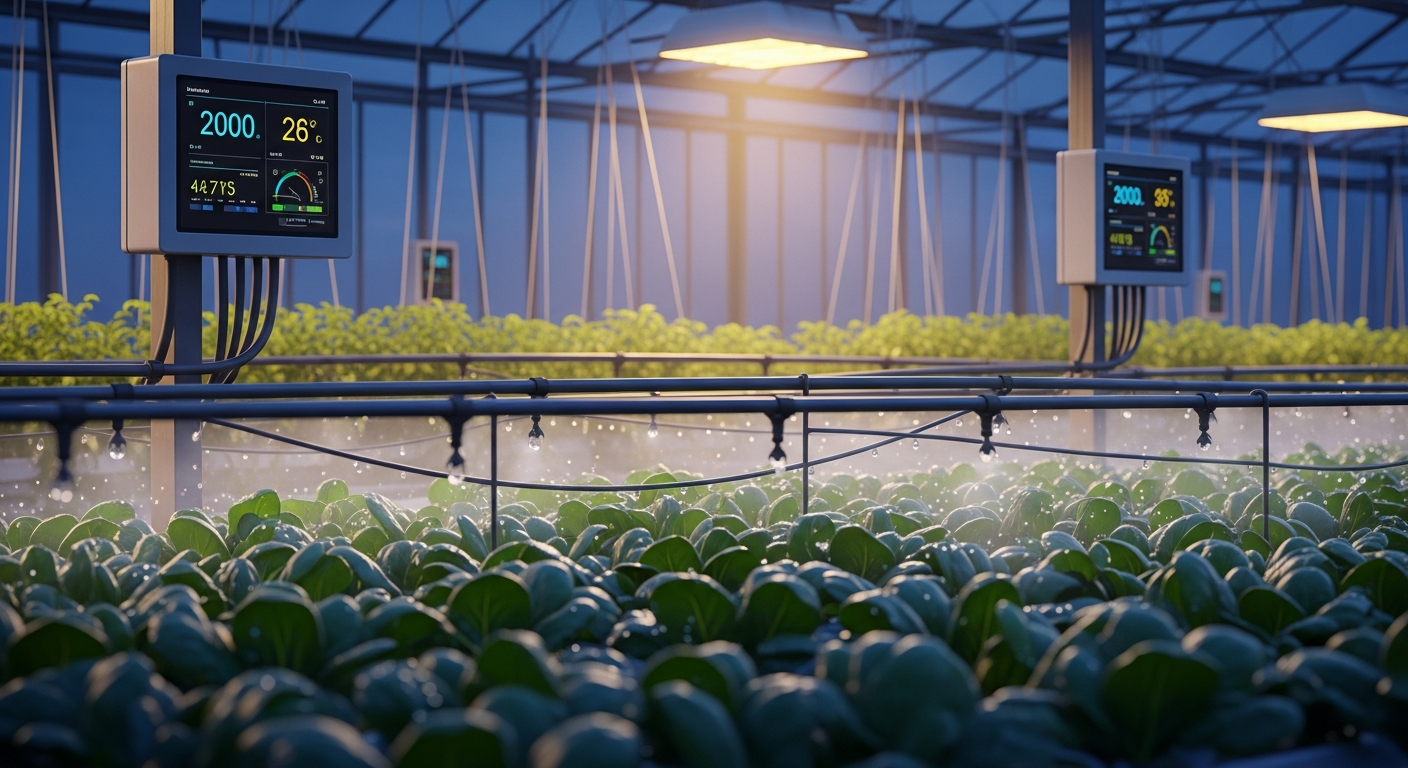
Modern greenhouse climate control systems integrate data from temperature, humidity, and CO2 sensors to automate ventilation, heating, and even irrigation. These systems can monitor real-time VPD and trigger fans or adjust heating setpoints to keep humidity within target ranges. Humidity sensors placed at crop level provide the most accurate picture of the plant’s immediate environment, allowing for proactive adjustments.
Ventilation and Air Circulation
Horizontal airflow fans (HAF fans) are excellent for breaking up stagnant air pockets and ensuring uniform humidity throughout the canopy. While passive vents might be closed at night to retain heat, strategic operation of exhaust fans for short periods, even in conjunction with minimal heating (a technique known as “pipe heating” or “dehumidification heating”), can purge humid air and introduce drier outside air, effectively reducing nighttime humidity. This needs to be balanced against energy costs, but the benefits in disease prevention often outweigh the heating expense.
Dehumidifiers and Desiccants
In highly sealed or advanced greenhouse operations, dedicated dehumidifiers can actively remove moisture from the air. These can be particularly useful during periods of extended cloudy weather or in propagation zones where high humidity is often desired during the day but problematic at night. Desiccant-based systems are also emerging as energy-efficient alternatives in some contexts.
By combining meticulous irrigation timing with these advanced environmental controls, growers can create a consistently optimized climate that minimizes disease pressure and supports robust plant growth.
Conclusion
The impact of irrigation timing on nighttime greenhouse humidity is a critical, yet often overlooked, aspect of successful greenhouse management. By understanding the science behind VPD, dew point, and the pathways for moisture accumulation, growers can make informed decisions that significantly reduce the risk of humidity-related diseases and physiological disorders. Adopting a “water in the morning” philosophy, avoiding overwatering, and leveraging technology for environmental monitoring and control are fundamental steps toward creating a healthier, more productive greenhouse environment. Mastering this balance is not just about avoiding problems; it’s about actively cultivating an ideal climate that allows your plants to flourish, ensuring sustained yields and superior crop quality. Pay attention to your watering schedule, and your plants will thank you with vibrant growth and a resilient defense against the unseen threats of high humidity.