
In the intricate world of modern greenhouse cultivation, precision is paramount. Automated irrigation systems have revolutionized how we deliver water and nutrients to our crops, offering unprecedented control and efficiency. However, with this advanced technology comes a crucial challenge: the silent, insidious threat of salt buildup in the root zone. Unmanaged, these accumulating salts can stunt growth, reduce yields, and even kill plants. This is where the concept of a leaching fraction becomes not just important, but absolutely essential for maintaining a thriving, productive greenhouse environment, especially within automated setups.
What is Leaching Fraction and Why is it Critical for Plant Health?
At its core, the leaching fraction (LF) refers to the proportion of irrigation water applied that is allowed to drain through the growing medium and out of the root zone. Think of it as deliberately over-watering just enough to wash away excess salts that have accumulated. While it might sound counter-intuitive to allow water to drain away, this practice is a cornerstone of effective nutrient management and salt prevention in soilless culture and container growing.
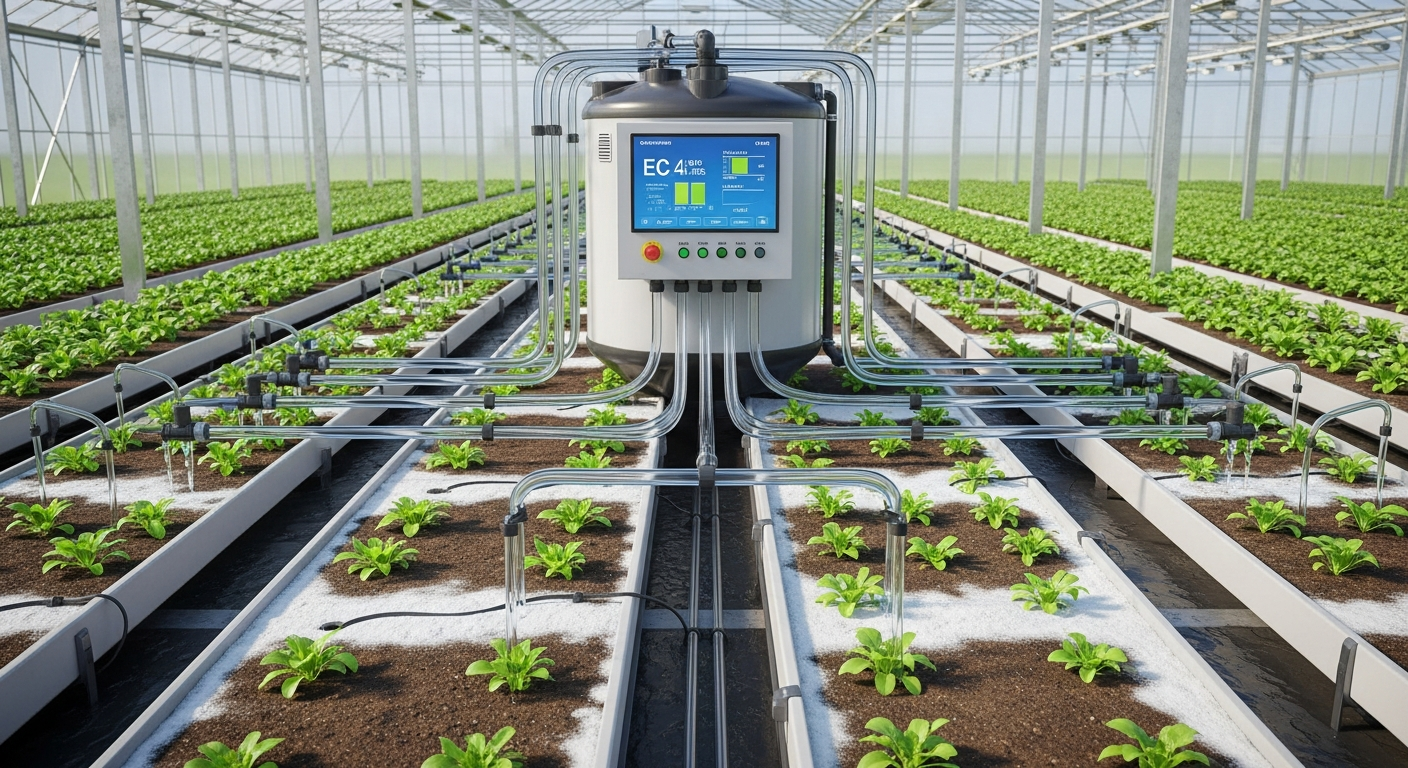
The Silent Threat: How Salts Accumulate
In any irrigation system, especially those utilizing nutrient solutions, salts are continuously introduced. These come from several sources:
- Nutrient Solutions: All commercial fertilizers are mineral salts. As plants absorb water, they selectively take up nutrients, leaving behind a higher concentration of unabsorbed ions.
- Source Water: Even “clean” tap water or well water contains dissolved minerals (salts), which contribute to the overall electrical conductivity (EC). Reverse osmosis (RO) water can minimize this, but it’s rarely completely zero.
- Evapotranspiration: As plants transpire and water evaporates from the growing medium surface, pure water leaves, concentrating the remaining salts in the root zone.
Without adequate leaching, these salts build up to toxic levels, leading to a range of problems known as salinity stress. High EC in the root zone makes it harder for plants to absorb water and nutrients, even if they are present. Symptoms include stunted growth, leaf tip burn, wilting, and reduced yields. Ultimately, severe salt buildup can lead to root damage and plant death, undermining all the benefits of your automated irrigation system.
Calculating and Implementing Your Ideal Leaching Fraction
Determining the optimal leaching fraction is not a one-size-fits-all endeavor. It depends on several dynamic factors within your greenhouse environment. The goal is to apply enough water to prevent salt buildup without wasting excessive amounts of water and expensive nutrients.
Factors Influencing the Leaching Fraction
- Crop Type and Salt Tolerance: Different plants have varying tolerances to salinity. Lettuce, for example, is highly sensitive, while tomatoes or cannabis can tolerate slightly higher ECs. More sensitive crops require a higher LF.
- Source Water Quality: If your initial irrigation water has a high EC, you’ll need a higher LF to compensate for the salts it introduces. Starting with low EC water gives you more flexibility.
- Substrate Type: The growing medium’s water holding capacity and drainage characteristics play a role. A free-draining substrate like rockwool or coco coir may require more frequent, smaller leaching events compared to a peat-based mix.
- Environmental Conditions: High temperatures and low humidity increase evapotranspiration, concentrating salts faster and potentially necessitating a higher LF.
- Nutrient Solution Concentration: Higher concentration nutrient solutions will naturally introduce more salts, requiring a greater leaching fraction.
Practical Calculation and Application
While there are complex formulas, a common practical approach for automated systems involves monitoring the electrical conductivity (EC) of both your applied nutrient solution and your drainage runoff.
- Monitor Input EC (ECin): Measure the EC of your nutrient solution being delivered to the plants.
- Monitor Runoff EC (ECout): Collect and measure the EC of the drainage water from your grow bags or containers. This can be done manually with a collection tray or automatically with drainage sensors.
- Target ECout: A common target for the runoff EC is generally 1.2 to 1.5 times the input EC. If your ECout is significantly higher than 1.5 times ECin, it indicates salt buildup, and you need a higher leaching fraction. If it’s too close to ECin, you might be over-leaching.
An initial general recommendation for many soilless systems is a leaching fraction of 10-30%. This means for every 100 gallons of water applied, 10-30 gallons should drain out. For sensitive crops or high EC source water, you might aim for the higher end; for robust crops with clean water, the lower end might suffice.
In automated systems, you can achieve this by programming your irrigation controller to deliver a specific volume of water, knowing the approximate drainage percentage. For instance, if you usually irrigate for 2 minutes and find you’re not getting enough runoff, you might increase it to 2.5 or 3 minutes, then monitor the resulting drainage volume and EC. Over time, you’ll dial in the optimal duration and frequency.
Strategies for Effective Salt Management and Leaching
Effective salt management goes beyond simply calculating a number; it involves a continuous process of monitoring, adjustment, and strategic action.
Continuous Monitoring is Non-Negotiable
- Regular EC and pH Checks: Routinely measure the EC and pH of your nutrient solution, your source water, and especially your runoff. Automated sensors can provide real-time data, but manual spot checks are always wise. Keep detailed records to identify trends.
- Plant Observation: Become familiar with the visual symptoms of salinity stress (e.g., dark green leaves, burned leaf tips, stunted growth). Your plants are the ultimate indicators of root zone health.
- Substrate Probes: For precision, consider using root zone sensors that can measure EC, pH, and moisture directly within your growing medium, providing the most accurate picture of what your plant’s roots are actually experiencing.
Optimizing Leaching Techniques
- Scheduled Leaching Events: Many growers implement periodic “flush” or high-leaching irrigation cycles. This might involve applying clear water (or a very dilute nutrient solution) to thoroughly flush the medium, or simply running a standard nutrient solution irrigation for a longer duration than usual. This is particularly useful for automated systems, where a “leach cycle” can be programmed weekly or bi-weekly.
- Pulse Irrigation: Applying nutrient solution in several short bursts throughout the day, rather than one long irrigation, can improve distribution and ensure more consistent moisture and nutrient levels, leading to more controlled drainage.
- Adjusting Frequency and Duration: If your runoff EC is consistently too high, increase the duration of each irrigation cycle slightly, or add an extra short cycle until the desired leaching fraction is achieved.
Water Quality and Nutrient Solution Management
- Start Clean: Using reverse osmosis (RO) water as your base can dramatically reduce the initial salt load, giving you greater control over your nutrient solution’s EC.
- Balanced Formulations: Ensure your nutrient solution is well-balanced for your specific crop and growth stage. Imbalances can lead to certain ions accumulating faster than others.
- System Maintenance: Regularly clean and calibrate your EC and pH meters. Keep irrigation lines free of algae and mineral deposits to ensure uniform flow and nutrient delivery.
Optimizing Automated Systems for Precision Leaching
Modern greenhouse technology offers incredible tools to automate and optimize your leaching strategy, turning a complex manual task into a data-driven process.
Leveraging Advanced Control Systems
High-tech climate and irrigation controllers are at the heart of precision leaching. These systems can:
- Integrate Sensor Data: Connect directly to drainage sensors, root zone EC probes, and runoff collection systems. This allows for real-time adjustments based on actual conditions.
- Adaptive Scheduling: Program irrigation schedules that automatically increase or decrease irrigation duration/frequency based on target runoff EC, substrate moisture levels, or even environmental data (e.g., higher leaching on very hot, dry days).
- Remote Monitoring and Control: Cloud-based platforms allow you to monitor your leaching fraction, EC levels, and plant health indicators from anywhere, making adjustments on the fly.
Essential Sensor Technologies
- Drainage Collection and Flow Meters: Systems that automatically collect runoff and measure its volume are crucial for accurately calculating the leaching fraction.
- Inline EC/pH Sensors: Installing sensors in both the irrigation supply line and the drainage collection system provides continuous data on input and output water quality.
- Substrate Moisture and EC Sensors: These devices provide direct insight into the root zone environment, alerting you to potential dry spots or areas of excessive salt accumulation before visual symptoms appear on the plants.
Training and Best Practices for Automation
Even the most advanced automated system is only as good as its operator. Investing in proper training for your staff on how to interpret sensor data, adjust irrigation programs, and troubleshoot issues is vital. Regular calibration of all sensors and flow meters is also paramount to ensure the data driving your automated leaching strategy is accurate and reliable.
By embracing these technologies and practices, you can transform your automated greenhouse system into a finely tuned instrument for managing root zone salinity, safeguarding plant health, and maximizing your yields.
Conclusion
Understanding and actively managing your leaching fraction is an indispensable practice for any greenhouse operation utilizing automated irrigation systems. It’s the primary defense against the detrimental effects of salt buildup, ensuring that your valuable crops receive the optimal balance of water and nutrients without succumbing to salinity stress. By integrating careful monitoring, adapting your irrigation strategies based on real-time data, and leveraging the power of modern greenhouse automation, you can maintain pristine root zone conditions. This proactive approach not only leads to healthier plants and significantly higher yields but also optimizes resource use, making your greenhouse operation more sustainable and profitable. Embrace the science of the leaching fraction, and watch your greenhouse thrive.