
In the world of controlled environment agriculture, every drop counts. For greenhouse growers, achieving optimal plant health and maximizing yields hinges on a delicate balance of light, temperature, humidity, and critically, water. While traditional watering methods often lead to waste and inconsistencies, a scientific marvel known as drip irrigation has revolutionized how we deliver this essential resource. Imagine a system so precise that it delivers water and nutrients directly to the plant’s root zone, minimizing evaporation, runoff, and disease risk. This isn’t just a fantasy; it’s the precise, efficient reality of modern drip irrigation, a cornerstone technology for sustainable and productive greenhouse climates.
Understanding the Principles of Drip Irrigation
At its core, drip irrigation, also known as micro-irrigation or trickle irrigation, is a method that saves water and fertilizer by allowing water to drip slowly to the roots of plants, either from above the soil surface or buried below the surface. The goal is to apply water precisely where it’s needed most, at a rate that the soil can absorb, thereby keeping the root zone consistently moist without saturating it.
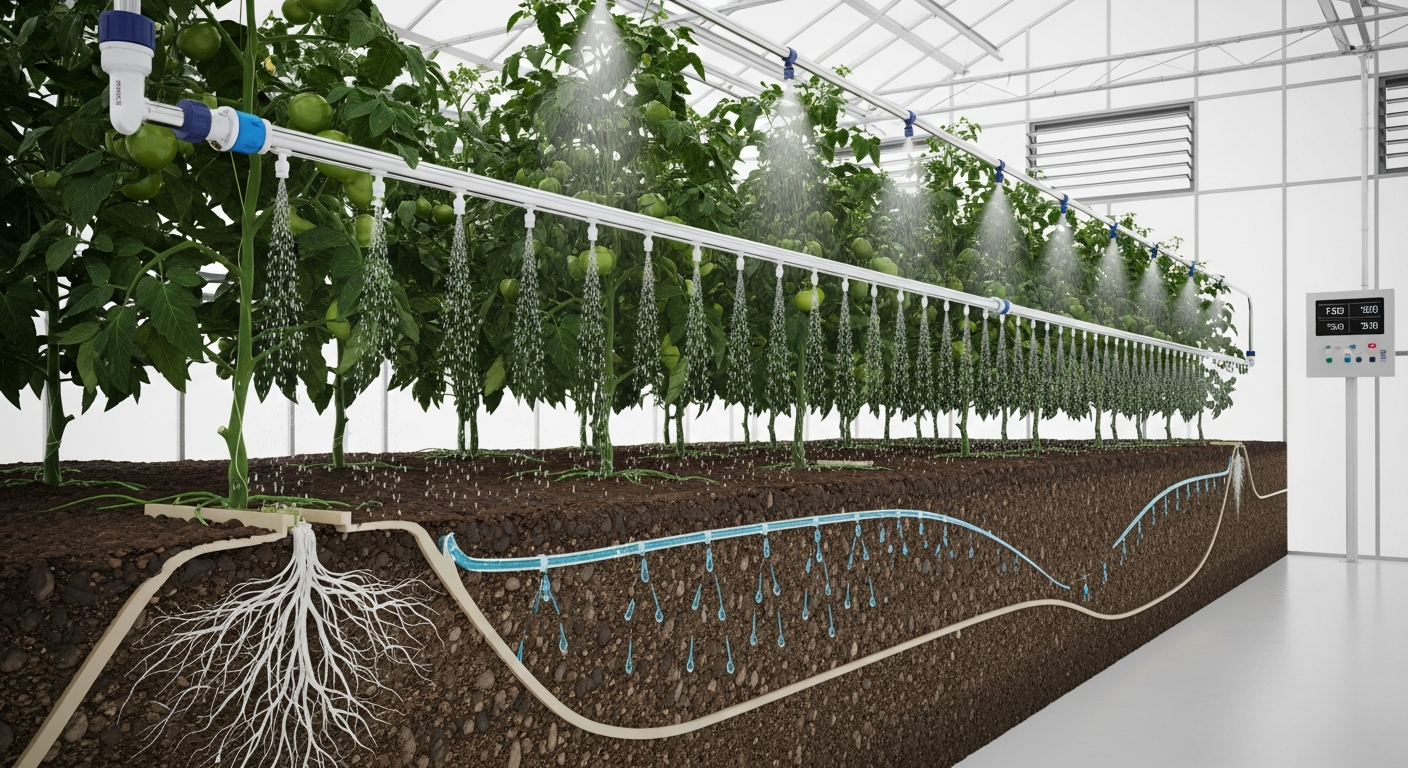
The system comprises several key components working in concert:
- Water Source: This could be a municipal supply, well, or collected rainwater.
- Filtration System: Crucial for preventing clogging of emitters, filters remove sediment, algae, and other particles. Different types include screen filters, disc filters, and media filters.
- Pressure Regulator: Maintains a consistent water pressure throughout the system, ensuring uniform flow from all emitters regardless of elevation changes.
- Mainlines and Sub-mainlines: Larger diameter pipes that transport water from the source to various sections of the greenhouse.
- Laterals: Smaller diameter tubes (often polyethylene) that branch off the sub-mainlines and run along rows of plants.
- Emitters (Drippers): The heart of the system, these small devices are spaced along the laterals to deliver water directly to individual plants or specific zones.
Unlike overhead sprinklers that wet foliage and paths, drip irrigation keeps water confined to the root zone. This fundamental difference drastically reduces evaporation losses, prevents waterlogging, and curtails the conditions favorable for many plant diseases, making it an indispensable tool for greenhouse climate control.
The Science Behind Precise Water and Nutrient Delivery
The efficacy of drip irrigation isn’t just about placing water at the base of a plant; it involves a sophisticated understanding of soil science, hydraulics, and plant physiology.
Capillary Action and Soil Moisture Dynamics
When water is slowly applied to the soil through an emitter, it doesn’t just sink straight down. Instead, it spreads out laterally and vertically due to capillary action and gravity, creating a distinct “wetted pattern” or “wetted bulb” around the emitter. The shape and size of this wetted bulb are crucial and depend heavily on the soil type:
- Sandy Soils: Water penetrates quickly and deeply with less lateral spread due to larger pore spaces and weaker capillary forces.
- Clay Soils: Water penetrates slowly but spreads more widely due to smaller pore spaces and stronger capillary action.
- Loam Soils: Offer a balanced penetration and spread, generally ideal for most crops.
Understanding these soil dynamics allows growers to select appropriate emitter flow rates and spacing to ensure uniform moisture distribution across the root zone of all plants. The goal is to keep the soil moisture tension within an optimal range, providing readily available water for plant uptake without suffocating roots or promoting anaerobic conditions.
Emitter Technology and Flow Rates
The science of emitters is critical to the precision of drip irrigation. Modern emitters are engineered to deliver specific, consistent flow rates, often measured in liters per hour (LPH) or gallons per hour (GPH). Key emitter types include:
- Non-Pressure Compensating (Non-PC) Emitters: Flow rate varies with pressure changes, making them less ideal for uneven terrains or long lateral runs.
- Pressure-Compensating (PC) Emitters: These incorporate a diaphragm or labyrinth path that adjusts to varying inlet pressures, maintaining a nearly constant flow rate over a wide range of pressures. This ensures all plants, regardless of their position in the system, receive the same amount of water, leading to unparalleled uniformity in crop growth.
- Micro-tubes and Micro-sprinklers: While not strictly “drip,” these are often categorized within micro-irrigation systems, offering slightly wider coverage for specific plant needs.
Choosing the correct emitter flow rate is essential. Too high, and you risk runoff and nutrient leaching; too low, and plants may not receive adequate water, especially in fast-draining media. The science here lies in matching emitter output to the plant’s water requirements and the soil’s infiltration rate.
Optimizing Nutrient Delivery (Fertigation)
One of the most significant scientific advantages of drip irrigation is its compatibility with fertigation – the application of fertilizers through the irrigation water. This allows for unparalleled precision in nutrient delivery:
- Direct to the Root Zone: Nutrients are delivered exactly where they are needed, minimizing waste and preventing uptake by weeds.
- Reduced Leaching: By delivering nutrients in smaller, more frequent doses, the risk of nutrients washing past the root zone is greatly diminished, enhancing fertilizer efficiency.
- Tailored Nutrition: Growers can precisely adjust nutrient concentrations and ratios throughout different growth stages, responding dynamically to plant needs. This leads to healthier plants, faster growth, and higher yields.
The science of fertigation within a drip system ensures that plants receive a constant, balanced supply of essential elements, fostering optimal physiological processes from seedling to harvest.
Benefits Beyond Water Conservation: Enhanced Plant Health and Yields
While water savings are a primary driver for adopting drip irrigation, its scientific advantages extend far beyond mere conservation, directly impacting plant vitality and greenhouse productivity.
Reduced Disease Pressure
Many common greenhouse diseases, especially fungal and bacterial infections (e.g., powdery mildew, botrytis, downy mildew), thrive in conditions of high leaf wetness. Drip irrigation virtually eliminates overhead watering, keeping foliage dry and dramatically reducing the incidence of these pathogens. This translates to healthier plants, less reliance on fungicides, and a more robust growing environment.
Optimized Root Development and Plant Growth
By maintaining a consistent, optimal moisture level in the root zone, drip irrigation encourages the development of a deeper, more extensive root system. Plants don’t have to expend energy searching for water, instead focusing resources on shoot and fruit development. This leads to stronger, more resilient plants that are better able to withstand environmental stresses and produce higher-quality yields. The steady supply of water and nutrients also reduces plant stress, promoting continuous, uninterrupted growth.
Weed Suppression and Nutrient Efficiency
Since water is applied only where plants are growing, areas between rows and on greenhouse pathways remain dry. This significantly suppresses weed germination and growth, reducing competition for water and nutrients, and decreasing the need for manual weeding or herbicides. Furthermore, nutrients are precisely delivered to the crop, preventing them from feeding weeds, thus improving the overall efficiency of fertilizer use.
Labor Savings and Automation Potential
The inherent design of drip irrigation lends itself perfectly to automation. With timers, controllers, and increasingly sophisticated sensor technology (soil moisture sensors, climate sensors), entire greenhouse irrigation schedules can be automated. This frees up valuable labor for other tasks, reduces human error, and ensures precise, consistent watering around the clock, optimizing greenhouse climate management.
Implementing and Managing Your Drip Irrigation System
To fully harness the scientific benefits of drip irrigation, careful planning, installation, and ongoing management are essential.
Design Considerations
Before purchasing components, map out your greenhouse layout. Consider:
- Crop Type and Spacing: Different plants have different water needs and spacing requirements, influencing emitter type and spacing.
- Water Source and Pressure: Ensure adequate pressure and flow rate for the entire system. A professional hydraulic calculation can prevent issues.
- Elevation Changes: Significant slopes may require pressure-compensating emitters for uniformity.
- Zoning: Grouping plants with similar water needs into separate irrigation zones allows for customized watering schedules.
Practical Tip: Start with a detailed drawing of your greenhouse, marking plant locations and potential irrigation lines. This helps visualize the system and calculate material needs accurately.
Component Selection
Invest in quality components. Pressure-compensating emitters are highly recommended for greenhouse applications to ensure uniform water delivery. Select tubing that is UV-resistant for longevity. Filtration is paramount; consult with suppliers to choose the right filter type and size for your water quality.
Irrigation Scheduling and Monitoring
This is where the science truly comes alive. Don’t just set a timer and forget it. Optimal irrigation scheduling involves:
- Monitoring Plant Needs: Observe your plants for signs of stress.
- Soil Moisture Sensors: These invaluable tools provide real-time data on soil moisture levels, allowing for “irrigation on demand” rather than fixed schedules.
- Evapotranspiration (ET) Data: Consider environmental factors like temperature, humidity, and light intensity which influence plant water use.
- Leaching Fraction: Occasionally, a slight over-application (leaching fraction) is necessary to flush accumulated salts from the root zone, especially in soilless media.
Actionable Advice: Start with shorter, more frequent irrigation cycles, especially in porous media. Adjust based on plant growth, visual cues, and sensor data. It’s better to slightly under-water and increase frequency than to over-water.
Maintenance Tips
Regular maintenance ensures the longevity and efficiency of your system:
- Filter Cleaning: Clean filters regularly (daily to weekly depending on water quality) to prevent clogs.
- Flushing Lines: Periodically flush lateral lines to remove sediment buildup.
- Checking for Leaks: Inspect tubing and emitters for leaks or blockages. Repair or replace as needed.
- Acid/Chlorine Injection: If you have issues with mineral buildup or algae, occasional chemical injections (e.g., dilute acid to dissolve scale, chlorine to kill algae) might be necessary, but always consult an expert.
Conclusion
Drip irrigation is far more than just an efficient way to water plants; it’s a testament to applying scientific principles for superior agricultural outcomes. By precisely controlling water and nutrient delivery directly to the root zone, greenhouse growers can achieve remarkable water savings, minimize disease risk, optimize nutrient uptake, and foster robust plant development. The science of capillary action, emitter design, and intelligent scheduling culminates in healthier plants, higher yields, and a more sustainable, profitable greenhouse operation. Embracing drip irrigation isn’t just a trend; it’s a strategic investment in the future of precise, climate-controlled growing.