
The quest for an ideal greenhouse environment is a continuous balancing act. For growers, understanding and manipulating key environmental factors like light, temperature, humidity, and airflow is paramount to cultivating healthy, thriving plants. Among the most potent tools in a greenhouse manager’s arsenal are shading systems, often underestimated in their profound influence. While their primary role might seem straightforward – reducing excessive light and heat – their ripple effects extend deeply into the fundamental physiological processes of plants, particularly transpiration and the overall humidity levels within the controlled environment. Let’s delve into how strategically deployed shading can be a game-changer for your greenhouse climate.
Understanding Transpiration and Humidity in the Greenhouse Ecosystem
Before we explore the impact of shading, it’s essential to grasp the core concepts of transpiration and humidity.
What is Transpiration?
Transpiration is the process by which plants release water vapor into the atmosphere, primarily through tiny pores on their leaves called stomata. It’s often described as the plant’s way of “sweating.” This process is vital for several reasons:
- Nutrient Transport: The evaporation of water from leaves creates a suction force that pulls water and dissolved nutrients from the roots up to the rest of the plant.
- Cooling: As water evaporates, it absorbs latent heat, effectively cooling the plant, much like sweat cools our bodies.
- Gas Exchange: Stomata must open for transpiration, which simultaneously allows for the uptake of carbon dioxide (CO₂) necessary for photosynthesis.
What is Humidity?
Humidity refers to the amount of water vapor present in the air. In a greenhouse, it’s typically measured as relative humidity (RH), which expresses the amount of moisture in the air as a percentage of the maximum amount it could hold at a given temperature. High humidity means the air is saturated with moisture, while low humidity indicates dry air.
The link between transpiration and humidity is direct: as plants transpire, they release water vapor, thereby increasing the humidity within the enclosed greenhouse space. Maintaining optimal humidity levels, often described using the Vapor Pressure Deficit (VPD) metric, is crucial for preventing plant stress, disease, and ensuring efficient growth.
The Direct Impact of Shading on Light and Temperature
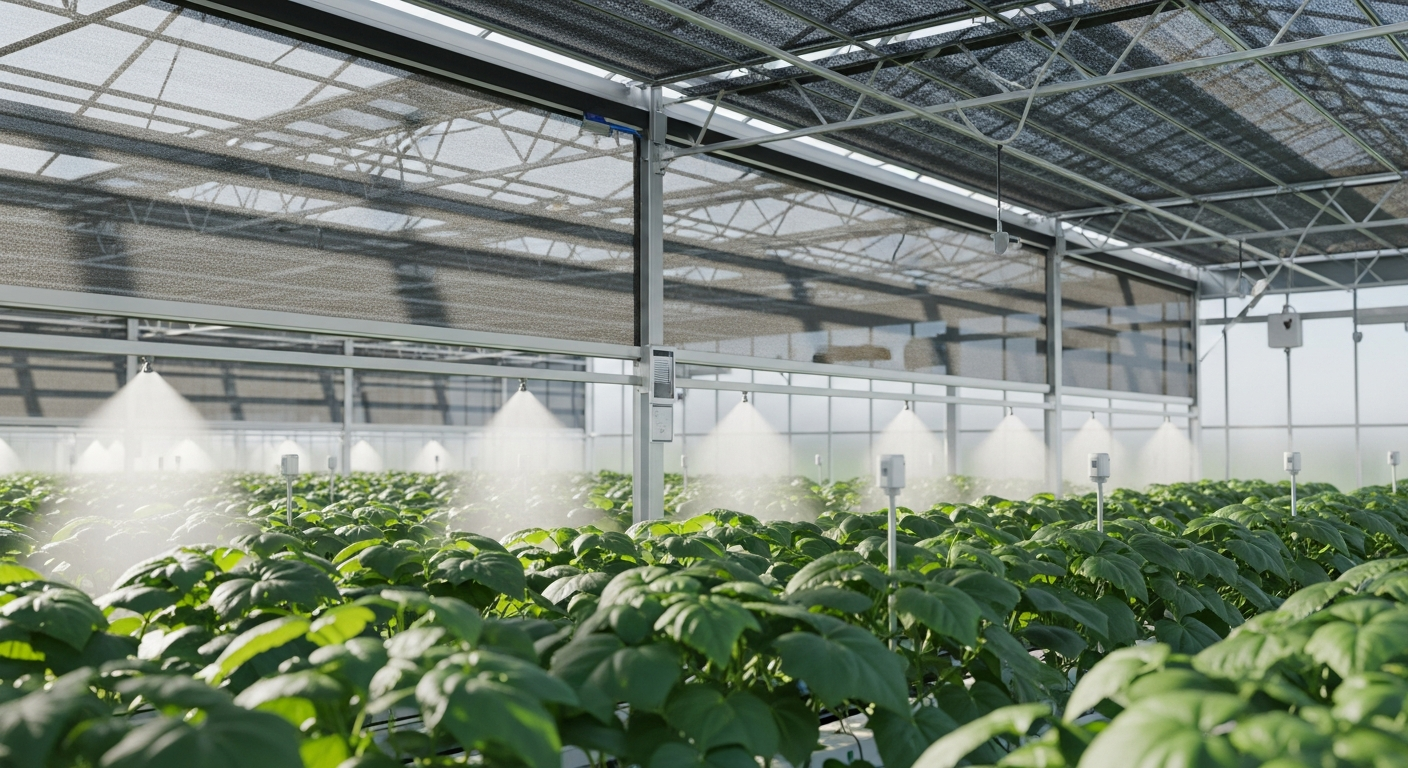
Shading systems, whether fixed screens, retractable cloths, or automated liquid shades, exert their influence by intercepting solar radiation before it reaches the plants and interior surfaces of the greenhouse. This action has two immediate and significant consequences:
Reduced Light Intensity
The most obvious effect of shading is the reduction of incoming light. While light is essential for photosynthesis, excessive light can lead to photoinhibition, bleaching, or even burning of plant tissues. Shading helps to bring light levels down to an optimal range for a specific crop, preventing stress and ensuring more efficient photosynthesis.
Lower Ambient Temperature
Solar radiation carries a significant amount of heat energy. By blocking or reflecting a portion of this radiation, shading systems prevent the greenhouse interior from overheating. This results in:
- Lower Air Temperature: Less solar energy is absorbed by the air, structures, and plants, leading to a cooler overall ambient temperature.
- Lower Leaf Temperature: Cooler ambient temperatures, combined with direct protection from intense radiation, significantly reduce the temperature of the plant leaves themselves.
These direct impacts set the stage for how shading profoundly influences both transpiration and humidity.
How Shading Systems Affect Transpiration Rates
Shading directly impacts transpiration by altering the key environmental factors that drive water loss from plants:
1. Reduced Solar Radiation: Transpiration is an energy-intensive process. The sun’s energy provides the heat needed to convert liquid water in the leaves into water vapor. By reducing the amount of solar radiation reaching the leaves, shading directly lowers the energy available for this phase change, thus decreasing the rate of transpiration.
2. Lower Leaf Temperature: Cooler leaves have a lower vapor pressure inside their tissues. The rate of water evaporation is directly proportional to the difference in vapor pressure between the inside of the leaf and the surrounding air. When leaf temperatures are high, this difference (and thus the transpiration rate) is high. Shading, by keeping leaves cooler, narrows this vapor pressure gradient, slowing down water loss.
3. Stomatal Response: Plants are remarkably adaptable. Under conditions of high light intensity and high temperatures (often correlated with high evaporative demand), plants may partially or fully close their stomata to conserve water. However, this also limits CO₂ uptake, negatively impacting photosynthesis. Shading can create a more benign environment where plants can keep their stomata open for longer periods without excessive water loss, optimizing both water use and carbon assimilation.
4. Altered Vapor Pressure Deficit (VPD): As shading often leads to a slightly higher relative humidity within the plant canopy (due to reduced air movement and plant cooling), the VPD between the leaf and the surrounding air can be narrowed. A lower VPD means less “pull” on water from the leaves, resulting in reduced transpiration rates. This is a critical point for maintaining optimal plant turgor and preventing water stress.
Practical Tip: Deploy shading during the hottest, brightest parts of the day, typically from late morning to late afternoon, to prevent excessive water loss, reduce plant stress, and conserve irrigation water. Automated systems can dynamically adjust shading based on light sensors, optimizing this balance.
Shading’s Influence on Greenhouse Humidity Levels
The relationship between shading and humidity is multifaceted, primarily stemming from its impact on transpiration and evaporation:
1. Decreased Transpiration, Slower Humidity Build-up: Since shading reduces the rate at which plants transpire, less water vapor is released into the greenhouse atmosphere by the plants themselves. This means the rate at which humidity increases from plant activity is significantly slower compared to an unshaded greenhouse under intense sun.
2. Reduced Evaporation from Surfaces: Shading doesn’t just cool plants; it also reduces the temperature of the soil, growing media, and other wet surfaces (e.g., floors after irrigation). Cooler surfaces evaporate water more slowly, further contributing to a reduced rate of overall moisture introduction into the air.
3. Creation of a Stable Microclimate: Shading helps create a more stable, cooler microclimate within the plant canopy. This can, paradoxically, lead to higher relative humidity *if ventilation is poor*, as the cooler air can hold less moisture before reaching saturation, and any transpired water vapor accumulates. However, the *rate* of humidity increase due to plant activity is still reduced.
It’s crucial to understand that while shading reduces the *generation* of humidity by plants, it doesn’t *remove* humidity from the air. In fact, if not properly managed, reduced air circulation under dense shade could trap moisture, potentially leading to issues like condensation, fungal diseases, or excessively high RH. Therefore, shading systems must be integrated with effective ventilation strategies to maintain an optimal balance.
Practical Tip: Combine the use of shading with adequate ventilation (natural or mechanical) to ensure that while transpiration is moderated, any accumulated humidity is also efficiently removed. This prevents excessively high relative humidity, which can be detrimental to plant health and encourages diseases. Monitoring tools like humidity sensors and VPD calculators are invaluable for fine-tuning this balance.
Optimizing Shading for a Healthy Greenhouse Climate
Leveraging shading systems effectively requires a strategic approach tailored to your specific crops and local climate:
Dynamic Shading Systems
Modern greenhouses often employ dynamic shading systems that automatically deploy or retract based on real-time environmental data. Light sensors (PAR sensors), temperature probes, and humidity sensors feed data to a climate control computer, allowing for precise and responsive shade management. This ensures plants receive adequate light when needed and are protected during peak intensity.
Material Selection
Shade cloth comes in various densities (expressed as a percentage of shade provided) and materials. Some are designed to simply block light, while others offer reflective properties to bounce heat away. Choosing the right material and density for your climate and crop is crucial. For instance, a 50% shade cloth might be ideal for vegetables in a hot climate, while 30% might suffice for ornamentals in a milder region.
Integration with Other Climate Controls
Shading should never be considered in isolation. It’s a component of a larger environmental control strategy. Work in tandem with your ventilation fans, roof vents, and even fogging or misting systems to create a truly balanced climate. For example, if shading reduces heat but causes humidity to spike, active ventilation can help lower it.
Crop-Specific Requirements
Different plants have vastly different needs. Orchids, for example, often thrive under higher humidity and moderate light, making strategic shading crucial. Cacti, on the other hand, require high light and very low humidity. Always consult crop-specific guidelines when developing your shading strategy to ensure optimal growth and minimize stress.
Conclusion
Shading systems are far more than just light blockers; they are sophisticated tools for microclimate manipulation. By intelligently deploying shading, greenhouse operators can significantly influence both transpiration rates and overall humidity levels, creating an environment that minimizes plant stress, optimizes water usage, and fosters robust growth. Understanding these intricate connections empowers you to make informed decisions, transforming your greenhouse into a finely tuned ecosystem where plants don’t just survive, but truly thrive. Embrace the power of strategic shading to master your greenhouse climate and unlock your crops’ full potential.