
In the intricate world of greenhouse cultivation, countless factors contribute to the success or failure of your crops. While light, temperature, and nutrients often take center stage, one unsung hero plays an equally critical role: humidity. Often misunderstood or overlooked, precise humidity control is not a “one size fits all” endeavor. The ideal humidity levels for your plants can drastically change as they progress through their life cycle, from delicate seedlings to bountiful harvest. Mastering these subtle shifts in atmospheric moisture is key to unlocking robust growth, preventing diseases, and maximizing your yields. Let’s delve into the vital humidity requirements at each distinct growth stage, ensuring your greenhouse climate is always perfectly tuned for prosperity.
Understanding Greenhouse Humidity and Its Impact on Plant Health
Before diving into specific stages, it’s crucial to grasp what humidity means for your plants. We primarily talk about Relative Humidity (RH), which is the amount of water vapor in the air expressed as a percentage of the maximum amount the air can hold at a given temperature. Plants primarily interact with humidity through their stomata, tiny pores on their leaves, which open and close to regulate gas exchange and transpiration.
A more advanced, and often more accurate, metric is Vapor Pressure Deficit (VPD). VPD measures the difference between the amount of moisture in the air and the amount of moisture the air can hold when it’s saturated. A low VPD (high humidity) means there’s less “pull” on the plant to transpire, while a high VPD (low humidity) means the plant has to work harder to transpire. Understanding VPD allows growers to fine-tune their environment for optimal plant processes, including water and nutrient uptake. However, for most greenhouse enthusiasts, starting with RH is a perfectly adequate and practical approach.
Why Humidity Matters:
- Transpiration Regulation: Optimal humidity allows plants to transpire efficiently, pulling water and nutrients from the roots to the leaves.
- Nutrient Uptake: Healthy transpiration is directly linked to robust nutrient absorption.
- Preventing Stress: Too low humidity causes plants to wilt and close stomata, hindering growth. Too high humidity can suppress transpiration, leading to slow growth and nutrient deficiencies, and also create a breeding ground for pathogens.
- Disease Prevention: Specific humidity ranges are crucial for preventing common greenhouse diseases like powdery mildew, botrytis, and damping-off.
Humidity Requirements Across Key Growth Stages
The ideal humidity levels fluctuate significantly as a plant matures. Tailoring your greenhouse environment to these changing needs is fundamental for vigorous growth and impressive yields.
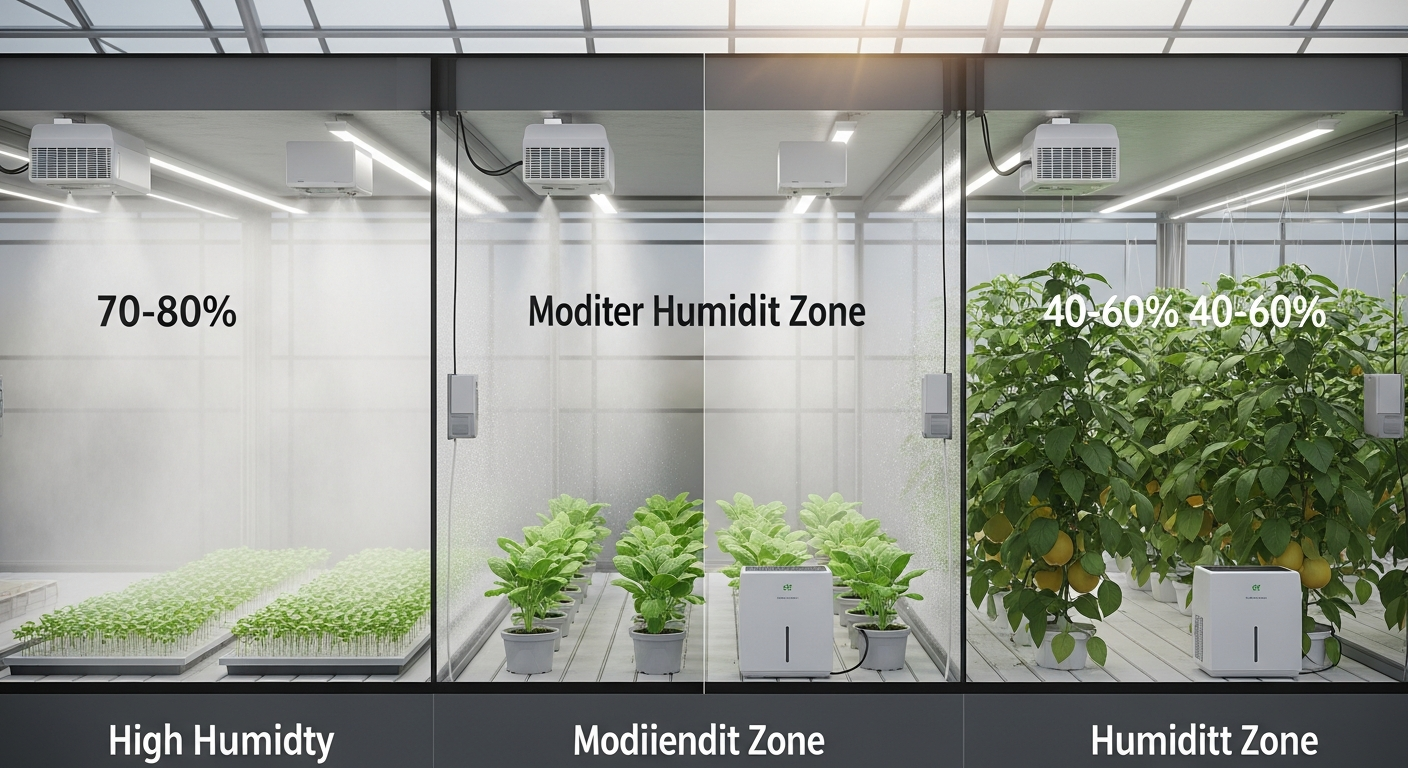
1. Seedling and Propagation Stage: High Humidity (70-85% RH)
This is arguably the most delicate phase of a plant’s life. Young seedlings and clones lack fully developed root systems, making them highly susceptible to desiccation. High humidity is paramount for several reasons:
- Root Development: High RH minimizes water loss through the undeveloped root system, allowing the plant to focus energy on growing new roots.
- Preventing Desiccation: Tender young leaves can quickly dry out in low humidity, leading to stunted growth or death.
- Stomata Regulation: High humidity reduces the need for stomata to close frequently, ensuring consistent CO2 uptake for early photosynthesis.
Practical Tips:
- Use propagation domes, mini-greenhouses, or humidity tents over your trays.
- Employ misting systems or foggers to maintain a fine, consistent humidity.
- Ensure your growing medium stays moist but not waterlogged.
- For clones, consider an aeroponic or deep water culture setup where roots are constantly in a high-humidity environment.
2. Vegetative Growth Stage: Moderate Humidity (50-70% RH)
Once seedlings have established a strong root system or clones have rooted, they enter the vegetative stage, characterized by rapid leaf and stem development. The humidity requirements shift to a more moderate range:
- Encouraging Strong Growth: Moderate humidity promotes robust transpiration without over-stressing the plant, leading to vigorous leaf and branch development.
- Efficient Nutrient Transport: Healthy transpiration drives the efficient movement of water and nutrients throughout the rapidly expanding plant.
- Preventing Stretch: While high humidity is good for seedlings, maintaining it too high during vegetative growth can lead to “stretching” or leggy plants, as they search for light in a dense, humid canopy.
- Mildew Prevention: Reducing humidity from the propagation stage helps deter the initial onset of powdery mildew and other fungal issues that thrive in overly damp conditions.
Practical Tips:
- Introduce more airflow and ventilation to naturally lower humidity from the seedling stage.
- If humidity is consistently too high, consider using a dehumidifier.
- If too low, a humidifier or strategically placed wet towels/trays of water can help.
- Monitor your RH closely, especially during lights-off periods when humidity tends to spike.
3. Flowering and Fruiting Stage: Lower Humidity (40-60% RH)
As plants transition into the flowering or fruiting stage, their humidity needs decrease significantly. This is a critical adjustment to make for both yield quality and disease prevention.
- Disease Prevention is Key: Lower humidity is crucial for preventing fungal diseases like bud rot (Botrytis), powdery mildew, and other moisture-loving pathogens that can devastate your developing flowers or fruits.
- Enhancing Quality: For many flowering plants, lower humidity can stress the plant slightly, encouraging the production of resins, essential oils, and terpenes, leading to more potent and aromatic harvests. For fruiting plants, it helps prevent fruit splitting and promotes denser, healthier produce.
- Air Circulation: Denser canopies during flowering can trap moisture. Lower ambient humidity, combined with strong airflow, prevents moisture pockets from forming around developing flowers and fruits.
Practical Tips:
- Increase ventilation and exhaust fan run-times to actively remove humid air.
- Employ dehumidifiers if natural ventilation isn’t sufficient to maintain the target RH.
- Consider watering strategically in the morning after lights on, allowing plants to dry out before lights off.
- Avoid foliar feeding or heavy misting during this stage, as it can encourage fungal growth on flowers and fruits.
4. Ripening/Pre-Harvest Stage: Very Low Humidity (35-50% RH)
For certain crops, particularly those where the flowers or fruits are dried (e.g., specific herbs or medicinal plants), an even lower humidity range might be beneficial in the final days or weeks leading up to harvest. This further reduces the risk of mold and can sometimes enhance the drying process or product quality.
Practical Tips:
- Maintain aggressive dehumidification and ventilation.
- Ensure adequate spacing between plants to maximize airflow.
- Continue to monitor for signs of mold or mildew, especially in dense plant canopies.
Achieving and Maintaining Optimal Greenhouse Humidity
Consistent humidity management requires the right tools and strategies:
- Monitoring Tools: Invest in reliable hygrometers or, even better, a grow environment controller that tracks both temperature and humidity (and calculates VPD). Smart sensors can provide real-time data and alerts.
- Increasing Humidity:
- Misters/Foggers: Introduce a fine mist into the air.
- Humidifiers: Specifically designed to add moisture.
- Evaporative Coolers: Naturally add humidity while cooling.
- Wet Surfaces: Watering floors or placing trays of water can contribute to local humidity.
- Decreasing Humidity:
- Ventilation: Exhaust fans and intake fans are crucial for air exchange, removing moist air and bringing in drier air.
- Dehumidifiers: Essential for actively removing moisture, especially in sealed greenhouses or humid climates.
- Heaters: Raising the temperature slightly can lower RH, as warmer air can hold more moisture (though this needs careful balancing with temperature targets).
- Strategic Watering: Water plants in the morning to allow excess moisture to evaporate throughout the day.
- Automated Climate Control Systems: For larger or more advanced operations, integrated climate control systems can automate humidity, temperature, and ventilation, providing unparalleled precision and consistency.
Conclusion
Humidity control is not merely an optional add-on but a foundational pillar of successful greenhouse cultivation. By understanding and actively managing the precise humidity requirements for each growth stage – from the high demands of fragile seedlings to the drier needs of mature flowering and fruiting plants – you empower your crops to thrive. Regular monitoring, strategic environmental adjustments, and the right equipment will transform your greenhouse into a finely tuned ecosystem, leading to healthier plants, fewer diseases, and ultimately, a more abundant and higher-quality harvest. Embrace the art and science of humidity management, and watch your greenhouse climates flourish.