
In the intricate world of greenhouse cultivation, growers meticulously monitor a myriad of factors: temperature, light intensity, CO2 levels, and nutrient delivery. Yet, there’s a powerful, often unseen force at play, profoundly impacting plant health and energy consumption: latent heat. This hidden energy, intrinsically linked to the evaporation of water, is the engine behind much of the humidity you experience in your greenhouse. Understanding how latent heat works, especially in the context of plant transpiration and water evaporation, isn’t just academic; it’s a critical skill for mastering your greenhouse climate, preventing disease, and optimizing plant growth. Let’s pull back the curtain on this vital thermodynamic principle and discover how to harness its power for a more efficient and productive growing environment.
What Exactly is Latent Heat?
To grasp the significance of latent heat in your greenhouse, it’s essential to first understand its fundamental definition. Simply put, latent heat is the energy absorbed or released by a substance during a phase change without a change in its temperature. The most common phase changes we observe in a greenhouse involve water: liquid turning into gas (evaporation or vaporization) and gas turning back into liquid (condensation).
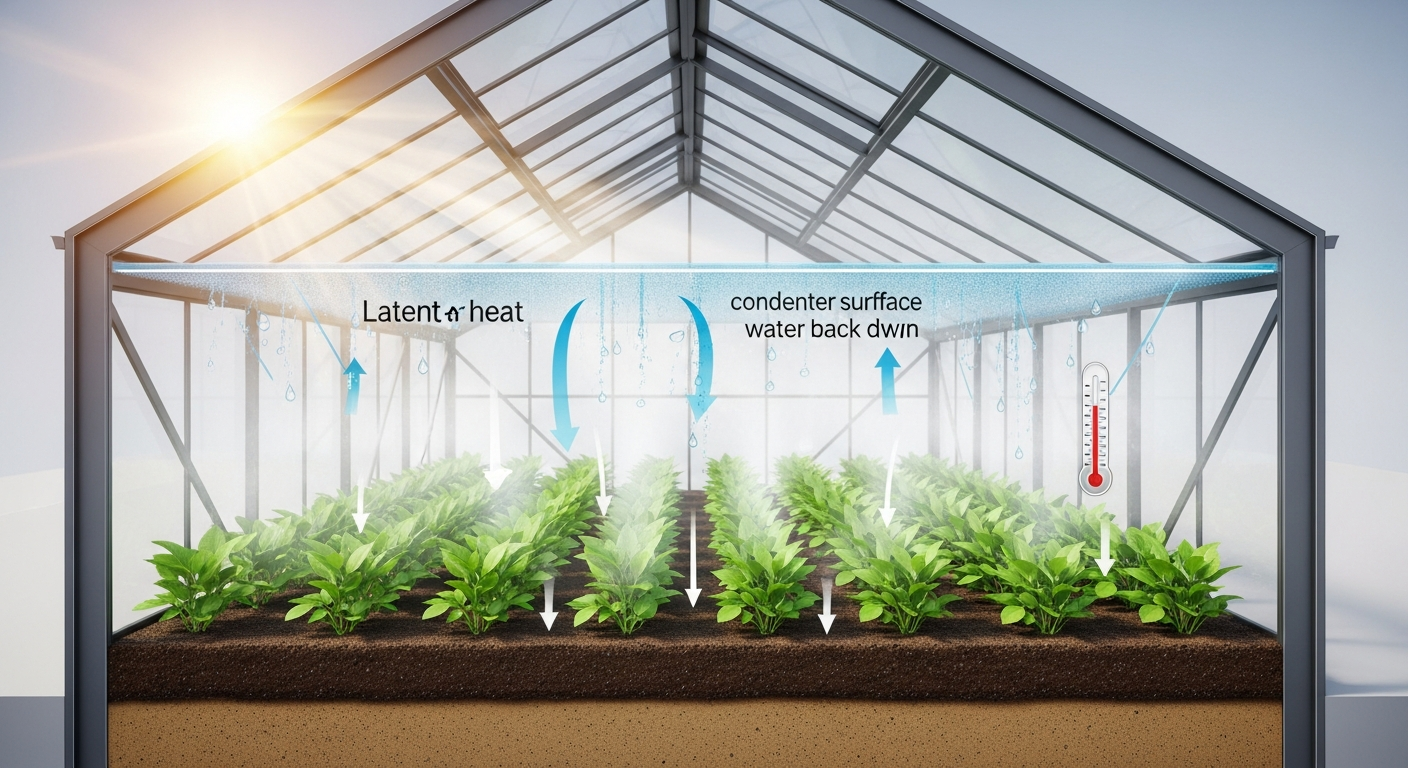
This concept often contrasts with sensible heat, which is the energy that does cause a measurable change in temperature. When you heat water on a stove, the temperature rises – that’s sensible heat. But once the water reaches its boiling point, it continues to absorb a large amount of energy to turn into steam, yet its temperature remains constant at 100°C (212°F). That energy being absorbed for the phase change, without increasing temperature, is latent heat – specifically, the latent heat of vaporization.
- Latent Heat of Vaporization: When water evaporates from a liquid surface (like a plant leaf or wet growing media) and turns into water vapor (a gas), it absorbs a significant amount of energy from its surroundings. This absorption of energy leads to a cooling effect in the immediate environment.
- Latent Heat of Condensation: Conversely, when water vapor cools down and condenses back into liquid water (like dew forming on leaves or condensation on greenhouse walls), it releases that absorbed energy back into the environment, causing a slight warming effect.
For greenhouse growers, the latent heat of vaporization is particularly important because it’s constantly at play as plants transpire and water evaporates from various surfaces, making it a primary driver of humidity levels and a critical factor in the energy balance of your cultivation space.
Latent Heat at Work: The Greenhouse Evaporation-Transpiration Cycle
The greenhouse environment is a dynamic system, constantly exchanging energy and moisture. Latent heat is intimately involved in two key processes:
- Evaporation: Water evaporating from wet floors, growing media, nutrient solutions, and even the exterior surfaces of plants that have been recently irrigated or misted.
- Transpiration: The process by which plants release water vapor into the air through small pores on their leaves called stomata. This is essentially “plant sweating” and is a vital part of their physiological functions, including nutrient uptake and cooling.
Both evaporation and transpiration require energy to convert liquid water into water vapor. Where does this energy come from? It’s absorbed directly from the surrounding greenhouse air, the plant leaves themselves, and other surfaces. As this energy is pulled from the environment, it causes a cooling effect. This is the principle behind evaporative coolers and why you feel cooler when stepping out of a shower.
As water vapor is released into the greenhouse atmosphere, it directly increases the air’s absolute humidity and, subsequently, its relative humidity. This constant cycle of water absorption, transportation, and release through transpiration, coupled with simple evaporation, means that latent heat is continuously being absorbed by water vapor within your greenhouse. Managing this cycle is paramount for maintaining an ideal growing climate.
Why Understanding Latent Heat is Crucial for Greenhouse Growers
The invisible hand of latent heat has profound and tangible effects on your greenhouse, influencing everything from plant health to operational costs. Overlooking its impact can lead to significant problems.
Humidity Control and Plant Health
The most direct consequence of latent heat absorption through evaporation and transpiration is the increase in greenhouse humidity. High humidity can be a double-edged sword:
- Disease Risk: Excessively high relative humidity (RH), especially at night or during cooler periods, creates a breeding ground for fungal pathogens like Botrytis cinerea (gray mold), powdery mildew, and downy mildew. Water on plant surfaces or in a saturated boundary layer around leaves allows spores to germinate and infect.
- Reduced Transpiration: When the air is already saturated with water vapor (high RH), the plant’s ability to transpire slows down significantly. This inhibits the plant’s natural cooling mechanism and can reduce nutrient uptake, as the flow of water carrying nutrients from the roots to the leaves is diminished. This directly impacts the Vapor Pressure Deficit (VPD), a critical metric for optimal plant growth.
- Stressed Plants: Conversely, extremely low humidity can cause excessive transpiration, leading to plant wilting, stress, and even desiccation, particularly in young or sensitive crops.
Mastering latent heat means mastering humidity, which directly translates to healthier plants and reduced reliance on chemical treatments.
Temperature Management and Energy Consumption
As water evaporates and absorbs latent heat, it cools the greenhouse air. While this evaporative cooling can be beneficial in hot climates, it can be detrimental in cooler regions or seasons, particularly when trying to maintain specific nighttime temperatures. The energy absorbed to turn water into vapor is effectively “hidden” within the humid air. To remove this humid air and replace it with drier air (or to actively dehumidify), significant energy can be required.
- Heating Costs: In colder weather, growers might be forced to heat the greenhouse while simultaneously venting out humid air, leading to substantial energy waste as newly heated air is constantly replaced. This is often called “heating to vent” or “ventilation for humidity.”
- Dehumidification Costs: Active dehumidification systems, whether mechanical or desiccant-based, consume electricity to remove water vapor from the air, thus removing the latent heat contained within it. Understanding the latent heat load helps optimize these systems.
Efficient management of latent heat directly impacts your bottom line by reducing unnecessary heating and cooling demands.
Mastering Latent Heat for Optimal Greenhouse Climates
Effectively managing latent heat is key to creating a stable, productive, and energy-efficient greenhouse environment. Here are several practical strategies:
1. Optimize Ventilation
Ventilation is your primary tool for removing humid air, which is rich in latent heat, and introducing drier air. This effectively “dumps” the latent heat and reduces humidity.
- Natural Ventilation: Utilize roof vents and sidewall vents to create a chimney effect, allowing warm, humid air to escape and drawing in cooler, drier air. Ensure proper sizing and automated controls for responsiveness.
- Mechanical Ventilation: Fans and exhaust systems are crucial for greenhouses lacking sufficient natural ventilation or when external conditions are still. Implement Horizontal Air Flow (HAF) fans to ensure uniform air movement and prevent localized humidity pockets around the plant canopy.
- "Heating to Vent" Strategy: In cool, humid conditions, it may be necessary to slightly raise the greenhouse temperature (heating) to lower the relative humidity and increase the air’s capacity to hold moisture, then vent this humid air out. While seemingly counterintuitive and energy-intensive, this can be crucial for disease prevention.
2. Implement Strategic Irrigation
The way you water your plants directly impacts the amount of water available for evaporation.
- Timing is Key: Water early in the day, allowing plants and growing media surfaces to dry out before nightfall. This minimizes the evaporation that contributes to high nighttime humidity.
- Avoid Overwatering: Saturated media provides a constant source of evaporation. Monitor soil moisture carefully and irrigate only when necessary.
- Drip or Subsurface Irrigation: These methods deliver water directly to the plant roots, minimizing surface evaporation compared to overhead irrigation or hand watering.
3. Employ Dehumidification Systems
For sophisticated climate control or in situations where ventilation alone is insufficient (e.g., in closed-loop systems, high-density cultivation, or during specific weather conditions), active dehumidification is essential.
- Mechanical Dehumidifiers: These systems cool air to its dew point, causing water vapor to condense and be removed as liquid water. They then reheat the air and return it to the greenhouse.
- Desiccant Dehumidifiers: These use absorbent materials to pull moisture directly from the air. While less common in typical greenhouses, they are highly effective in specific applications.
4. Manage Plant Canopy and Spacing
Dense plant canopies can trap humid air and impede airflow, creating microclimates conducive to disease.
- Optimal Spacing: Ensure adequate spacing between plants to allow for good air circulation.
- Pruning: Regular pruning of lower leaves and suckers can improve airflow within the canopy and reduce the overall transpiring leaf area.
5. Monitor Key Climate Parameters
You can’t manage what you don’t measure.
- Relative Humidity (RH) Sensors: Crucial for tracking humidity levels and triggering climate control actions.
- Dew Point Sensors: Understanding the dew point helps predict when condensation might occur, a critical factor for preventing disease.
- Vapor Pressure Deficit (VPD) Calculation: Modern climate control systems often calculate VPD, which provides a more accurate picture of the plant’s comfort level and transpiration rate than RH alone. Aim for an optimal VPD range for your specific crop to encourage healthy transpiration without stress.
Conclusion
Latent heat, though invisible and often underestimated, is a monumental force in the greenhouse. It is the silent driver of humidity, a key player in temperature regulation, and a direct determinant of plant health and energy efficiency. By thoroughly understanding the principles of latent heat – how it’s absorbed during evaporation and transpiration – greenhouse growers can move beyond simply reacting to climate problems and instead proactively manage their environment.
Mastering latent heat means optimizing ventilation, strategically irrigating, leveraging dehumidification when necessary, and maintaining a vigilant eye on crucial climate data. This comprehensive approach empowers you to create a stable, productive, and disease-resistant greenhouse climate, leading to healthier plants, higher yields, and a more sustainable operation. Embrace the science of latent heat, and unlock a new level of control over your greenhouse destiny.