
In the intricate world of greenhouse cultivation, every environmental factor plays a crucial role in plant health and productivity. We meticulously manage temperature, light, CO2, and even nutrient delivery, often with sophisticated climate control systems. Yet, one fundamental atmospheric force, often overlooked, subtly but significantly influences the delicate balance within our controlled growing environments: atmospheric pressure. While its direct effects might seem less pronounced than a sudden temperature drop or a swing in light intensity, changes in atmospheric pressure ripple through the greenhouse, particularly impacting one of the most critical variables for plant well-being: humidity. Understanding this subtle interplay is key to truly mastering your greenhouse climate and preventing issues before they arise.
The Invisible Hand: Understanding Atmospheric Pressure and Vapour Pressure
Before diving into its effects, let’s briefly define atmospheric pressure. Simply put, it’s the weight of the air column pressing down on the Earth’s surface. This pressure isn’t constant; it fluctuates with weather patterns, creating high-pressure systems (where air is denser and pushes down more forcefully) and low-pressure systems (where air is lighter and exerts less force). Within your greenhouse, this external pressure subtly dictates how easily water molecules can escape into the air.
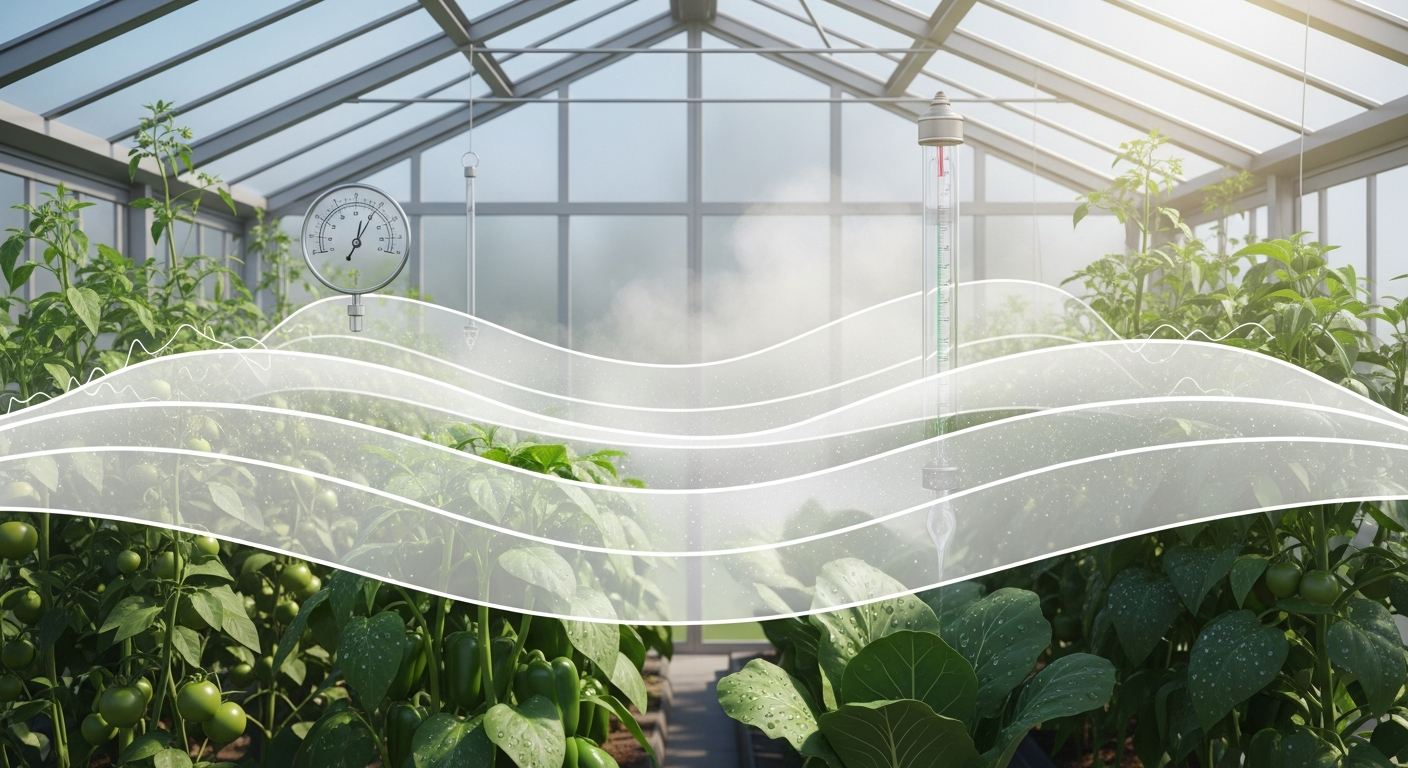
Crucially, atmospheric pressure directly influences vapour pressure deficit (VPD), a widely recognized metric for greenhouse growers. VPD measures the difference between the amount of moisture in the air and how much moisture the air could hold when saturated. It’s a powerful indicator of how much “pull” there is on a plant to transpire. While temperature and relative humidity are the primary drivers of VPD, atmospheric pressure acts as an underlying baseline, subtly adjusting the environment’s capacity to hold water vapor. A lower atmospheric pressure means water molecules can escape into the air more easily, potentially increasing the partial pressure of water vapor in the atmosphere and thus affecting the overall VPD, even if temperature and relative humidity remain constant.
The Role of Vapour Pressure and Evaporation
- Higher Atmospheric Pressure: When the atmospheric pressure is high, the air molecules are more tightly packed. This creates a greater resistance for water molecules trying to evaporate from surfaces or transpire from plant leaves. Consequently, evaporation and transpiration rates tend to be slightly reduced.
- Lower Atmospheric Pressure: Conversely, under lower atmospheric pressure, air molecules are less dense. This reduced resistance allows water molecules to escape into the atmosphere more readily. As a result, both evaporation from growing media and transpiration from plants can increase.
This subtle shift in the ease of water vapor escape directly impacts the relative humidity (RH) within your greenhouse, as more or less water is entering the air from plant surfaces and growing media.
How Atmospheric Pressure Influences Water Dynamics in Your Greenhouse
The core mechanism through which atmospheric pressure affects greenhouse humidity lies in its influence on the phase change of water – specifically, evaporation and transpiration. These processes are fundamental to how water moves into the air, contributing to the overall humidity level.
Evaporation from Surfaces
Water evaporates from all exposed surfaces within your greenhouse: the top of your growing media, the drainage water on the floor, and even condensation droplets. When atmospheric pressure is low, the air exerts less force on the water’s surface, making it easier for water molecules to break free and turn into vapor. This can lead to a slight but noticeable increase in the rate of evaporation, pushing the greenhouse’s relative humidity upwards. Conversely, high atmospheric pressure slightly suppresses evaporation, making it harder for water molecules to escape, which can lead to marginally lower humidity levels if other factors remain constant.
Transpiration from Plants
Transpiration is the process by which plants release water vapor through tiny pores called stomata, primarily on their leaves. This is essentially the plant’s way of “breathing” and cooling itself, and it’s a major contributor to greenhouse humidity. The rate of transpiration is heavily influenced by the vapour pressure deficit (VPD) between the leaf interior and the surrounding air.
- During Low Pressure Systems: With lower atmospheric pressure, the air above the plant’s stomata is less dense. This makes it easier for water vapor to diffuse out of the leaf and into the atmosphere. Plants can transpire more freely, potentially leading to increased humidity within the greenhouse, assuming adequate water availability in the substrate. This also means plants might draw more water from their roots, increasing their overall water demand.
- During High Pressure Systems: Conversely, under high atmospheric pressure, the denser air makes it slightly more difficult for water vapor to escape the stomata. Transpiration rates may be marginally reduced. While this might seem beneficial in high-humidity situations, it can also mean plants are less efficient at moving water and nutrients, potentially leading to nutrient uptake issues or heat stress if temperatures are high.
These subtle shifts, while not as dramatic as direct changes in temperature or ventilation, can accumulate over hours or days, leading to consistent higher or lower humidity levels that can impact plant health and disease susceptibility.
Practical Implications for Greenhouse Growers and Climate Control
Understanding these subtle effects isn’t just academic; it has real-world implications for your greenhouse management, particularly concerning disease prevention and optimizing plant growth. Growers who monitor and adapt to atmospheric pressure changes can gain a significant edge.
Impact on Humidity Management Strategies
Consider a period of consistently low atmospheric pressure. This environmental state facilitates both evaporation and transpiration, meaning your greenhouse is naturally inclined towards higher humidity. If not properly managed, this can lead to:
- Increased Risk of Fungal Diseases: Many common greenhouse pathogens, such as Botrytis cinerea and powdery mildew, thrive in high-humidity environments where water can condense on leaf surfaces. Low pressure exacerbates this risk.
- Reduced Transpiration Efficiency: While low pressure makes it easier to transpire, persistently high humidity (often a consequence of low pressure) can reduce the VPD too much. If VPD drops too low, plants struggle to transpire effectively, leading to reduced nutrient uptake and potentially even edema.
Conversely, during periods of high atmospheric pressure, evaporation and transpiration are slightly suppressed. This can lead to:
- Lower Humidity: If other factors like heating or dry external air are also at play, high pressure can contribute to undesirably low humidity levels.
- Increased Plant Stress: Very low humidity can cause plants to close their stomata to conserve water, leading to reduced photosynthesis and potential stress.
Adapting Your Climate Control
While you can’t control atmospheric pressure, you can certainly control your reaction to it. Smart growers integrate barometric pressure readings into their overall climate control strategy:
- Anticipate Humidity Swings: A falling barometer indicates approaching low pressure (often associated with rain and higher humidity), while a rising barometer signals high pressure (often associated with clear skies and potentially lower humidity). Use this to anticipate changes.
- Adjust Ventilation: During anticipated low-pressure periods (higher natural humidity), be proactive with increased ventilation. Use exhaust fans, open vents, or activate horizontal air flow (HAF) fans more frequently or for longer durations to circulate air and reduce stagnant, humid pockets.
- Optimize Dehumidification: If you use active dehumidification systems, you might need to run them more intensely or for longer during low-pressure fronts.
- Refine Misting/Fogging: In high-pressure scenarios where humidity might be too low, you may need to increase misting or fogging cycles to maintain optimal humidity and VPD.
- Monitor Substrate Moisture: Recognize that plants may transpire differently. During low pressure, plants might use more water, requiring slight adjustments to irrigation schedules. During high pressure, they might use less.
Monitoring and Adapting for Optimal Greenhouse Climates
The key to harnessing your understanding of atmospheric pressure is continuous monitoring and proactive adaptation. While the effects are subtle, ignoring them can lead to chronic imbalances in your greenhouse environment.
Essential Monitoring Tools
- Digital Barometer: An inexpensive tool that provides real-time atmospheric pressure readings. Many advanced greenhouse climate control systems integrate this data.
- Hygrometers and Temperature Sensors: Crucial for monitoring relative humidity and temperature, which are the primary inputs for calculating VPD. Place multiple sensors throughout your greenhouse for a comprehensive view.
- VPD Calculators/Software: Many modern climate controllers and apps can calculate VPD automatically based on temperature, relative humidity, and even atmospheric pressure.
- External Weather Station: Knowing the outdoor conditions, including barometric pressure trends, helps you anticipate changes inside your greenhouse.
Strategic Management for Dynamic Environments
Once you’re equipped with the data, you can implement dynamic management strategies:
- Integrate with Automation: If your greenhouse uses an automated climate control system, try to program it to account for atmospheric pressure changes. For instance, instruct it to increase ventilation or dehumidification slightly when pressure drops below a certain threshold.
- Focus on Air Movement: Regardless of pressure, excellent air circulation is paramount. HAF fans help homogenize the air, preventing localized humidity pockets and ensuring even distribution of temperature and CO2, which becomes even more critical when atmospheric pressure is influencing overall humidity.
- Nighttime Humidity Management: Low atmospheric pressure during the night can significantly increase condensation risk as temperatures drop. Ensure proper heating and ventilation strategies are in place to prevent dew point formation.
- Observe Your Plants: Ultimately, your plants are the best indicators. Look for signs of stress, such as wilting, burnt leaf tips (often indicating low humidity stress), or fungal spots (indicating high humidity problems). Correlate these observations with your atmospheric pressure readings.
Conclusion
Atmospheric pressure, though an invisible force, is a silent partner in shaping your greenhouse climate. Its subtle influence on evaporation and transpiration rates can tip the scales of humidity, impacting everything from plant vigor to disease susceptibility. By understanding how high and low pressure systems affect the movement of water vapor, and by integrating this knowledge with vigilant monitoring and adaptive climate control strategies, greenhouse growers can move beyond merely reacting to environmental changes. Instead, they can anticipate, optimize, and cultivate truly robust, healthy plants, ensuring the “Greenhouse Climates” they create are as stable and productive as possible.