
In the intricate world of greenhouse cultivation, achieving optimal environmental conditions is paramount for plant health and productivity. Among the most critical factors is humidity, and while many growers focus on humidifiers or dehumidifiers, the unsung hero in maintaining truly uniform humidity levels is often overlooked: air circulation. Without proper air movement, even the most advanced climate control systems can struggle, leading to localized pockets of high or low humidity that can severely impact your crops. This article delves deep into why air circulation isn’t just a good idea, but an absolute necessity for consistent humidity management within your greenhouse.
The Silent Threat of Uneven Humidity
Imagine a greenhouse where some plants thrive while others struggle with mildew or stunted growth. Often, the culprit isn’t a lack of water or light, but rather a lack of consistent humidity. Uneven humidity creates a multitude of problems:
- Disease Hotspots: Localized areas of high humidity, particularly within the plant canopy, create perfect breeding grounds for fungal diseases like botrytis, powdery mildew, and downy mildew. Spores thrive in still, moist air, leading to rapid spread and potentially devastating crop losses.
- Stunted Growth and Stress: Conversely, areas of excessively low humidity can lead to increased plant stress as plants struggle to transpire efficiently. This can result in nutrient deficiencies, wilting, and reduced growth rates.
- Inconsistent Transpiration: Plants release moisture through their leaves in a process called transpiration. If the air immediately surrounding the leaf is saturated with moisture (high localized humidity), the plant’s ability to transpire slows down, impacting nutrient uptake and overall metabolic functions. This creates a challenging environment for maintaining a healthy Vapor Pressure Deficit (VPD).
- Reduced CO2 Uptake: Stagnant air can also lead to depleted carbon dioxide levels around plant leaves, as plants quickly absorb available CO2. Without fresh air movement to replenish this, photosynthesis can become limited, hindering growth.
- Microclimates: Poor air circulation fosters the development of “microclimates” – small, distinct areas within the greenhouse that have different temperature and humidity profiles than the overall environment. These hidden zones can undermine your entire climate control strategy.
Understanding these challenges highlights why simply monitoring average humidity isn’t enough; true success lies in ensuring that humidity is consistent across every inch of your growing space.
How Air Movement Evens the Score
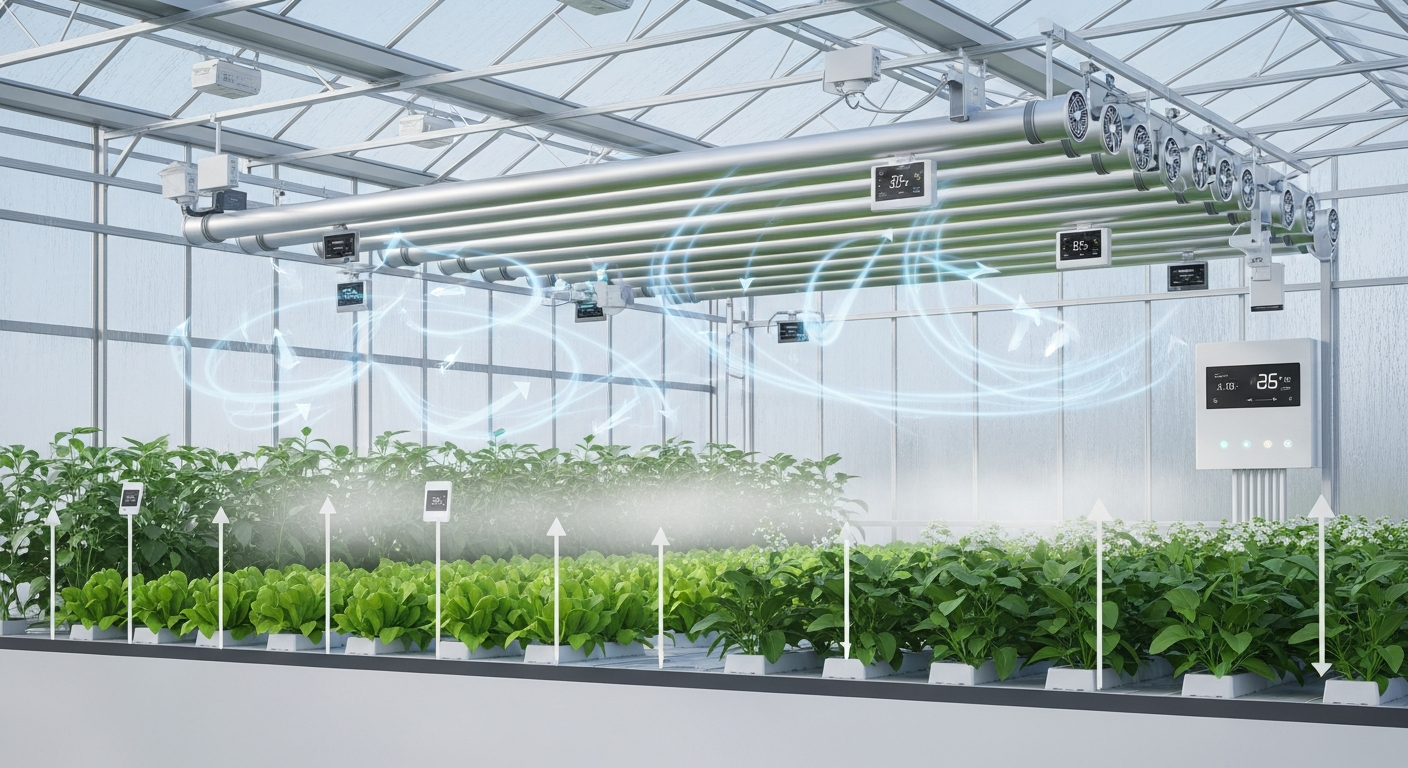
Air circulation acts as the great equalizer in a greenhouse environment. It actively works to homogenize the air, preventing the formation of those problematic microclimates and ensuring that temperature and humidity are consistent throughout the entire volume of air.
Here’s how effective air movement achieves this:
- Dispersing Moisture: Plants constantly release water vapor into the air. Without airflow, this vapor accumulates in a thin, moist layer (the “boundary layer”) around the leaves. Air circulation constantly sweeps away this saturated air, allowing plants to continue transpiring efficiently and preventing moisture buildup that leads to fungal issues. It also helps distribute the moisture evenly throughout the greenhouse, preventing localized pockets of extreme humidity.
- Mixing Air Layers: Heat rises, and cool air sinks. This natural stratification can lead to temperature and humidity differentials between the top and bottom of your greenhouse, or between different rows of plants. Air circulation breaks up these layers, thoroughly mixing the air to create a uniform temperature and humidity profile from floor to ceiling and wall to wall.
- Replenishing CO2: As air circulates, it brings fresh carbon dioxide to the plant canopy, ensuring that plants have ample supply for photosynthesis, especially in enclosed environments where CO2 can quickly be depleted.
- Preventing Condensation: By maintaining consistent air temperature and humidity, circulation helps prevent condensation on plant surfaces, structural elements, and cold spots – another major factor in disease prevention.
- Aiding Dehumidification: If you are using dehumidifiers, effective air circulation ensures that moist air reaches the dehumidifier and that the drier air it produces is then distributed evenly throughout the space, maximizing its efficiency.
In essence, air movement transforms a collection of individual plant microclimates into one cohesive, optimally controlled environment, making your overall climate control strategy far more effective.
Tools and Techniques for Optimal Airflow
Achieving superior air circulation requires more than just opening a vent. It involves a strategic combination of equipment and thoughtful design.
Horizontal Airflow (HAF) Fans
HAF fans are the workhorses of greenhouse air circulation. Designed to move air in a horizontal, elliptical pattern, they create a gentle, continuous “air current” that sweeps through the plant canopy and across the entire greenhouse. This ensures that air is constantly mixed, preventing stagnant pockets.
- Placement: HAF fans should be strategically placed to create a continuous loop of air. Typically, they are mounted above the crop, often along the side walls or suspended from the rafters, pointing in the same direction to create a racetrack pattern. The number and size of fans will depend on the greenhouse’s dimensions.
- Benefits: They are highly efficient at homogenizing air temperature and humidity, reducing the boundary layer around leaves, and ensuring even CO2 distribution.
Exhaust and Intake Systems
While HAF fans circulate air within the greenhouse, exhaust and intake systems are crucial for replacing stale, moist air with fresh, drier outside air (when conditions permit). This is a primary method of active ventilation and humidity removal.
- Exhaust Fans: These powerful fans draw air out of the greenhouse, expelling excess heat and humidity. They are typically placed at one end or side of the greenhouse.
- Intake Vents/Louvers: Located at the opposite end or side from the exhaust fans, these allow fresh air to enter. They should be appropriately sized and sometimes fitted with automatic louvers to prevent uncontrolled air entry.
- Cross-Ventilation: The combination of exhaust and intake fans creates a powerful cross-ventilation system that helps exchange the entire air volume of the greenhouse, crucial for managing overall humidity and temperature.
Vertical Airflow (Circulation) Fans
In some larger or taller greenhouses, or specific zones, vertical circulation fans can complement HAF systems by pushing air downwards or upwards, helping to break up vertical stratification. They are particularly useful in multi-level growing operations or to target specific areas with dense canopies.
Strategic Placement and Sizing
The effectiveness of your air circulation system hinges on correct fan sizing and placement. Factors to consider include:
- Greenhouse Size and Shape: Larger greenhouses require more powerful fans or a greater number of them. Unique shapes might necessitate a more complex fan arrangement.
- Crop Density: Denser canopies require more vigorous air movement to penetrate the foliage and prevent moisture buildup within the leaves.
- Obstructions: Internal structures, equipment, and even dense plant rows can create barriers to airflow. Fans should be positioned to overcome these.
- Air Changes Per Hour (ACH): For exhaust/intake systems, aim for sufficient ACH to effectively remove heat and humidity. Consult fan manufacturers or greenhouse design guides for appropriate sizing.
Beyond Fans: Other Factors Influencing Airflow and Humidity
While fans are central, other practices contribute to effective air circulation and humidity control:
- Plant Spacing and Canopy Management: Overcrowding plants restricts airflow within the canopy, creating perfect conditions for disease. Proper spacing and strategic pruning (e.g., lower leaf removal, thinning) improve air penetration and reduce humidity buildup around individual plants.
- Greenhouse Design: The fundamental design of your greenhouse (e.g., roof vents, sidewall vents, overall structure) significantly impacts natural ventilation potential, which can augment mechanical systems.
- Bench Design: Using benches with slatted or mesh tops allows air to circulate underneath pots, preventing moisture accumulation at the base of plants.
- Humidity Monitoring Systems: Advanced climate control systems with multiple humidity sensors placed strategically throughout the greenhouse can provide real-time data, allowing you to fine-tune your air circulation strategy and identify problem areas before they escalate. Integrating these with automated fan controls ensures dynamic response to changing conditions.
Conclusion
Air circulation is far more than just “moving air” in a greenhouse; it is a fundamental pillar of effective humidity management and, by extension, overall plant health. By actively homogenizing the environment, it prevents the formation of disease-prone humidity pockets, ensures consistent transpiration, and optimizes CO2 uptake. Investing in a well-designed air circulation system – incorporating HAF fans, exhaust/intake setups, and thoughtful plant management – is an investment in the vitality and productivity of your crops. Prioritizing uniform air movement will not only help you maintain stable humidity levels but also create a more resilient, healthier, and ultimately more successful growing environment.