
In the intricate world of greenhouse cultivation, mastery over environmental factors is paramount for healthy plants and bountiful harvests. While concepts like temperature and relative humidity are commonly discussed, one often-overlooked metric holds immense power over your crops’ well-being: the dew point. Understanding the dew point isn’t just a technicality; it’s a strategic advantage that allows you to predict and prevent one of the most insidious threats to greenhouse plants – surface moisture and its associated fungal diseases. Imagine being able to anticipate condensation before it even forms, giving you the power to intervene and maintain optimal conditions. This comprehensive guide will demystify the dew point, explain its critical role in your greenhouse, and equip you with practical strategies to control it, ensuring a healthier, more productive growing environment.
What Exactly is Dew Point?
At its core, the dew point is a specific temperature. More precisely, it’s the temperature at which a given parcel of air, at constant barometric pressure, must be cooled to become saturated with water vapor. When the air cools to this temperature, the water vapor condenses into liquid water, forming dew, fog, or condensation on surfaces. Think of it like this: warmer air can hold more moisture than cooler air. As air cools, its capacity to hold moisture decreases. Once it hits the dew point temperature, it can’t hold any more, and the excess moisture has to go somewhere – often onto your plant leaves or greenhouse structure.
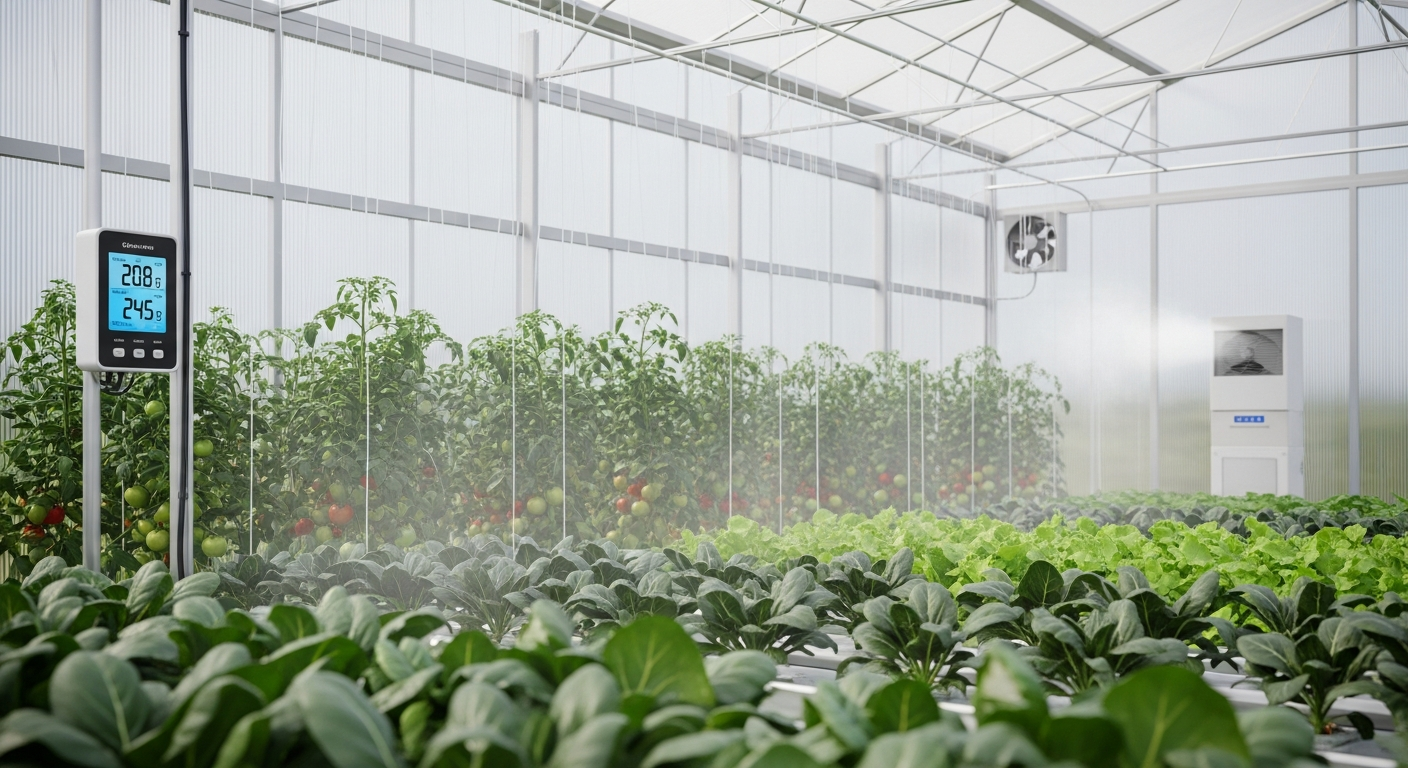
It’s crucial to distinguish dew point from relative humidity (RH). While related, they measure different things and provide distinct insights:
- Relative Humidity (RH): Expressed as a percentage, RH tells you how saturated the air currently is with water vapor relative to its maximum capacity at that specific temperature. For example, 70% RH means the air holds 70% of the maximum moisture it could at that temperature.
- Dew Point: Expressed as a temperature, the dew point tells you when the air will become saturated. A high dew point means there’s a lot of moisture in the air, and it won’t take much cooling for condensation to occur. A low dew point means the air is dry, and significant cooling would be required for condensation.
For greenhouse growers, the dew point is often a more practical indicator of condensation risk than relative humidity alone. You might have 70% RH in a warm greenhouse, which is fine. But if your surface temperatures drop below the dew point, even at 70% RH, you’ll get condensation. It’s the absolute amount of moisture in the air that the dew point reflects, making it a powerful predictor of surface wetness.
Why Dew Point is a Greenhouse Game-Changer
Understanding and controlling the dew point is fundamental for maintaining a healthy and productive greenhouse environment. Ignoring it can lead to a cascade of problems that undermine crop health and yield:
The Menace of Surface Moisture
When plant leaves or greenhouse surfaces cool to or below the dew point, condensation forms. This leads to prolonged periods of leaf wetness, creating an ideal breeding ground for various plant pathogens.
- Fungal Diseases: This is arguably the biggest threat. Fungi like Botrytis cinerea (gray mold), powdery mildew, downy mildew, and various rusts thrive in conditions of persistent leaf wetness. Spores germinate quickly on moist surfaces, leading to widespread infections that can decimate crops.
- Bacterial Diseases: While less directly tied to dew point than fungi, some bacterial pathogens also benefit from moisture on plant surfaces for entry and spread.
- Pest Infestations: Certain insect pests, such as fungus gnats and some mites, prefer humid environments. While not directly caused by condensation, a high dew point contributes to overall greenhouse humidity that can favor these pests.
Impact on Plant Physiology and Growth
Beyond disease, uncontrolled dew point and subsequent condensation can negatively affect your plants’ physiological processes:
- Stomatal Closure: Prolonged leaf wetness can inhibit the stomata (tiny pores on leaves) from opening properly, reducing gas exchange (CO2 uptake for photosynthesis) and transpiration. This can lead to reduced growth and nutrient uptake.
- Reduced Light Transmission: Condensation on greenhouse glazing (polycarbonate, glass) reduces the amount of light reaching your plants, directly impacting photosynthesis and overall plant vigor.
- Nutrient Imbalances: Wet leaves can sometimes lead to nutrient leaching or can make it harder for plants to properly absorb foliar fertilizers.
Structural Damage and Energy Inefficiency
Persistent condensation isn’t just bad for plants; it can also harm your greenhouse structure:
- Corrosion and Degradation: Over time, continuous moisture can lead to corrosion of metal components and accelerate the degradation of wood or other structural materials.
- Reduced Insulation: Condensation within double-layer poly systems can compromise their insulating properties, leading to higher heating costs.
By proactively managing the dew point, you’re not just preventing problems; you’re creating a consistently optimal environment that supports robust growth and maximizes your greenhouse’s potential.
Monitoring and Predicting Dew Point in Your Greenhouse
To effectively prevent condensation, you first need to be able to monitor and predict when surface temperatures might drop below the dew point. Thankfully, several tools and methods can assist you in this critical task:
Essential Tools for Growers
- Thermometers and Hygrometers: These are your basic tools. A good digital thermometer/hygrometer will provide accurate readings of air temperature and relative humidity (RH). With these two values, you can calculate the dew point.
- Dew Point Calculators/Apps: Numerous online calculators and smartphone apps allow you to input your current air temperature and RH to instantly get the dew point temperature. This simplifies the process significantly.
- Infrared Thermometer (IR Gun): This non-contact thermometer is invaluable for measuring surface temperatures – specifically leaf temperatures and the temperature of your greenhouse glazing. Remember, condensation forms when the surface temperature drops to or below the air’s dew point. By knowing your leaf temperature, you can anticipate problems.
- Greenhouse Environmental Controllers: Advanced climate control systems often integrate dew point calculations and monitoring into their software, providing real-time data and even automating preventative actions.
- Vapor Pressure Deficit (VPD) Meters: While VPD is a more advanced metric, it is closely related to dew point and humidity. Some growers use VPD as a comprehensive measure of the air’s “drying power,” which indirectly relates to condensation risk.
How to Interpret and Act
The key insight is simple: if the temperature of a surface (like a plant leaf or the inside of your greenhouse roof) drops to or below the dew point of the surrounding air, condensation will occur on that surface.
Consider this scenario:
- Your greenhouse air temperature is 70°F (21°C).
- Your relative humidity is 80%.
- Using a calculator, you find the dew point is 64°F (18°C).
This means that if any surface in your greenhouse cools to 64°F or lower, moisture will condense on it. If your leaf temperatures are already at 65°F and nightfall is approaching, you know you’re at high risk for leaf wetness. Your goal is to ensure that your critical surfaces (especially plant leaves) remain above the air’s dew point temperature.
Mastering Dew Point: Strategies for Prevention
Proactive management of the dew point is key to a healthy greenhouse. Here are practical strategies you can implement to predict and prevent problematic surface moisture:
1. Optimize Air Circulation and Ventilation
Good air movement is your first line of defense against condensation:
- Horizontal Air Flow (HAF) Fans: These fans create a gentle, continuous air current throughout the greenhouse, mixing the air and equalizing temperature and humidity. This prevents pockets of stagnant, moist air from forming and helps keep leaf surface temperatures closer to the ambient air temperature, preventing them from cooling below the dew point.
- Exhaust Fans: By venting moist air out of the greenhouse and drawing in drier outside air, exhaust fans directly reduce overall humidity and consequently, the dew point.
- Ridge and Side Vents: Utilize natural ventilation whenever possible. Opening vents can allow humid air to escape and fresh air to enter, especially effective in the early morning to purge overnight accumulated moisture.
- Strategic Venting: Consider a brief, controlled venting period (perhaps with some supplemental heat) an hour or two before sunset. This can replace humid air with drier air before the temperatures drop significantly overnight.
2. Intelligent Heating Strategies
Heating plays a crucial role in dew point control, not just for warmth, but for moisture management:
- “Pulsing” or “Bump” Heating: A common strategy is to briefly raise the greenhouse air temperature by a few degrees (a “heat pulse”) during periods of high risk, especially just before dawn. This small temperature increase lowers the relative humidity and slightly raises the temperature of plant surfaces, lifting them above the dew point and evaporating any nascent condensation.
- Maintain Minimum Temperatures: Ensure your greenhouse never drops below a safe minimum temperature, especially at night. Cooler temperatures exacerbate dew point issues.
- Bottom Heat: For propagation mats or specific zones, using bottom heat can warm the root zone and indirectly help warm the lower leaves, reducing condensation risk there.
3. Effective Humidity Control
Reducing the overall moisture content in the air directly lowers the dew point:
- Dehumidifiers: In sealed or highly insulated greenhouses, or during specific critical growth stages, mechanical dehumidifiers can actively remove moisture from the air.
- Watering Practices:
- Water in the Morning: Water your plants early in the day so that excess moisture has time to evaporate and be vented out before nightfall.
- Drip Irrigation/Bottom Watering: Whenever possible, use methods that deliver water directly to the root zone rather than overhead watering, which increases leaf wetness and ambient humidity.
- Avoid Overwatering: Saturated growing media contributes significantly to evaporation and overall greenhouse humidity.
- Plant Spacing: Ensure adequate spacing between plants to allow for good air circulation around individual leaves, preventing microclimates of high humidity.
4. Greenhouse Structure and Technology
The design and features of your greenhouse can significantly impact dew point management:
- Double-Layer Glazing/Polycarbonate: These materials provide better insulation than single layers, keeping the inner surface temperature higher and thus less likely to cool below the air’s dew point. This reduces condensation on the glazing itself.
- Anti-Drip Coatings: Some greenhouse films and rigid panels come with anti-drip coatings that cause condensation to form a uniform sheet rather than individual droplets. While this doesn’t prevent condensation, it minimizes light obstruction and can reduce the “drip” effect onto plants.
Conclusion
The dew point is far more than a meteorological curiosity; it’s a critical environmental parameter that directly influences the health and productivity of your greenhouse crops. By understanding what the dew point is, why it matters, and how to monitor it, you gain a powerful tool for proactive disease prevention and optimal plant growth. Implementing intelligent strategies like enhanced air circulation, strategic heating, and mindful humidity control empowers you to control your greenhouse climate with precision. Embracing dew point management isn’t just about avoiding problems; it’s about fostering an environment where your plants can truly thrive, leading to healthier crops and more successful harvests for years to come. Start paying attention to the dew point – your plants will thank you.