
In the intricate world of greenhouse cultivation, temperature isn’t just a number on a thermostat; it’s a dynamic, invisible force shaping plant growth, health, and yield. Many growers diligently monitor their greenhouse temperature, but often overlook a critical detail: the existence of thermal gradients. These subtle, yet powerful, temperature differences within your growing space can create microclimates that significantly impact crop performance, energy efficiency, and disease susceptibility. Simply placing a single sensor or haphazardly scattering a few won’t provide the accurate data needed for optimal climate control. To truly master your greenhouse environment, you need a strategic approach to temperature sensor placement, one that reveals these gradients and empowers you to respond effectively. Let’s delve into how you can achieve precision temperature monitoring and unlock your greenhouse’s full potential.
Why Accurate Temperature Monitoring and Gradient Detection are Crucial
Understanding and managing temperature gradients within your greenhouse is not merely about achieving a comfortable environment; it’s fundamental to the success and profitability of your operation. The implications of poorly monitored temperature variations are far-reaching, affecting everything from individual plant health to overall operational costs.
- Optimized Plant Growth and Yield: Different crops, and even different stages of a single crop, have specific temperature requirements. A uniform temperature profile across your greenhouse ensures that all plants experience their ideal conditions, leading to consistent growth rates, improved flower and fruit set, and ultimately, higher yields. Unaddressed gradients can lead to stunted growth in cooler areas or heat stress in warmer zones.
- Disease and Pest Prevention: Fluctuating temperatures and localized cold or hot spots can create ideal breeding grounds for pests and pathogens. Condensation forming in cooler areas, for instance, encourages fungal diseases like botrytis. Maintaining stable, uniform temperatures across the crop canopy significantly reduces these risks, lessening the reliance on chemical treatments.
- Energy Efficiency and Cost Savings: Many growers over-ventilate or over-heat their greenhouses in an attempt to compensate for perceived cold spots or to achieve a desired average temperature. By accurately mapping thermal gradients, you can identify specific areas requiring attention, allowing for targeted heating, cooling, or ventilation adjustments. This precision climate control prevents wasted energy, leading to substantial savings on utility bills. Knowing exactly where the heat is escaping or pooling allows for more intelligent HVAC operation.
- Consistent Product Quality: For commercial growers, uniformity in product quality is paramount. Temperature gradients can cause variations in plant size, maturity, color, and even flavor. Accurate monitoring helps ensure that every plant grows under similar conditions, resulting in a consistent, high-quality product that meets market demands.
- Informed Decision-Making: Reliable, granular temperature data is the bedrock of intelligent climate management. Without it, you’re making decisions based on assumptions, which can be costly. Understanding where and why temperature variations occur allows you to make informed adjustments to your ventilation, heating, shading, and irrigation strategies, optimizing your growing strategy.
Understanding Thermal Gradients and Microclimates in Greenhouses
To effectively place temperature sensors, it’s essential to grasp the concept of thermal gradients and microclimates. A thermal gradient is simply a gradual change in temperature over a specific distance. In a greenhouse, these gradients are ever-present and influenced by a multitude of factors, creating unique “microclimates” – small, localized areas with distinct environmental conditions.
Common Causes of Thermal Gradients:
- Solar Radiation: The sun’s path across the sky creates dynamic hot spots. Areas receiving direct sunlight will be warmer than shaded areas. South-facing walls and roof sections often accumulate more heat.
- Structural Influences: Greenhouse walls, especially those made of less insulated materials, can lose or gain heat rapidly, creating cooler zones near exterior walls and warmer zones in the center. End walls often present unique temperature profiles due
to less air movement. - Heating and Cooling Systems: Heaters, fans, and vents are designed to distribute conditioned air, but their placement and effectiveness can create gradients. Areas directly in front of a heater will be warmer, while distant spots might remain cooler. Similarly, cooling pads and exhaust fans create air movement that can lead to cooler regions near vents and warmer regions where air stagnates.
- Plant Canopy Density: A dense crop canopy can trap heat and humidity within it, creating a warmer, more humid microclimate at the plant level compared to the air above the canopy. Conversely, a sparse canopy might allow more air movement and less heat retention.
- Air Movement: Lack of air circulation can lead to pockets of stagnant, warm, or cool air. Proper fan placement is critical to break up these gradients. Drafts from poorly sealed doors or vents also contribute.
- Floor and Growing Media: The temperature of the growing media and the floor can significantly influence the immediate air temperature around the root zone and lower canopy. Concrete floors, for example, can absorb and radiate heat differently than gravel or soil.
A single sensor providing an “average” temperature for your entire greenhouse completely misses these critical variations. You might be targeting 75°F for your crop, but if your single sensor is in a hot spot, vast sections of your greenhouse could be operating at a detrimental 68°F or below, impacting growth and risking disease.
Strategic Sensor Placement: Unveiling the Invisible
Effective temperature sensor placement requires a thoughtful, multi-point strategy that considers the unique architecture and climate dynamics of your greenhouse. The goal is to capture a representative sample of temperatures across the entire growing environment, particularly at critical plant levels.
Key Principles for Sensor Placement:
- Multiple Sensors are Essential: Forget the idea that one or two sensors are enough. Depending on the size and complexity of your greenhouse, you’ll need several to accurately map gradients. For small hobby greenhouses, 3-5 might suffice; for commercial operations, dozens could be necessary.
- Place at Crop Canopy Level: This is arguably the most critical placement. The temperature experienced by your plants’ leaves and flowers is paramount. Sensors should be placed directly within or just above the crop canopy. As your plants grow, remember to adjust the sensor height accordingly. For tall crops like tomatoes, consider multiple sensors at different heights within the canopy.
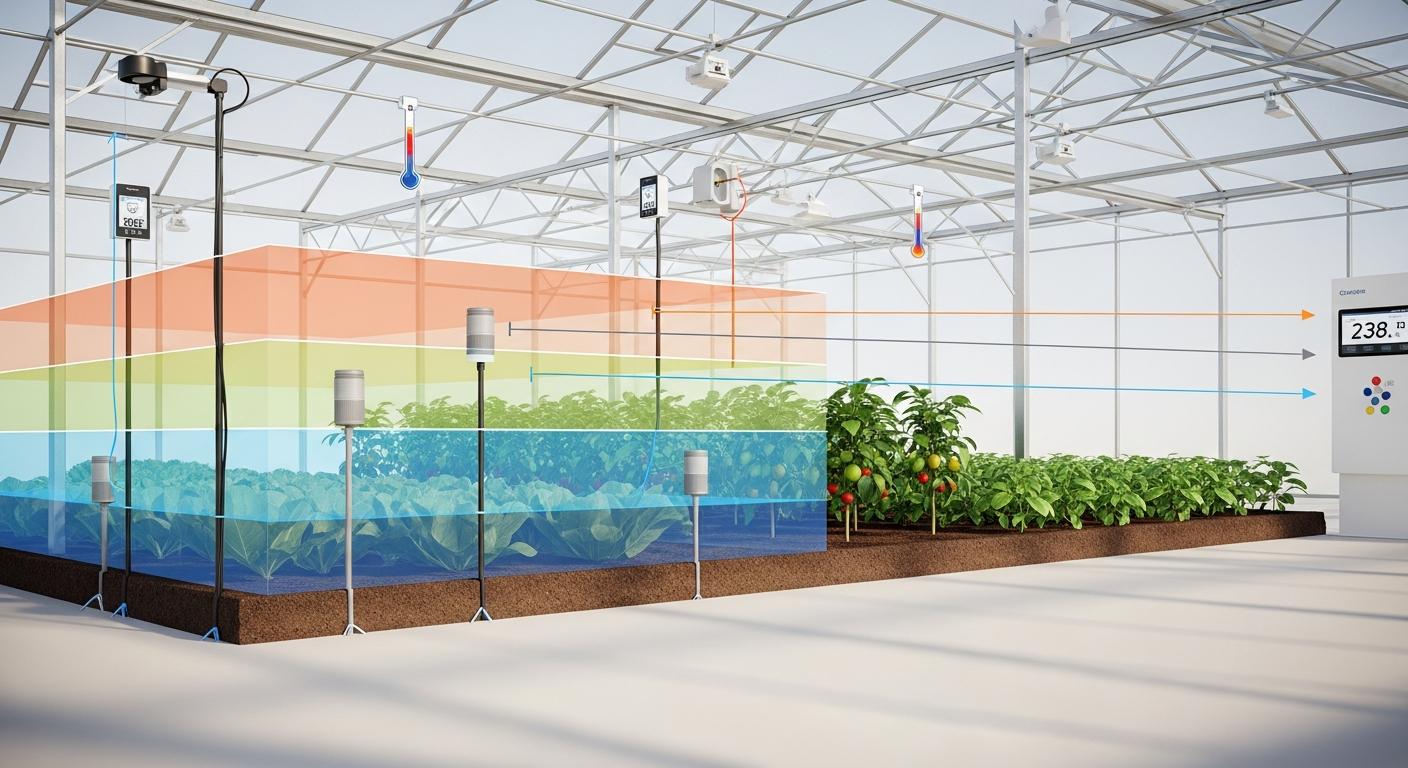
- Vary Heights to Detect Vertical Gradients:
- Low Level (Root Zone): Place sensors near the growing media or just above the floor to monitor root zone temperatures and detect cold drafts or heat retention from the floor.
- Mid Level (Crop Canopy): As mentioned, this is crucial.
- High Level (Above Canopy): A sensor above the canopy provides an overall air temperature reading, useful for HVAC control and general ambient conditions. This often reveals thermal stratification where warmer air rises.
- Strategic Grid Placement: Divide your greenhouse into zones. Place sensors at regular intervals within these zones, paying particular attention to areas known for variations:
- Near Walls and Corners: These areas are often prone to heat loss/gain and reduced air circulation.
- Near Vents, Fans, and Heaters: Monitor the effectiveness of your climate control equipment. Place sensors both directly in the air stream and at a distance to gauge distribution.
- Sun/Shade Delineations: If certain areas are consistently shaded or exposed to direct sun, ensure you have sensors in both.
- Adjacent to Different Crops: If you’re growing crops with varied temperature needs, place sensors specifically within each crop’s zone.
- Away from Direct Influences:
- No Direct Sunlight: Always shade your sensors, typically using a radiation shield or a simple plastic cup. Direct sun will cause inaccurate, inflated readings.
- Away from Water Sources: Avoid placing sensors where they can get wet from irrigation or misting, as evaporation will skew temperature readings.
- Away from Hot Surfaces: Don’t place sensors directly against hot pipes, heaters, or dark surfaces that absorb and radiate heat.
- Consider Air Flow: Place sensors in areas representative of the general air movement, not in stagnant pockets unless you specifically want to identify those. Conversely, avoid placing them directly in front of powerful fans unless you are specifically measuring fan output.
- Map Your Greenhouse: Draw a simple floor plan of your greenhouse and mark the proposed sensor locations. This helps visualize coverage and identify gaps.
- Use Data Loggers or Wireless Systems: For truly effective gradient monitoring, you need continuous data. Wireless sensors linked to a central data logger or climate control system are ideal, allowing you to view trends and spatial differences over time.
- Adjust with Crop Growth: As your plants mature and their canopy develops, remember to reposition sensors to maintain their placement at the active growing level.
- Regular Calibration Checks: Periodically check your sensors against a known accurate thermometer (e.g., an ice bath for 32°F/0°C) to ensure accuracy.
- Integrate with Climate Control Systems: The ultimate goal is to have your sensors feed data directly into an automated climate control system. This allows for real-time adjustments to heating, ventilation, and cooling based on actual conditions across multiple points, rather than just an average. This is where true energy efficiency and precision climate management come into play.
- Analyze Trends and Historical Data: Don’t just look at real-time readings. Utilize data logging capabilities to identify daily and seasonal trends in your gradients. Are certain areas consistently colder at night? Do specific zones overheat on sunny afternoons? This historical data provides invaluable insights for proactive adjustments and long-term greenhouse optimization.
- Combine with Humidity Sensors: Temperature and humidity are inextricably linked. Often, where you find a cold spot, you’ll also find elevated relative humidity, increasing the risk of fungal diseases. Placing humidity sensors alongside your temperature sensors provides a more complete picture of your microclimates.
- Visual Inspection and “Walking the Crop”: While sensors provide data, nothing replaces the keen eye of an experienced grower. Regularly walk through your greenhouse at different times of the day, feeling the air, observing plant health, and identifying any visual signs of stress (wilting, condensation, discolored leaves) that might correlate with your sensor data. Trust your instincts and cross-reference with your readings.
- Consider Radiation Shields: Even if a sensor isn’t in direct sunlight, radiant heat from the roof or other warm surfaces can influence readings. A well-designed radiation shield protects the sensor from direct and reflected radiation, allowing it to measure true air temperature.
- Zoned Climate Control: For larger greenhouses or those growing diverse crops, consider implementing zoned climate control. This allows you to manage different sections of the greenhouse independently, tailoring conditions more precisely based on the specific gradients and crop needs in each zone.
Practical Tips for Implementation:
Advanced Considerations and Best Practices
Once you’ve implemented a robust sensor network, the journey isn’t over. Maximizing the value of your temperature data involves ongoing analysis and adaptation.
Conclusion
In the world of greenhouse cultivation, neglecting the nuances of temperature gradients is akin to navigating blindfolded. Effective temperature sensor placement is not a luxury; it’s a fundamental practice for any grower aiming for optimal crop health, maximum yields, and efficient energy usage. By strategically deploying multiple sensors at varying heights and locations, protecting them from direct influences, and continuously analyzing the data, you gain an unparalleled understanding of your greenhouse’s unique microclimates. This precision monitoring empowers you to make informed decisions, fine-tune your climate control strategies, and ultimately, cultivate a more vibrant, productive, and sustainable growing environment. Invest in smart sensor placement today, and watch your greenhouse thrive.